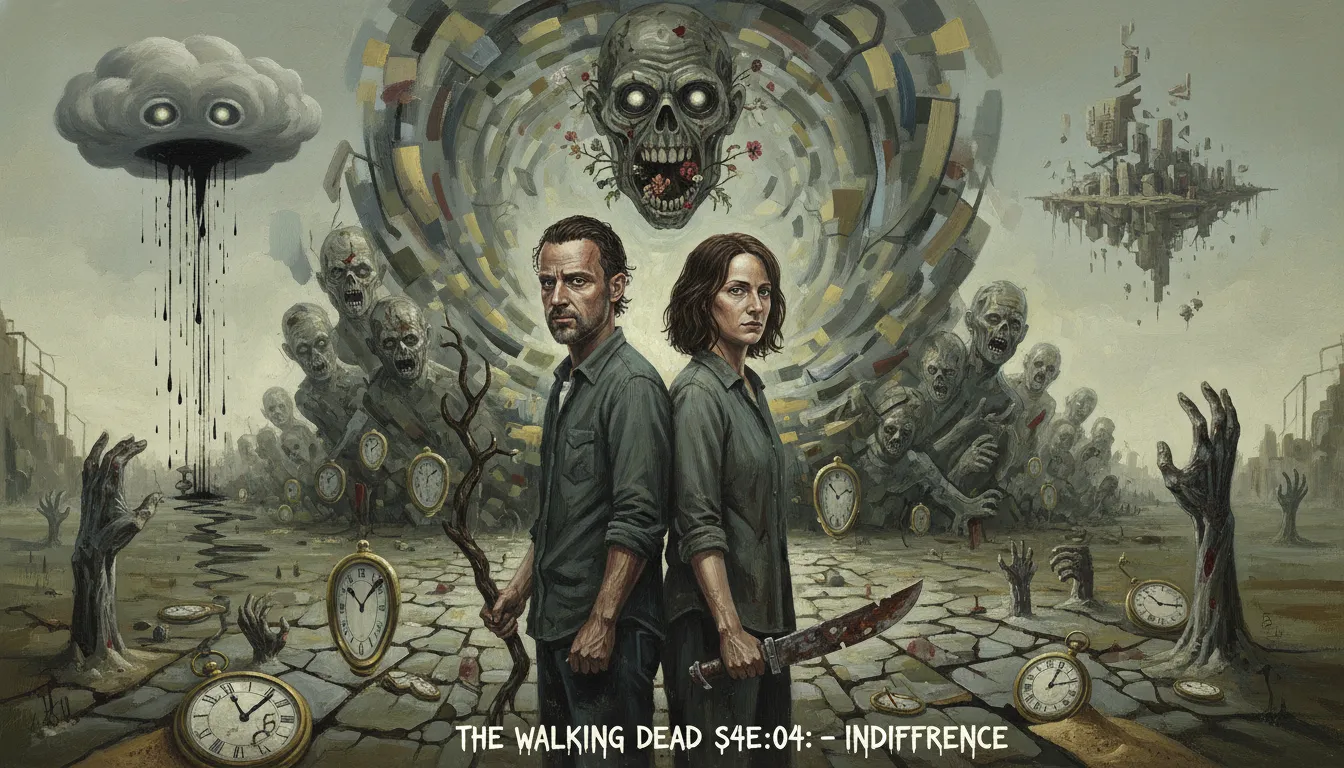
The first cut in “Indifference” is not the one Carol made to Karen and David’s throats, but the incision Rick makes into his own fantasy that a man can both plow the earth and refuse to decide who must die.
The episode turns on this impossible demand. Rick wants to live as if the apocalypse still allowed for a stable hearth: tomatoes, pigpens, shared chores, a father who can retire into agrarian anonymity. Carol will not let him. Her quiet sentence—“You can’t just be a farmer”—is not merely an accusation; it is the announcement that the type of human Rick is trying to resurrect no longer fits the circulating flows of death, contagion, and scarcity that structure their world.
“Indifference” stages a duel not between right and wrong, but between two incompatible machines: the Farmer-State, which organizes bodies into a home, a council, a prison-turned-village; and the Survivor War-Machine, which moves through this organization like a surgical instrument, cutting where necessary, attaching knives to children’s hands, abandoning broken limbs of the group so that something can keep crawling. The episode’s apparent moral question—was Carol justified?—is only the outer shell of this deeper machinic conflict.
The schizoanalytic wager here is that desire is not “inside” the characters; it runs through the fences, knives, cars, supply runs, conversations, and silences that plug them into each other. “Indifference” is an anatomy lesson in how one community’s desire to avoid making a cut produces a woman who will make it for them, and then be expelled as if she were the entire problem.
1. The Agrarian Ghost: Rick’s Garden as Counter‑Apocalypse
The episode opens with Rick already divided. He has put away the sheriff’s hat; he tends plants, repairs fences, pulls down hog pens. The prison has been re-coded from punitive machine to pastoral enclave. Dirt under fingernails is supposed to replace blood on hands. This is a textbook reterritorialization: the State apparatus, no longer backed by formal law, tries to reassemble itself around the image of the farm, that oldest of civilizing diagrams (Deleuze & Guattari, 1987).
The garden is not just a food source; it is an image-repair device. Rows, order, predictability: things grow if you tend them, seasons follow each other, the sky rains when needed. Rick’s entire posture—bent over soil, away from watchtowers—is an attempt to convince his nervous system that time still obeys cycles rather than catastrophes. The farm is the simulation of a world in which violence is the last resort rather than the daily medium of relation (Baudrillard, 1981).
But the prison will not stay a homestead. The flu epidemic oozes through the cinder blocks, rotting lungs irrespective of moral standing. Fence-lines buckle under the sheer weight of the dead. Pigs die inexplicably. Every agricultural gesture—planting, feeding, mucking—runs along the same channels as infection. The earth here does not stabilize; it vectors. The Farmer-Stratum is laid over a swamp of virality.
Schizoanalytically, Rick’s agrarian turn is a massive effort to re-molarize flows that have become wildly molecular: to pin down life into plots and family roles after every prior coding (law, town, police, state) has melted (Deleuze & Guattari, 1983). He wants desire to sit still: father–children, soil–seed, fence–inside. But the world now runs on other couplings: breath–droplet, tooth–flesh, car–gasoline–horde, council–quarantine–burned bodies.
Carol’s actions—killing two infected community members, dragging their bodies, burning them to stave off further spread—detonate inside this fragile agrarian fantasy. It is not just that she killed; it is that she operated as if the Farmer no longer existed, as if the garden were just another patch of land in a battlefield. She violated not only a norm, but the very image of what this place is supposed to be.
2. Carol’s Indifference: From Battered Wife to War‑Machine
Carol arrives in this episode already transformed. The woman who once hid bruises from an abusive husband has passed through several becomings: grieving mother, bereft almost-mother to Sophia’s absence, pragmatic caretaker who will put a knife in a re-animated child’s skull without flinching. By the time she walks beside Rick’s car on this supply run, the softness in her gestures has hardened into something like a blade.
Her repeated line—“You do what you have to do”—is not a slogan of self-help; it is a practical ethics forged under the relentless pressure of loss. Carol’s “indifference” is not apathy; it is the calculated suspension of sentimental response where that response would jam the survival-machine. She has burned away, with her dead daughter, much of what Nietzsche would call the “reactive” layer of pity that binds us to inherited moral codes, leaving a stripped-down will to preserve a certain collective at all costs (Nietzsche, 1967).
When Rick confronts her in the car—“Did you kill Karen and David?”—her “Yes” is delivered almost casually, as if admitting to having taken extra rations. There is no hysteria, no justification. In this tiny delay between question and answer, the episode invites the viewer to project all sorts of motivations: guilt, coldness, righteousness, fatigue. But Carol does not perform guilt for Rick. She presents herself as an operational node: a desiring-machine that saw a problem (infectious bodies in a crowded prison), calculated a solution (eliminate vectors quickly), and implemented it without waiting for authorization.
This is why her act horrifies Rick so deeply. Not simply because it was murderous, but because it reveals that the group’s survival no longer runs exclusively through the Farmer-State and its Council. A parallel war-machine has grown in the cracks of domesticity: the Carol-machine, which can detach from affective bonds long enough to cut.
Deleuze and Guattari insist that the war-machine is not necessarily military; it is any assemblage that operates outside the State’s codes, moving along different coordinates, often in the name of protection rather than conquest (Deleuze & Guattari, 1987). Carol embodies such a machine: she protects by pre-emptive strike, she educates by arming children, she cares by refusing to let sentimental attachments block lethal necessity. Her “indifference” is the lubricant that allows this machine to spin.
3. Teaching Children to Cut: Anti‑Oedipal Pedagogy
The episode’s quieter scenes—Carol with Lizzie and Mika—make explicit how far she has traveled from the protected-child model. She shows Lizzie how to handle a knife, how to stab, where to aim. She speaks not in the language of “when you’re older” but of “you have to be able to now.” In a previous world, this is monstrous. In the present one, it is, for Carol, simple alignment with reality.
This pedagogy short-circuits the Oedipal diagram—parents as protectors, children as dependents waiting in line for adulthood. Instead, Carol folds the girls directly into the group’s defensive circuitry. They are not the “future” to be safeguarded; they are components that must be weaponized in the present. The knife lesson plugs small bodies into the war-machine’s drive-train, not as passive beneficiaries but as rotating parts.
Here, Lazzarato’s observation that contemporary systems produce subjects as machinic components rather than autonomous individuals gains a new, brutal clarity (Lazzarato, 2014). Carol is not interested in Lizzie’s “development” in a psychological sense; she needs Lizzie to become reliable in a very specific function: killing walkers and, if needed, sick humans. She molds her according to the group’s operational needs.
Rick finds this intolerable not because he denies the necessity of violence—he has killed more people than Carol—but because it shreds the Farmer’s core image of the hearth: children playing while adults stand guard. The very notion of “childhood” is one of the last molar identities he clings to; its erasure threatens his own position as father. Carol’s pedagogy reveals that his paternal role has already been hollowed out by events.
Thus the conflict between them is not just about past murders; it is about the future diagram of subjectivity in the prison. Will children be raised as miniature citizens of a reconstituted State, shielded from hard decisions? Or as early-inducted soldiers of a war-machine that has no rear lines? “Indifference” argues, through Carol’s actions, that the conditions on the ground have already answered—even if Rick cannot yet accept it.
4. Sam and Ana: Failed Alliances, Broken Lines of Flight
On the supply run, Rick and Carol encounter Sam and Ana, a young couple holed up in a suburban house. The space is a museum of the lost world: framed photos, couches, a broken TV. Sam’s ankle is injured; Ana’s leg is partly bitten, but crudely bandaged. Both are under-equipped and naive by prison standards, yet still warm, still believing in mutual aid. They practically beg to be allowed into the group, offering to contribute.
Rick, still oscillating between Farmer and Sheriff, sets up a kind of audition: they will each be given tasks (gather supplies, meet back in two hours), and their competence and honesty will be judged. Carol’s face registers skepticism. She bandages Sam’s hand with brisk tenderness, but her eyes calculate. She knows, viscerally, how often such hopeful newcomers die.
The subsequent events are brutal in their banality. Ana goes out and is later found torn apart. Sam never makes it back to the rendezvous before Rick and Carol leave. One dead, one abandoned. The experiment in alliance fails almost immediately.
Schizoanalytically, this sequence is a small laboratory for the question: can new lines of flight—new connections, new groupings—still be formed without overloading the already-fractured assemblage of the prison? Sam and Ana represent potential expansions of the rhizome: two more nodes, two more sets of hands, two more stories. Their presence exposes the tension between extensiveness (more allies, more complexity) and intensiveness (harder, leaner survival among a smaller core).
Rick’s initial inclination to integrate them is the Farmer-State’s hospitable face: the community that absorbs outsiders, assigns them a place, enlarges its field. Carol’s coolness anticipates their failure: she sees them not as identities but as fragile linkages that will likely snap under pressure, leaving the group with more grief and less food. And indeed, moments after Rick offers terms, the world confirms her pessimism.
When Rick decides, later, to abandon any further search for Sam, the episode has already suggested that potential solidarities are continually snuffed out not only by walkers, but by the group’s limited capacity to absorb more risk. Every new connection is also a new vulnerability. The rhizome wants to proliferate; the war demands pruning.
Sam and Ana thus function as test cases for Carol’s ethic. Their swift neutralization supports her rule: better a smaller, hardened assemblage than a sprawling, sentimental one. Indifference here is not cruelty toward these strangers in the abstract; it is a limit imposed by the machinic saturation of the group’s ability to care.
5. The Sovereign’s Cut: Exiling the War‑Machine
The true operation of “Indifference” occurs in the final scenes, when Rick stops the car, hands Carol a backpack, and tells her she cannot return. He is, in effect, conducting a one-man tribunal outside the walls, far from the listening ears of the Council. The Farmer disappears; the Sovereign returns.
Agamben’s figure of the sovereign as the one who decides the state of exception—who can suspend the law in order to preserve it—finds here an almost literal enactment (Agamben, 1998). Rick does not “arrest” Carol or bring her to trial; instead, he steps outside any formal procedure and exiles her, declaring that the normal rules (collective decision-making, in-group loyalty) do not apply in this case. The road, the woods, the abandoned cars: this is the camp-space, where a life can be pushed outside the protection of the group while still being “one of us” in memory.
Rick’s justifications are couched in care: if Carol returns, Tyreese will kill her; the group will fracture; children will learn the wrong lesson about killing in cold blood. But beneath these arguments churns another necessity: the Farmer-State must excise the war-machine that threatens to prove it obsolete. Carol has done what Rick could not and perhaps, in his own eyes, should have done. Her continued presence exposes his oscillation as cowardice.
To preserve the image of the community as bound by shared norms, the desiring-production that resulted in Karen and David’s deaths must be individualized and expelled. The group does not want to recognize that Carol only enacted, in a concentrated way, a general will to contain infection at all costs. She becomes the sacrificial bearer of this distributed desire.
In exiling her, Rick mirrors her own logic. He makes a cold calculation: the risk Carol represents to the group’s moral imaginary outweighs the contribution she makes to its material survival. His “indifference” to her pleading looks, her history, even to the fact that she saved his newborn daughter more than once, reveals that the decisive cut cannot be outsourced. The Farmer has learned, reluctantly, to wield the knife on human flesh again.
This is what makes the episode’s title so precise. “Indifference” is not only Carol’s affect; it is Rick’s final stance. He must become, in this act, a little like her. The sovereign who exiles the dangerous woman is not morally superior to the woman who burned the infected; both occupy, momentarily, the same space beyond good and evil where only operational decisions count. Nietzsche’s genealogy of morals is enacted without fanfare: both characters step, briefly, into a “master” position where the health of the group authorizes transgression of inherited codes (Nietzsche, 1967).
6. Parallel Engines: The Road‑Team’s Violence as Background Noise
While Rick and Carol conduct their intimate war at the edge of the road, another machine hums elsewhere: Daryl, Michonne, Tyreese, and Bob on the pharmaceutical run. Their storyline in this episode is all mud, blood, and strain: pushing a car through a horde, Tyreese stuck in a death-drive freeze before hacking his way out, Bob’s near-fatal reach for a bag of alcohol.
This parallel thread is not mere action filler; it is the ambient sound of the world within which Rick and Carol’s ethical drama unfolds. The road-team operates as a pure war-machine: constant adjustment, immediate violence, no time for council votes. Yet even here, questions of “indifference” surface. Bob risks everyone’s life for a bottle; Tyreese seems to prefer near-suicidal immersion in walkers to the ongoing work of living. Their drives are not altruistic; they short-circuit the collective’s stated goals.
The contrast is instructive. Carol’s lethal calculus is aimed at the group’s health, however distorted; Bob’s and Tyreese’s dangerous acts are aimed at private satisfaction or self-annihilation. The war-machine, unchecked, frays at its edges: addiction, fatalism, recklessness. If Carol represents an over-coding of care by cold necessity, Bob and Tyreese represent desiring-machines that no longer plug cleanly into any collective aim.
Seen from this angle, Rick’s exile of Carol is also an attempt to keep the war-machine “outside,” confined to those who run missions and face walkers, while the prison interior remains a quasi-State space where law, council, and childhood can still be spoken of. But “Indifference” insists that no such clean division holds: the war-machine is already inside the walls, in Carol’s pedagogy, in the quarantined ward, in the daily triage decisions no one wants to own.
7. After the Hearth: Toward a New Subject of the Ruins
By the episode’s end, no one has “won” the argument. Carol drives away alone, equipped but banished; Rick returns to a prison that will soon be breached. The Farmer has killed the farm-woman; the survivor-warrior has been cut loose. What remains is a field of damaged but still-running machines: children with knives, grieving men on dangerous roads, a prison whose fences groan.
“Indifference” sketches, in this dispersed aftermath, the outline of a new subjectivity forced by catastrophe. Neither the old Law-Giver (the sheriff, the councilman, the patriarch) nor the unbridled Murderer (the sociopath, the marauder) can function here as stable types. Instead, we glimpse a nomad-subject that must continually slide between regimes: sometimes tender, sometimes lethal; sometimes hospitable, sometimes ruthlessly excluding; sometimes father, sometimes executioner.
Schizoanalysis, taking the episode seriously, must adjust one of its own habits. It is too easy to oppose State and war-machine as if the former is always repressive and the latter always liberatory (Deleuze & Guattari, 1987). “Indifference” complicates this: Carol’s war-machine threatens to calcify into a micro-fascism of survival-at-any-cost; Rick’s momentary return to sovereignty averts, however temporarily, the normalization of clandestine killing as routine policy.
The more radical insight the episode offers is that care itself becomes a cold machine under certain conditions. To “care” for the group requires killing some of its members, abandoning potential allies, weaponizing children, exiling those whose necessary cruelties have become too visible. The warmest intentions are routed through the sharpest implements. No one here is merely sadistic; even Bob’s bottle-grab is a twisted self-medication of trauma.
The title “Indifference” thus names not a lack of feeling, but a structural requirement: the subtraction of certain affects at key decision points so that the machine of collective survival does not jam. This requirement circulates; it cannot be deposited entirely in one person and then driven away in a car. The community will have to metabolize it, or die.
In that sense, Carol’s final look back at Rick before she turns the key is not a plea, but a mirror: You have become what you exiled me for being. The Farmer cannot return to his rows unchanged. Every seed he plants from now on will be watered not only with hope, but with the knowledge that he, too, can leave someone on the roadside for the greater good.
The Walking Dead’s “Indifference” refuses to offer moral comfort because its world has already shredded the coordinates that made such comfort possible. What it gives instead is a chilling pedagogy: in the ruins of the State, every hearth is also a war-room, and every gesture of love toward the many cuts, somewhere, into the flesh of the few.
References
Agamben, G. (1998). Homo sacer: Sovereign power and bare life. Stanford University Press.
Baudrillard, J. (1981). Simulacra and simulation. University of Michigan Press.
Deleuze, G., & Guattari, F. (1983). Anti-Oedipus: Capitalism and schizophrenia (R. Hurley, M. Seem, & H. R. Lane, Trans.). University of Minnesota Press.
Deleuze, G., & Guattari, F. (1987). A thousand plateaus: Capitalism and schizophrenia (B. Massumi, Trans.). University of Minnesota Press.
Foucault, M. (1995). Discipline and punish: The birth of the prison (A. Sheridan, Trans.). Vintage Books. (Original work published 1975)
Lazzarato, M. (2014). Signs and machines: Capitalism and the production of subjectivity (J. D. Jordan, Trans.). Semiotext(e).
Nietzsche, F. (1967). On the genealogy of morals (W. Kaufmann & R. J. Hollingdale, Trans.). Vintage Books. (Original work published 1887)
Comments
Post a Comment