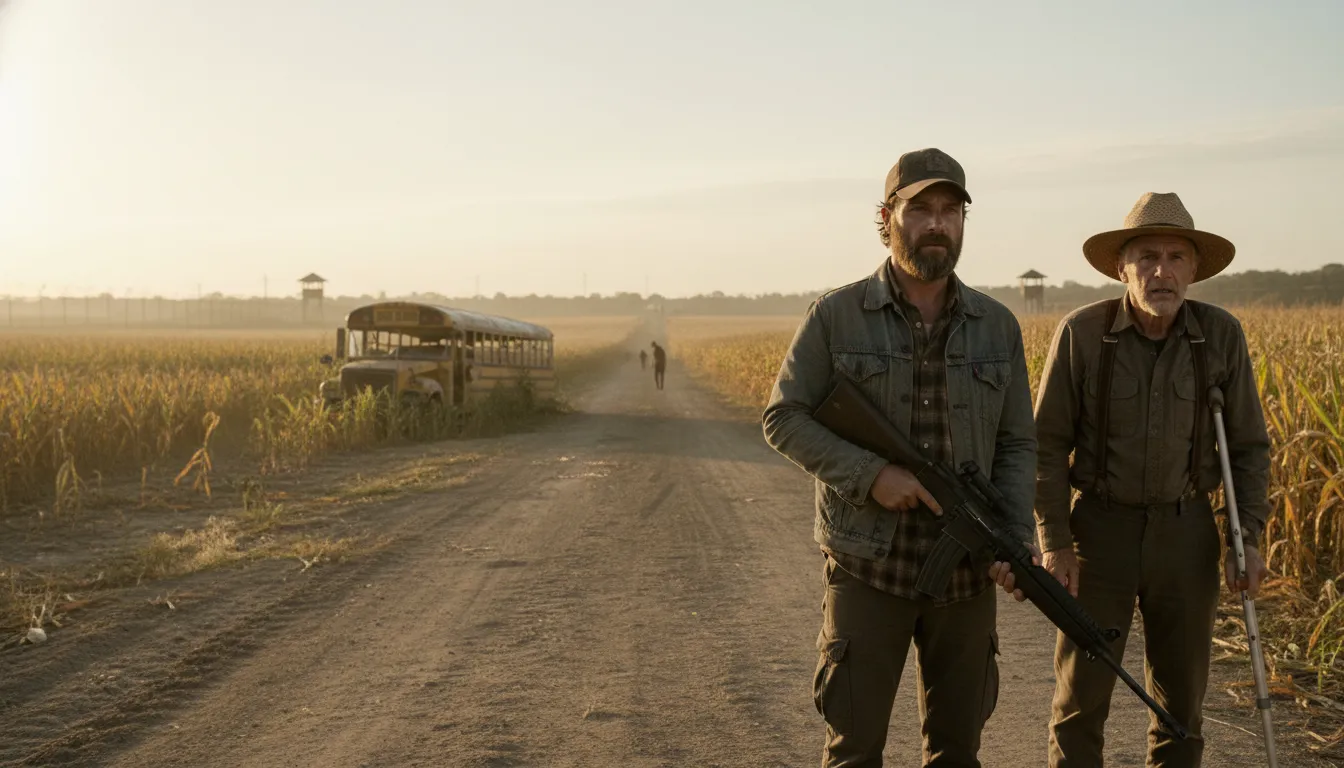
The episode begins from a hole in the social skin: two charred silhouettes on the concrete, a blood trail, and a community already sick before any fever hits. The virus is not the first contagion; the first is the idea that some lives can be quietly removed for the sake of the many. The Walking Dead S4E03, Isolation, stages a war inside this idea, not in the form of a courtroom drama, but as a clash of incompatible machines: the investigative State, the micro-fascist purifier, and, improbably, a limping, bearded farm-veterinarian who insists on walking into the quarantined ward with a kettle of elderberry tea.
Hershel’s decision to enter the infected cell block is not sentimental heroism. It is the episode’s most radical proposition: that in a world run by viral flows, the only law that holds is the one you are willing to inscribe in your own body as risk. Kant’s Categorical Imperative—so often imagined as a frigid tribunal of reason—reappears here as a sweaty, coughing, shuffling old man who refuses to let the sick be reduced to “bare life,” even as they wheeze and bleed behind bars (Kant, 1993; Agamben, 1998). He does not debate principles; he boils leaves.
The prison, already repurposed into a fragile commune, becomes a diagram of competing ethics. On one axis, Rick follows the trail of the burned bodies, trying to restore a social contract premised on justice and investigation. On another, Carol tightens the logic of triage, leaning into a biopolitics that is ready to sacrifice the few for the many. And cutting across them, Hershel creates an unregistered line of flight: a pastoral war-machine which turns the duty to care into an active refusal of sacrificial calculus (Foucault, 2007; Deleuze & Guattari, 1987).
Pastoral Power in the Quarantine Zone
The Council’s response to the outbreak is diagrammatic: identify the symptomatic, segregate them into a separate block, close the gates, post guards, and wait for the disease to run its course. It is biopolitics in its most literal form: the management of life at the level of the population, the calculation of risk and benefit, the attempt to keep the “healthy” circulation of the group from collapsing under the weight of infection (Foucault, 2007). From above, the layout of the prison now resembles a spreadsheet: A-block for the sick, another block for the children and vulnerable, outer yards for work, and the fences as harsh margins.
Agamben’s “camp” is usually read as an exception space where law is suspended and bare life can be killed with impunity (Agamben, 1998). In Isolation, the infected ward becomes a camp in a subtler sense: those inside are not yet killed, but their status as political subjects is suspended. They are counted as risk factors, not interlocutors. Decisions about them are made in the Council room, not with them, in the ward. Their breath has already been coded as threat.
Hershel’s intervention disrupts this coding. When he insists on entering the quarantine, he is not simply offering his medical skills; he is reconfiguring the very form of power at play. Foucault’s notion of pastoral power is useful here: a kind of power modeled on the shepherd, who knows each member of the flock, who cares for them individually, and who is, in principle, ready to risk his life for theirs (Foucault, 2007). Hershel does exactly that: he names people, touches them, listens to their coughs, wipes their brows, and, crucially, refuses to let the Council’s decision be the last word on their fate.
This pastoral power is not soft. It is a war-machine in Deleuze and Guattari’s sense: something that does not primarily aim to dominate territory, but to sustain, mobilize, and transform a field of forces (Deleuze & Guattari, 1987). Hershel does not attempt to seize the Council or abolish quarantine; he bores a tunnel through its logic. The old man, the kettle, the elderberries, the improvised masks, and the feverish bodies form an assemblage oriented not toward purging or controlling, but toward keeping life going one breath, one sip at a time.
Every step he takes down the corridor, past the rows of hacking patients, is the materialization of a maxim: act only on that principle which you could will as a law for everyone (Kant, 1993). If it is acceptable to leave the sick to die unattended in order to protect oneself, then it is acceptable for anyone, at any time, to do the same. Hershel rejects that world; he walks into another one.
Universalizing Risk: Kant with Blood on His Hands
The usual reading of Kant imagines a subject abstracted from circumstance, coolly considering whether a maxim can be universalized without contradiction (Kant, 1993). Isolation drags this operation into the muck of infection and panic. Hershel’s speech to Rick—“You step outside, you risk your life. You take a drink of water, you risk your life. You don’t have a choice. The only thing you can choose is what you’re risking it for.”—rewrites the Categorical Imperative as a calculus of risk rather than of duty in the abstract.
In the prison, risk is not an exception; it is the default. There is no safe position from which to calculate. Any movement—outside the yard, into the forest, into the ward—is a wager. The question “what should I do?” mutates into “what am I willing to risk my body for?” Universalization shifts: instead of asking whether a rule can be rationally legislated as universal, Hershel asks whether a certain acceptance of vulnerability can become the shared ground of communal life.
His maxim might be phrased: act so that your willingness to risk yourself for others could serve as the basis for a world in which no one is abandoned. This is not altruism; it is an ontological claim about community in conditions of radical precarity. In such a world, the only solidarity that counts is the one that crosses the quarantine line.
Hence the small but decisive ritual of Hershel removing his mask to cough, then putting it back on. He does not pretend that he is immune or that his measures will fully protect him. Instead, he inhabits a zone of managed vulnerability, working within a narrow margin between care and contamination. The mask is not a wall; it is a porous membrane, constantly negotiated. The Categorical Imperative has become a choreography of cloth, air, and spit.
This is where schizoanalysis does its work: instead of positing a transcendent moral law, we see an immanent ethics produced by the coupling of a sick ward, a man with veterinary training, a virus, a prison architecture, and a desperate community. It is a machine that manufactures responsibilities as it turns, not a pre-given code applied to a situation (Deleuze & Guattari, 1983).
Rhizomes in the Woods: Elderberries, Infection, and the Child-Soldier
Parallel to the interior drama of the quarantine, the episode sends Hershel and Carl into the forest to gather elderberries. This is not a mere supply run; it is a brief deterritorialization from the gridded, panoptic prison into a space where lines of growth, decay, and danger proliferate without straight edges. The camera tracks them through underbrush and dappled light, guns raised, then lowered, then holstered. The forest is not innocent; walkers lurk; a tree still holds the corpses of a family Hershel discovers, long dead.
Here the rhizome appears not as a philosophical metaphor, but as a vegetal and epidemiological fact: roots, stems, and berries intertwine underground and in the air; spores, microbes, and viruses circulate without respect for fences (Deleuze & Guattari, 1987). The elderberry bush and the influenza-like pathogen in the prison lungs belong to the same diffuse ecology. Hershel’s medicine is not a magic bullet; it is one element in a web of forces that includes rain, decomposition, birds, and the invisible chemical reactions in boiling water.
Carl’s presence in this sequence is decisive. In previous episodes, he has been a child drifting toward the role of child-soldier, quick to draw and to execute. In the woods, Hershel instructs him to lower his gun except when truly necessary, to see the environment not only as a target field but as a pharmacy and a shared habitat. A new maxim is being installed in Carl’s body: not simply “shoot walkers in the head,” but “discern when life can still be cultivated here.”
This is a different sort of training than Carol’s earlier knife lessons with the children. Carol’s pedagogy, while understandable, anchors the internal policeman in the child: a superego that insists, “You must be able to kill when needed, without hesitation.” Hershel’s counter-pedagogy installs another voice: “You must be able to expose yourself when needed, without hiding behind fear.” Two rival micro-machines of subjectivation are at work. One codes the child as an instrument of preemptive violence; the other as a caretaker who must still know how to shoot, but not as a first and only gesture.
The dead family that Hershel finds in the forest functions as a diagram of what refusal of risk can become. Barricaded in their home, they presumably tried to wait out the catastrophe, shrinking their world until air and time ran out. Their corpses are not monstrous or punitive; they are simply still, overtaken by the same ecology that now offers Hershel his elderberries. Life continues, but not human life. The rhizome is indifferent.
Hershel reads this tableau not as a caution against leaving the prison, but as a reminder that withdrawal is no guarantee. The only meaningful distinction is not inside/outside, but acting/not acting. In the absence of secure ground, you must still choose what to affirm with your limited movements. This is Kant’s rigor translated into a posthuman ecology of mud, leaves, and microbes (Braidotti, 2013).
Cells, Camps, and Bodies Without Organs
Back in the quarantine, the spatial logic of the prison is pushed to a limit. The cell block—designed to immobilize, classify, and surveil—has been converted into a sick ward, but without changing its basic geometry. Bars still segment space; catwalks still separate above from below. Yet the virus ignores these divisions, moving through droplet and breath, rendering top-down surveillance largely irrelevant. The cell becomes a strange kind of body without organs: an organized grid whose functions (punishment, containment) have been short-circuited, leaving behind a site of disarticulated bodies, irregular breathing, and indeterminate futures (Deleuze & Guattari, 1983).
Hershel’s rounds, moving from cell to cell, stitching together this disorganized field into a network of care, are a kind of re-organization that does not restore the original disciplinary function. Instead, he overlays a pastoral cartography on top of the carceral architecture: each body is now mapped not by guilt or sentence length, but by fever, symptoms, and small increments of improvement or decline. The same bars that once separated “criminals” now separate the coughing from the not-yet-coughing; Hershel, passing through, is the membrane between them.
Agamben notes that in the camp, the distinction between inside and outside the law collapses: the camp is both included (under sovereign decision) and excluded (outside normal legal protections) (Agamben, 1998). The infected ward is similar: those inside are subjected to intensified regulation (no one in or out without permission), yet at the same time they are stripped of full membership in the community. Hershel’s presence complicates this: he brings back into the zone elements of recognition and solidarity usually withdrawn from the camp.
He refuses the reduction of the infected to mere bearers of risk. He tells jokes, listens to complaints, allows the dying man’s request to have the curtains opened so he can see outside. These actions are small, but they restore a minimum of subjectivity within the camp. The ward becomes, however briefly, a collective body that is more than the sum of its decaying parts. It is a precarious social body without organs: no stable organs of power, no formal deliberative structures, only improvised lines of care and shared air.
The Investigative State and the Micro-Fascist Burner
While Hershel constructs this pastoral war-machine, Rick runs another kind of machine: the investigative State. From the moment he follows the blood smear to the charred remains, his instinct is procedural. There has been a crime; there must be a culprit; the culprit must be known, confronted, and held accountable. It is not enough that “someone” burned the bodies for some arguably pragmatic reason. For the social contract to survive, the who and the how must be clarified.
Rick’s questioning of Tyreese and the others, his examination of clues, his reactivation of the cop persona he had tried to suspend, all exemplify a return to molar law: identities, responsibilities, and causal chains must be nailed down. There is something noble in this: it resists the slide into anonymous terror where anything can happen to anyone without explanation. But it also risks missing the more distributed nature of responsibility.
Carol’s eventual confession—her quiet “yes” when Rick asks if she killed Karen and David—does not close the case so much as shift its register. The burning was an individual act, but it emerged from an atmosphere of fear in which many silently agreed that “something like that” might have to be done. Micro-fascism flourishes in precisely such climates: not as a top-down imposition, but as a convergence of small, fearful, “pragmatic” desires for purity and security (Deleuze & Guattari, 1983).
Carol is not a cackling villain; she is a woman who lost a child, who has seen the worst, and who now believes that ruthlessness is a necessary adult virtue. Her act is horrifying, but it is also the expression of a collective fantasy: that by cutting out potential infectors early and absolutely, the group can stabilize itself. She becomes the executor of a shared but disavowed wish.
Rick’s punch-up with Tyreese—where he pulverizes Tyreese in a fit of misdirected rage—shows how this State logic can itself collapse into undirected violence when its investigative energies fail to produce a manageable narrative. Without a clear line from crime to criminal to punishment, the desire for order lashes out blindly. The fists that were supposed to uphold the law swing at the wrong face.
Hershel’s war-machine does not offer a solution to the murder mystery; it sidesteps it. He does not condone the burning; nor does he devote his energy to tracking the burner. His focus is on making sure there are fewer bodies to burn in the first place. This is not an anti-political retreat into “mere” compassion; it is another politics, one that treats the care of the most vulnerable as the primary site of resistance to the community’s own fascist tendencies.
Engines on the Road: The War-Machine Leaves the Prison
Midway through the episode, another machine revs up: Daryl, Michonne, Tyreese, and Bob take a car out to search for medicine at a veterinary college. The transition from the claustrophobic prison corridors to the open road is jarring. Asphalt stretches ahead; trees blur by; the car radio suddenly crackles to life with a disembodied voice pleading, “Keep listening…” This moment detonates the assumption that the prison community is alone. Other assemblages—other experiments in survival, other war-machines or micro-fascisms—are broadcasting into the ether.
The road trip is not merely a logistics run; it is a temporary deterritorialization from the State-like structure of the prison into the open, where another set of dangers and possibilities appears. The pile-up of abandoned cars and the subsequent swarm of walkers through which they must hack their way literalize the idea that every flight line is at risk of being recaptured. The war-machine that leaves the prison is quickly enveloped by the debris of former escapes gone wrong.
Tyreese’s behavior in this segment—his moment of almost-suicidal immobility, standing in the midst of the horde, swinging wildly—dramatizes what happens when grief plugs into the war-machine without being metabolized. His body becomes a desiring-machine locked in a death-drive circuit: not quite wanting to live, not quite ready to die, whirling in a destructive loop (Reich, 1949). Only the others’ intervention pulls him out.
If Hershel’s war-machine is pastoral and careful, the one on the road is improvisational and violent, yet both are oriented against the same thing: the reduction of life to bare survival and risk-management. The search for antibiotics is an attempt to buy time for Hershel’s care to work; the two machines are coupled across space. Lines of flight do not operate in isolation; they form networks.
The radio’s voice remains unresolved in the episode, a spectral reminder that outside the prison, other diagrams of power and desire are unfolding. The prison’s attempt to be a closed system is undermined at both ends: by the viral flows that ignore its walls, and by the signals that penetrate its imagined isolation.
Coda: The Categorical Imperative of the Rhizome
By the time the credits approach, Isolation has not solved its moral and political problems. The killer has been identified but not judged. The sick are attended but not cured. The road trip has acquired medicine at great cost but has not guaranteed anything. The fences still groan under the pressure of the dead. What has changed is not the objective situation so much as the distribution of ethical vectors within it.
Hershel’s pastoral war-machine has inscribed a new maxim into the prison’s collective body: that in a world where every breath is a potential weapon, the only way to avoid becoming your own worst enemy is to risk yourself for others. Kant’s dry imperative—treat humanity always as an end, never merely as a means—has been dragged through blood, phlegm, and panic and emerges not with less force, but with more (Kant, 1993). It can no longer be mistaken for a comfortable abstraction.
At the same time, the episode refuses to idealize this stance. Hershel will likely get sick. His coughs already suggest as much. To adopt his ethic is to accept not only risk, but probable loss. Yet precisely here, schizoanalysis finds its most potent terrain: in a subjectivity that is not the sovereign ruler of its acts, but a node in a rhizomatic network of humans, viruses, plants, fences, guns, and engines, improvising a law adequate to that complexity (Deleuze & Guattari, 1987; Braidotti, 2013).
The “Categorical Imperative of the rhizome” would then be: act so that your line of flight does not close down other lines, but multiplies them—even when this means undoing your own illusions of safety. Hershel’s elderberries, Carl’s lowered gun, the open curtains for a dying man, the radio’s mysterious voice, even the battered but still-breathing Tyreese hacking his way out of the walker sea—all of these are small affirmations in a landscape dominated by fear and scarcity.
Against the burning of bodies as a shortcut to security, Isolation proposes a slower, more fragile, more dangerous machine: the care that persists in the very heart of contagion. The episode does not ask who is innocent; it asks who is willing to stand at the threshold, mask damp, hands shaking, and say: I will not abandon you, and I will not let you be quietly erased, even if it kills me.
In that moment, the prison ceases, briefly, to be a camp and becomes something else: a precarious, coughing, makeshift polis, holding itself together not by fire, but by the shared decision to risk contamination rather than purity.
References
Agamben, G. (1998). Homo sacer: Sovereign power and bare life. Stanford University Press.
Braidotti, R. (2013). The posthuman. Polity Press.
Deleuze, G., & Guattari, F. (1983). Anti-Oedipus: Capitalism and schizophrenia (R. Hurley, M. Seem, & H. R. Lane, Trans.). University of Minnesota Press.
Deleuze, G., & Guattari, F. (1987). A thousand plateaus: Capitalism and schizophrenia (B. Massumi, Trans.). University of Minnesota Press.
Foucault, M. (2007). Security, territory, population: Lectures at the Collège de France, 1977–1978 (G. Burchell, Trans.). Palgrave Macmillan.
Kant, I. (1993). Grounding for the metaphysics of morals (J. W. Ellington, Trans., 3rd ed.). Hackett Publishing Company. (Original work published 1785)
Reich, W. (1949). Character analysis (T. P. Wolfe, Trans.). Farrar, Straus and Giroux.
Comments
Post a Comment