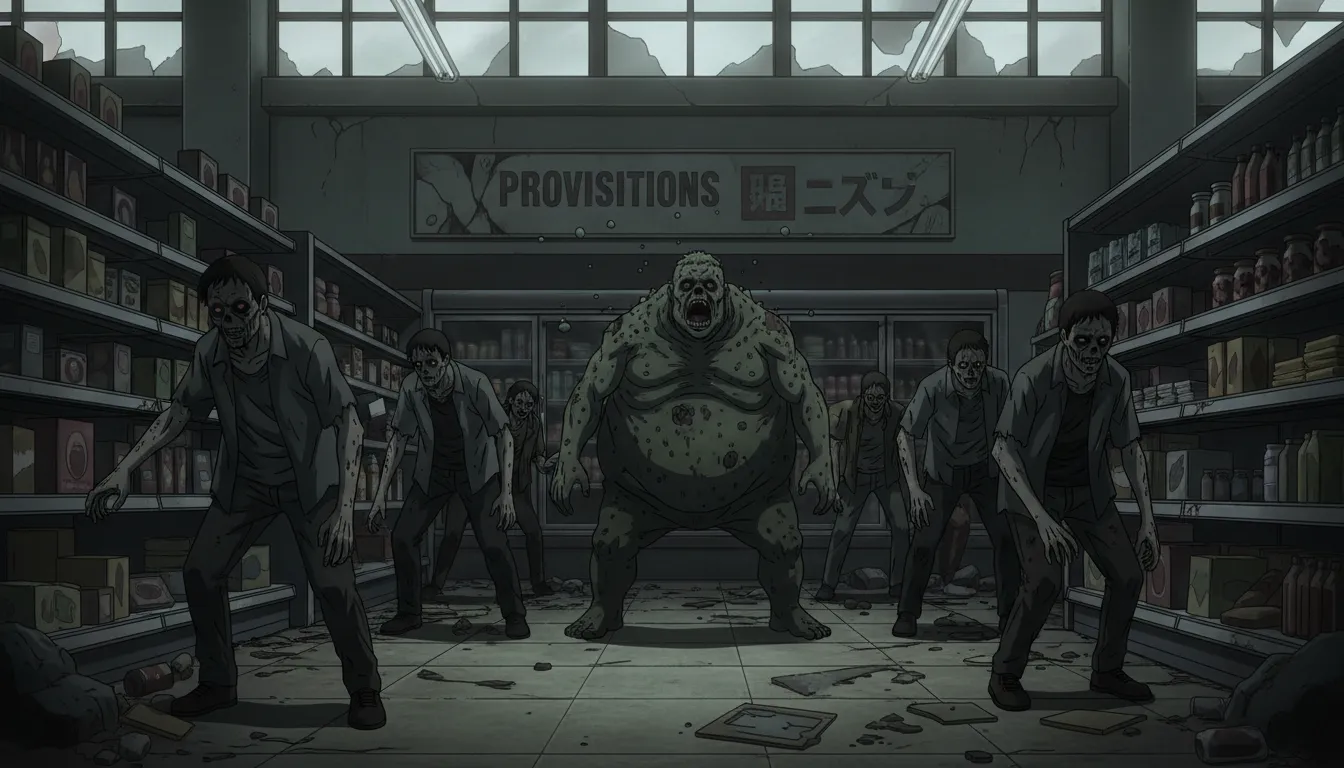
The decision to douse a pair of already-dead bodies in gasoline and set them alight is not the origin of horror in Infected; it is the point where the community’s deepest desire finally finds its most efficient flame.
The Smoke Above the Tombs
The episode hangs itself on a single visual refrain: smoke rising from inside a place that was designed to contain death. The prison, already a tomb repurposed as refuge, begins to exhale. Later, the camera will track Rick’s gaze as he discovers the charred traces of Karen and David: two dark shapes dragged to the concrete, the scorched outline of where their faces once were, the acrid residue that clings to his nostrils and to Tyreese’s grief. Before the detective question—who did it?—there is a more basic sensory education: this is what it looks like when a social body cauterizes itself.
Earlier in the episode, another combustion has already taken place, without fire. Patrick collapses in the shower, dies quietly, and returns as an interior explosion: the same boy who had been playing with the others at story-time now staggers through Cell Block D, bleeding from the eyes, tearing open throats while the sleeping bodies around him become fuel. The sprinkler system rains down, turning blood into diluted pink streams. Here, infection and infrastructure collaborate: a dead teenager, the prison’s plumbing, and the sleeping crowd assemble into a single machine that converts one anonymous flu into a generalized massacre.
These two images—the sprinkler rain and the blackened corpses by the wall—bookend the episode’s lesson. Between them, the prison community discovers that death is no longer an event that arrives from outside, through the fence or the gates. It is inside the lungs, on the breath, in the cough. Walkers claw at the fence, yes, but the real catastrophe seeps through the air vents of the cell block. The episode insists: the true danger is not at the perimeter; it is already coded into the everyday exchanges of intimacy and proximity.
It is precisely at this moment, when the “enemy” can no longer be reliably placed beyond the wall, that the desire to purify, to cauterize, to cleanse through fire begins to crystallize. The smoke over the tombs is less a cover-up than a symptom: a sign that the social organism is attempting to seal its own wound by burning off its sick flesh.
Prison-State: From Refuge to Apparatus
The prison has, by this point in The Walking Dead, ceased to be a mere shelter. Crops grow in the yard, pigs root in their pen, the fences are reinforced; there is a Council, rules, delegated responsibilities. What began as a fort has mutated into a miniature State apparatus, complete with its own police (Rick and the others), legislature (the Council), and biopolitical concern for the health of its population (Foucault, 1977). The camera’s lateral movements along the walkways and catwalks visualize this stratification: watchtowers, inner yards, cell blocks, quarantine zones—nested layers of security and exposure.
The emergence of the Council is crucial. Decisions are no longer ad hoc responses to immediate threat; they aspire to generality, to rules that apply across cases. Hershel argues about quarantining the sick, Carol demands access to children’s education and knife training, Daryl negotiates food runs and work details. This shift from improvisation to institution is a classic territorialization: the community attempts to pin down flows—of people, of zombies, of food, of affection—into a stable arrangement that can be managed and predicted (Deleuze & Guattari, 1987).
Yet the walls of this new State are profoundly ambiguous. They were not built for this population; they pre-existed as part of another disciplinary regime, the carceral system of the old world (Foucault, 1977). The group has squatted atop a pre-formed diagram of power. The same architecture that once segmented, surveilled, and punished bodies for the old State now organizes the survival of the new. The prison’s geometry—cells, tiers, locked gates—offers a ready-made image of order that is all the more seductive because it promises security in a world of chaos.
The episode meticulously stages how this inherited architecture shapes the community’s response to infection. At the first sign of the unknown flu, the Council does not imagine tents in the yard or an open-air infirmary; it decrees a Sick Ward inside one of the cell blocks. Those with symptoms are to be separated, locked away behind bars, watched but contained. The very idea of “contagion management” arrives already formatted: to be sick is to be placed, to be enclosed, to be silently processed by an apparatus that knows only how to separate and surveil.
This is how a prison becomes a State: not by formal proclamation, but by allowing inherited spatial diagrams to dictate how problems are thought. When illness appears, it is immediately coded as a question of territory—who belongs where, who can share air or water with whom—rather than as an opportunity to invent new forms of care. The episode stages this transformation quietly, through doorways sliding shut, through the reappearance of locked cages as the default response to uncertainty.
Viral Lines of Flight and Leaking Walls
Against this carefully layered architecture, the virus operates like a mockery. It crosses fences without noticing them. It passes through grates, under doors, within droplets of cough and the condensation of shared breath. The walkers pressing against the outer fence are almost comforting in their predictability: they scratch, they push, they tear at the metal, forming a visible, manageable threat. They pile up in ways the Council can count and address: “There are more at the fence,” someone says, and concrete actions follow—reinforce, kill, distract.
The flu, by contrast, is an invisible line of flight that moves transversally through every stratum the prison erects (Deleuze & Guattari, 1987). Patrick’s arc shows this with cruel simplicity. He begins as a friendly, socially integrated teenager, sharing meals and games, then becomes a coughing, sweating sleeper, and finally a walker whose first bite tears open the throat of the man in the bunk above him. The same body traverses three statuses—healthy, infected, undead—without crossing any doorway. It is the dormitory, the bunks, the shared bathroom, and the nightly proximity that enable the virus’s dance. Infrastructure and illness co-compose a lethal coupling.
The Council’s attempt to respond—quarantine, separate, move the vulnerable (children, the elderly) to other blocks—has the paradoxical effect of multiplying points of contact. Mika and Lizzie, the two sisters, are shuttled from place to place, their own coughs and anxieties trailing behind them. The sick ward gathers infected bodies into a dense cluster, a localized storm charged with potential transformation. Hershel’s insistence on going inside to offer medicine and comfort contaminates the boundary even further, introducing care as an additional vector of risk.
In this sense, the virus is not simply a “threat” to the community; it is a nonhuman desiring-machine that plugs itself into the existing assemblage and forces it to show its tendencies (Deleuze & Guattari, 1983). It reveals what the prison-State values (order, separation, productivity) and what it fears (opacity, indeterminacy, intimacy without guarantees). By indifferent circulation, it strips away the comforting illusion that danger is always “out there” beyond the fence. The world leaks. The social body is porous.
The sequence at the fence, where the walkers begin to push the metal inward, driven wild by someone feeding them live rats, makes this porosity literal. Human hands have been nourishing the exterior threat, pulling it closer, intensifying its pressure. Desire itself, from within the community, is conspiring with the supposedly external enemy. The wall bends, its solidity shown to be contingent, dependent on a continuous work of reinforcement and a fragile consensus about who belongs inside and who belongs outside.
It is in this context that the incineration of Karen and David occurs. The act is not a random eruption of cruelty; it is the condensation of all the community’s anxieties about leaking boundaries into a single, brutal gesture of sealing.
Micro-Fascism and the Desire for the Incinerator
When Tyreese finds the blood trail leading from the sick ward to the charred remains by the wall, the narrative briefly flirts with a standard detective frame: someone has murdered and burned two vulnerable people. Who is the killer? But the episode’s more unsettling question is different: How did the community collectively dream this incinerator before anyone lit the match?
Fascism, in this context, is not a matter of uniforms and flags but of desire: the wish to purify, to make the world homogeneous, to cut out anything that threatens cohesion (Deleuze & Guattari, 1983). Before any individual decides to drag bodies and strike a match, there is a diffuse, shared current running through the group: we are under siege; the infection could wipe us out; drastic measures might be necessary. Whispered conversations about “isolating the sick,” about “hard choices,” about “doing what it takes” cultivate the soil in which the act will sprout.
This is micro-fascism: not the grand spectacle of a totalitarian regime, but the small, everyday alignment of fear and control in the name of safety (Deleuze & Guattari, 1987). Someone in the group evidently concludes that keeping Karen and David alive in quarantine is too risky. The calculus is simple and terrifying: better to preemptively destroy these two points of contagion than to risk an outbreak that could kill dozens. The decision masquerades as sacrifice-for-the-group. Its logic is: the organism must be preserved; the diseased parts must be cut off and burned.
The incinerator itself—an industrial furnace left over from the prison’s previous life—becomes a desiring-machine of purification. Gasoline, match, flesh, fear: these elements come together in a new assemblage that promises an almost ecstatic relief from anxiety (Reich, 1949). Fire seduces precisely because it offers an instantaneous solution: no more coughing, no more waiting to see if the fever breaks, no more managing the ambiguous status of the sick. Ash does not turn.
Yet this is where the episode bites deepest. The very act intended to protect the group detonates its fragile trust. Tyreese’s grief becomes rage; suspicion flowers; every face is a possible mask for the secret burner. The community discovers that in its desire to cauterize the social body, it has burned a hole in its own fabric. The incinerator did not remove threat; it internalized it, made it impossible to locate safely. The killer is not just “out there” beyond the wall, nor just “in here” in the lungs; it is now also “among us,” encoded in a neighbor’s idea of what must be done.
The micro-fascist solution, then, reveals itself as a trap. It short-circuits deliberation and solidarity in favor of a unilateral, purifying act that leaves behind residues it cannot handle: ashes, yes, but also rage, guilt, paranoia. The community does not simply suffer from the killer’s decision; it is shown to have participated in its conditions of possibility, to have “worked together without knowing it” to build the incinerator as a fantasy of safety.
Sick Ward, Black Hole, and the Burned BwO
The sick ward is ostensibly a zone of care, but its formal logic is that of a black hole: bodies go in and are no longer fully part of the social field (Deleuze & Guattari, 1987). Karen and David, once lovers, friends, workers, are reclassified as “the infected.” Their names persist in speech, but their status has shifted. They are watched through bars, spoken about rather than with, handled using precautions that implicitly treat them as dangerous objects rather than interlocutors.
This reclassification does not occur only at the level of discourse; it expresses itself in spatial arrangements, camera positions, gestures. The bars of the cell doors are foregrounded, slicing the frame; the sick are shown lying on cots in cramped rows, faces sweating, lit by harsh overheads. When characters like Hershel or Glenn speak to them, there is a subtle hesitation at the threshold, a balancing between compassion and self-preservation. The ward is a pocket universe where time slows and waiting becomes excruciating.
From the vantage point of the prison-State, the infected bodies present a problem: they have ceased to be fully functional members of the organism. They cannot work the fence, farm, cook, or fight; they risk catastrophic transformation into walkers, whose only “function” is to decompose and bite. In this sense, the infected are living embodiments of a body without organs: zones where the usual flows of labor, speech, and normative social interaction have been suspended, leaving behind a mass of potential that the State finds intolerable (Deleuze & Guattari, 1983).
The incineration of Karen and David is an attempt to resolve this impasse by erasing the troublesome bodies altogether. Ash is the ultimate orderly residue: it cannot rise up, cannot escape quarantine, cannot suddenly reanimate on a cot and start tearing into throats. The fire converts a disorganized, threatening potential into a homogenous powder. It is an attempt to wipe the slate clean and restore the organized, productive body of the community.
But the episode also hints at another possibility for how to relate to these quasi-organless zones. Hershel’s insistence on entering the sick ward with herbal remedies, his willingness to expose himself, carves out a different response. He refuses to treat the infected purely as objects of risk. His body becomes a relay that accepts the flows of cough, sweat, and possibly virus, not in a suicidal embrace of death but in a stubborn affirmation that the social field cannot be maintained by simple subtraction of trouble. His choice is dangerous, perhaps even reckless; yet it opens a line of care where the State’s automatic reflex would be exclusion.
The contrast between Hershel’s entrance into the ward and the anonymous burner’s exit with two bodies shows two distinct ways of forming relations to the body without organs: one that tries to organize it anew through experimental care, and one that annihilates it to restore an idealized organism. The sick ward, in this reading, is not just a place in the plot; it is a conceptual hinge where the community’s ethics of contagion are forged.
Children, Pigs, and the Internal Policeman
Parallel to the drama of infection and incineration runs another, seemingly smaller thread: Carol’s secret instruction of children in knife-use, and Rick’s agonizing over his pigs. These micro-scenes are not side plots; they are the everyday laboratories where the internal policeman is either installed or dismantled.
Carol reads stories to the children, a spectral echo of pre-apocalypse schooling. Yet between fairy tales she pulls aside select kids, placing knives in their hands, showing them where to stab walkers in the brain. With Mika and Lizzie, we see two divergent responses: one recoils, clinging to a residual moral world where killing is wrong; the other, Lizzie, appears almost entranced by walkers, naming one at the fence, grieving its destruction as if it were a pet.
Carol’s pedagogy is double: on the one hand, she insists that sentimentality is a liability, that children must harden themselves to kill; on the other, she secretly maintains a tenderness that the official discourse of toughness denies. The knife lessons install within the kids a new kind of conscience: not a moral law that says “Thou shalt not kill,” but a tactical law that says “Thou shalt kill when necessary, cleanly and without hesitation.” The internal policeman here is not the voice of the State, but the voice of survival woven directly into the child’s body (Foucault, 1977).
Lizzie’s relation to the walkers complicates this installation. She projects personhood onto the undead, cries for the one at the fence, seems to feel a solidarity with the infected. In the context of Infected, where people are being burned for their status as carriers, Lizzie’s sympathy functions as a minor but crucial line of resistance to the pure logic of purification. She refuses, at least for now, to let the category “in danger of turning” erase the subject.
Meanwhile, Rick slaughters his pigs: first by feeding them alive to the walkers at the fence, then by culling the rest when they are suspected of being vectors for the virus. The pigs were his attempt at agriculture, at a pastoral alternative to the gun. The scene where he lures the herd of walkers away from the fence by dropping squealing pigs from the back of a truck is almost ritualistic. Each pig is sliced, bled, pitched overboard, where it is immediately torn apart by the herd. Flesh is used as bait to protect the fence, a calculus not unlike the incineration of Karen and David, but here at one remove: animal life is sacrificed to preserve human walls.
The subsequent decision to kill the remaining pigs—sick or not—completes another kind of cauterization. Rick is erasing the biological substrate of his agrarian fantasy. Its blood spatters his face and clothes, a stark contrast to the soil-stained overalls he wore when he tried to be “just a farmer.” When he later re-belts his gun, the episode marks a return to a different subjectivity: the sheriff-soldier who has accepted that violence and hard decisions are intrinsic to leadership.
These micro-scenes show how the community’s larger fascist tendencies are not only enacted in spectacular acts like incineration, but also in quiet, cumulative practices: the way children are taught to allocate life and death, the way animals are reduced to tactical units, the way individuals re-internalize roles they had tried to escape. The internal policeman is not merely the voice that says “burn the bodies”; it is also the voice that says “teach the kid to stab,” “slaughter the pigs,” “strap the gun back on.”
Toward a Schizo-Ethics of Contagion
The final power of Infected lies in its refusal to offer a clean alternative. It does not present a utopian community that would simply “care more” or “burn less.” Instead, it multiplies situations in which every option is entangled with risk and complicity. Quarantine may be necessary; entering the sick ward may be noble; burning bodies may be understandable. No position is pure. The point is not to locate the one innocent decision but to map how desires for security, purity, and control weave through each of them.
A schizo-ethics of contagion would begin from this map. It would not deny the reality of infection or the horror of watching loved ones turn. But it would resist the temptation to translate every uncertainty into a calculus of sacrificial victims. It would refuse the dream of an organism restored to purity by cutting off contaminated parts. Instead, it would look for arrangements—however fragile, however improvised—in which care and exposure are acknowledged as constitutive of the social field.
In the episode, Hershel’s small insistence that “you risk your life every time you drink water” gestures toward such an ethics. Risk is not an anomaly introduced by the virus; it is the baseline condition of life together. To pretend otherwise is to make oneself available to the fascist fantasy that somewhere there is a configuration—enough walls, enough burns, enough guns—in which risk disappears. That fantasy is what fuels the incinerator.
The rising smoke above the tombs at the episode’s close is ambiguous. It is at once the sign of a crime and the emblem of a desperate attempt at self-preservation. It marks the point where the prison-State’s apparatus of control collides with biological reality and responds by burning what it cannot integrate. But it also signals a threshold: from this point on, the community must confront that it has begun to do the walker’s work for it, disassembling itself piece by piece under the banner of safety.
The walkers at the fence will keep coming. The virus will keep mutating. The real question is whether the community can learn to live with its own permeability without continually reaching for the match. Schizoanalysis reads Infected as a diagram of this problem: how a group under siege organizes its desires, how it recruits architecture, fire, children, animals, and lungs into a machinery that might either sustain or consume it.
If there is a line of flight in the episode that does not simply lead back into the furnace, it lies perhaps in those minor, stubborn gestures that refuse totalization: Lizzie naming the walker, Hershel stepping into the sick ward, even Rick’s anguished expression as he kills his pigs and then, reluctantly, reclaims the gun. These are not heroic solutions; they are cracks in the smooth surface of the cauterized social, points where the community might yet decide that life with infection, life with risk, is preferable to the deadly purity of ash.
References
Deleuze, G., & Guattari, F. (1983). Anti-Oedipus: Capitalism and schizophrenia (R. Hurley, M. Seem, & H. R. Lane, Trans.). University of Minnesota Press.
Deleuze, G., & Guattari, F. (1987). A thousand plateaus: Capitalism and schizophrenia (B. Massumi, Trans.). University of Minnesota Press.
Foucault, M. (1977). Discipline and punish: The birth of the prison (A. Sheridan, Trans.). Pantheon Books.
Reich, W. (1949). Character analysis (T. P. Wolfe, Trans.). Farrar, Straus and Giroux.
Comments
Post a Comment