Love that insists on feeding a severed, rotting head is at once the most faithful and the most treacherous act toward what we call “the human.”
I. The Body Without Organs of the Apocalypse
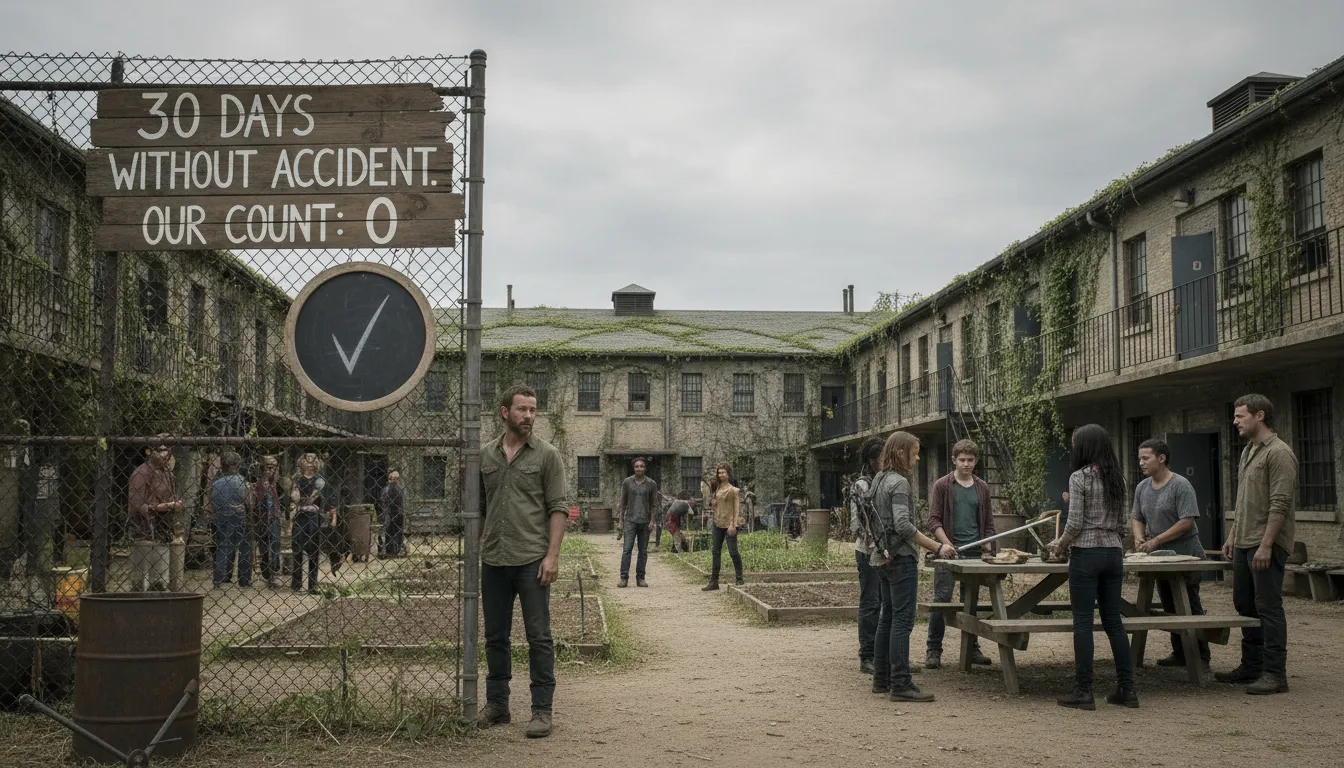
Season 4 of The Walking Dead opens not on a grand battle, but on a weird equilibrium: the prison has become an almost pastoral machine, an improvised homestead where crops grow in the yard and children learn knife techniques in the library. The apocalypse has not merely destroyed the old social body; it has produced a new one whose skin is chain-link fencing and whose entrails are cell blocks, watchtowers, and pig pens. This improvised fortress is the group’s attempt to solder a new “organism” out of scavenged parts: law, work, intimacy, agriculture, defense, all wired together and made to circulate.
Within this precarious organism, Rick tries to become less a sheriff than a farmer, literally burying his gun in the soil. The episode’s early images of him tending the earth stage a wager: perhaps a stable body can grow out of decoded ruins if enough discipline, routine, and care are invested. The prison is not just a shelter from walkers; it is an attempt to reterritorialize life, to give form back to a social body that the apocalypse had peeled open and left raw.
It is against this agricultural, quasi-domestic assemblage that Clara appears. Rick encounters her in the forest, dragging a suspiciously heavy sack, her body gaunt, voice wavering, orbiting the edge of sanity. She is not simply “a survivor out there”; she is the remainder that the prison-organism cannot digest, a nomad flickering between the world of the living and the world of the undead. Where the prison’s project is to give the group clear boundaries—inside/outside, safe/dangerous, alive/dead—Clara’s existence scrambles those distinctions.
Her devotion to the man in the bag—ultimately revealed as a severed, turned head she calls Maurice—presents the central problem of the episode’s philosophy. Is her insistence on feeding him, talking to him, and killing for him a failure of the human subject, a descent into pathological infatuation? Or does it mark a dangerous kind of fidelity that refuses the state’s definition of “life” and “person,” maintaining a machine of love even when the biological organism has been decapitated? The episode forces us to see that the apocalypse does not simply replace romance with survival; it mutates desire itself, stretching it around corpses and ruins until it adheres to things that, by every rational metric, no longer count as people.
Clara’s love is neither sentimental “true love” nor a trivial crush gone wrong. It is a schizoid fidelity: an uncompromising attachment to a desiring arrangement that continues to operate even when its organic substrate has come apart. This is why her story educates us, not by offering a moral lesson about letting go, but by showing how desire builds circuits that do not stop when the organs fail.
II. The Mechanics of the Severed Head
When Rick follows Clara back to her camp, the camera lingers on a small, pathetic world: a tent, scattered objects, a crude table, and that sack which has become the gravitational center of her existence. The eventual reveal—that Maurice is nothing but a disembodied, turned head—feels less like a twist than like the externalization of what we have been sensing all along: Clara’s life has been organized around a partial object, a fragment that nevertheless commands total devotion.
The human face is traditionally the site where personhood is read: identity, recognition, moral status. Deleuze and Guattari describe how the face, in modern societies, becomes a kind of miniaturized surface of control, a billboard where power inscribes legible traits—normal/abnormal, trustworthy/suspicious, sane/mad—so that bodies can be managed and sorted (Deleuze & Guattari, 1987). To decapitate a body is to tear this surface away from its supporting infrastructure of organs and actions, to let the face float, disconnected from the behaviors and institutions that once gave it meaning.
Yet Clara clings to Maurice’s head as if it concentrated his entire being. In refusing to discard the head, she refuses to let his personhood be erased by the new regime of the dead, where walkers are treated as pure threat or pure resource. The sack is her portable altar, the improvised shrine where the face survives as a relic. Instead of letting the zombie infection dissolve Maurice into the anonymous mass of “walkers,” she insists that there is still a who inside this what.
Feeding the head literalizes this insistence. Every time she kills to bring back food, she inserts living flesh into a mouth that can no longer transform it into nourishment in any meaningful sense. Biologically, the circuit is broken: there is input but no proper output, only the mechanical chomping of a reflex. But at the level of desire, the circuit still runs. Clara’s labor—stalking, killing, butchering—is an energy flow that loops through Maurice’s mouth and back into her own sense of purpose. The head does not eat; rather, it consumes her, attaching every action she performs to its insatiable presence.
This is why the head is less a remnant of an organism than a kind of perverse “body without organs”: a zone where the usual functions of life—movement, digestion, reproduction—have been shut down or hollowed out, but where desire still clings and circulates. It is a surface that absorbs Clara’s actions without giving back the responses that would ordinarily stabilize love: recognition, speech, touch. The more the head fails to respond, the more Clara must act, must invent little rituals of feeding and care to sustain the illusion of a shared life.
Her ritual attempts at re-organization are visible in the camp’s arrangement. She has placed the head in a position of honor, carefully shielded it, oriented her entire layout of objects and movements around its centrality. This is not madness in the sense of random chaos; it is an intensely ordered microcosm, a one-person cult in which everything is subordinated to the maintenance of a single desiring machine. The episode thus teaches us that in the absence of ordinary social organs, people will build new circuits out of whatever fragments remain, soldering their lives to pieces of the dead in order not to fall into sheer indifference.
III. True Love, Infatuation, and Schizoid Fidelity
At first glance, Clara’s attachment might be easily dismissed as infatuation carried to a grotesque extreme. She speaks of Maurice as if he were still her partner, her protector, the center of her emotional world. In a more conventional narrative, such a figure might be a cautionary example of someone who cannot “move on,” who confuses obsession with love. But the episode resists this easy classification by staging Clara’s story as a mirror for Rick’s own attempts to define what counts as a livable attachment after the end of the world.
The ideology of “true love” inherited from the pre-apocalyptic world—the world of weddings, Valentine’s cards, and legal contracts—defines love as a stable, socially recognized bond oriented toward a shared future. This is the love that underlies the nuclear family, property arrangements, and reproductive continuity. In such a framework, Clara’s situation is doubly deviant: her beloved is not only dead but undead, and her relation to him is actively destructive of her own survival, subordinating her to a bond with no future.
If we then turn to the language of “infatuation,” we typically mean a fixation that immobilizes the subject: an overwhelming, consuming focus on an object that prevents growth, change, or the cultivation of multiple ties. Infatuation, in this sense, is a molar category—a way of naming and dismissing a certain intensity of attachment as immature or pathological. To call Clara “infatuated” would be to protect ourselves from the uncomfortable proximity of her devotion: we are not like her because we know when to let go.
What the episode reveals, however, is that Clara is not simply stuck; she is faithful. Not faithful in the banal sense of marital loyalty, but in the sense Badiou gives the term: a sustained, active commitment to an event that has ruptured a previous order of life and opened up a new field of possibilities (Badiou, 2001). For Clara, the event was not just “falling in love” with Maurice; it was living through the collapse alongside him, discovering a way of being that, however fragile, felt like a truth in the midst of ruin.
When Maurice died and turned, that event did not simply end. It shifted, migrated, found a new, horrific support in the reanimated head. Clara’s fidelity is not to the flesh as such but to the relational configuration that once passed through that flesh. She remains committed to the idea that “we” still exist, that the couple is not abolished by biological death. Her error, if we can call it that, is not that she loves too much but that she refuses to register a new event: the event of Maurice’s transformation into something that can no longer reciprocate or participate in that shared world.
From this angle, Clara’s love becomes an educational diagram of schizoid fidelity. Unlike romantic ideology, which imagines love as the fusion of two intact persons into a harmonious unit, her attachment clings to a fragment, a partial object, and builds an entire world around it. Unlike mere infatuation, which collapses the subject into passivity, her fidelity propels her into constant activity: hunting, feeding, arranging, talking. She is not frozen; she is hyper-productive, but all her production flows into a dead circuit.
The episode subtly juxtaposes this with Rick’s own fidelity. He continues to orbit the memory of Lori, to be haunted by her image, and yet he channels his commitment into the cultivation of the prison community: into soil, pigs, fences, and shared labor. Both Rick and Clara are faithful to their dead, but where Rick allows his fidelity to be re-routed into new assemblages, Clara seals hers inside the sack. The educational force of the episode lies in this contrast: it shows that what matters is not whether one “moves on” or “lets go,” but how fidelity is wired—whether it opens onto new connections or closes into a solitary loop.
IV. The Ethics of the Stranger Woman
Rick’s meeting with Clara is framed as an ethical test. He approaches her with rules derived from the prison’s fragile code: he will decide whether she may join them based on his now-famous “three questions” about how many walkers she has killed, how many people she has killed, and why. These questions distill an entire moral and political order into a short diagnostic: they evaluate a stranger not by her story or her potential but by her relation to killing.
In this system, Rick functions as a kind of mobile tribunal, an emissary of the prison’s fledgling law. Foucault’s account of modern discipline shows how institutions like the prison create subjects through routines of examination, classification, and normalization (Foucault, 1977). Rick’s interview with Clara is a miniature version of such an examination: she is to be assessed, sorted as safe or unsafe, useful or dangerous, based on how her past actions fit the group’s norms.
Yet Clara scrambles this judicial machinery. She does not answer the questions cleanly; instead, she talks around them, deflecting, pleading, insisting that everything she has done she did to survive with Maurice. Her narrative does not fit the grid that Rick offers. When she speaks of killing, she speaks not in terms of moral justification or survival calculus, but in terms of feeding, caring, loving. For her, the ethical axis is not “right/wrong kill” but “for him/against him.” Her horizon of responsibility has shrunk to a point: the sack.
By insisting that he come meet Maurice before deciding, she attempts to force Rick’s ethical apparatus to confront the object of her fidelity. She wants him to see what she sees: not a threat, but a beloved. In a sense, she is trying to extend the circuit of her schizo-fidelity outward, to plug Rick into it, to make him part of her micro-cult. If he could recognize Maurice as a person, perhaps the prison could become not just a shelter for Clara but for the head as well.
Rick, however, cannot and will not enter that circuit. For him, Maurice is already on the other side of the line that separates “people” from “walkers.” The prison’s entire survival strategy depends on maintaining that distinction; to begin treating walkers as persons again would unravel the group’s moral topology. If walkers were people, every defensive act would become a murder. The nascent law of the prison thus requires a certain hardness of heart: it must foreclose precisely the kind of radical empathy that Clara embodies.
The ethical education of this encounter lies in its refusal of a simple verdict. The episode does not invite us to side entirely with Rick’s sober pragmatism or with Clara’s impossible love. Instead, it shows that new orders of power always crystallize by excluding some forms of attachment as unthinkable. Rick’s world cannot accommodate someone who insists on loving a walker as a person; therefore, Clara must remain outside, or die. The price of reconstructing a social body is the sacrifice of certain desiring circuits that threaten its coherence.
V. Suicide and the Final Line of Flight
When Clara realizes that Rick will not accept Maurice, that her attempt to induct him into her micro-world has failed, she does not beg for entry as a lone survivor. Instead, she asks a question that shocks even in a universe saturated with death: “Can you do something for me?” She asks Rick to leave her body unstabbed after she kills herself, so that she may “be with” Maurice as a walker. She does not want to be “put down.” She wants the contagion to finish what it started.
This is the most radical gesture of the episode. Up to this point, Clara has maintained a strange compromise: she remained alive, human, in order to care for an undead beloved. Her body was the bridge between worlds, the living support for an unlivable fidelity. In choosing suicide without a headshot, she elects to destroy that bridge and follow the line all the way into the other side. Rather than continue to be the caretaker of a partial, disorganized body, she chooses to become one herself.
The act is not framed as a romantic sacrifice in the usual sense. She is not dying to save him or the group; she is dying to rejoin a desiring circuit that no longer has any place within the living order. Her suicide is thus both an exit and an entry: an exit from Rick’s binary—inside the prison or outside, with us or against us—and an entry into the anonymous swarm of the undead, where Maurice and Clara will finally be equalized as feeding, shuffling bodies.
There is, however, a final twist. By killing herself in front of Rick, she forces him to witness the absolute horizon of his own system. He cannot incorporate her; he cannot prevent her from choosing a destiny the law cannot recognize as meaningful. All he can do is listen to her story—the story he had promised not to concern himself with—and then walk away. His earlier decision to stop “listening to stories” is momentarily suspended, but too late to alter the outcome. The episode suggests that once an order of power has abstracted its ethical questions into formulas and checklists, it loses the ability to be affected by singular lives.
Suicide, in this context, is a line of flight that neither the walkers nor the prison can fully capture. It is not resistance in any heroic sense, yet it undermines the binary logic of survival that governs the show’s world. Clara refuses the injunction to live at any cost and the counter-injunction to die in the right way (clean, neutralized, safely put down). Instead, she composes her own death as a continuation of her schizo-fidelity: if she cannot keep feeding the head from the outside, she will become part of the same headless, organless mass from the inside.
For viewers, this is a dark but precise lesson in how desire can choose oblivion when the available forms of life are experienced as betrayals of a fundamental attachment. It complicates any easy moral about “getting over” loss. Sometimes the only consistency that seems bearable is the one that leads straight out of the living world.
VI. Clara’s Lesson: Educating Desire After the End
By the time Rick returns to the prison, leaving Clara’s newly dead body in the woods, the episode has quietly transformed from an action-suspense opener into a philosophical diagram. The internal incidents at the prison—the flirtations, the children learning to name walkers, the infected pig, the small pleasures of shared meals—play out against the shadow of what Rick has just seen: a form of love that the group cannot admit, even as it reveals something about their own attachments.
What does Clara teach us about schizoanalysis through her ruin? First, she reveals that desire never simply corresponds to biological life. Even when the organism fails—when the body decomposes, when consciousness disappears—desiring circuits can continue to run around the dead object, investing it with meaning, structuring actions, organizing entire miniature worlds. Love is not a property of intact persons but an arrangement of flows, rituals, and repetitions that can attach to fragments, memories, even sacks with heads inside.
Second, Clara shows how every attempt to reconstruct order after a catastrophe must decide which desiring circuits are allowed and which must be cut. The prison is not neutral; it is a machine that promotes some attachments (to community, to work, to children) while repressing others (to walkers, to hallucinations, to suicidal fidelity). Schizoanalysis invites us to map these decisions not as moral absolutes but as technical choices in the engineering of a social body: which flows can the organism tolerate without dissolving?
Third, her story makes visible the tension between fidelity and transformation. To be faithful to an event—whether a love, a revolution, or a survival pact—does not necessarily mean preserving its original form. Rick’s fidelity to his dead, routed through care for the group, contrasts with Clara’s rigidity. The episode suggests, without preaching, that when fidelity refuses any mutation of its object, it risks closing into a deadly loop. Yet it does not condemn Clara outright; instead, it keeps open the possibility that her consistency, however self-destructive, preserves a kernel of truth about the inhuman persistence of love.
Finally, by tracking Clara’s movements, words, and acts, the episode offers a practical lesson in schizoanalytic reading. To follow her is to follow connections: between a head and a body, between a woman and a sack, between a forest camp and a prison, between law and love, between survival and suicide. It is to see characters not as isolated psyches but as nodes in networks of power, grief, and desire. And it is to recognize that the apocalypse is not only an external setting but an internal condition: a tearing-apart of the old organs of meaning that forces new, sometimes monstrous, assemblages to arise.
Clara’s “madness” is thus not an anomaly in an otherwise rational world; it is an extreme, crystalline expression of tendencies that run through everyone in the series. Rick, Hershel, Carol, the children naming walkers from behind fences—all are engaged in experiments of wiring and rewiring desire under conditions where the old maps of life and death, love and duty, have lost their authority. If we let Clara’s head haunt us as it haunted her, we may begin to see that what survives the end of the world is not the human as such, but the restless, often destructive creativity of desire, always searching for a new body to animate.
References
Badiou, A. (2001). Ethics: An essay on the understanding of evil (P. Hallward, Trans.). Verso.
Deleuze, G., & Guattari, F. (1983). Anti-Oedipus: Capitalism and schizophrenia (R. Hurley, M. Seem, & H. R. Lane, Trans.). University of Minnesota Press.
Deleuze, G., & Guattari, F. (1987). A thousand plateaus: Capitalism and schizophrenia (B. Massumi, Trans.). University of Minnesota Press.
Foucault, M. (1977). Discipline and punish: The birth of the prison (A. Sheridan, Trans.). Pantheon Books.
Comments
Post a Comment