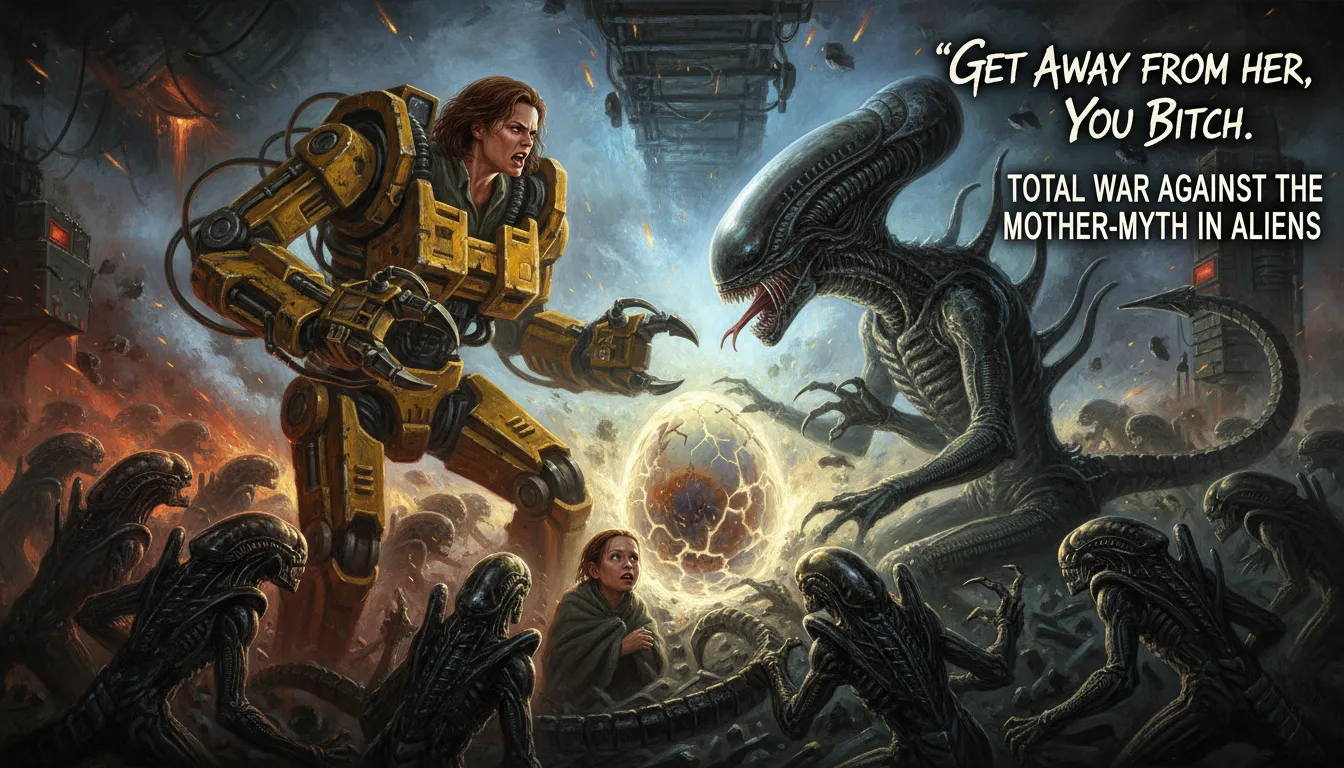
The most frightening discovery in Aliens is not that another species breeds in our bodies, but that our institutions breed in exactly the same way.
Colonies Facing Each Other
LV-426 is presented as a frontier settlement, a small human colony clinging to a toxic planet, yet from the first establishing shots it is less a “community” than a hardware configuration: atmosphere processor, habitation modules, vehicle bays—all bolted onto a storm-lashed rock to extract value. The “shake and bake” terraforming plant hums like an enormous industrial organ, converting hostile air into breathable atmosphere, barren ground into property titles, raw geology into corporate assets.
Opposite this stands another colony, initially invisible: the alien hive, buried in the cooling towers and crawlspaces of the processing station. Where the human outpost is arranged into offices, families, schoolrooms, and medical bays, the hive rewrites every room into a single continuous surface of resin, secretion, and pulsating sacs. One is molar, segmented—workers vs. administrators, Marines vs. corporate; the other is molecular—eggs, facehuggers, drones, queens, all sliding into each other functionally rather than hierarchically (Deleuze & Guattari, 1987).
The genius of Aliens is that it never allows us to keep these two colonies apart. The alien infestation does not arrive from outside; it is triggered by a corporate instruction relayed through radio and bureaucracy. Burke reroutes a family of colonists to investigate a derelict ship, setting in motion the incubation that will reconfigure the entire complex. The human colony calls the alien colony into existence inside itself, like capital summoning its own parasites. The film’s war is not “humans vs. monsters” but one mode of colonization mutating into another, more ruthless one.
The Hive Without a Mother
The camera’s first real tour of the alien nest, deep inside the atmosphere processor, is a slow, nauseating descent. Walls drip, shapes bulge; pipes and girders disappear under calcified secretion. It is here that the film stages what many readings call the “maternal core” of the alien species: the Queen suspended in biomechanical grandeur, abdomen fused to an oozing ovipositor that extrudes translucent eggs with obscene calm.
It is tempting to treat her as the return of the archaic mother, the devouring goddess whose womb is indistinguishable from a grave—Lacan’s lamella, or Žižek’s “monstrous Thing” that threatens to engulf subjectivity in pre-symbolic jouissance (Žižek, 1992). But the scene refuses the grammar of kinship even as it flaunts its iconography. The Queen’s enormous head crest is not a face but a crown of armor; her multiple limbs move with insect precision; her egg-laying is more conveyor belt than pregnancy. There is no breast, no lap, no place for a child to curl up. There is only throughput.
The Queen is not “Mother” but an organ of a production line. The hive is not a family tree; it is a factory diagram in living tissue. Deleuze and Guattari’s desiring-machines come into view here not as metaphors but as literal couplings: egg-laying tube to abdomen, egg to facehugger, facehugger to host, host to chestburster, chestburster to drone, drone back to protect the Queen (Deleuze & Guattari, 1983). Every link is functional, and none presupposes the vocabulary of lack, castration, or filial love.
Donna Haraway’s critique of “naturalized motherhood” helps clear away the last residues of humanist projection: what looks like maternity is often a technological and economic script pasted onto female bodies under the sign of “nature” (Haraway, 1989). The Queen is precisely such a technological institution—biological but also infrastructural. She is more analogous to a reactor core or mainframe than to a person. To call her “mother” is already to misrecognize her technicity.
Ripley’s gaze in this sequence is crucial. When she enters with a flamethrower and a bandolier of grenades, nursing the wounded Newt in her arms, the film aligns two different assemblages: the human line of care, improvised and fragile, and the inhuman line of industrial reproduction, massive and indifferent. Ripley threatens the eggs; the Queen signals drones to stand down. There is a momentary “understanding,” but not maternal recognition; it is a calculation between machines about risk and capacity. Once the flamethrower’s burning arc hits the eggs, the truce ends. What follows is not a family quarrel but a factory fire.
Marines in a Maze They Don’t Own
The Colonial Marines march into this biomechanical factory armed with the state’s preferred tools: hierarchies, blueprints, and metrics. The drop onto LV-426 is choreographed as a textbook insertion. Sergeant Apone barks orders, Gorman monitors heart-rate readouts and helmet cams, and the APC’s screens display neat floor plans with unit positions. Space is presumed to be striated—gridded, nameable, controllable (Deleuze & Guattari, 1987).
Their weaponry includes not just pulse rifles and smart guns but an entire abstract machine of rules and codes. They are forbidden to fire inside the atmosphere processor due to the risk of rupturing coolant systems. The striation is doubled: tactical constraints overlaid on architectural limits. The Marines’ own bodies are segmented into roles—point, rear guard, medic, new lieutenant chained to his terminal.
The hive, however, is not in the plans. As they push deeper, the corridors narrow; steel becomes secretion; stairwells contort into chutes. The carefully rendered schematics that Gorman squints at bear less and less resemblance to what the squad actually encounters. The hive flips the relation: instead of subjects mapping space, space consumes subjects. The Marines are gradually immobilized in sticky resin, their vital signs reduced to flatlines on a monitor far away.
When the first ambush comes—movement all around them, blipping on the motion trackers from “inside the walls”—the Marines discover that their sense of direction is meaningless. Deleuze and Guattari speak of smooth spaces navigated by affective vectors rather than fixed coordinates; the hive’s resinous caverns are such a space, where the aliens move vertically, cling to ceilings, and spring from holes no architect would list as “doors” (Deleuze & Guattari, 1987). The Marines’ segmentarity—their chains of command, crisp formations, and carefully distributed firepower—melts into blind panic.
Gorman’s paralysis at the monitors is not merely cowardice; it is the failure of a model. He sits surrounded by screens that no longer correspond to a coherent territory. His infamous “We’re not leaving!” as the APC barrels into the hive is less a decision than a software crash: the code of the state-machine cannot process a space where adversaries are not opposing units but omnidirectional eruptions.
This is why the film’s macho posturing—Hudson’s bragging, Vasquez’s bravado—disintegrates so quickly. Their hyper-coded masculinity depends on an environment that rewards directness, force, and frontal assault. In a space that attacks from behind, above, and within, such categories are liabilities. War here is not duel but saturation.
Burke and the Company’s Schizoid Logic
If the Marines represent the state’s molar organization of force, Burke personifies capital’s more fluid, schizoid logic. He is not a general but a middle manager, moving between boardrooms and loading bays, shuttling memos and risk assessments. His weapon is not the rifle but the “special instruction” slipped into a communication channel.
Burke’s decision to send colonists to the derelict ship is the first true act of aggression in Aliens. It is an act of speculation: he gambles that the coordinates Ripley provides might hide a patentable biological asset. There is no malice, only opportunity. Marx describes capital’s drive to incessant expansion, a compulsion to convert every exteriority into value (Marx, 1976). Burke is this compulsion on legs. The alien organism is, in his language, “worth millions.”
He does not work alone. The colony administrator who receives Burke’s instruction complies without hesitation; the family that discovers the egg chamber treats it as another job to be done, an errand on a hostile planet. Each performs a minor obedience, but together they open the circuit for the facehugger’s leap. This is what Foucault calls the micro-physics of power: no single grand tyrant, but a distributed network of small acts that cumulatively produce catastrophe (Foucault, 1978).
Later, on the Sulaco, Burke’s proposed plan—to smuggle alien embryos back to Earth by infecting Ripley and Newt, then placing them in cryosleep—follows the same logic. He does not “hate” them; he simply routes them into another channel of value extraction. His betrayal of the Marines is not a breakdown of morality but a functional requirement: the fewer witnesses, the cleaner the corporate record.
Burke’s horror is that he recognizes, more than anyone else, that the aliens are not metaphysical demons but perfect desiring-machines for capitalism: self-replicating, infinitely aggressive, indifferent to morality. He admires them in the same way Ash did before him; he wants to plug their reproductive line into the company’s product line. Hardt and Negri’s “Empire” as a global network that internalizes all difference as resource is foreshadowed here in microcosm (Hardt & Negri, 2000). The hive is not the enemy of capital; it is its dark mirror, an even more efficient colonizer.
Ripley Between Machines: Repetition and Refusal
Ripley’s return to LV-426 is framed initially as a personal drama: survivor’s guilt, recurrent nightmares of chestbursters, corporate disbelief. A psychoanalytic reading would see her acceptance of the mission as repetition compulsion, the subject circling back to the trauma site in a doomed effort to master it (Freud, 1920/1955). But Aliens complicates this by embedding her trauma in a larger industrial echo.
The Company has already turned her first ordeal into a file, a suspect report, a possible resource. There is no recognition of her suffering, only an inquiry into the lost ship and the destroyed cargo. Her nightmares are not private; they are cross-examined. When Burke and Gorman visit her with news that contact has been lost with LV-426, they effectively offer her a line of flight: return as an “advisor,” gain reinstatement, clear your record.
Ripley becomes a vector between machines: the Nostromo incident, the LV-426 colony, the Marine unit, the corporate board. She is not simply repeating her past; she is being recoded. Her agreement to go back is both an act of courage and a submission to a new assemblage that will use her knowledge as tactical insight.
Yet Ripley continually tries to carve a different path. Her insistence on destroying the site—“I say we take off and nuke the entire site from orbit. It’s the only way to be sure.”—is a desire for absolute deterritorialization, a refusal of all further coding (Deleuze & Guattari, 1983). She seeks not mastery of the trauma but annihilation of its conditions of reproduction. This is where she diverges from both the company and the Marines: they want to control the hive; she wants to erase it.
Her protective bond with Newt is similarly ambivalent. On one hand, it reinstates a familial schema: surrogate mother and child, tender glances, lullabies amid chaos. On the other, it emerges within a warzone where all other institutions of care have been liquefied. Newt’s biological parents are dead; her community has been cocooned. The “family” they form is more like a makeshift raft than a restoration of domestic order.
In this sense, Ripley’s subjectivity is stretched between two attractors: the molar codes of motherhood, duty, and heroism on one side; and the pull of a more radical line of flight—total destruction of the industrial-colonial machine—on the other. She repeatedly chooses the latter whenever forced: torching the eggs, overloading the reactor, opening the airlock. Her “maternal instinct” expresses itself as sabotage.
Newt’s Tiny, Devious Cartography
Among all the characters, Newt is the one who has already learned to live in the hive’s borderlands. First seen as a blur on a motion tracker, then as a feral child scurrying through ventilation shafts, she has survived weeks of infestation by becoming small, quiet, and mobile. Her world is not organized by maps but by hunches: which ducts lead to safety, which grates are loose, which shadows conceal danger.
If the Marines’ relation to space is striated and Ripley’s is oscillating, Newt’s is smooth. She slips through maintenance tunnels that circumvent both human and alien patrols. She knows how to become-imperceptible: no screaming, no flashy gear, just dirty overalls and an ability to blend with the rubble. Deleuze and Guattari describe such minoritarian movements—becoming-child, becoming-animal—as ways to navigate oppressive structures without frontal resistance (Deleuze & Guattari, 1987). Newt’s very tininess is strategic.
Her speech patterns reflect this. She does not speak of “us” vs. “them,” nation, species, or mission. She says simply: “They mostly come at night. Mostly.” Her temporality is local, empirical, tactical. The aliens are not ontological Others; they are predictable rhythms of danger. In this, she is closer to the hive’s own timed assaults than to the Marines’ grand operational plans.
Ripley’s attempt to draw her into a new domesticity—bath, bedtime, reassurances about going home—are genuine but fragile. The famous scene in the med lab, where Newt and Ripley are trapped with loose facehuggers after Burke disables the weapons and releases the specimens, breaks any illusion that the maternal can be sealed off from the machinic. The would-be bedroom becomes a laboratory trap, the nurturing woman and the child gasping for air under an automated sprinkler system while security cameras roll.
Newt’s capture later, dragged under the floor by a taloned hand, shows the limit of her minor cartography. Even the most agile becoming-child can be snapped back into the reproduction circuit. Ripley’s subsequent descent into the hive to retrieve her is an attempt not only to rescue a child but to snatch a molecular line away from both capital and insectile production. It is a wager that some forms of small, improvised life can be carried across the threshold of annihilation.
Queen vs. Power Loader: Duel of Machines
The final battle—Ripley in the yellow power loader exoskeleton versus the Alien Queen in the Sulaco’s hangar—is often narrated as a clash of mothers: protective human vs. monstrous biological, each fighting for “her” child. Yet almost every frame of the sequence undermines this sentimental reading.
Ripley’s first act is not to cradle Newt; it is to strap herself into a machine. The power loader enfolds her, clamps onto her limbs, and enhances her force. She becomes taller, heavier, louder, her steps echoing metallically. The famous line, “Get away from her, you bitch!” is shouted not by a fleshly woman but by an armored mouthpiece attached to hydraulic limbs. Her punches are pistons.
The Queen, stripped of her ovipositor, has already become more mobile, less tied to territorial reproduction. She advances with double jaws snapping, tail lashing, moving with a lethal grace that the lumbering loader cannot match. The choreography plays as a collision between two machinic phyla: industrial-mechanical vs. bio-chitinous. Subjectivity is an effect, not a cause. Ripley’s decisions matter, but their execution is inseparable from steel and servos.
Donna Haraway’s cyborg manifesto insists that we abandon the myth of a pure human essence battling impure technology; there are only hybrids all the way down (Haraway, 1989). The loader scene stages this erasure. Ripley wins not because she is “more human” but because her cyborg configuration momentarily outperforms the Queen’s. Even her final tactic—opening the airlock—is a manipulation of spaceship architecture, atmosphere, and gravity, not a psychic victory.
The famous image of the Queen clinging to the threshold, torn between the vacuum of space and the ship’s artificial gravity, with Ripley dangling from a ladder, collapses any clear subject-object distinction. Both are caught in the same pressure differentials, the same mechanical vents. The hangar becomes a Body-without-Organs whose openings decide life and death (Deleuze & Guattari, 1983).
When the airlock slams shut and Ripley and Newt are hauled back up, what has been secured is not the triumph of human motherhood over alien monstrosity, but a temporary stabilization of one machinic configuration over another. The loader is jettisoned with the Queen; Ripley returns to a more modest coupling: human, child, and android torso aboard a drifting military carrier. But the machinery of cryosleep soon reasserts itself. They slide into pods, once again becoming inert nodes awaiting the next corporate appropriation.
Distributed Guilt: Who Built This War?
One of Aliens’ most unsettling features is its refusal to locate evil in a singular villain. Burke is despicable, but he did not design the colony. Gorman is inept, but he did not schedule the mission. The board that revokes Ripley’s license is callous, but they did not lay the eggs. Instead, the film spreads responsibility across a network of minor actions and inactions.
Consider the chain that leads to the first facehugger outbreak on LV-426. Ripley supplies coordinates under duress of corporate skepticism. The administrator orders an exploratory trip with minimal safety protocols. The family obeys. No one intends genocide; everyone intends to “do their job.” Foucault’s insight that modern power operates through normalizing procedures rather than sovereign decrees is echoed here: filling out forms, following schedules, and obeying memos become the vehicles for an inhuman reproduction machine (Foucault, 1978).
The Marines, for their part, are not innocent professionals duped by the company. They relish the mission as a chance for combat, keep trophies, and flirt with the fetish of overwhelming firepower. Their bravado participates in the same fantasy that underwrites Burke’s bioweapon dreams: the belief that any threat can be dominated if you bring enough guns. Hudson’s panicked breakdown (“Game over, man!”) is the moment when this fantasy collapses, revealing not a passive victim but a complicit believer whose world has imploded.
Even Bishop, the seemingly ethical android who refuses to harm humans and volunteers for the most dangerous tasks, is a company product. His “I cannot harm or, by omission of action, allow to be harmed a human being” echoes Asimov but is also a corporate guarantee against another Ash incident. His loyalty helps the mission survive, but it also smooths over Ripley’s justified distrust, allowing the company’s cybernetic infrastructure to continue embedding itself into the crew’s survival.
Ripley herself is not outside this web. Her initial report, her later tactical advice, and her insistence that the colony is doomed all feed into decisions that kill and save in unequal measure. The film refuses her the luxury of pure victimhood; she acts, misjudges, and recalibrates under pressure. To adopt a purely psychoanalytic view of her as a traumatized subject working through repetition would be to ignore these material entanglements.
Responsibility in Aliens is thus a gradient, not a binary. Every figure is a junction where flows of capital, state power, scientific curiosity, and survival instinct intersect. None are all-powerful; none are clean. The aliens exploit this mesh, not by plotting but by plugging into whatever opening appears—ducts, bodies, legal loopholes.
Capital’s Double Hive
Viewed from a distance, Aliens diagrams two intertwined hives. The first is capital’s: Weyland-Yutani’s networks of colonies, supply chains, military contracts, and legal immunities. The second is the xenomorph hive: eggs, hosts, drones, queens, all oriented toward expansion and saturation. Each attempts to colonize the other.
Burke’s plan to weaponize the aliens is capital’s move: capture the other hive as a subsystem of its own, transform an uncontrollable predator into a cost-effective terror tool. The aliens’ counter-move—using human bodies and architecture as incubation chambers—incorporates the company’s assets into their reproductive chain. The atmosphere processor becomes a nest; colonists become larvae. Both hives treat the other as fodder.
Marx’s image of capital as a vampire that lives by sucking living labor is literalized here: the company’s apparatus survives only by risking its workers’ bodies on ever more dangerous frontiers (Marx, 1976). The aliens, in turn, are an intensification of this logic, a kind of “capital without capitalists”—pure, decentralized extraction and multiplication. If capital means that “all that is solid melts into air,” the hive means that all that is solid gets cocooned and digested (Marx, 1976).
Ripley’s proposal to nuke the site from orbit is an attempt to break this double bind. It is a nihilistic stroke against both hives: no eggs, no samples, no survivors to testify. It is the only moment where the film approaches something like a revolutionary gesture in Deleuze and Guattari’s sense: not seizing control of the existing machine, but destroying the coordinates that make its operation possible (Deleuze & Guattari, 1983).
Yet even this is compromised. The nuke is a military asset; its use requires the Sulaco and its armaments. The weapon that wipes out the colony is itself a product of the same imperial apparatus that built the colony. There is no outside; there are only more or less catastrophic rearrangements.
The closing image—Ripley, Newt, and Bishop entering hypersleep—appears peaceful, but it is also a re-entry into corporate time. They are once again cargo, listed on a manifest, hurtling toward a future in which someone will open their pods according to schedule. The war between molar colonies and molecular hives has not ended; it has merely shifted to another chapter, another film.
References
Deleuze, G., & Guattari, F. (1983). Anti-Oedipus: Capitalism and schizophrenia (R. Hurley, M. Seem, & H. R. Lane, Trans.). University of Minnesota Press.
Deleuze, G., & Guattari, F. (1987). A thousand plateaus: Capitalism and schizophrenia (B. Massumi, Trans.). University of Minnesota Press.
Foucault, M. (1978). The history of sexuality, Volume 1: An introduction (R. Hurley, Trans.). Pantheon Books.
Freud, S. (1920/1955). Beyond the pleasure principle (J. Strachey, Trans.). In J. Strachey (Ed.), The standard edition of the complete psychological works of Sigmund Freud (Vol. 18). Hogarth Press.
Hardt, M., & Negri, A. (2000). Empire. Harvard University Press.
Haraway, D. (1989). Primate visions: Gender, race, and nature in the world of modern science. Routledge.
Marx, K. (1976). Capital: A critique of political economy, Volume 1 (B. Fowkes, Trans.). Penguin Books.
Žižek, S. (1992). Enjoy your symptom!: Jacques Lacan in Hollywood and out. Routledge.
Comments
Post a Comment