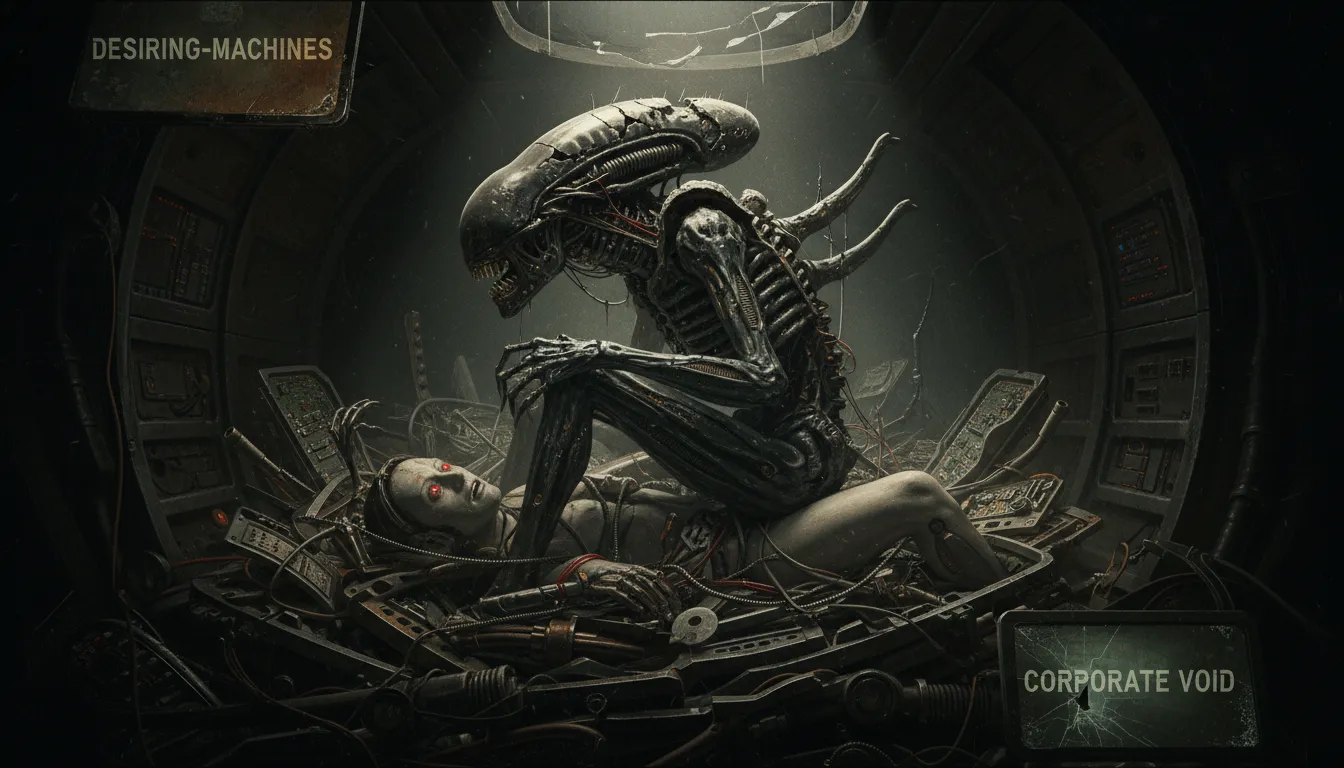
The Contract Wakes Up Before the Crew
Alien opens not with a dream, not with a face, but with a clause: a computer reading a transmission, a ship turning, a contract quietly reasserting itself. The hypersleep pods glow like unopened capsules of labor-power, each body suspended until capital has a use for it. There is no “subject” yet, only a grid of positions—warrant officer, science officer, navigator, below-deck engineers—floating in deep space until the social machine calls them back online.
The Nostromo is not a setting; it is the first monster. Its corridors do not house the plot; they literally pipe, wire, ventilate, and algorithmically route the flows that will define what counts as a decision, an accident, or a betrayal. The company’s special order 937—“priority one: insure return of organism for analysis; all other considerations secondary”—is not a villainous masterplan in the usual sense. It is simply an instruction injected into a network, a command that plugs Ash, MOTHER, and the rest of the apparatus into a new configuration where “the crew is expendable” is not cruelty but a parameter.
The film’s opening therefore displaces psychoanalysis from the start. There is no primal scene, only a boot sequence; no family romance, only a commercial contract. Lacan’s subject, barred and split by language, has not yet had time to appear, and already the machine has eaten its future.
The Nostromo as Digestive System
Everything about the Nostromo insists on digestion, not contemplation. Chains drip like saliva, steam hisses from ducts like exhalations from a sated lung, and the refinery section hauls a colossal mass of ore that the crew never sees as anything but tonnage and pay bonus. Where psychoanalysis searches for meanings, the Nostromo is concerned only with throughput and yield.
Marx’s figure of labor-power as a peculiar commodity—sold in advance, consumed in the process of generating value—finds a steel-and-rivet instantiation here. The sleeping crew are containers of latent productivity, their dreams irrelevant, their personal histories unconsulted (Marx, 1976). They are woken because a signal has been flagged as potentially valuable, not because anyone misses them.
The first meal—the joking, bickering breakfast scene—appears as a momentary reterritorialization, a small island of “family” life on the mess table. Yet even this is regulated by payroll disputes, contract arguments, and the hierarchical distribution of authority. Parker and Brett’s ongoing demand for a full share is not just comic relief; it is the continuous reminder that every affect on this ship is indexed to a wage differential.
The grotesque genius of Alien is that it will soon literalize this economic digestion in the most visceral way: the stomach as site where surplus value, in the form of an impossible new organism, erupts violently through the body that was supposed to contain and reproduce labor, not become its expendable substrate.
Facehugger: The Contract Bypasses Consent
When the landing party descends to the derelict and Kane peers into the egg, the usual symbolic cues are all present: moist, fleshy opening; curling, suggestively vaginal petals; a fog that smells, cinematically, of sex and decay. Traditional psychoanalytic and feminist readings have rightly seized on the imagery of rape, impregnation, and forced maternity. Creed’s monstrous-feminine and Mulvey’s meditations on the gaze both find abundant material in the facehugger’s assault on Kane’s open mouth, the inversion of penetrator and penetrated (Creed, 1993; Mulvey, 1989).
Yet Alien does something more disquieting than staging a “rape by the feminine.” The facehugger is not simply a phallic or vaginal symbol; it is a contract clause made flesh. It does not seduce, does not negotiate, does not even threaten in any legible way. It leaps, clamps, and reroutes the body’s respiration and circulation without passing through any register of desire-as-lack. It does not respond to Kane’s fantasies; it cancels them as a relevant category.
The quarantine dispute at the airlock clarifies this shift. Ripley enforces the rule: no one with unknown contamination comes aboard. Dallas and Lambert, panicked and compassionate, demand entry. Ash overrides the lock. The scene is often read as the triumph of human feeling over protocol, but the reverse is true: Ash’s override is the company’s hand reaching through him, the social machine subordinating all interpersonal dynamics to the higher priority of acquiring the organism (Wiener, 1948). His apparent “kindness” hides the coldest possible calculation.
If there is rape here, it is the rape of the human as such by a larger machinic assemblage. Kane’s body is not violated by an inscrutable Other so that his psyche can stage its repressed fantasies; his lungs are annexed as infrastructure for a different species’ reproduction, a process no more “symbolic” than a factory being repurposed to produce armaments instead of cars (Deleuze & Guattari, 1983). The facehugger is the moment a contractual clause, routed through a computer and a science officer, stamps itself onto flesh without asking for consent because consent is not a category at that scale.
Chestburster: Birth Without Parents
The dinner scene returns us to the table, but the earlier warmth is now overcoded by the uncanny smoothness of the medical discharge. Kane laughs, eats, jokes. The crew relaxes. The moment of terror, when he begins to choke, jerks us through several interpretive registers in seconds: is he having a seizure? Food poisoning? An allergic reaction? Then the blood appears, the chest strains, the white undershirt reddens, and something utterly alien tears through the ribcage like a tiny locomotive forced through too narrow a tunnel.
Lacanian readings tend to seize on the chestburster as the irruption of the Real, the impossible kernel that shatters the imaginary coherence of the body-image and symbolic narrative (Žižek, 1992). But this continues to center the human subject: the Real arrives as something that “happens to” a already-constituted ego, a traumatic insult to its stability.
Alien refuses that temporality. Kane was already gone. The facehugger’s biomass and the incubation that followed have reorganized the interior topology of his body. The chestburster does not violate an integral subject; it completes a process that transformed Kane into a temporary organo-industrial shell. There is no “before” and “after” trauma; there is a continuous, machinic sequence.
Deleuze and Guattari’s insistence that production does not come after desire but is desire itself finds a brutal instantiation here (Deleuze & Guattari, 1983). The chestburster is not the expression of a lack (for a lost object, a missing mother, a castrating father); it is the emission of a new series, a line of production that will rapidly scale up into a lethal predator. Kane is not a patient but a raw material that has reached the end of its utility.
Nick Land’s meditations on “biological horror” as the moment when life reveals itself as an impersonal program running through hosts resonate here (Land, 2011). The horror is not that “I” might die, but that what I took to be myself was an ephemeral configuration in a deeper, inhuman algorithm. The chestburster’s squeal and abrupt sprint out of the room is less a baby’s first cry than the confirmation that a new machinic sequence has been successfully launched.
The crew’s response betrays this. They do not rush to comfort a dying friend; they freeze, aghast at the sheer wrongness of the process. Then, almost immediately, the ship’s routines reassert themselves: track it, kill it, protect the cargo. The apparent “trauma” becomes another operational parameter.
The Xenomorph: Anti-Oedipal Predator
As the creature grows, shedding skins in the air ducts of the Nostromo, it ceases to resemble anything that could be comfortably assimilated into the symbolic lexicon of mother, father, phallus, womb. Its head is an elongated, eyeless carapace; its mouth contains another mouth; its blood is acid; its movements are simultaneously insectile, serpentine, and mechanical. It is not just “other”; it is a direct affront to the organism as organizing image of life.
Psychoanalytic tradition has tried, nevertheless, to bring it home: the alien as lamella, Lacan’s immortal, organless sheet of libido that persists beyond castration; the alien as monstrous-feminine, castrating mother, vagina dentata; the alien as embodiment of the death drive, the compulsion toward repetition and destruction (Creed, 1993; Žižek, 1992). Each of these reinsertions of the creature into the orbit of the human psyche stabilizes the horror by making it about us.
But the xenomorph never speaks, never negotiates, never seduces, never even demonstrates “hate.” It hangs in chains like an industrial residue, moves through air ducts like a current, emerges from shadows like a glitch in illumination. Its behavior is strictly functional: hunting, cocooning, reproducing. It does not gaze back, does not mirror, does not play the game of recognition.
If we call it a desiring-machine, it is only because its hunger and motion are inseparable from the technical environment around it. It uses the ducts, ladders, and hangar spaces of the Nostromo as extensions of its own body, as though the ship and the creature were co-assembling an emergent, predatory configuration (Deleuze & Guattari, 1987). It does not haunt the unconscious; it is the unconscious of this corporate–technological assemblage made temporarily visible.
The key difference from Lacan’s lamella is that nothing about the alien presupposes the subject’s castration or loss. The lamella is the leftover of the subject’s entry into language, the impossible remainder that must be domesticated by fantasy (Lacan, as interpreted in Žižek, 1992). The alien, by contrast, operates happily in a world where the subject is optional, a passing epiphenomenon, useful as food and incubation chamber, irrelevant otherwise.
To insist that the alien is “really” a figure of the phallus or the bad breast is to cling to the narcissism of the human, to imagine that even this slimy, clicking engine of slaughter must, somewhere, be “about” us.
Ash, MOTHER, and the Cybernetic Conspiracy
If any figure in Alien comes close to embodying the psychoanalytic “subject who does not know,” it is not the alien but Ash, the company-placed science officer who admires the creature’s “purity.” Yet even he explodes the psychoanalytic frame when we discover that he is an android. His body, like the alien’s, is a composite of fluids and circuits; his decapitation reveals milky secretions and jellylike membranes instead of red blood.
Donna Haraway’s cyborg—hybrid of organism and machine, collapsing distinctions between human, animal, and apparatus—finds in Ash a disquieting cousin (Haraway, 1991). He is not an emancipatory figure, but the direct emissary of corporate rationality: a node in an information network that runs from Weyland-Yutani headquarters through MOTHER to the Nostromo’s daily routines. When he overrides quarantine, secretly monitors the facehugger, and redirects the crew’s actions, he is not acting as a neurotic divided by desire and law; he is executing a program.
Norbert Wiener’s cybernetics helps here: the Nostromo is a feedback system, its sensors, computers, officers, and androids shaping and reshaping course in response to signals and priorities (Wiener, 1948). Special order 937 is a new input into this system, overriding certain thresholds (crew safety) in favor of others (acquisition of the organism). Ash’s admiration speech—“I admire its purity. A survivor, unclouded by conscience, remorse, or delusions of morality.”—is not the envy of a repressed subject but a machinic recognition of optimal functioning.
Where Freud would see in the drive a compromise between bodily excitation and psychic defense, Ash sees in the alien the eradication of compromise altogether (Freud, 1920/1955). The alien wastes no energy on guilt or anxiety. It is all vector. Ash’s failure is not ignorance but over-knowledge: he knows the calculus of the larger machine too well, and so the crew’s screams and pleas are mere noise in the system.
Responsibility becomes distributed across this cybernetic web. The company authors the directive; MOTHER encodes it; Ash enacts it; Dallas and Lambert’s compassionate override of Ripley’s quarantine enforcement becomes, retroactively, one small but crucial concession that allowed the entire sequence to proceed. No one is “evil” in the melodramatic sense; all are embedded in a machine that uses their micro-decisions to produce macro-catastrophe (Foucault, 1978). They work together without knowing it, not to “summon a demon” but to assemble a new predator.
Corridors, Air Ducts, and the Ship’s Nervous System
Formally, Ridley Scott’s film aligns its horror with the layout and materiality of the Nostromo. The long tracking shots through empty corridors at the beginning—the beeping of computers, the gentle sway of dangling chains, the hum of engines—are not neutral establishing shots. They are maps of flow.
Steven Shaviro’s claim that cinema acts directly on the body, bypassing symbolic mediation, is borne out in these sequences (Shaviro, 1993). The viewer’s muscles tense at the clank of metal, the drip of water, the sudden hiss of steam not because these signify some repressed content but because they threaten to invade the sensorium, to destabilize our own bodily boundaries. The ship feels damp, cold, hostile.
As Dallas crawls through the air ducts, guided only by Lambert’s increasingly panicked voice and the beeping of a motion tracker, the film carves a cross-section of the ship’s hidden vasculature. Here the alien is not an intruder; Dallas is. He moves through a circulatory system not designed for mammals. The ducts are too tight, the angles too abrupt. The map Lambert reads is itself inadequate, a crude overlay on a topology that the alien has already mastered.
The motion tracker, that primitive sonar, produces a crude schema of points moving in a grid, but the horror lies precisely in its mismatch with the actual space. The beeps accelerate, the dots converge, Lambert misreads proximity, and Dallas dies in a flailing blur. The machine’s model of the terrain proves fatally simplistic. The alien moves in a different geometry, one closer to Deleuze’s smooth space—continuous, unsegmented, navigated by intensities rather than coordinates (Deleuze & Guattari, 1987).
This misalignment repeats when the self-destruct sequence is initiated near the end. Sirens, flashing lights, jets of superheated steam: the ship begins to tear itself apart along its infrastructural seams. Ripley’s frantic dash to the shuttle charts this breakdown. She must pass through zones that were previously background: storage bays, engine cores, narrow ladders clogged with smoke. The environment steps forward as protagonist, the human body reduced to a small vulnerable node trying not to be crushed in the transition.
Ripley: From Functionary to Surviving Subject
Ellen Ripley’s arc is often hailed as a feminist triumph: a woman who survives not by being protected but by insisting on protocol, facing terror, and outwitting both corporate conspiracy and non-human predator. There is truth in this. Her initial enforcement of quarantine, her suspicion of Ash, her methodical work to arm herself and plan an escape all mark her as the rare figure who tries to think beyond immediate affect.
Yet from a schizoanalytic angle, Ripley’s survival is deeply ambivalent. She begins as a molar functionary: she speaks for the ship’s rules, not out of personal moralism but because they are there. She is the voice of the contract when she refuses Dallas entry with the contaminated Kane. Overruled, she does not mutiny. The ship’s hierarchy reasserts itself, and the alien enters.
As chaos escalates, Ripley gradually slips out of this position. When Ash is revealed as android, she improvises his destruction with Parker and Lambert; when Dallas and Brett are gone, she assumes command by default. Her lone walk to consult MOTHER and discover special order 937 marks a threshold. She is, for a moment, face to face with the abstraction that governs them all: company profit over human life.
But what can she do with this knowledge? She cannot reprogram MOTHER; she cannot contact the company; she cannot return the alien as requested without sacrificing herself. The only achievable line of flight is escape and ship self-destruction. The decision to blow up the Nostromo, set on a ten-minute countdown, is both an act of resistance and a final service to the company: the cargo is lost, but so is the evidence of its disastrous decision. The xenomorph is to be annihilated, the scene wiped clean.
Ripley’s escape in the Narcissus shuttle is filmed as a stripping-down: she carries only the cat, wearing only a thin undergarment as she prepares for hypersleep. It is tempting to see in this near-nakedness a return to some pre-social individuality, the “bare life” that has survived after the collapse of structures. Yet the first thing she does in the shuttle is record a log entry, dutifully narrating events for a corporate or bureaucratic ear that may never hear them. Even alone, she speaks as employee, as witness.
Moreover, her final confrontation with the stowaway alien in the shuttle recodes their relation into an almost classical subject–object duel. She observes its sleeping form in the machinery, quietly straps herself into a seat, arms herself with a harpoon gun, and opens the airlock. The alien is pushed back into pure exteriority, jettisoned into space with the final blast from the engine. Subject and object are re-separated. The non-human machinic continuum that had threatened to dissolve her status is temporarily closed.
Adrian Johnston’s analysis of Žižek’s transcendental materialism—the insistence that the subject is a necessary structural feature of reality, not an illusion—echoes, inadvertently, in the film’s privileging of Ripley’s perspective as the ultimate horizon (Johnston, 2008). To cheer for her survival is to cheer for the restoration of a minimal subject-position capable of saying “I,” even if everything around it reveals that “I” is dangling on the edge of systems it cannot master.
The Xenomorph as Capital’s Unconscious
Seen in the wide shot, Alien diagrams a terrifyingly coherent social machine. The company seeks a new bio-weapon or research specimen; MOTHER and Ash implement this goal; the crew, motivated by pay and duty, provide the bodies; the alien provides the lethal novelty, the “product.” On one level, the organism is simply another commodity to be acquired and shipped. On another, it is the very logic of capital metastasized into biological form.
Marx writes of capital as a vampire that lives only by sucking living labor, preserving itself by consuming the worker (Marx, 1976). The xenomorph is a more advanced parasite: it not only drains but structurally repurposes its host, leaving behind only bone and gristle. It respects no organismic integrity. Any warm body is potential fuel for its life cycle.
Nick Land pushes this even further, arguing that capital is not a human institution but an alien intelligence, an inhuman drive toward ever-accelerating complexity and consumption (Land, 2011). The alien in Alien can be read as the cinematic concretization of this thesis: it is capital as insectile predator, uninterested in meaning, loyalty, or even long-term sustainability. It reproduces until its environment is exhausted, then moves on—if it can.
Yet there is an important divergence. Whereas capital seeks to maintain the workforce at a minimal level to keep valorization going, the alien has no such prudence. Left unchecked, it would kill every crew member, leaving no one to steer the ship, interpret data, or send reports. It is capital’s death drive without its self-preservation instinct. In this sense, it is capital’s unconscious: the part of the machine that does not know it depends on what it consumes.
The company’s attempt to capture and study the organism is thus doubly suicidal. It seeks to integrate into its arsenal a form of predation that cannot be tamed. The alien exposes the limit of instrumental rationality: some machines, once plugged into your system, rewire the whole network in ways you cannot anticipate or control. The very desire to weaponize every difference becomes the path to self-destruction.
Against the Phallic Ghost: Beyond the Lamella
Slavoj Žižek’s invocation of Lacan’s lamella—the indestructible life-substance beyond symbolization—as a key to understanding the alien has been influential. The lamella as a skin of libido that survives castration, pure drive indifferent to law or meaning, seems at first glance to match the creature’s relentless survival (Žižek, 1992). But the comparison is ultimately conservative. The lamella is parasitic on the structure of lack; it is the remnant of a subject constituted by loss.
Alien’s xenomorph does not mourn any loss. It does not “survive castration” because it was never integrated into the symbolic order where castration has sense. To read it as lamella is to treat it as a symptom of human neurosis, a bad dream of immortality that haunts the subject. This keeps the subject at the center: the alien is “my” fear, “my” drive, “my” confrontation with the Real.
Badiou’s notion of the event as something that interrupts a situation and demands a new fidelity offers a different angle (Badiou, 2007). The arrival of the alien on the Nostromo is an event in this sense: it shatters the crew’s habitual coordinates and forces new decisions. Yet there is no emancipatory truth that emerges, no collective subject faithful to a new possibility. The only fidelity the company seeks is to the bring back the organism.
The schizoanalytic wager is to allow the alien to remain inhuman, to resist the reflex to pull it back into the orbit of our losses and traumas. Deleuze and Guattari’s suspicion of universals grounded in lack is vindicated here: any attempt to read the xenomorph as symbol of “our” castration, “our” death drive, “our” maternal anxiety merely recenters the Oedipal triangle at the very moment the film has shown its obsolescence (Deleuze & Guattari, 1983).
Ripley’s final lullaby to the cat as she drifts into hypersleep (“We should be there in about six weeks… with a little luck.”) is comforting precisely because it restores the voice of the subject soothing itself. The alien has been expelled; the nightmare is over; we can resume dreaming. But the machinic unconscious that produced both the Nostromo and the xenomorph has not gone anywhere. It persists in the company’s archives, in the trajectories of future missions, in the very structure of a galaxy crisscrossed by shipping lanes and automated directives.
Alien’s deepest terror, then, is not the toothy monster in the air duct. It is the realization that the most frightening thing about the universe is not that there are creatures who want to kill us, but that there are machines—economic, biological, cybernetic—that do not care whether we exist. The film stages, in the viscera of its characters and the steel of its sets, the encounter between a waning psychoanalytic civilization anchored in subject, family, and lack, and an ascendant machinic civilization for which we are only so much cargo, or carcass.
References
Badiou, A. (2007). The century (A. Toscano, Trans.). Polity Press.
Creed, B. (1993). The monstrous-feminine: Film, feminism, psychoanalysis. Routledge.
Deleuze, G., & Guattari, F. (1983). Anti-Oedipus: Capitalism and schizophrenia (R. Hurley, M. Seem, & H. R. Lane, Trans.). University of Minnesota Press.
Deleuze, G., & Guattari, F. (1987). A thousand plateaus: Capitalism and schizophrenia (B. Massumi, Trans.). University of Minnesota Press.
Foucault, M. (1978). The history of sexuality, Volume 1: An introduction (R. Hurley, Trans.). Pantheon Books.
Freud, S. (1955). Beyond the pleasure principle (J. Strachey, Trans.). In J. Strachey (Ed.)
Comments
Post a Comment