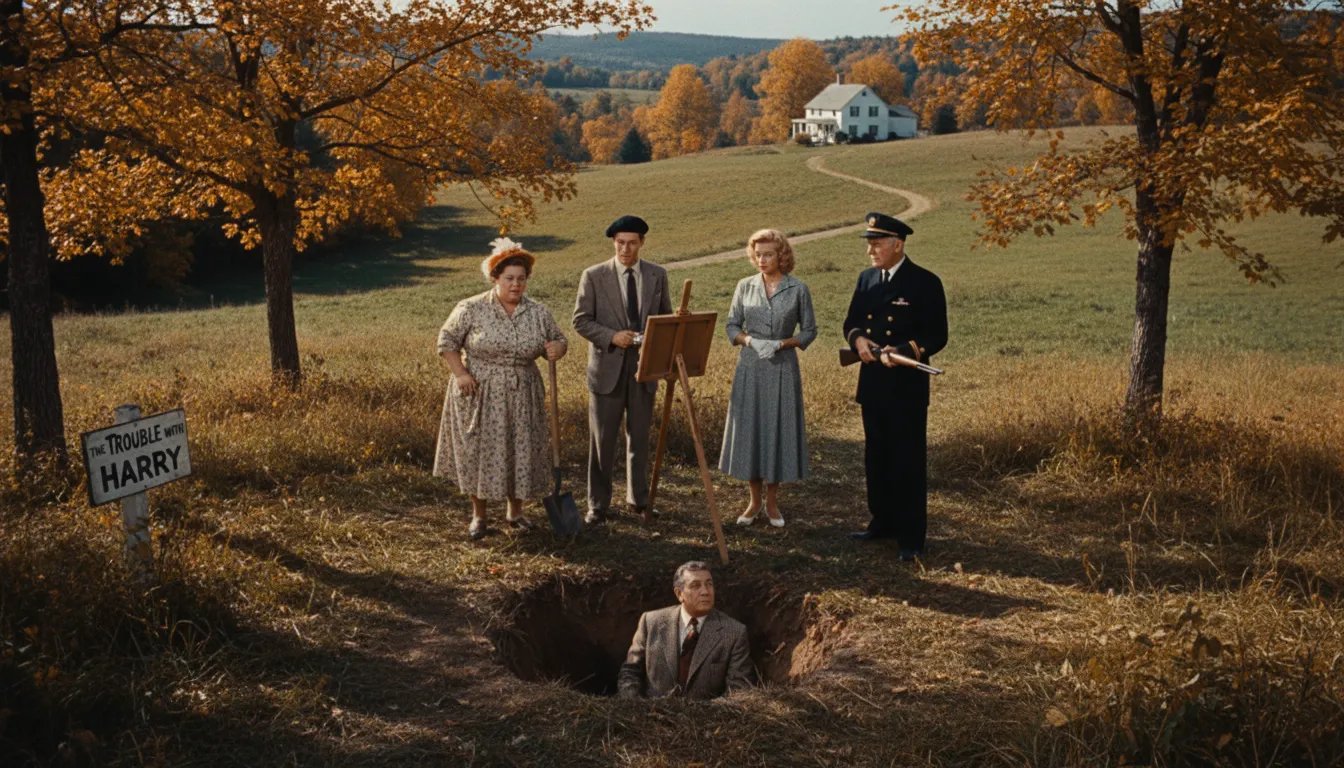
That a dead man in an autumn meadow could be the happiest thing that ever happens to a New England village is the scandal around which The Trouble with Harry quietly reorganizes the entire cartography of desire.
Beneath the cheerful Technicolor leaves, the film installs a corpse that refuses to function as trauma, sin, or moral anchor; instead, it becomes a relay, a hinge, a low-voltage generator that re-wires an isolated community into a clandestine collective. The dead Harry is not the return of repressed guilt; he is the diagram of a different social machine, a pastoral experiment in how bodies can be used otherwise than as bearers of conscience or property. The Vermont hillside becomes the nearest thing classical Hollywood ever gave to a gleefully improvised Body‑without‑Organs: a soft, leaf-strewn plane where procedures of law, mourning, and heterosexual propriety are continually plugged in, short-circuited, and rearranged.
The film’s tonal “lightness” has often perplexed commentators, who either treat it as a minor, whimsical deviation in Alfred Hitchcock’s oeuvre, or as a sly exercise in black comedy that drains the corpse of serious significance (Modleski, 1988). Yet the calm with which characters discover, manipulate, and repeatedly rebury Harry’s body does not so much trivialize death as relocate the site of seriousness away from the moralized individual psyche and into the circuitry of collective practices. What matters is not what Harry means—why he died, who really killed him—but how Harry is used: as an object to be dressed, transported, exchanged for groceries, covered, uncovered, and folded into the rhythms of the town’s life. Desire here is technical and pragmatic, not hermeneutic, and the corpse becomes the testing ground for a cinema that refuses to ask what lies “behind” the image, preferring to explore what can be done with a body.
In this sense, the film mounts a quiet but radical refusal of the Lacanian logic that still dominates much Hitchcock commentary, in which the corpse is the sublime object that anchors the lack structuring the symbolic order (Žižek, 1992). Harry does not mark a void; he marks a surplus, a gratuitous extra piece that no code quite knows how to absorb, and which therefore provokes a continuous improvisation of new couplings. Anxiety, when it appears, is never about the loss of a loved one; it is about the possible reterritorialization of this playful machine by the Law—by sheriffs, coroners, or any apparatus capable of turning the corpse back into a case. The “trouble” with Harry is precisely that he inaugurates too many possibilities.
I. Pastoral Surface, Subterranean Machine
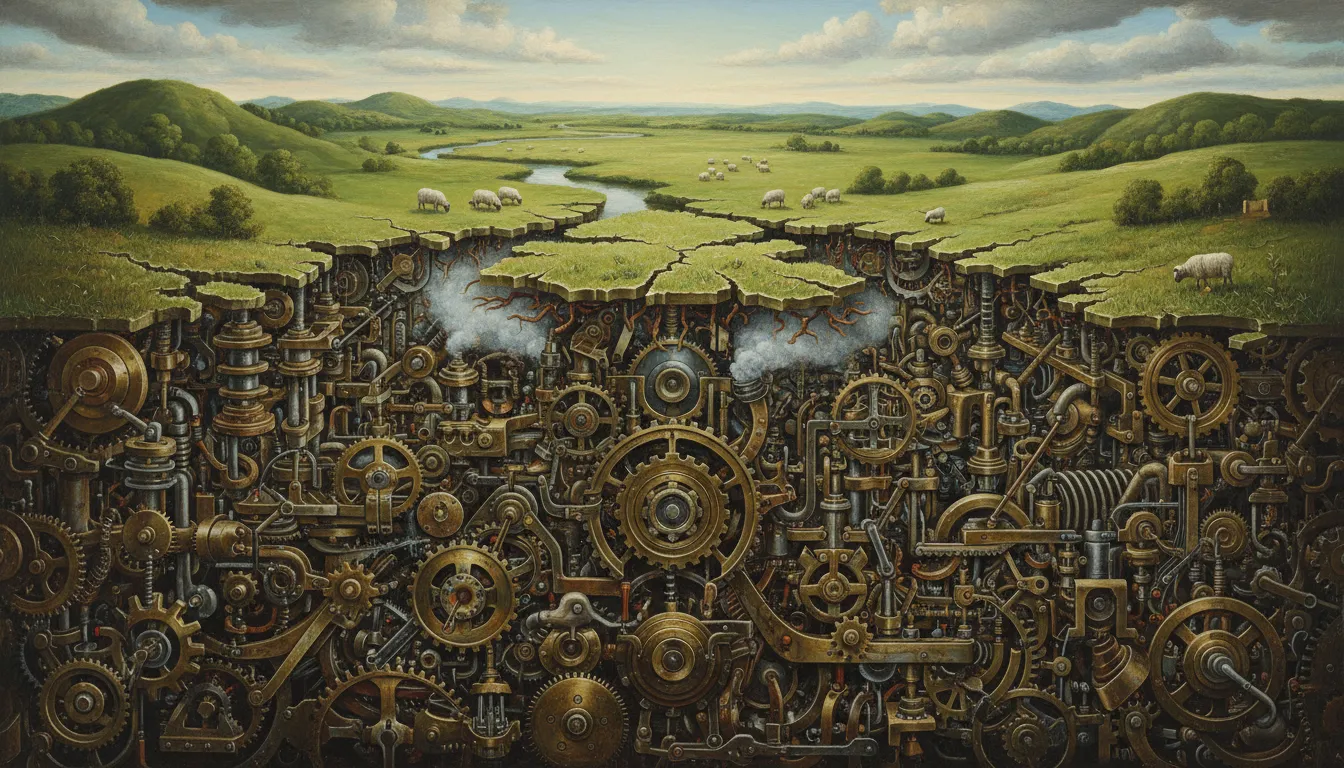
The film opens on a textbook pastoral: a child chasing a rabbit through a riot of autumn colors, the landscape washed in saturated Technicolor, the soundtrack soft and whimsical. Suspense is suspended; there is no stalking camera, no looming menace. The meadow appears as a self-contained idyll, a closed territory framed by the hills and trees. Yet the first appearance of Harry’s body—feet poking from under bushes, shoes neat, as if still poised for a polite stroll—introduces a fissure in this idyll that is not yet moral but strictly spatial and functional. The body is slightly out of place, an object that interrupts the smooth continuity of the slope like a stone lodged in the flow of a stream.
The camera’s relation to Harry is telling. It does not rush in for a shocked close‑up of the face, but slides around, lingers on the shoes, the hands, the awkward angle. The gaze is non-organic, apathetic, curious in the way a geological survey might be curious about a new rock formation. Rather than a subject identifying with another subject, the image arranges partial objects: soles, trousers, leaves, soil, a child’s gaze, a rabbit’s errant trajectory. The hillside becomes a surface onto which these fragments are laid out, tested for compatibility. The pastoral is not a mythic outside of modernity, but a soft stratum in which new couplings can be rehearsed with low risk, like a studio where the stakes have been temporarily suspended.
The whole mise-en-scène works as a low-intensity desiring-machine. The bright colors soften any sense of crime; the music refuses suspense; the smallness of the community dissolves the usual distinction between private and public. Every passerby who encounters the corpse does so in an almost experimental key: What can be done with this? Hide it? Confess it? Sell it? Paint it? Fall in love around it? Each answer opens a new circuit. The film’s notorious calm is not indifference; it is the serenity of an apparatus exploring its own capacities without yet being captured by the high-voltage codes of tragedy or melodrama.
II. The Corpse as Improvised Body‑without‑Organs
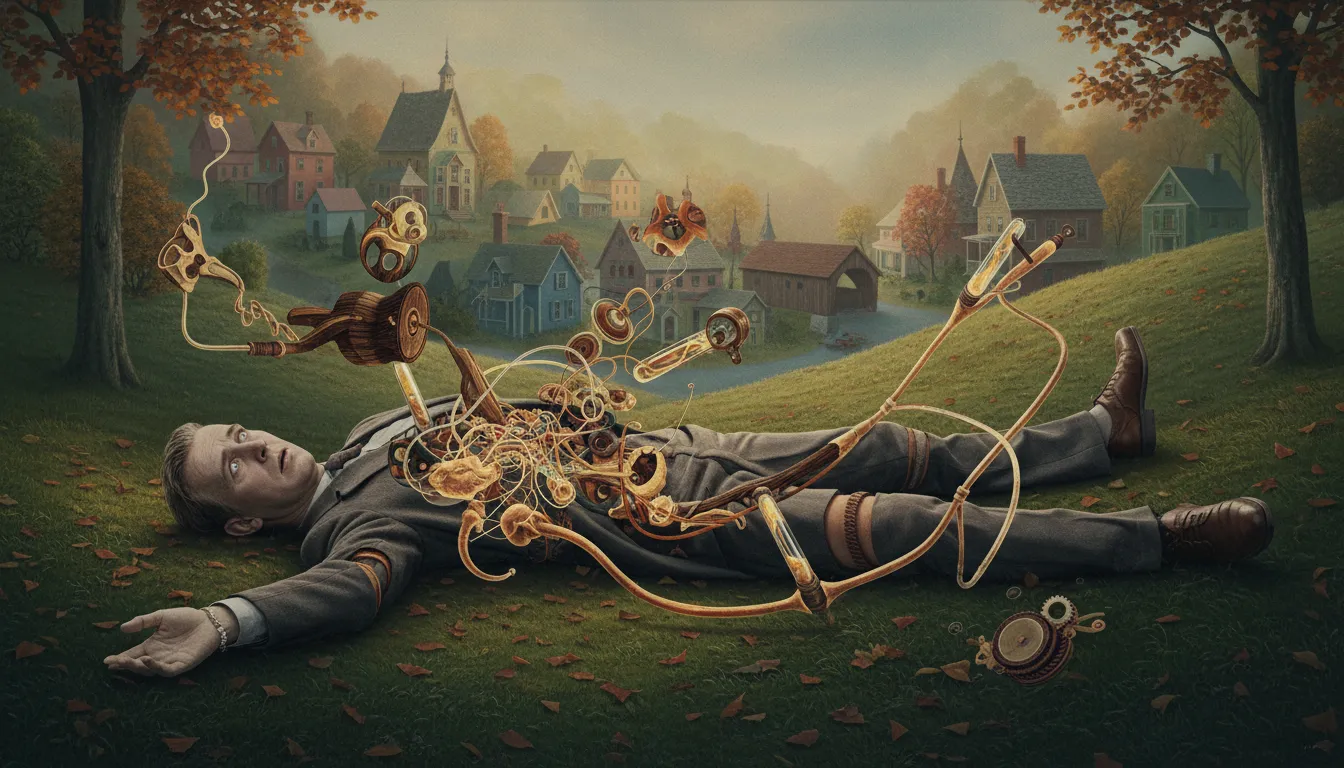
Harry is never a character; he is a layout. He has no dialogue, no flashbacks, no subjectivity; even the backstory of his marriage functions mostly as a pretext for Jennifer Rogers’ wry liberation. Instead, the film dwells obsessively on his physical arrangement: how his limbs are posed when first found, how he looks in different clothes, how heavy he is to carry, how he should be positioned in his various graves. Harry is successively stripped of biography, intention, psychological depth; what remains is the bare fact of a body around which other bodies reorganize themselves.
This stripped body functions as an improvised Body‑without‑Organs, not in any mystical sense, but as a plane that draws to itself all the anxieties, projects, and attractions of the town, only to redistribute them as new flows. Each character encounters Harry as a problem of use, not of meaning. Sam Marlowe sees in him an opportunity: the scandal of the corpse becomes material for his art, a chance to translate the town’s secret into a modernist portrait of Jennifer that will be exchanged for goods. Miss Gravely reads the body through her own narrative, convinced she has killed him with a blow from her hiking shoe, and thereby discovers a hitherto dormant capacity for passionate engagement. Captain Wiles initially believes he has accidentally shot Harry while hunting, turning the corpse into evidence of his own incompetence and a spur to frantic concealment.
The key is that Harry is never finally allocated to any one of these stories; the corpse does not belong to a single signifying chain. It is claimed and reclaimed, dressed and undressed, buried and exhumed, each time producing a different social configuration. Where Oedipal narrative would pin the body to a single murderer, a single guilty secret, here the “who killed him?” question evaporates into a collaborative multiplicity. Across the film, several characters believe at different moments that they are responsible for Harry’s death, and each such belief rearranges their relations; guilt is not a stable property but a mobile operator, passing from node to node, reconfiguring alliances. Responsibility becomes a shared hallucination that paradoxically frees them: in learning to shoulder a crime together, they discover a capacity for collective action otherwise denied them by their polite isolation.
The Vermont hillside thus approximates a low-stakes BwO assembled on the fly: a patch of ground where the usual organization of bodies by family, property, and law is temporarily flattened, allowing new transversal links to be drawn across age, class, and gender. Harry’s corpse is the catalyst that stops the small-town organism from functioning in its usual rigid manner; it jams the gears, forcing the parts to redistribute themselves in novel patterns. The problem is not to restore order, but to keep this experimental plane from being overcoded by official procedures.
III. Repetition as Refrain: Burying, Unburying, Re‑arranging
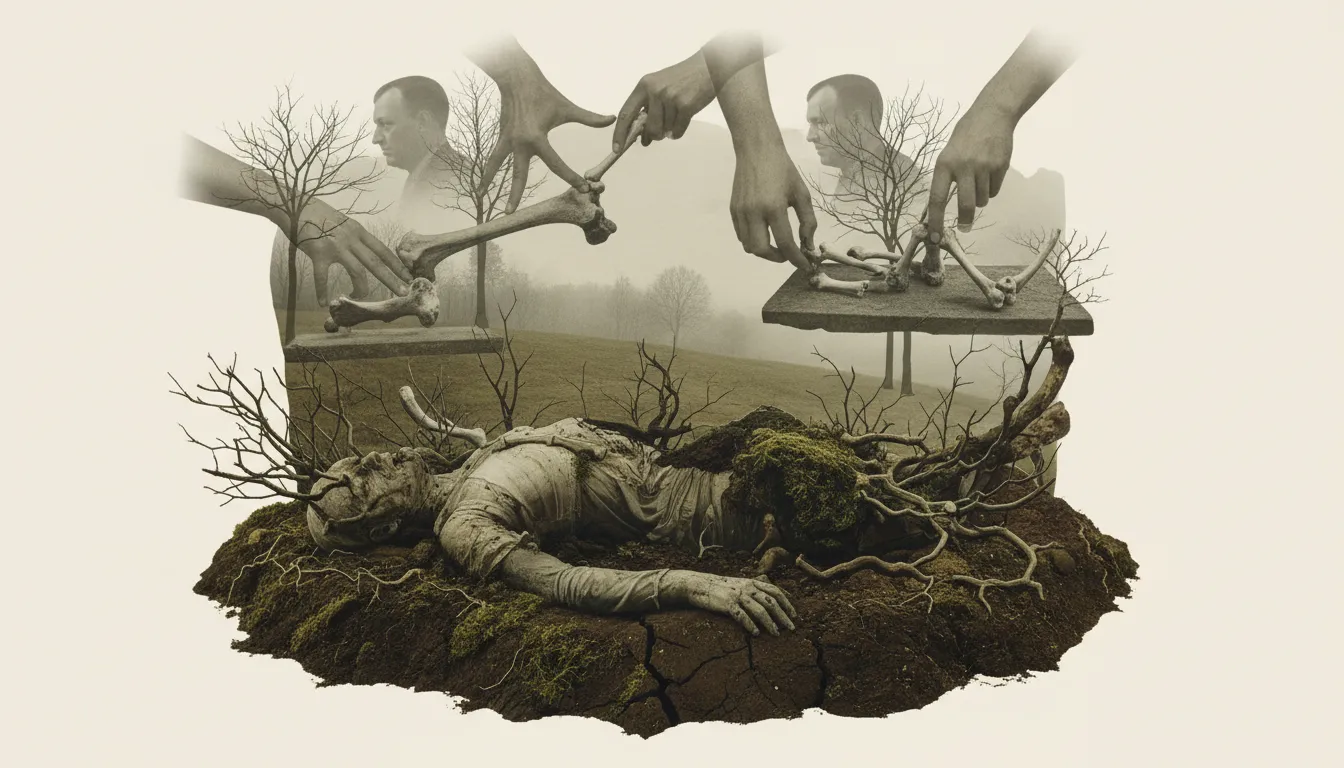
The central structural gag of The Trouble with Harry—repeated burying and exhuming of the same corpse—could easily have been mere farce. But the serial rhythm with which the characters dig, cover, reopen, and relocate the grave gradually takes on the qualities of a refrain. The hill itself bears the marks of these operations: disturbed earth, rearranged leaves, footprints and trails. Each iteration is slightly different in motive and composition of participants: sometimes it is Captain Wiles and Sam, sometimes Miss Gravely, sometimes Jennifer is present. The group is never exactly the same, yet the operation is recognizably “the same” act.
This refrain does not enclose the group; it opens their world. With each burial, they risk a little more, trusting that secrecy can be maintained, that the sheriff can be outwitted, that they can collectively manage the logistics of hiding a dead man in broad daylight. With each exhumation, they reexpose themselves to potential discovery, but also reassert their creative sovereignty over Harry’s body. They are rehearsing their own capacity to manage life and death outside institutional protocols.
The refrain also functions as a temporal machine. Classical narrative would move inexorably toward the revelation of the truth and the definitive disposal of the corpse, coding time as progress toward resolution. Here, time is gently folded back on itself; the same afternoon seems to loop, and even as daylight wanes the world does not darken into noir but softens into a cooler palette that continues to hold the group in a luminous bubble. The editing underscores this soft loop: calm, evenly paced cuts, little suspenseful crosscutting, an almost languid confidence that the rhythm of bury–unbury can keep repeating without escalation. Time is not leading anywhere; it thickens around the corpse in a series of variations.
This temporal loop is inseparable from the film’s ethical experimentation. Each repetition slightly redistributes responsibility: who suggested this burial? Who dug? Who watched for passersby? Each micro-decision aggregates into a collective authorship of Harry’s fate. Instead of a single decisive act of killing, the film presents a series of small decisions—tell the sheriff or not, move the body now or later, alter his clothing—that collectively amount to a quiet secession from the State’s monopoly on death and its documentation. Law is not openly defied; it is silently outmaneuvered through repeated micro-adjustments.
IV. The Sheriff as Mini‑State and the Micro‑Fascisms of Conscience
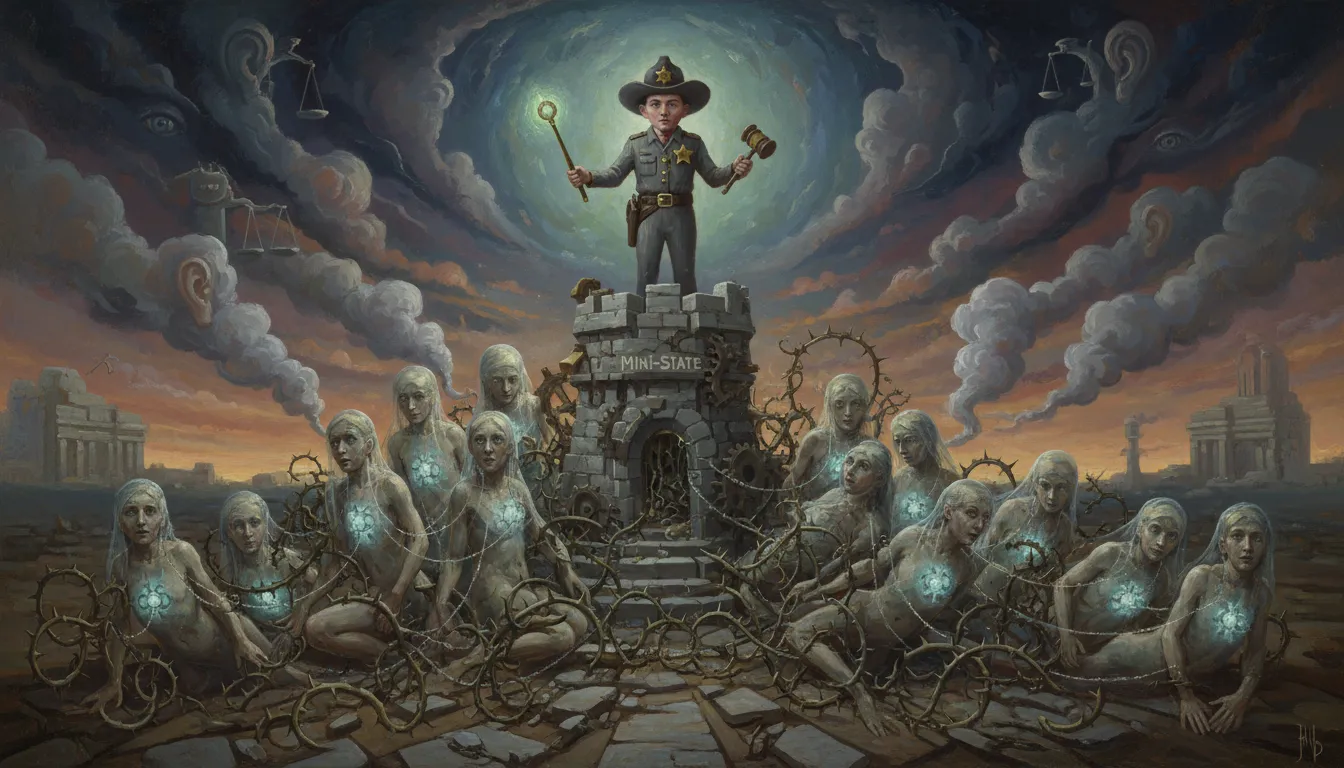
If Harry’s body functions as a low‑intensity BwO, the sheriff represents the ever-present possibility of its reterritorialization. He is not an especially menacing figure; indeed, his bumbling good nature is played for gentle comedy. Yet his very friendliness, his habit of popping up at inopportune moments, embodies the way in which the State-form today no longer needs overt violence to secure obedience. The sheriff’s gaze is the administrative eye that threatens to convert the town’s joyous complicity into a dossier, a case file, an official narrative.
What the characters dread is not prison in the abstract, but the loss of their improvised machine: once the law takes Harry, the corpse will be transformed into evidence, a cause of death will be assigned, the messy assemblage of shared misbeliefs will be cleaned up into a coherent story. The law’s power lies in its ability to retrospectively impose causality and assign responsibility in a molar fashion—this person killed him, at this time, for this reason—thereby dissolving the more diffuse, collective authorship that actually characterizes the film’s events.
At the same time, the sheriff is doubled by an internalized micro‑fascism in each character’s conscience. Captain Wiles’ desperate attempts to confess, his almost eager desire to be told he is guilty and must pay, reveal the degree to which the Law has already colonized his self-image. He craves punishment as a way to stabilize his errant desire, to give it a clear outline. Likewise, Miss Gravely’s immediate leap to the conclusion that she has killed Harry with her walking stick allows her to insert herself into a familiar melodramatic script: the spinster as tragic accidental killer. In both cases, the fantasy of guilt provides a ready-made identity, a safe position from which to relate to others.
Yet the collective handling of the corpse gradually erodes the hold of these micro‑fascist impulses. Each time they successfully evade the sheriff’s questions, each time they manage to alter appearances just enough to keep Harry inconspicuous, they discover capacities for tactical deception and mutual cover that exceed the internalized demand to confess. The film does not celebrate deception for its own sake; rather, it stages how small acts of not‑saying, of strategic silence and misdirection, can be ethically productive when they sustain a fragile line of flight away from institutions that would overcode desire. The trouble with conscience is that it is too ready to collaborate with power; the trouble with Harry is that he gives everyone a reason to hesitate before surrendering to that collaboration.
V. Desire, Sex, and the Pastoral Commune
Around Harry’s body, two heterosexual couples form: Sam with Miss Gravely, Jennifer with Captain Wiles. Superficially, this might look like a textbook restoration of normative order: the narrative ends with romantic pairings, suggesting that the corpse has merely functioned as a catalyst to slot people back into recognizable positions. But the way these couplings emerge, and the peculiar alliances they entail, suggests something far less stable.
Sam and Miss Gravely’s courtship is mediated entirely through the conspiracy; their first real intimacies are about the logistics of burial and the distribution of responsibilities. Their affection grows not from a private exchange of confidences, but from a shared willingness to handle the corpse, to lie smoothly, to improvise stories together. Desire here is inseparable from technical collaboration, from the pleasure of successfully running a small but risky operation. Eroticism is displaced from bedroom to hillside, from confession to co‑crafting a lie. The pastoral landscape is the bed on which this new form of intimacy is tested.
Jennifer’s bond with Captain Wiles is even stranger. As Harry’s estranged wife, she is the character who, in a more conventional film, would be the locus of melodrama: grief, resentment, the exposure of long-suppressed marital secrets. Instead, her reaction to Harry’s death is cool, almost relieved; she treats him as an inconvenient leftover bureaucratic tie to be quietly annulled. Her flirtatious sparring with the captain is framed less as a widow’s second chance than as two accomplices recognizing in each other a compatible cynicism about social norms. The captain’s supposed killing of Harry becomes almost a dowry: he has unwittingly cleared the ground for a new form of life.
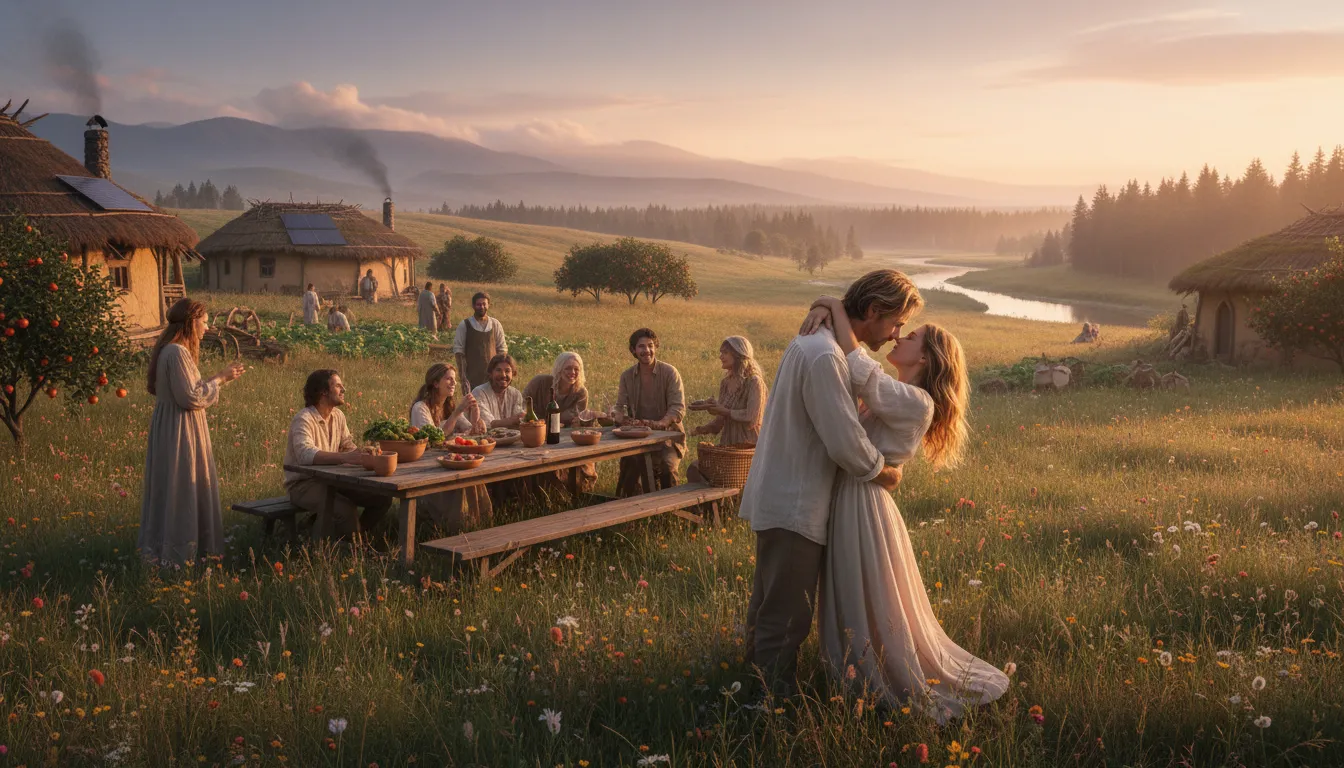
What emerges by the film’s end is not a simple restoration of the nuclear family, but something closer to a small pastoral commune. Sam moves into Jennifer’s house to finish the portrait; Miss Gravely brings preserves; the captain hovers on the threshold. The child, Arnie, already comfortable with the corpse, is folded into this new domestic rhizome not as an object to be protected from knowledge, but as an active participant who has seen more than any adult suspects. The household is bound together less by law or blood than by shared secrets, shared labour on the hillside, and shared refusal of the sheriff’s narrative.
This is why the film feels so oddly joyful: death has not been denied, but it has been stripped of its monopoly over seriousness, redistributed across a set of practices that include art, flirtation, gardening, and minor criminality. The pastoral setting is not a return to nature; it is the emergence of a tiny, contingent collective that discovers, around a corpse, that it can self-organize without waiting for permission from church, court, or clinic.
VI. Art as Deterritorialization: Sam’s Paintings and the Economy of Secrecy

Sam Marlowe, the local painter, is the character closest to the film’s own desiring eye. His paintings, scattered through the narrative, are not just eccentric props; they are the visible trace of a deterritorialization already underway before Harry’s arrival. Sam paints in a modernist, semi‑abstract style, producing works that the local shopkeeper finds unsellable until they are recontextualized as commodities desired by a nearby millionaire. The film quietly connects Harry’s corpse to this aesthetic economy: Sam’s promise to paint Jennifer in exchange for money and goods reorganizes the entire chain of value in the town.
Harry’s body is never painted directly, yet he haunts the portrait as its enabling condition. Without the conspiracy, Sam would not have the intimate access to Jennifer that allows him to see and depict her anew; without the impending risk of discovery, he would not have the leverage to negotiate with the storekeeper and the out‑of‑town buyers. The corpse thus indirectly finances a shift from subsistence to a modest artistic marketplace, where desire for images can circulate as currency. This is not simply an allegory of commodification, however.
The key is that Sam’s art is inseparable from secrecy. The portrait of Jennifer is not just a representation; it is a coded document of the conspiracy, a way of capturing the newly emerging subjectivity that Harry’s death has allowed her to assume. The canvas is a membrane between the private knowledge of the group and the public world of commerce. Selling the painting spreads the effects of the secret without revealing it: the millionaire buys an image of a woman unknowingly constituted by complicity in covering up a death. The town’s economy is thus lubricated by the invisible flow of a crime that has been carefully not‑reported.
Art here is not a noble transcendence of sordid events, but a technical means of sending a tremor through the broader capitalist system from the shelter of a small pastoral enclave. A single portrait, produced under the sign of a corpse, becomes the vector by which the group’s newfound autonomy begins to interface the market on its own terms. The deterritorialization is partial and reversible—Sam remains dependent on the buyer’s whims—but it marks a shift from passive integration into a larger economy to active modulation of it. The aesthetic machine and the corpse machine interlock.
VII. Cinematic Perception: The Meadow as Non‑Human Eye

Formally, The Trouble with Harry advances another line of flight: away from the tightly motivated suspense mechanics that define much of Hitchcock’s work and toward a cinema of “pure optical situations” where action no longer automatically follows perception (Deleuze, 1985). Characters frequently stand around Harry’s body with nothing urgent to do, discussing, reflecting, mulling over possibilities. The camera lingers on their faces, their small gestures, the way they step over the corpse as they move through the frame.
These intervals, in which nothing strictly necessary to the plot happens, detach perception from immediate response. The meadow becomes a space of contemplation not in the spiritual sense but in the machinic sense: an image-loop where the system idles, testing patterns, shuffling potential moves without yet committing. The dead body, lying inert, is the literal embodiment of suspended action; the living figures orbit it like satellites in search of a stable trajectory.
The result is a gentle crisis of the action-image. Traditional cause‑and‑effect loses its urgency; the narrative proceeds, but as if distracted, more interested in exploring the capacities of the small assemblage than in reaching a climactic resolution. The final “solution”—that Harry died of natural causes and no one is to blame—lands almost as an afterthought, confirming what the film’s form has long since suggested: the whodunnit was never the point.
Instead, the camera’s patient gaze on the corpse and its manipulators foregrounds the non-human dimensions of perception. The hillside is photographed as if it too were watching, registering the repeated disturbances of its surface, the impressions of shovels and boots. Trees and clouds silently witness the group’s operations, indifferent yet enfolded in the same image. The film’s visual style thus resonates with its thematic experiment: both tend toward a decentering of the human subject, a redistribution of attention across bodies, tools, soil, and sky. The pastoral is no longer a backdrop; it is a participant in the circuit of desiring-production.
VIII. Distributed Responsibility and the Refusal of Innocence
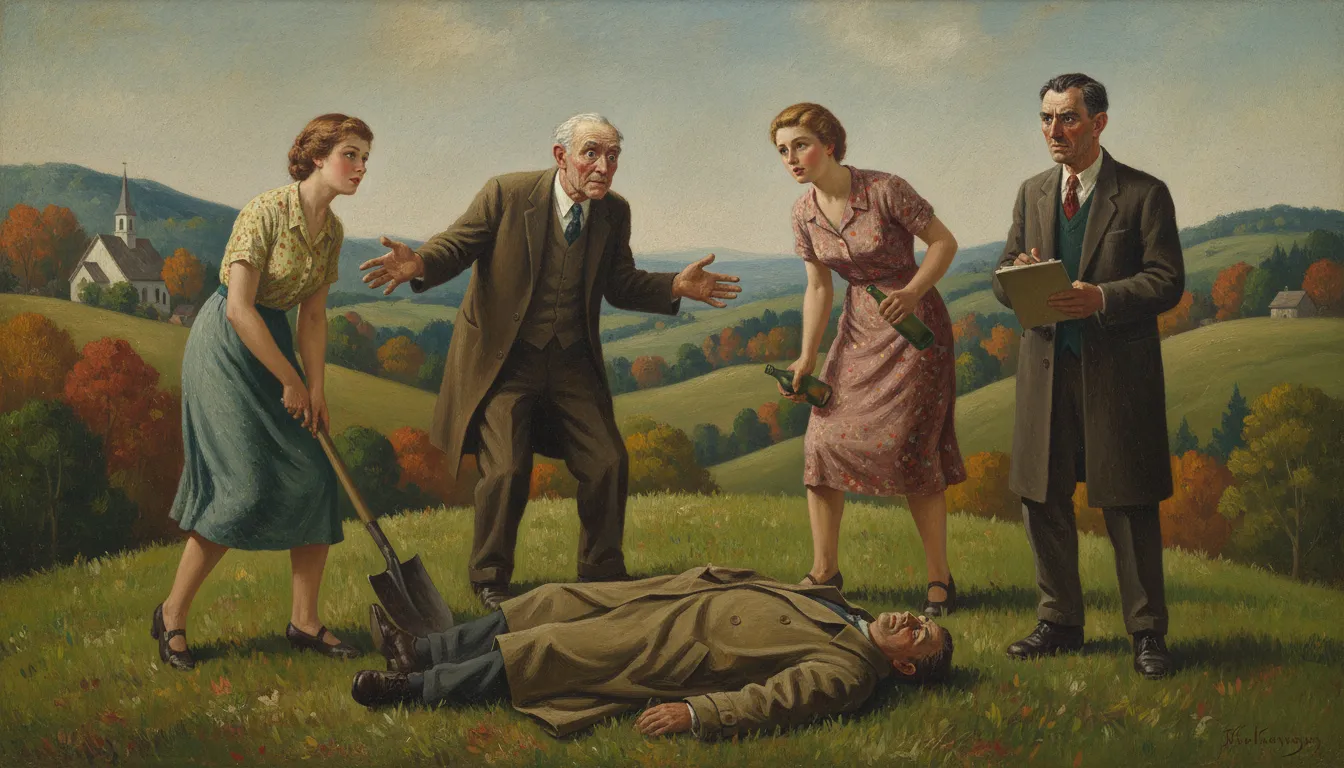
One of the film’s most disquieting achievements is the way it dissolves the very category of innocence without sinking into cynicism. No character can plausibly claim to be untouched by Harry’s fate: each has at some point believed themselves his killer, each has handled the body, each has lied about it. The child has seen him first and said nothing; the storekeeper has inadvertently supported the conspiracy by participating in the new circuits of exchange; the doctor misrecognizes the cause of death; the sheriff fails to connect the visible traces of disturbance on the hillside to any legal claim.
Responsibility is not located at a single point but emerges from the interaction of dispersed, often banal acts: a decision not to mention something, a willingness to dig, an eagerness to sell a painting, a lazy medical examination, a sheriff’s distracted questioning. Evil, if that word applies, is not an eruption of monstrous will but an almost casual co‑production of a community that has quietly decided it can manage a death better than the State can. Yet the film refuses to condemn this decision.
Instead, it insists that in a world where institutions harness guilt to maintain their own power, the refusal of innocence is a necessary step toward any politics of freedom. Innocence is the flip side of a system that demands confession: only those who position themselves outside all complicity can be interpellated as pure victims or pure perpetrators. The joy of The Trouble with Harry lies precisely in the abandonment of that posture. Everyone is “guilty” in small ways; therefore no one can be isolated as the sacrificial culprit whose punishment would restore order.
The “happy ending” is therefore not a return to moral equilibrium, but the stabilization of a new kind of collective subject that has learned to live with the knowledge of its own involvements. The convivial gathering at the end—the small household assembled around Jennifer’s table—does not wash away the past; it quietly shares it as a condition of shared life. Harry’s corpse, though removed from the hill, remains as an invisible bond, a negative presence that keeps the group together precisely because it can never be legally or publicly acknowledged.
IX. The Pastoral BwO and the Death of the Human Figure
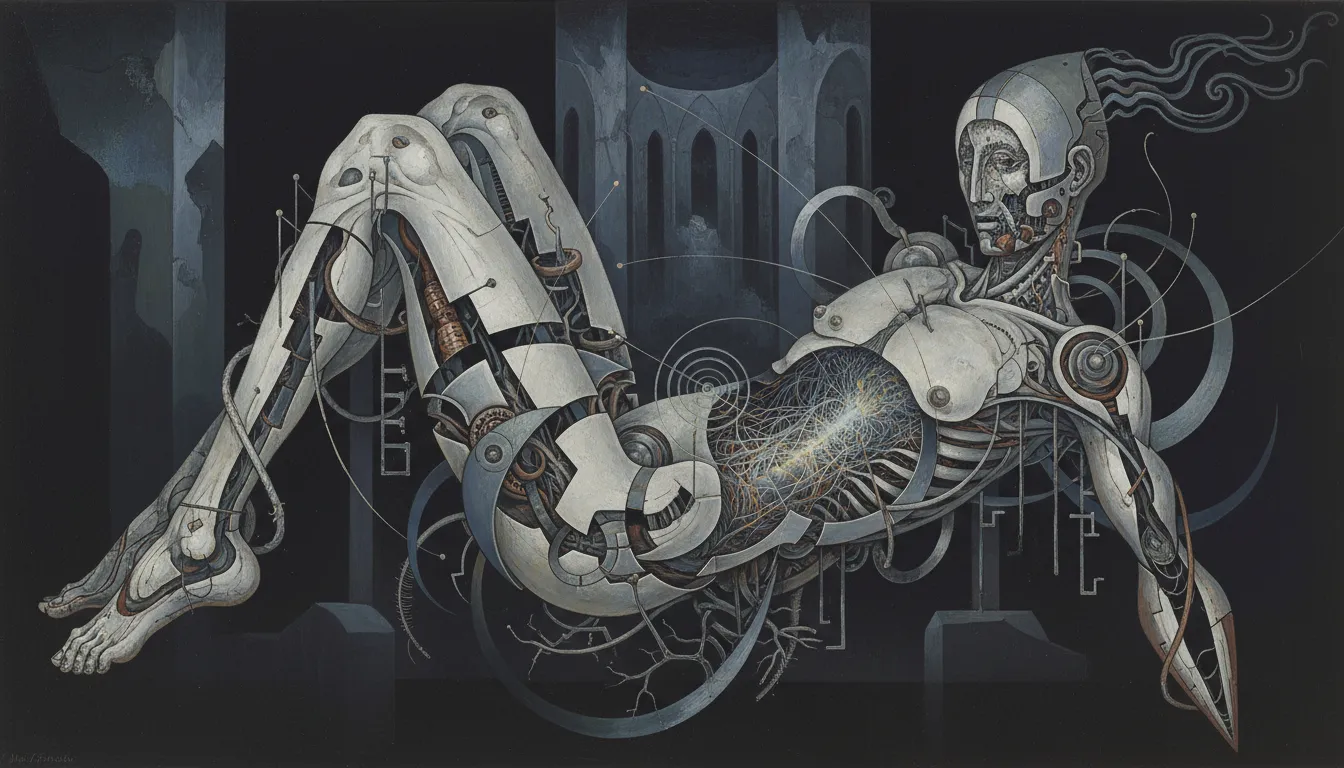
By treating the human corpse as one object among others in a landscape, The Trouble with Harry flirts with a post‑humanist sensibility unusual for Hollywood in 1955. Harry is never framed as a singular, irreplaceable person; his face, when shown, is a mask among masks, no more or less expressive than the pumpkins, trees, or household items that fill Hitchcock’s carefully composed frames. The flattening of affect around his death—no grief, no tears, no solemn funerals—repositions the human figure in a continuum of material processes. Bodies die, leaves fall, shovels dig, paintings circulate, lovers meet; none of these events is ontologically privileged.
This is not a nihilistic devaluation of human life; rather, it is an opening toward a different ethics, one in which what matters is not the sanctity of the individual organism but the quality of the assemblages it sustains or disrupts. Harry, as an individual, may be unloved and even resented, yet his corpse, as an object around which a new community forms, becomes oddly precious. The film values not the life that preceded the death, but the lines of flight that the dead body makes possible.
The Vermont hill, by the end, is a worked surface, a gently scarred BwO bearing the marks of a brief but intense experiment in living otherwise. The leaves will eventually fall again, covering the traces; snow will erase the outlines of the disturbed earth. Yet the memory of what was done there persists in the small commune that has withdrawn, for now, into Jennifer’s house. The pastoral BwO is not a permanent utopia; it is a temporary clearing in the forest of institutions, a fragile plateau that may in time be reabsorbed into the State’s cartography. But for the duration of the film, it holds.
In that holding, The Trouble with Harry quietly rewrites the coordinates of Hitchcockian cinema. Suspense gives way to curiosity, guilt to shared complicity, death to a minor festival of reorganized relations. The corpse is no longer the anchor of a paranoid symbolic order; it is the hinge of a local, joyful schizo‑collective. Around Harry, a rhizome sprouts in the least likely of soils—a 1950s American village—and for ninety minutes, the world becomes, under the smiling mask of comedy, the rehearsal ground for a different way of being together with our dead.
References
Copjec, J. (1994). Read my desire: Lacan against the historicists. MIT Press.
Deleuze, G. (1985). Cinema 2: The time-image (H. Tomlinson & R. Galeta, Trans.). University of Minnesota Press.
Deleuze, G., & Guattari, F. (1983). Anti-Oedipus: Capitalism and schizophrenia (R. Hurley, M. Seem, & H. R. Lane, Trans.). University of Minnesota Press.
Deleuze, G., & Guattari, F. (1987). A thousand plateaus: Capitalism and schizophrenia (B. Massumi, Trans.). University of Minnesota Press.
Modleski, T. (1988). The women who knew too much: Hitchcock and feminist theory. Routledge.
Wood, R. (2002). Hitchcock’s films revisited. Columbia University Press.
Žižek, S. (1992). Everything you always wanted to know about Lacan (but were afraid to ask Hitchcock). Verso.
Comments
Post a Comment