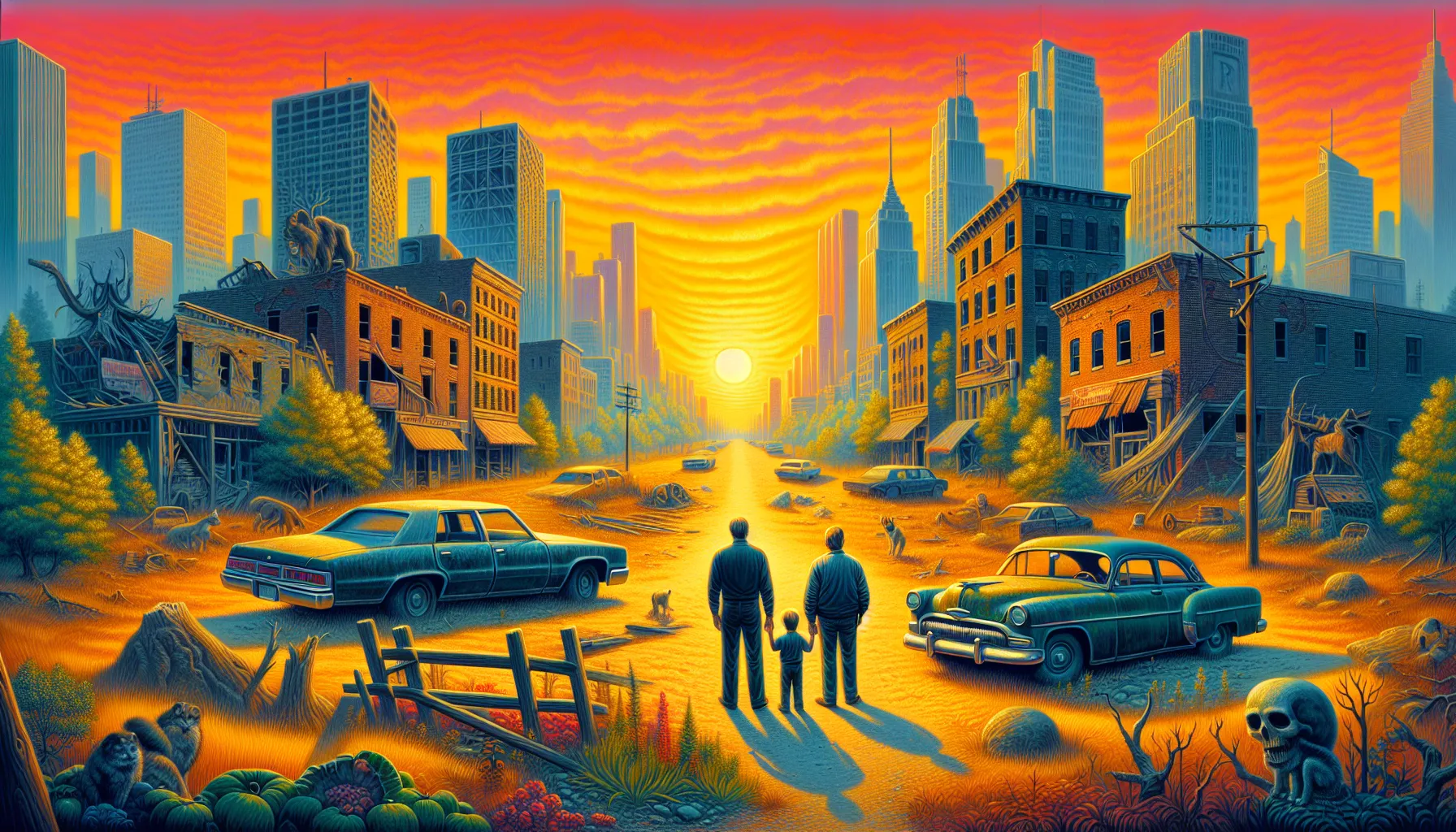
Masculinity in The Hills Have Eyes walks on two legs: one carries a Bible and a baby stroller, the other drags a bloodied axe through irradiated sand.
Cracked Family Portrait in the Desert
A family photo is taken before the nightmare: Bob the retired cop, Ethel the pious wife, their adult daughter Brenda, their pregnant daughter Lynne with her husband Doug, baby Catherine, teenage son Bobby, two dogs, an RV gleaming like a rolling suburb. The composition is perfect, almost parodically so—white, middle class, cross-generational, the American nuclear family sealed in chrome and optimism.
Then the film drives this image into the desert, into land hollowed out by nuclear tests, into a space where the state has already experimented on human flesh and left behind a residue of altered bodies and warped kinship. The family portrait continues to exist, but as a fragile decal applied to an environment that will not support it.
The “nuclear family” here is not merely metaphorical; it is literally installed in a landscape poisoned by the state-sponsored nuclear project. The word “nuclear” doubles and splits: one refers to a moral fantasy of contained reproduction and paternal order; the other to fission, fallout, molecular chaos, the desert as an exposed Body‑without‑Organs that has already absorbed more violence than this RV can imagine (Deleuze & Guattari, 1987). The film arranges an encounter between these two senses of the nuclear, and masculinity is the primary conductor through which the shock travels.
The opening antagonism between Bob and Doug is staged as comic relief but already codes the territory. Bob mocks Doug’s “softness,” his lack of practical skills, his consumerist dependence on gadgets and city comforts. Doug mumbles resentments sideways to Lynne, obeys her plea to “take the high road,” to swallow his pride, to endure humiliation rather than escalate conflict. Masculinity here appears as a bad transmission—an older, hard, authoritarian model trying to overwrite a younger, flexible, conflict-averse variant that speaks the language of compromise and irony.
Yet the desert does not tolerate this negotiation. It will demand a different circuitry.
Nuclear vs Radiated Families: Two Machines Facing Off
Opposite the RV stands another family, never granted a wholesome photo: the desert clan of irradiated mutants living in mine-shafts and shacks, feeding on travelers, breeding endogamously, forming a hierarchy of warped bodies and brutal roles. The Hills themselves “have eyes”: every rock face conceals a gaze, every scrap of junk is a possible trap.
The film stages the nuclear family and the radiated family not as symbolic opposites but as two desiring-machines locked into the same circuit. The suburban clan is organized by law, monogamy, Christian piety, state-sanctioned masculinity; the mutant clan is organized by hunger, incest, rape, and the scavenging of the very commodities the RV brings. Both arrangements circulate sex, violence, and authority, but at different intensities and with different degrees of hypocrisy.
In one sense, the mutants are simply the return of what the nuclear family represses. They surface as the obscene underside of the American dream, the “waste product” of state science, military secrecy, and capitalist dispossession. The backstory the film hints at—miners ordered off their land, some refusing, nuclear tests conducted anyway, survivors mutating in the irradiated fallout—renders the clan as the literal fallout of progress. If capital thrives by externalizing its costs onto land and bodies, these bodies are the debt that never went away (Marx, 1976).
But the mutants are not simply victims. They actively enjoy their position as predators, their hypermasculine postures, their leering at women, their sadistic playfulness. Here Reich’s insight that fascist energies are incubated in distorted family structures becomes strangely literal: an authoritarian father-figure, Big Brain in his wheelchair, commands a tribe of violent sons whose erotic life is fused with killing and rape (Reich, 1970). This is not outside patriarchy; it is patriarchy condensed into a grotesque caricature, unrestrained by law and shame.
The nuclear family, by contrast, is saturated with law—Bob is the retired cop, Doug the cell-phone salesman, Ethel the Christian mother—and yet the law here is impotent. Bob’s gun will not protect them, his cop instincts fail in this unfamiliar terrain, his authority degenerates into shouting. The law that once organized his masculinity has no jurisdiction in this irradiated zone, which is itself the forgotten product of state violence.
Thus the two families face each other not as natural and monstrous, but as two partial expressions of the same historical machine: Cold War nuclear projects, frontier dispossession, patriarchal Christianity, consumer capitalism. The film does not ask which family is more “real” but which arrangement of bodies and behaviors is better adapted to a world already cracked by fallout.
Bob and Doug: Masculinity as Failed Transmission
If the desert is a test site for bodies, Bob and Doug are the primary specimens. Bob’s masculinity is forged in the furnace of mid-century cop culture: certainty, aggression, racism lurking under jokes, a belief that threats are met with superior force, that “men” protect “their” women and property. His retirement has only moved this script into the domestic sphere, where he bullies Doug in place of suspects.
Doug’s masculinity is post-industrial and post-heroic. He is thin, bespectacled, a liberal rationalist who sells technology rather than wielding weapons. His skills are symbolic; his world is software, contracts, negotiations. The film opens with his failure to change a tire; he owns tools but does not understand them. Bob sneers: here is a man who cannot defend his family, whose manhood is merely decorative.
This intergenerational conflict is not merely personal; it embodies a shift in the political economy of masculinity itself. The old model aligned men with the repressive apparatuses of the state: cops, soldiers, patriarchs, all invested with the right to violence in the name of order (Foucault, 1977). The new model aligns men with flexible labor, emotional intelligence, consumer choice, a diffused and “civilized” power that negotiates instead of commands.
In the RV, however, Bob still occupies the role Lacan called the Name‑of‑the‑Father, the symbolic anchor that guarantees the consistency of the family and the social order (Lacan, 1977). Doug chafes but yields; his murmured complaints to Lynne are a form of impotent rebellion, ressentiment without teeth. Nietzsche’s account of the interiorization of aggression—turned inward when it cannot be discharged outward—haunts Doug’s early passivity (Nietzsche, 1994).
The desert will not allow this unresolved tension to remain comic. When the attacks begin, Bob pursues what he thinks is a minor threat, leaving the RV exposed. He is captured, crucified, set ablaze: the patriarch literally burns on the horizon. The shot is almost obscene in its clarity: the old cop’s body is sacrificed as a useless offering to a terrain his training did not anticipate.
Doug’s arc is the inverse. Initially hiding, panicking, gagging at corpses, he is forced into action when his baby is taken. The film orchestrates an initiation rite: armed only with a baseball bat, then mutant weapons, then scavenged tools, Doug moves deeper into the desert, his glasses broken, his face bloodied, his body increasingly indistinguishable from the brutes he fights. Masculinity here is transmitted not by advice but by trauma. Bob’s taunts echo as a kind of posthumous commandment: be a man, which now means be willing to kill.
This is where the film’s politics twist. It appears to critique Bob’s bullying, to expose the fragility of macho posturing, and yet it also validates his underlying thesis: survival requires violence, and Doug must “man up.” Doug’s becoming-warrior is staged as necessary, even glorious, down to the final freeze-frame of him standing over a dead mutant, an American flagpole rammed through the monster’s body. The failed transmission between generations is retroactively completed by the desert itself.
Radiated Patriarchy and the Desert Body‑without‑Organs
The mutant clan occupies a space that is not simply outside society but excavated from beneath it. Their homes are abandoned test towns, mine shafts, bomb craters, spaces the state once animated with mannequins and blast measurements and then deserted. The desert here is not nature; it is a laboratory scarred by human experiments, a Body‑without‑Organs carved full of cavities, bunkers, and rusted metal (Deleuze & Guattari, 1987).
This BwO is hostile to stratified identities; it melts the distinctions upon which suburban normalcy depends. Inside the RV, there are clear rooms, assigned beds, a bathroom with a door, gendered divisions of labor. In the desert, there are only holes and heaps. One cannot stand upright in many of these spaces; one must crawl, slither, compress. Bodies are constantly forced into non‑upright positions, into contortions that erase the dignified verticality of the bourgeois subject.
The mutants’ own bodies bear the imprint of this environment. Swollen heads, missing limbs, distorted skin: they are walking archives of radiation’s slow violence. Yet they also weaponize these deformities. The huge-headed patriarch, tethered to a wheelchair, wields psychic and strategic authority; the massive brute with the sledgehammer embodies pure force; the leering, relatively less deformed sons use mobility and cunning. Each body is a specialized organ in a larger predatory machine.
Their patriarchy is radiated but recognizable: father at the top, warrior-sons beneath, women as reproductive resources, children as both offspring and bait. Incest and rape are not deviations from their order but its constitutive practices; their “family values” are unmasked as nothing but the circulation of sperm and blood within a closed system. Where the nuclear family masks its incestuous fantasies under the cover of law and morality, the radiated family lives them without shame.
This obscene clarity recalls Kristeva’s concept of abjection: the horror experienced when what should remain out of sight—excrement, blood, the maternal body—is thrust into visibility (Kristeva, 1982). The mutants are abject beings, simultaneously repulsive and attracting, living reminders of the state’s dirty secrets and the family’s buried desires. Their huts overflow with refuse, animal bones, pornography, stolen household items; the inside/outside distinction collapses.
The RV’s penetration by these figures—the assault scene in which a mutant suckles at Lynne’s breast before shooting her, another rapes Brenda while the baby cries in the next room—is the collision point between stratified domestic space and abject desert space. Patriarchal control crosses from one family to the other: the mutants exercise, in hyperbolic fashion, the very power Bob thought he had monopolized. The domestic interior is revealed as only contingently protected; its walls fold like paper under a different intensity of male violence.
Violence as Initiation: Doug’s Becoming‑Monster
Doug’s trajectory after the assault is a long, stumbling line of flight away from suburban softness. He sets out to retrieve his abducted child, accompanied only by the family’s German Shepherd, Beast. This pairing is crucial. The dog, once a pet in the RV, now becomes a guide in the desert, modeling a different relation to environment and threat. Doug’s reliance on Beast is not sentimental; it is tactical, a becoming‑animal in which he learns from the dog’s instincts.
Becoming‑animal is not a fantasy of literally turning into a beast but of abandoning the rigid subject positions of “husband,” “consumer,” “civilized man” for a more mobile, attuned kind of embodiment (Deleuze & Guattari, 1987). Doug begins to move differently, listen differently, hide differently. His city shoes slip in the sand; he stumbles, bleeds, adapts. Each wound is a deterritorialization of his previous comfort, an entry point for a new, feral competence.
Yet this line of flight is quickly recaptured by a familiar figure: the action hero. As Doug accumulates weapons—knife, pickaxe, shotgun—he also accumulates narrative capital. The film rewards his brutality with forward movement: each killing clears another level of the desert labyrinth. When he impales a mutant with the remnants of an American flag, the gesture fuses personal vengeance with national iconography. The flagpole becomes a spear, the patriotic symbol a weapon driven through the enemy’s flesh.
Žižek has shown how such moments of violent catharsis often stage the obscene underside of liberal democracy, where the fantasy of clean law gives way to the enjoyment of unrestrained force (Žižek, 1992). Doug’s frenzy—screaming, stabbing, bludgeoning—little resembles the rational, rights-respecting subject of liberal myth. Instead, he resembles, in his sweat and blood and desperation, the very creatures he is killing.
The film indulges and critiques this transformation simultaneously. On one hand, it suggests that this “becoming‑monster” is what was required all along, that the earlier, ironic Doug was inadequate to reality. On the other, it shows him increasingly haunted, visually echoing the mutants in posture and gaze. The final image of him clutching his baby, framed in the crosshairs of an unseen viewer, undermines any triumphant reading. If Doug has become a successful protector, he has done so by swallowing the logic of the desert, which is also the logic of state violence: preemptive killing, territorial control, family as fortress.
Nietzsche warned that whoever fights monsters must take care not to become a monster; here the becoming is not a moral failure but a structural inevitability when one accepts the terms of the struggle as given (Nietzsche, 1994). Doug could not have rescued his child without intensifying his capacity for harm, but this intensification merely re‑entrenches the very model of masculinity—violent, sacrificial, stoic—that seemed so ridiculous when Bob performed it.
Radiation of the American Dream
The desert is littered with failed dreams: the fake nuclear test town with its mannequins frozen at kitchen tables, the mine whose economic promise evaporated, the makeshift mutant dwellings crammed with relics of suburban life. The Hills do not simply “have eyes”; they have memory, sedimented layers of state and corporate projects abandoned once their immediate utility faded.
Foucault’s analysis of power as capillary, diffused through institutions and technical practices rather than just sovereign commands, is materialized in the nuclear test apparatus that once suffused this landscape (Foucault, 1977). The blast is not just an explosion but a reorganization of life possibilities: certain bodies die instantly, others are slowly altered, others profit far away, never seeing the desert. The radiated family is what emerges when biopolitics—management of populations, calculation of acceptable casualties—condenses into a single clan, marked in its very flesh.
The Carter family’s RV is itself a mobile fragment of the American dream: air conditioning, television, chrome, a mini‑kitchen, enough room to carry multiple generations and dogs. It is the promise that one can traverse any terrain while remaining within a bubble of comfort. When the RV is disabled and penetrated, what collapses is not just a vehicle but a fantasy of immunity from the material conditions that produced this desert in the first place.
Marx noted that capitalism produces its own gravediggers by creating classes whose exploitation eventually destabilizes the system (Marx, 1976). Here the “gravediggers” are something like nuclear proletarians, a population produced and then disavowed by the very technologies that secured American supremacy. Their labor was their exposure to radiation, their reward a slow mutation, their revenge the cannibalization of those who arrive still basking in the glow of that supremacy.
Reich argued that fascism thrives where economic misery meets repressed sexuality and rigid family structures (Reich, 1970). The mutant clan is a kind of desert fascism, built on scarcity, territorial paranoia, and an incestuous patriarchal order. Yet the suburban family is hardly immune to these tendencies. Bob’s casual sexism, his attachment to guns, his contempt for weakness, all resonate with fascist micro‑politics in a soft, normalized key.
The film’s horror, then, is not just the sight of deformed bodies but the recognition that the American dream is itself radioactive, that its nuclear tests, its military adventures, its economic exclusions inevitably produce enclaves like this—places where law and morality have melted, leaving only a brutal economy of survival and enjoyment. The line dividing “civilized” and “savage” is merely the line between those who benefit from the fallout at a distance and those who breathe it directly.
Eyes in the Hills, Eyes on the Screen
“The Hills Have Eyes” is not a metaphor; it is a literal condition. Scopes, binoculars, peepholes, gaps in rock formations: the mutants watch the family long before the family knows it is visible. Surveillance belongs here not to the state but to those the state abandoned, a perverse reversal of the panopticon (Foucault, 1977). Instead of prisoners constantly observed by guards, we have citizens obliviously parading while the “prisoners” of the desert observe.
The gaze, in Lacanian terms, is not simply the look from one person to another but the point from which we realize that we ourselves are caught in a field of vision we do not control (Lacan, 1977). When the camera glides from the family’s playful interactions to a far‑off figure on a hill, then back, the spectator is sutured into this structure: we share the mutants’ view even as we align emotionally with their targets. Our horror is doubled by a strange complicity; we, too, are the eyes in the hills.
Inside the mutants’ lair, however, other screens glow. A deformed child watches cartoons, soothed by the imagery of mainstream culture. A broken television, powered by stolen generators, brings the radiated family into contact with the same spectacle economy the RV family enjoys. Baudrillard’s analysis of simulation haunts these images: the desert, once the site of real nuclear tests, is now a backdrop for cinematic horror, while within the fiction, flickering screens mediate even the mutants’ sense of normality (Baudrillard, 1994).
The film invites a layered voyeurism. We watch the Carters; the mutants watch the Carters; the camera watches the mutants; sometimes, as in the final zoom to a crosshair overlay, a meta‑gaze appears, suggesting further observers—perhaps more mutants, perhaps, allegorically, the state apparatus returning. This circulating gaze erodes any secure position from which to pronounce moral judgment. Everyone is exposed, and everyone looks.
Žižek remarks that horror cinema often externalizes internal conflicts, giving monstrous shape to what cannot be acknowledged in polite discourse (Žižek, 1992). Here the monstrous is less some ineffable psychic content than the very architecture of seeing and being seen in a society that tests bombs in secret, hides their effects, and then spectacularizes violence for entertainment. The Hills, like the theater, are a viewing platform.
Masculinity After the Blast
By the end, Bob is dead, Lynne and Ethel are dead, Brenda and Bobby are traumatized, Doug stands bloodied holding his recovered child, and the surviving dog licks wounds in the dust. Above them, the crosshair lingers. Rescue? Further threat? The film refuses closure. The desert has not been “cleared”; many mutants are dead, many are not. The RV is wrecked, but the gaze endures.
Masculinity has passed through fire and radiation and come out altered but not transformed. The film appears to say: the only effective man is the violent man, the man willing to do what must be done, to abandon civility and softness. Yet it also shows that this effective masculinity is indistinguishable, in its gestures and affects, from the monstrosity it opposes. The difference is that one kills “for family,” the other “for hunger” or “for fun,” but the blows land the same.
In schizoanalytic terms, both the nuclear and radiated families are rigid molar formations that capture desire and channel it into repetitive circuits of domination and submission (Deleuze & Guattari, 1983). The nuclear family offers stability at the price of obedience; the radiated family offers belonging at the price of mutilation. Both treat women as reproductive resources, children as property to be guarded or stolen, men as instruments of controlled aggression.
What the film does not quite imagine is a different line of flight for masculinity, one that would refuse both the softness defined by its distance from violence and the hardness defined by its readiness to kill. Doug’s only options are cowardice or monstrosity; he chooses monstrosity and is rewarded with survival. A truly radical departure—a masculinity that would abandon the patriarchal script altogether, that would not equate protection with domination—remains off‑screen.
And yet, some residues hint at other possibilities. Beast’s loyalty is not tied to patriarchal authority; his violence is direct, non‑symbolic, protective without moralizing. Brenda and Bobby’s improvisations—baiting mutants, setting traps—show capacities for strategic thinking and courage not anchored in phone‑book masculinity. The film’s own aesthetic, its refusal to let the final image settle into triumphant heroism, undermines the glory of Doug’s transformation.
Nietzsche spoke of the possibility of a “gay science,” a life‑affirming creativity beyond ressentiment and guilt (Nietzsche, 1994). Here, the desert is too saturated with blood and fallout to allow such a figure to appear. But perhaps the task after the blast, after recognizing that the American dream is built on irradiated ground, would be to invent forms of relation—familial, sexual, communal—that no longer require fathers burning on crosses and sons stabbing flags through skulls to prove they are “men.”
For now, The Hills Have Eyes offers a merciless X‑ray of existing arrangements. It shows masculinity as both victim and vector of a historical catastrophe whose epicenter lies not in caves but in laboratories, test sites, and police stations. The monsters in the hills are only half the story. The other half is the RV, gleaming with good intentions, carrying within it the very patterns of domination and blindness that will make its destruction both inevitable and, in the film’s cruel logic, deserved.
References
Baudrillard, J. (1994). Simulacra and simulation (S. F. Glaser, Trans.). University of Michigan Press.
Deleuze, G., & Guattari, F. (1983). Anti-Oedipus: Capitalism and schizophrenia (R. Hurley, M. Seem, & H. R. Lane, Trans.). University of Minnesota Press.
Deleuze, G., & Guattari, F. (1987). A thousand plateaus: Capitalism and schizophrenia (B. Massumi, Trans.). University of Minnesota Press.
Foucault, M. (1977). Discipline and punish: The birth of the prison (A. Sheridan, Trans.). Pantheon.
Kristeva, J. (1982). Powers of horror: An essay on abjection (L. S. Roudiez, Trans.). Columbia University Press.
Lacan, J. (1977). Écrits: A selection (A. Sheridan, Trans.). W. W. Norton.
Marx, K. (1976). Capital: A critique of political economy, Volume 1 (B. Fowkes, Trans.). Penguin.
Nietzsche, F. (1994). On the genealogy of morality (C. Diethe, Trans.). Cambridge University Press. (Original work published 1887)
Reich, W. (1970). The mass psychology of fascism (V. R. Carfagno, Trans.). Farrar, Straus and Giroux.
Žižek, S. (1992). Looking awry: An introduction to Jacques Lacan through popular culture. MIT Press.
Comments
Post a Comment