The Hills Have Eyes 2 (2007) – When the Battlefield Is the Drill: Mutants, Soldiers, and the Desert’s Body‑without‑Organs
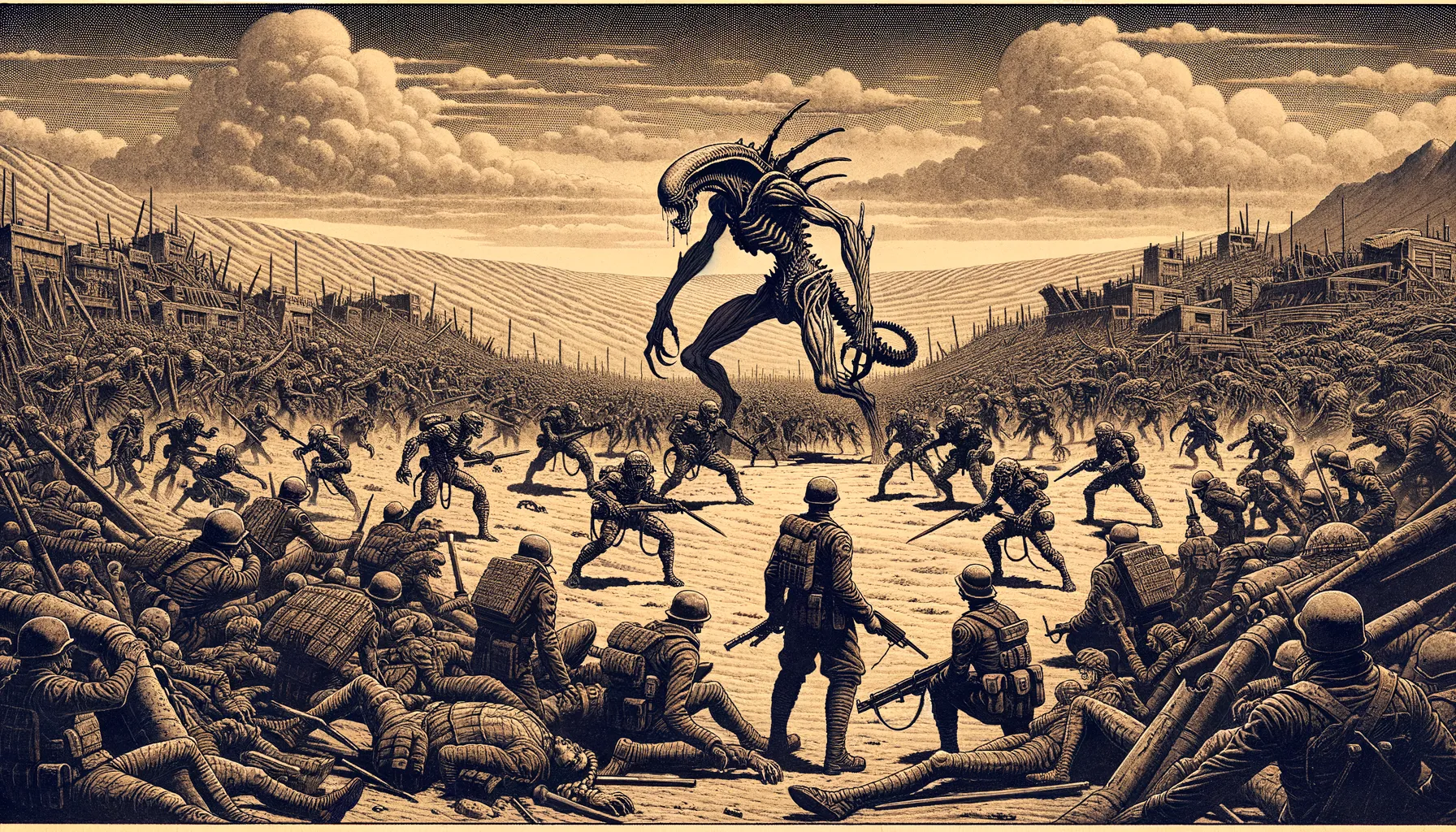
The most unsettling thing about The Hills Have Eyes 2 is not the mutants in the caves, nor the familiar erosion of the human form under knives and rocks, but the fact that the war never arrives and the battlefield still manages to be full of corpses. The film is a war movie without a war, a combat zone with no official enemy, where the National Guard never leaves the training ground and yet gets massacred as if by a conflict that never needed a declaration.
The desert is already occupied: by an earlier film, by nuclear tests, by a prior allegory of the war on terror, by a first iteration of the mutant clan that stalked a nuclear family and taught them to shoot their way into conservative manhood. The sequel returns to the same scarred space and replaces the family with a “soup sandwich” platoon of National Guard trainees, a diversity-optimized cross‑section of American youth, poorly prepared, lightly armed, and immediately swallowed.
The official story is that they are out on a training exercise, a simulation. They are brought by truck into a landscape of decommissioned watchtowers, abandoned research stations, and dry rock—a scenery of military leftovers and state experiments. Yet the simulation never clearly flips into the real; it is as if the film wants to insist that the training ground and the battlefield were never different in the first place, that war has always been waged first on the bodies of one’s own soldiers.
The camera lingers on dog tags, fatigues, helmets, rifles: the paraphernalia of a war that is conspicuously absent, or perhaps displaced just a few ridges over, into Afghanistan, Iraq, any desert where young Americans might be sent with as little preparation and as much bad communication. The hills have already digested one family in the previous film; now they are invited to taste the army. The result is less a narrative than a series of misfirings, an accumulation of tactical errors and confused desiring-machines, stumbling.
From Desert Allegory to Franchised Slasher
In the first remake, the mutants harassed, stalked, and terrorized a traveling family with an almost guerrilla logic, laying traps, exploiting terrain, and staging ambushes that could easily be read as a warped reflection of insurgent tactics in a foreign occupation. The desert was coded as an alien land whose inhabitants knew every crevice and crag, a reverse home‑field advantage that turned the white nuclear family into clumsy invaders. That film made its war on terror allegory embarrassingly clear, then let it turn back on itself by forcing a liberal husband to become a shotgun-wielding avenger.
Here, the set‑up seems primed for a darker intensification: soldiers instead of civilians, an explicit training mission, radios and command structures, the perfect apparatus for a paranoid war film where the Hills are insurgent territory. Yet The Hills Have Eyes 2 immediately flattens this potential. The mutants feel less like cunning desert guerrillas and more like generic slasher antagonists who happened to inherit some leftover story bible from the previous film.
The early scene of a pregnant woman kidnapped from a remote checkpoint and dragged underground feels momentarily sharp: it registers the desert as a zone of abduction, a space where even the military can be overrun and turned into breeding stock. The body of a woman in uniform becomes a contested site: for the army, she is a soldier, a unit; for the mutants, she is a womb, a resource. The film could have traced the circuit that links these two forms of capture, but instead it mostly uses the abduction as an opening gambit, a pretext to send the platoon in.
Once the young National Guard members reach the outpost, the film’s desire collapses into pure genre mechanics: split the group, pick them off, move them underground, stage kills at regular intervals. Instead of a war on terror allegory, we get a slasher with camouflage. The mutants bump into the soldiers rather than systematically hunting them; the hills do not so much “have eyes” as have a franchise obligation to provide a certain number of bodies and gore effects.
This regression from political allegory to generic repetition is itself a telling movement. It amounts to a reterritorialization: the volatile energies of the first remake, where suburban masculinity was forced to mutate under pressure, are here smoothed into a sequence of expected beats, like a once wild current routed through a dam’s turbines. The horror of insurgency, of a land that resists occupation, is tamed into the more manageable horror of being chased in a cave.
The desert, which had once functioned as an unstable plane where nuclear history, American family romance, and war on terror paranoia intersected, is now mostly backdrop. Even the mutants’ tactics are degraded from improvised mines and sniper nests to sudden lunges and blunt-force trauma. A single organizing thought seems to have guided the sequel: more soldiers, more kills. Desire is simplified, directed toward body counts, its earlier political multiplicity sacrificed to the comfort of a standard slasher schema.
National Guard as Desiring-Machine
The platoon that trudges into this dead zone looks like a recruitment poster smashed into a sitcom: different races, accents, genders, all corralled into a loose hierarchy whose discipline never quite takes. They complain, they joke, they disobey minor orders, they flirt, they piss in the sand. They are the United States idealized as a multicultural military melting pot, but also as an institutional failure of cohesion.
The commanding sergeant is a parody of authority, barking orders that barely register as the group lumbers along. Discipline here is less an internalized habit than a temporary performance; the soldiers wear the uniform like a costume that has not yet had time to soak into their muscles. Foucault’s dream of the perfectly docile, endlessly trained body, drilled by armies and schools into automatic obedience, has not quite materialized in these figures (Foucault, 1977). They fumble instead of executing.
As soon as the external frame of command frays—lost radio contact, confusing terrain, a strange noise—their training dissolves into raw panic. Rifles shake, orders are contradicted, decisions are made on impulse. The state has assembled them as an organ of its military apparatus, yet the connective tissue is weak; the desiring-machine of the National Guard jams as soon as it is plugged into a real threat (Deleuze & Guattari, 1983). What remains are isolated affects: fear, bravado, guilt.
The film takes almost perverse pleasure in watching the chain of command disintegrate. Friendly fire wounds as much as enemy action. Scouts sent ahead disappear without clarity. The map of the desert their superiors have drawn—literally and metaphorically—does not match the territory beneath their boots. They stumble into abandoned structures, old research shacks, hilltop posts with shattered glass, all the decaying infrastructure of a military presence that once thought itself thorough and total.
Marx wrote of labor-power as a peculiar commodity, bought and consumed by capital in the process of production (Marx, 1976). Here, the soldiers’ bodies are not even efficiently consumed; they are squandered. They have been assembled, transported, deployed, and then scattered with no productive result, no territorial gain, not even the containment of the mutant threat. They are labor-power left to rot in a mined training field.
One could see in the platoon an image of late imperial war-making itself: an institution that still commands young bodies but no longer commands a coherent strategy. The desiring-machine of the army malfunctions in real time; the soldiers become mere biomass thrown into an environment that has outlived its original military logic, eaten by a leftover enemy from an earlier script.
Mutant Clan: Necropolitical Family in the Caves
If the National Guard is a desiring-machine that cannot quite cohere, the mutant clan is an over-cohered one: a closed circuit of incest, rape, and cannibalism buzzing relentlessly in the dark. Down in the caves, far from the sun-bleached training camp, bodies are organized according to a brutal immediacy: who can break bones, who can breed, who can scout, who can sniff out weakness.
The mutants are the literal fallout of an earlier epoch of state power: nuclear testing, secret experiments, the abandonment of suffering populations in poisoned zones. They represent not just biological mutation but social remainder, the residue of a national project that irradiated land and people and then left them to fend for themselves. Foucault’s biopolitical dream of administering life slides into Mbembe’s necropolitics, where sovereignty expresses itself in the power to let certain lives simmer in death-in-life at the margins (Mbembe, 2019).
In this sequel, however, the necropolitical logic tilts towards the reproductive. The opening abduction of a pregnant soldier and the later attempted rape of a female Guard member sharpen the mutant project: to survive, they must breed, and their own gene pool is exhausted. The army’s women become both enemy and resource, a chance to refresh the contaminated lineage with new flesh.
The body of the female soldier is caught between two apparatuses of capture. The military has already inscribed her as a unit, a rank, a function within the war machine. Her pregnancy makes her body doubly coded: on the army’s side, it complicates her utility while also symbolizing the reproduction of the nation; on the mutants’ side, it marks her as a rare, precious womb that can be stolen.
In the caves, this double coding becomes horrific. The pregnant woman is strapped, dragged, silenced, reduced to a breathing incubator. The camera rarely grants her full subjectivity; she is mostly seen as an object, a thing to be retrieved or violated. The mutants’ interest in her is crudely practical: offspring, meat, continuity. Yet their practices echo the state’s own instrumentalization of bodies, stripped of rights once they enter the zone of exception where normal law does not apply (Agamben, 1998).
The mutant clan’s family romance is a parody of the nuclear family’s own obsessions. Where the first film showed a middle‑class family’s descent into savagery to protect a baby, this one shows savagery attempting to reproduce itself on the backs of soldiers. Both arrangements revolve around the child, the future, the anxiety of continuation—that “will there be more of us?” that undergirds so much of national and familial desire.
Reich’s insistence that fascist politics grow in the soil of distorted family structures feels strangely literal here (Reich, 1970). The cave family is an obscene condensation of patriarchal authority, misogynist violence, and racialized hatred, but the army family above ground is merely a more polished version, still governed by male commanders and sacrificial logics. The difference is less moral than aesthetic: camouflage versus torn rags, clean bunks versus rock ledges.
Caves as Body‑without‑Organs
The caves themselves are the film’s most compelling invention. Humid, black, glistening with a kind of geological sweat, they twist into bifurcations and dead ends, forcing the soldiers to crawl, squeeze, and contort. The upright posture of the armed human—booted, helmeted, scanning the horizon—is systematically dismantled as the film drags these bodies down into four‑limbed, dirt‑smeared, animalistic motion.
This is the desert’s Body‑without‑Organs: not an empty void but a perverse smoothness where distinctions between corridors and chambers, inside and outside, lair and grave, blur (Deleuze & Guattari, 1987). The soldiers enter seeking the stolen woman and instead find their own limbs unfastened, their tactical formations dissolved into a mere line of terrified bodies feeling along wet rock. Guns become awkward batons; flashlights betray their positions; the technology of war flickers.
Above ground, the training camp had offered a grid: tents, watchtowers, pathways, recognizable coordinates. Underground, there is no grid, only a continuous surface folded and refolded, indifferent to maps. The cave system is less a place than an undoing of place, a dérive forced upon reluctant wanderers. It is not the sublime open desert of Lawrence of Arabia fantasy but an anti‑landscape that closes in on the body, appropriating it.
In this underworld, the distinction between soldier and mutant also begins to fray. Both speak mostly in grunts and shrieks; both crawl, hiss, and lash out. One might say the caves produce a becoming‑mutant in the soldiers, an enforced solidarization at the level of bare survival. The uniforms do not protect; rank disappears in the dark. Identity collapses to a single function: not being the next one taken.
The cave’s spatial logic also short‑circuits the state’s gaze. Watchtowers, binoculars, drones—these belong to the open air. Down below, the field of surveillance is reduced to a narrow beam of flashlight that betrays more than it reveals. The soldiers are no longer the subjects of panoptic vision; they are instead its blind bearers, broadcasting their own vulnerability. If the desert was once a place where the army could see everything, the caves are where it goes blind.
Post‑9/11 Shine: War, Screens, and Nihilism
Visually, The Hills Have Eyes 2 bathes its training camp and caves in a recognizable post‑9/11 horror gloss: desaturated colors, high‑contrast shadows, the grainy sense of a world already exhausted. The film was released into a cultural moment saturated with images of sand, fatigues, and anonymous brown rock faces blown apart on the nightly news. Its desert is not the timeless frontier of the Western but the overexposed backdrop of embedded journalism and grainy hostage videos.
Baudrillard argued that contemporary war becomes increasingly indistinguishable from its media simulations, that conflict is both rehearsed and consumed as spectacle before, during, and after its official timelines (Baudrillard, 1994). Here, the entire premise—soldiers in a training exercise who stumble into “real” danger—feels like a dramatization of this collapse. Were they ever not in danger? Was the training ever only training? Or has the distinction between combat and rehearsal melted in the relentless feedback loop of war footage and propaganda?
The outpost bristles with communication devices that do not function: radios crackle, screens flicker, antennas jut uselessly into the sky. The infrastructure of connection is all there, but the lines do not carry anything meaningful. Orders from command are partial, delayed, or absent. The state appears as a distant, crackling voice that shoves young bodies into the desert and then disappears at the moment of crisis.
Virilio once described war as a “logistics of perception,” where victory depends as much on who sees first and better as on who shoots more (Virilio, 1989). In this film, perception itself is compromised. The soldiers cannot trust what they see; the mutants inhabit angles and shadows that elude the human eye. The caves are a blackout in the logistics of perception, and the mutants are those who have adapted to see in that blackout.
The post‑9/11 nihilism that radiates from the film’s sets lies in this constant short‑circuiting of sense. There is no mission objective that matters, no high‑value target, no clear edge between victory and loss. There is only the slow attrition of young lives in an environment built by the same forces that now claim to be threatened by it. The desert training ground is both cradle and grave of a military machine that has forgotten why it runs.
The film never gives the soldiers a redeeming purpose; there is no village to save, no civilians to protect, no intelligence to gather. They die because the army has sent them where it once experimented with radiation and now pretends only to simulate war. Their horror is not that they are attacked by an unimaginable enemy, but that the enemies are so eminently imaginable: by‑products of past state violence, directly linked to the very institution that trained them.
Race, Survival, and the Whitening of the Ending
One of the most quietly chilling aspects of The Hills Have Eyes 2 is its distribution of survival along racial lines. The film assembles a diverse platoon—Black, Latino, white, male, female—then systematically cuts down the non‑white, the visibly “other,” the loudest and least conventional, until the final surviving figures are the most normatively white and heteronormative bodies the group had to offer.
Horror cinema has long been complicit in this pattern, killing off Black and brown characters early or using them as moral or comic relief. Here, the effect is amplified by the military framing: these are supposedly equal comrades, wearing the same uniform, bound by the same code. Yet when the credits approach, it is the whitened remainder that crawls out of the desert’s maw, suggesting that even in a zone of extreme precarity, some lives are structurally more survivable than others.
Mbembe’s account of necropolitics insists that modern power is characterized by the production of death-worlds—zones where populations are subjected to conditions of life so reduced that they hover in a constant proximity to death (Mbembe, 2019). In this film, the desert training ground is a micro death-world, and yet within it there are gradations of disposability. The racialized soldier is closer to the cliff’s edge than the white one, even before any mutant appears.
Butler has argued that not all lives are equally grievable, that media and political frames decide in advance which deaths will register as losses and which will fade as background noise (Butler, 2004). The film reproduces this asymmetry in its very structure of empathy. Some characters are granted fleeting backstories—family photos, hopes for the future—while others are defined almost entirely by stereotype, their deaths fast and often grotesquely framed for entertainment.
The whitening of the ending is not simply a casting quirk; it is a diagram of whose survival counts as an endpoint in the narrative. The desert may be indifferent, but the film is not. It routes its line of flight through particular bodies, insuring that the final image of escape conforms to a recognizably “American” figure of resilience: a white soldier staggering into the horizon, battered but intact enough to signify both victimhood and heroism.
At the same time, this very predictability hollows out the triumph. The survivors have not overcome systematic forces; they have simply floated upwards on a pre‑structured buoyancy. Their survival feels less like resistance than like the default setting of a cinematic machine that cannot imagine a different endpoint. The horror of the racial calculus is hidden inside the banality of an action‑horror climax.
The Failure of Terror: When Monsters Forget How to Haunt
What is most striking about the mutants this time is their lack of strategy. In the first remake, they stalked like insurgents, used radios, set traps, studied their prey. Here, they behave closer to cornered animals, pouncing when a soldier comes too near, wielding blunt instruments in cramped spaces, relying less on planning than on sheer ferocity. The shift is not just a failure of writing; it is a symptom.
The franchise has forgotten its own terror. The earlier film’s power lay not only in its gore but in its uncanny mirroring of contemporary fears: of home invasion, of foreign ambush, of the enemy within the landscape itself. The mutants’ cunning made them plausible stand-ins for a demonized insurgent figure. In stripping them of that cunning, the sequel accidentally strips them of political charge.
Žižek often notes how ideology persists precisely in the moments that feel most apolitical, at the level of framing and genre habit rather than explicit statement (Žižek, 2008). Here, the decision to turn the mutants into more generic slashers, to remove their quasi‑military tactics and reduce them to mere brutes, performs an ideological cleaning. It detaches the horror from war on terror allegory and reroutes it into a simpler fear of the abnormal body in the dark.
This is, paradoxically, a de‑radicalization. The line of flight opened by the first remake—where American domesticity discovered itself as violent as the enemy—breaks off into a cul‑de‑sac. Instead of forcing soldiers to question their own role in a larger imperial project, the film lets them be “good guys” hounded by inhuman monsters. The desert as a politically charged space of occupation becomes, instead, a monster closet.
Yet the failure to haunt also haunts. There is a palpable boredom in watching the mutants swing their clubs and drool; a sense that the film knows it is replaying moves whose affect has dulled. This boredom is not just the viewer’s; it is baked into the repetition that has lost its referent. Without a sharp political edge, the violence becomes mechanical, and the apparatus of horror begins to eat its own tail.
Deleuze and Guattari distinguished between lines of flight that lead to new compositions and those that curl back into destruction or stagnation (Deleuze & Guattari, 1987). The Hills Have Eyes 2 embodies the latter: a would‑be escape from simple allegory into something else that instead spirals into franchise fatigue. The mutants forget how to haunt because the film forgets what there is to be haunted by.
What Escapes These Hills?
If the desert training ground devours its soldiers and the caves devour their bodies, what, if anything, escapes? The film ends with survivors stumbling away, but the more interesting question is what conceptual or affective residue slips out of this apparently lazy sequel and back into the broader cultural desert from which it emerged.
One possibility is the image of the training ground itself: a place where war is rehearsed with young, semi‑prepared bodies in a landscape already marked by earlier state violence. This image refuses to be fully contained by the film’s clumsy narrative. It resonates with real training camps, live‑fire exercises gone wrong, and the countless ways in which states test weapons and tactics on their own subjects before exporting them. It is as if the movie accidentally documents a real apparatus while failing to dramatize it convincingly.
Another is the stubborn centrality of reproduction in the horror. The mutants’ obsession with breeding through kidnapped soldiers, the pregnant captive strapped underground, the female bodies reduced to sites of forced continuation—all of this points to a deeper anxiety about how the nation reproduces itself biologically and militarily. Butler’s reflections on whose lives are considered worth protecting after 9/11—whose vulnerability counts as intolerable—hover awkwardly over these scenes (Butler, 2004). The soldiers are simultaneously expendable and precious, as are their wombs.
There is also the film’s boredom, its obvious lack of inspiration. This may be its most honest gesture. In refusing to invent, the film registers the exhaustion of a particular mode of post‑9/11 horror, one that has run the circuit from allegory to cliché and back again. The desert has been overfilmed, overcoded, saturated with the same images of sand, guns, and screaming faces. What emerges is a kind of affective flatline, a sense that the horror machine is churning but not connecting.
Schizoanalysis is not interested in judging films as good or bad but in tracing what kind of machines they are and how they connect to other machines. The Hills Have Eyes 2 is a broken one: it sputters, restarts, steals parts from its predecessor, and still fails to produce the same charge. Yet broken machines leak. They spill oil, sound, fragments. In that leakage lies their political and critical value.
The leaking oil here is the uneasy convergence of training and combat, of diversity and disposability, of caves and wombs, of mutants and soldiers sharing the same mutilated terrain. It is the fact that the film cannot quite hide that the mutants are products of the same military‑scientific complex that now sends the Guard to die; that the horror under the hills is a direct descendant of the horror above ground.
In the end, the desert remains. It outlives the platoon, the mutants, the franchise. It sits there under the simulated war, under the leftover bunkers, under the caves. It is not simply “nature” but a palimpsest of state experiments, cinematic projections, and buried bodies. From a schizoanalytic angle, it is the real protagonist: an immense, indifferent Body‑without‑Organs on which both the National Guard and the mutant clan inscribe their small, frantic gestures before vanishing.
What escapes these hills is perhaps not a character but a question: how many training grounds are already war zones, how many rehearsals are already casualties, how many “bad movies” are in fact diagrams of desire gone stale, replaying the same murderous circuits because they no longer know how to invent new ones? The film does not answer. It only leaves us with the image of uniforms half‑buried in dust and a sense that somewhere, under another range of hills, another platoon is already on the truck, already heading into a simulation that will not stay simulated for long.
References
Agamben, G. (1998). Homo sacer: Sovereign power and bare life (D. Heller-Roazen, Trans.). Stanford University Press.
Baudrillard, J. (1994). Simulacra and simulation (S. F. Glaser, Trans.). University of Michigan Press.
Butler, J. (2004). Precarious life: The powers of mourning and violence. Verso.
Deleuze, G., & Guattari, F. (1983). Anti-Oedipus: Capitalism and schizophrenia (R. Hurley, M. Seem, & H. R. Lane, Trans.). University of Minnesota Press.
Deleuze, G., & Guattari, F. (1987). A thousand plateaus: Capitalism and schizophrenia (B. Massumi, Trans.). University of Minnesota Press.
Foucault, M. (1977). Discipline and punish: The birth of the prison (A. Sheridan, Trans.). Pantheon.
Marx, K. (1976). Capital: A critique of political economy, Volume 1 (B. Fowkes, Trans.). Penguin.
Mbembe, A. (2019). Necropolitics (S. Corcoran, Trans.). Duke University Press.
Reich, W. (1970). The mass psychology of fascism (V. R. Carfagno, Trans.). Farrar, Straus and Giroux.
Virilio, P. (1989). War and cinema: The logistics of perception (P. Camiller, Trans.). Verso.
Žižek, S. (2008). Violence: Six sideways reflections. Picador.
Comments
Post a Comment