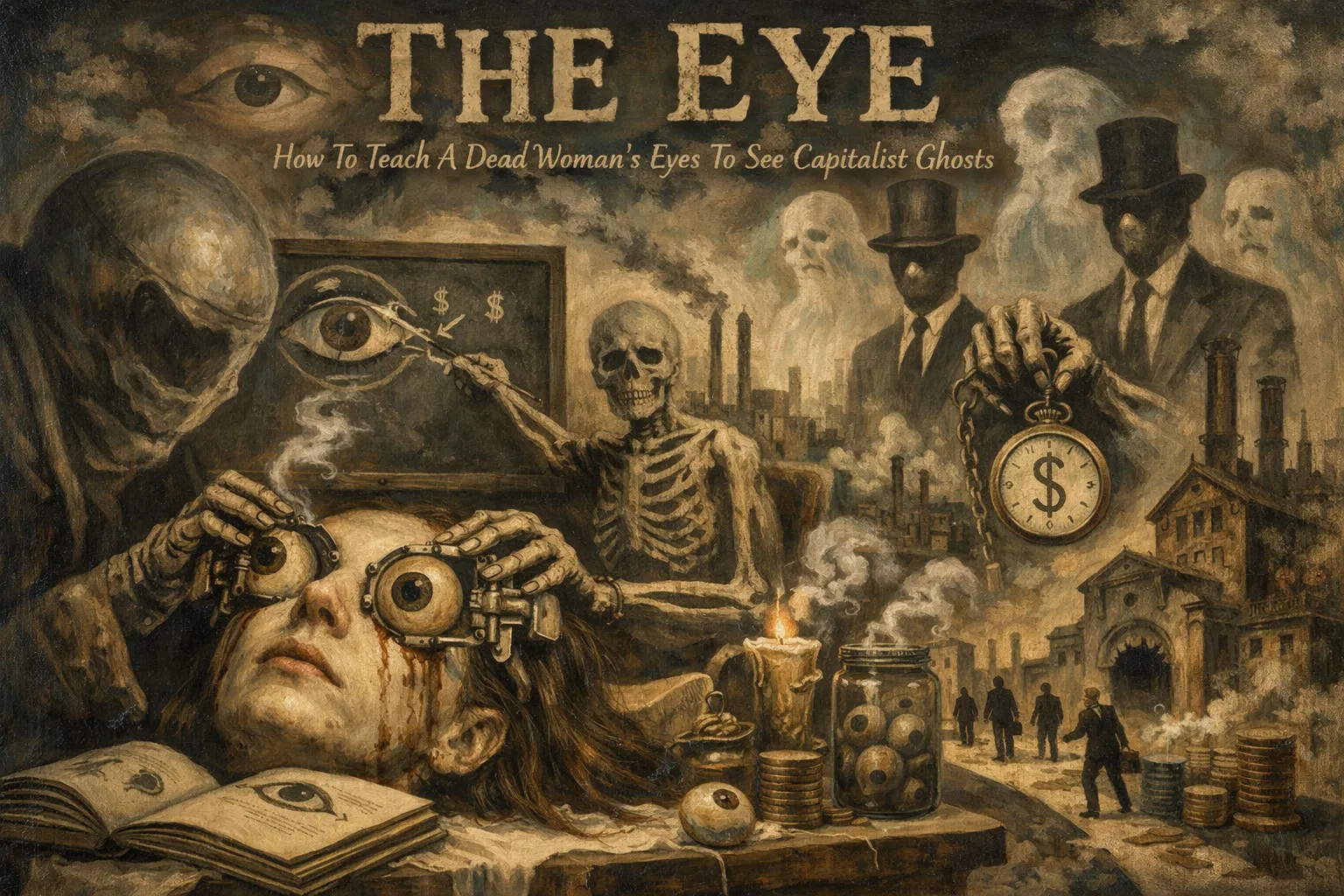
The problem with finally being able to see is that the world is already overfull with things that never agreed to be visible.
Hallways Where Vision Learns To Lie
The first corridor Mun walks after her transplant is not just hospital architecture; it is a tutorial level in a new ontology. The floor is real, the fluorescent hum is real, the hand on the wall is real—but the figure at the far end of the hallway refuses to choose between being an object and being an accusation. We, the spectators, already know it is a ghost; Mun does not yet know that “seeing” and “knowing” have been divorced, that the eye can be perfectly functional and still be fundamentally deceived.
Space here is not neutral backdrop. It folds around the appearance of the ghost, warping the corridor into a tunnel between two incompatible regimes of perception: the pragmatic hospital and the afterlife’s side-channel broadcast. Contemporary discussions of space in geospatial theory distinguish between space as absolute container and space as a web of relations between objects(Vastaranta et al., 2020). The ghost discovers a third option: space as the glitch in those relations, where the coordinates no longer add up to a coherent world but to a demand.
The corridor is thus a primitive machine: live body + transplanted eyes + institutional lighting + spectral residue. Each new step Mun takes feeds this machine. The film does not stage “psychology” in the modern therapeutic sense; it stages desiring-machines soldered together by surgical steel, fluorescent tubes, and grief. There is no inner realm separated from outer; there is a network of circuits where affects, images, and social institutions plug into each other and spark.
Staplers, Babies, And The Birth Of A New Eye
The stapler scene is almost comic in its banality. A woman who has spent her life blind sits opposite the therapist, and he holds up an object. “What is this?” he asks, as though naming were simple, as though vision were merely an app you can reinstall. Mun reaches not with her eyes but with her hand; touch is her native operating system.
For Mun, the stapler is a rattle in an infant’s fist: something that makes a noise in the world without yet coagulating into a concept. The therapist wants to drag her into the adult regime where objects are already sorted into functions, purposes, and exchange values. This is not just rehabilitation; it is colonization. It is the forced alignment of a newly opened visual field with the symbolic order that preceded it.
In that instant, we witness the violent modesty of “education.” Research on teaching contexts sometimes speaks of “faithful practice,” the attempt to attend seriously to the actual conditions and textures of a learner’s world(Beech, 2014, p. 3). Here, the therapist’s “faith” lies not in Mun’s pre-existing sensorium but in the existing visual-symbolic grid he needs her to enter. He is catechizing her into the church of the visible. The stapler is not merely a tool; it is a liturgical object of the office, inducted into the sacrament of paperwork.
The tragedy is that, alongside this catechism, another education is underway. The ghosts are teaching her a second ontology, running in parallel: one where objects do not stay quietly in their categories, where rooms overwrite themselves with other times, where the dead insist that the world is not closed. She is becoming bilingual in two incompatible visual languages at once.
Ghosts As Failed Subjects Of The Gaze
Jean-Paul Sartre notes that the dead remain in the world as objects, yet are stripped forever of the possibility of presenting themselves as subjects to another’s look (Sartre, 1956). The ghost in The Eye is precisely the rebellion against that sentence. She keeps trying to become a subject in Mun’s field of vision, to move from being a passive, seen thing to an active, seeing presence.
And yet her condition of death betrays her. She flickers, appears in blurred outline, staggers half-translucent through rooms that are not quite hers. She cannot stabilize into a legible message. When Mun’s bedroom oscillates into the room of the ghost’s suicide—furniture mutating, light changing, the rope an insistent vertical scar—the ghost attempts to force a comparison: Look, this was my room; look what your world refused to see. But she lacks the continuous materiality required to articulate a clear sentence. Her demand arrives as a stutter.
Freud called this stutter of the real into the visible world the unheimlich, the uncanny, where what should have remained hidden returns in distorted, frightening form (Freud, 1955). The ghost is the return of the unseen social crime—the shaming, the scapegoating, the refusal of her warning—now condensed into visual disturbances. But Freud’s term is still too domestic; the ghost is not just the repressed of one psyche but the repressed of a whole community’s political economy of attention.
She died of a failed gaze. The village looked at her and saw not a seer but a threat to the order of things. Her prophecy of fire was not an event in Alain Badiou’s sense—a rupture that calls a new truth into being—but a noise the situation managed to absorb and reject (Badiou, 2001). She hung herself at the point where her words could no longer find a position in the shared world. Now she returns, demanding not belief in her vision, but retroactive acknowledgment that she was ever truly seen.
Cinema As Exorcism: Religion, Film, And The Re-Creation Of Worlds
There is a quiet theological current running beneath The Eye: not in the form of priests or temples, but in the very act of rearranging the visible. Film theorists of religion argue that cinema can be understood as a medium that “re-creates the world,” staging new cosmologies of sense and experience through moving images(Mayward, 2019). Ghost stories in particular treat the screen as a thin membrane between this world and another, a kind of secularized iconostasis where the sacred flashes in horror’s clothing.
Mun’s transplant is more than a medical procedure; it is a secular miracle. Eyes—the paradigmatic organs of revelation—are replaced. The film then performs a double creation: first, it creates Mun’s new visual world, teaching us along with her what counts as “normal” sight; second, it populates that world with irregularities, anomalies, ghosts. Each shot becomes a liturgy of ambiguity.
Cinema, here, is not only representing the supernatural; it is simulating the very phenomenology of haunting. The jump cuts between Mun’s perspective and the camera’s clear view, the alternation between her blurred confusion and our knowledge—these formal techniques function like a liturgy of doubt. We are made to occupy two ontologies at once: one where ghosts are objectively there, and one where Mun might be hallucinating. The film itself becomes the haunted corridor she first walks down, a machine that will not decide for us which world is real.
In this sense, the movie participates in a broader cultural moment where memoir, affect, and neurological discourse meet. Contemporary discussions of life-writing emphasize the role of emotional memory and the brain’s limbic circuits in shaping how experiences are narrated(Shelley, 2019). Mun’s visual field is a kind of involuntary memoir not of her own past but of the ghost’s. She becomes the medium for someone else’s unprocessed catastrophe. The film is less about a woman learning to see than about a dead woman finally finding an amygdala willing to feel her story.
The Capitalist Optics Of Transplant Vision
Eyes do not float into hospitals by chance. Someone had to die; someone had to sign a document; a medical supply chain had to exist; a market had to be organized around the circulation of organs. Under capitalism, even the ability to see is mediated by the commodity form. Marx insisted that in commodity exchange, social relations between people take on the fantastical character of relations between things (Marx, 1977). In The Eye, the reverse also holds: relations between things (eyes, corridors, screens) reveal the suppressed history of relations between people.
The transplanted eyes carry an embedded social history: the ostracized seer, her suicide, the village that made her unlivable. None of that appears on the medical paperwork. The hospital treats the eyes as functional units, stripped of their past; the surgeon is akin to a shopkeeper exchanging goods, not a historian of suffering. Commodity fetishism here is literal: the fetish-object is an organ whose acquisition is supposed to free Mun into a fuller life while quietly binding her to another’s unresolved death.
Foucault’s analysis of modern institutions as apparatuses of surveillance and normalization finds a twisted echo here (Foucault, 1995). The hospital, with its clinical gaze, tries to normalize Mun’s body, bringing her into the regime of the visible worker-citizen who navigates world and screen with ease. Yet the eyes it installs introduce a counter-gaze that cannot be domesticated. The disciplinary machine miscalculates: it assumes that improving a sense organ is synonymous with deepening integration into the norm. Instead, it plugs Mun into an underground network of the excluded and the dead.
Wilhelm Reich once wrote of character armor: the way posture, muscle tension, and habitual emotional responses harden into a defense against intolerable energies (Reich, 1949). Mun’s previous blindness was a kind of social armor; the world’s cruelty and stupidity were kept at a tactile, auditory distance. After the transplant, the armor is punctured. But the new eyes come pre-loaded with someone else’s unspent rage and grief. The armor does not vanish; it migrates. Instead of a blind shell, Mun now has a haunted visor.
The Community That Refused Prophecy
The ghost’s backstory is almost banal in its horror. She foresaw a catastrophe: a fire that would kill many in her community. She tried to warn them. In return, they mocked, shunned, turned on her. The fire came; the bodies burned; she hung herself; and the community proceeded to metabolize the entire sequence into silence.
Ernest Gellner’s work on nationalism emphasizes how shared worldviews and loyalties structure what counts as intelligible within a community(Periwal, 2001, pp. 183–199). When someone speaks from outside the accepted frame—when their vision of the world diverges too radically—they risk being cast as mad, dangerous, or impure. The seer in The Eye is precisely such a figure. Her prediction threatened not just empirical expectations but the symbolic stability of the village. Better to let people die than to reconfigure the shared categories of sense.
Nietzsche would recognize in this the reactive soul of ressentiment (Nietzsche, 1994). The community, faced with someone who sees more than they do, responds not by elevating their own perspective but by degrading hers. Her warning is offensive precisely because it testifies to a power they lack. Rather than affirm their vulnerability and act, they prefer to condemn her as a disturbing element. Later, when the prophecy proves true, the guilt is too enormous to face. The solution: erase her, turn her into a local embarrassment, then a rumor, then nothing.
Except nothing stays nothing. The dead woman hangs again and again in Mun’s reconfigured room, nightly loops of failed recognition. Her suicide becomes an infinite GIF, replaying not for her own sake but as indictment of the community that converted truth into scandal and scandal into oblivion. Badiou would say they refused fidelity to the event—the fire as rupture—and thus forfeited the new political and ethical possibilities it opened (Badiou, 2001). The ghost is fidelity returning as nightmare.
Gaze, Screen, And The Horror Of Being Seen Too Late
Lacan famously distinguished the eye from the gaze, insisting that the gaze belongs not to the subject who looks but to the field of the visible itself, which seems to look back (Lacan, 1978). In The Eye, Mun’s new organs allow her to participate in a visual register that is already staring at her. As soon as she wakes from surgery, she is plunged into a field saturated with other beings’ claims on her attention: doctors, family, strangers, ghosts.
The most terrifying aspect is not that she sees ghosts, but that the ghosts see her. Their faces tilt, their blank or sorrowful eyes lock onto hers. The gaze here is not a neutral optical ray; it is accusation, plea, and metaphysical subpoena. The ghost’s repetitions—appearing in hallways, on buses, in bedrooms—constitute a dispersed tribunal.
Slavoj Žižek argues that cinematic images can stage a particular kind of gaze: not simply characters looking, but the film itself “looking back” at us through the arrangement of shots and sound (Žižek, 2001). In The Eye, point-of-view shots from Mun’s perspective are repeatedly undercut by objective views that reveal the ghost more clearly than she can see it. The editing thus plays a cruel game: the film knows more than its protagonist, and we share that excess knowledge. We are placed in the position of the community that refused to believe the seer. We see the ghost; she almost does; the institutions around her will not.
The horror, then, is delayed recognition. The psychiatrist, the family, the bus passengers—everyone around Mun clings to a safe ontology where the visible equals the real and the invisible equals hallucination. By the time they are forced to admit that the ghost is not simply “in her head,” it is too late to make amends to the dead donor. Recognition has arrived after the window for ethical action has closed. This is the ethical structure of haunting: an infinite too late.
Schizoid Optics: A Body With More Than One World
Before the transplant, Mun’s body approximated what Deleuze and Guattari call a “body without organs”: a surface of intensities and affects not yet fully pinned down by the dominant organ-machines of a visual civilization (Deleuze & Guattari, 1983). Touch, sound, temperature, smell—these were her primary lines of relation. She lived in a world of proximal, haptic encounters, a different cartography of space and time than the one organized by sight.
The transplant grafts onto this BwO a new organ that comes with its own symbolic firmware. Her eyes are not raw biological matter; they are already coded. They carry the sedimented experiences of a woman whose final years were spent being slowly expelled from her community’s shared reality. In Anti-Oedipus, Deleuze and Guattari insist that the unconscious is not a theater of representations but a factory of desiring-machines (Deleuze & Guattari, 1983). The ghost’s eyes, once installed, resume production: they begin to manufacture visions, flashbacks, warning signs.
Mun thus becomes a composite machine: her old affective circuits, her tactile memory, her auditory expertise, all now overlaid with a spectral visual feed. This is not multiple personality disorder; it is a doubled world-interface. On one level, she can learn to recognize staplers, faces, traffic signals. On another, she is haunted by images that resist integration into the everyday semiotic grid.
Cinema theory offers a parallel. In Cinema 2, Deleuze describes the “time-image,” where the sensory-motor schema of classical cinema breaks down and images no longer serve coherent, goal-directed action (Deleuze, 1989). Mun’s haunted visions are time-images invading her sensory-motor life: glimpses of past disasters, stalled suicides, and impending accidents that suspend her ability to act straightforwardly. Her body hesitates in front of doors, corridors, buses; every ordinary decision becomes an ethical and ontological gamble.
The Uncanny Bus And The Logistics Of Fate
One of the film’s most charged scenes occurs on a bus. Mun, already wary of her apparitions, sees a ghostly figure standing close to another passenger, hovering with intent. Here, everyday public transport becomes an arena where logistics and fate intersect. The bus is a capitalist machine par excellence: standardized route, predictable schedule, optimized flow of workers and students. But the ghost walks against the grain of this choreography, moving toward a single human node as if to mark them for death.
Baudrillard would have us notice how such a scene stages the collision of two orders of simulation (Baudrillard, 1994). The bus is part of the hyperreal infrastructure of late modern life: a space where individuals become interchangeable units in a transport system. The ghost, meanwhile, is like a bug in the software, a visual artifact that points to a remainder the system cannot account for: ungrieved death, unacknowledged guilt, a destiny that no timetable includes.
Mun’s panic—the frantic attempt to warn, to intervene—is a kind of micro-revolt against this logistical fatalism. She tries, belatedly, to be the prophet the donor once was. Where the dead woman failed to convince her village to evacuate before the fire, Mun tries to convince a stranger to move before catastrophe. The uncanny here is political: it is the return of the possibility that ordinary infrastructures are not neutral but deadly, and that only those who see differently can disrupt their smooth function.
But the film does not grant her an easy victory. Intervention is partial, always undercut by the stubborn inertia of systems and the skepticism of others. The lesson is cruel: seeing differently does not guarantee the power to change outcomes. Prophecy, sight, and agency are triangulated and then misaligned.
Ethics After The Ghost: Kant With A Headache
What kind of duty could we have toward the dead whose organs we use, whose lives we never knew, whose social deaths preceded their physical ones? Kant insisted that we must never treat persons merely as means but always also as ends in themselves (Kant, 1998). But what happens when the person is already dead, and the only trace left is an organ, a vision, a repetitive nightmare?
Mun’s journey might be read as a belated attempt to treat the donor as an end: to uncover her story, to acknowledge her suffering, to repair, however symbolically, the injustice done to her. This is a peculiar extension of ethical regard, because it moves both backward in time and outward beyond the limits of shared language. The ghost cannot articulate maxims or consent; she is caught in a loop of traumatized repetition. Yet her very persistence is a kind of mute moral claim: do not let what happened to me vanish into statistics.
This demand collides with the clinical ethos of “first, do no harm,” a principle invoked in scientific and medical ethics debates that emphasizes avoiding new damage over correcting old injustices(May, 2014, pp. 1065–1065). The surgeons have succeeded by that limited standard: they restored sight without killing anyone. But the film suggests this is not enough. Harm is not just what happens intraoperatively. Harm includes the historical violence embedded in the materials we use to heal, the social deaths and exclusions that make certain bodies available as donors in the first place.
The ghost transforms Kantian dignity into something like negative theology: she is not a person we can respect in the usual ways, yet her very impossibility becomes the measure of our ethical failure. We have no ready-made category for duties to the invisibly dead; The Eye manufactures one by force.
Haunted Worlds As Cultural Products
Mathematics is often treated, in philosophy, as an exception: a kind of pure knowledge untouched by culture. Yet some thinkers insist that even mathematics is a cultural product, shaped by histories, languages, and social needs(Volker & Thoralf, n.d.). Vision, too, is usually naturalized, taken as a neutral channel of truth. The Eye annihilates that fantasy.
Mun’s new sight is not a simple access to reality; it is a cultural artifact, woven from surgical techniques, eye-donation protocols, medical metaphors, cinematic traditions of the ghost story, and East Asian spiritual imaginaries. The very form of her haunting—the way ghosts appear, linger, distort rooms—is scripted by genre as much as by metaphysics.
Film criticism of religion and cinema reminds us that movies do not simply represent inherited cosmologies; they actively re-create worlds, mixing sacred and secular, horror and transcendence(Mayward, 2019). The Eye creates a world where technology, trauma, and spiritual residue are inseparable. To see is to participate
References
Badiou, A. (2001). Ethics: An essay on the understanding of evil (P. Hallward, Trans.). Verso.
Baudrillard, J. (1994). Simulacra and simulation (S. F. Glaser, Trans.). University of Michigan Press.
Deleuze, G. (1989). Cinema 2: The time-image (H. Tomlinson & R. Galeta, Trans.). University of Minnesota Press.
Deleuze, G., & Guattari, F. (1983). Anti-Oedipus: Capitalism and schizophrenia (R. Hurley, M. Seem, & H. R. Lane, Trans.). University of Minnesota Press.
Foucault, M. (1995). Discipline and punish: The birth of the prison (A. Sheridan, Trans.). Vintage Books.
Freud, S. (1955). The “uncanny.” In J. Strachey (Ed. & Trans.), The standard edition of the complete psychological works of Sigmund Freud (Vol. 17, pp. 217–256). Hogarth Press. (Original work published 1919)
Gellner, E. (1983). Nations and nationalism. Cornell University Press.
Kant, I. (1998). Groundwork of the metaphysics of morals (M. Gregor, Ed. & Trans.). Cambridge University Press. (Original work published 1785)
Lacan, J. (1978). The four fundamental concepts of psychoanalysis (A. Sheridan, Trans.). W. W. Norton.
Lang, T. A. (2023). Where did this come from? When (not how) to cite sources in scientific publications. European Science Editing.
Marx, K. (1977). Capital: A critique of political economy (Vol. 1, B. Fowkes, Trans.). Vintage Books. (Original work published 1867)
Nietzsche, F. (1994). On the genealogy of morality (C. Diethe, Trans.). Cambridge University Press. (Original work published 1887)
Pang, O., & Pang, D. (Directors). (2002). The eye [Film]. Applause Pictures.
Reich, W. (1949). Character analysis (T. P. Wolfe, Trans.). Farrar, Straus and Giroux.
Sartre, J.-P. (1956). Being and nothingness: An essay on phenomenological ontology (H. E. Barnes, Trans.). Philosophical Library.
Žižek, S. (2001). The fright of real tears: Krzysztof Kieślowski between theory and post-theory. British Film Institute.
Comments
Post a Comment