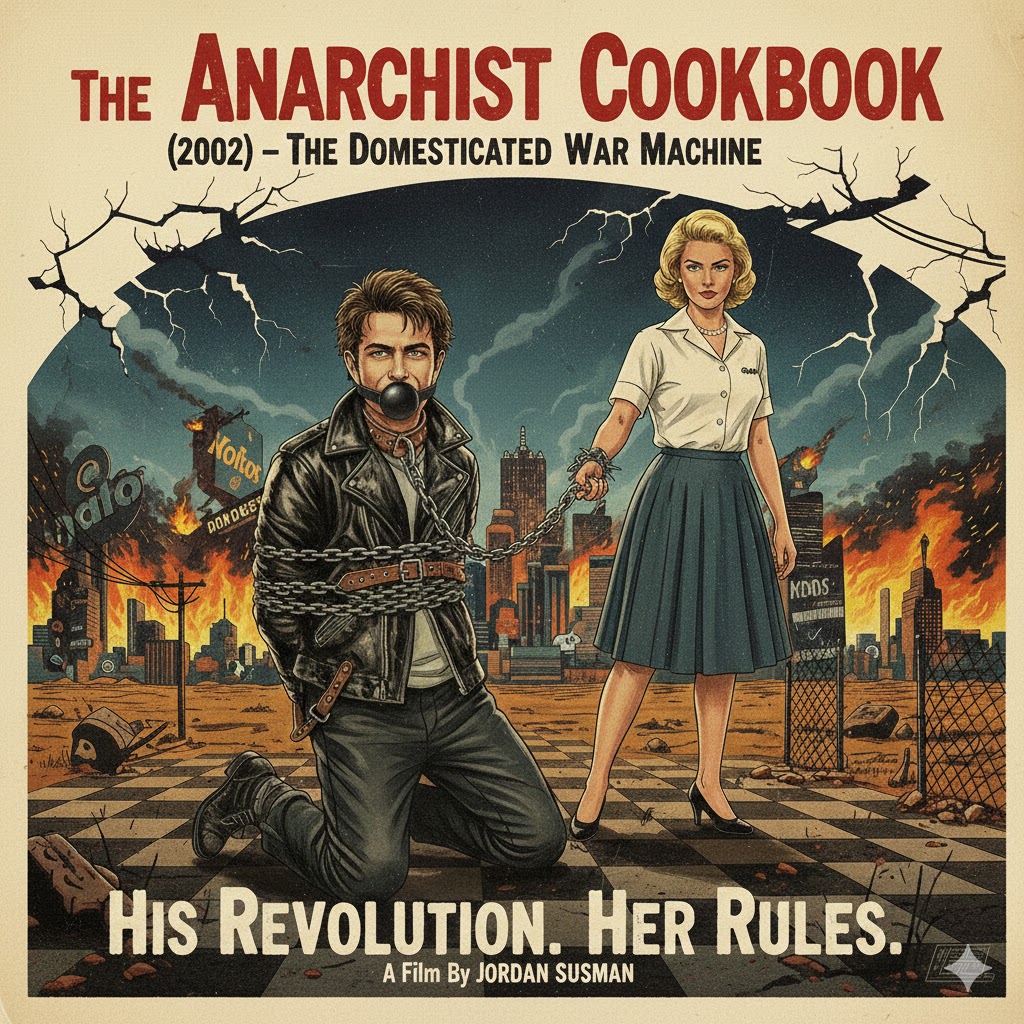
A mapmaker asked the nomad for the secret trail through the dunes. The nomad handed him a handful of shifting sand. "Follow this," he said. The mapmaker cried, "But the wind will blow it away!" The nomad nodded: "That is the only way to ensure the State doesn't follow you."
I. Introduction: The Cartography of the Line of Flight
The nomad does not move; on the contrary, he is nomad because he does not move, because he sticks to the steppe and is only displaced by the intensity of the desert itself. In The Anarchist Cookbook (2002), the protagonist Puck begins as such a nomad, a Body without Organs (BwO) attempting to vibrate at a frequency that the Molar structures of Dallas, Texas—the university, the family, the corporate grid—cannot decode. He is a philosophy student who has abandoned the striated space of the academy for the smooth space of a fringe anarchist collective. This movement is not a simple rebellion; it is a Line of Flight, a deterritorialization of the self that seeks to escape the Oedipal triangle of father-mother-son and the State Machine that demands a productive, recognizable identity.
However, the tragedy of the film lies in the Apparatus of Capture. The State is not just a central government; it is a process of capture that operates at every level of social and psychic life (Deleuze & Guattari, 1987). In this Dallas-based narrative, the capture is not performed by the police or the military, but by the Small State of domesticity and Emotional Capitalism. Jody, the sorority-affiliated representative of the Dallas elite, functions as the primary agent of re-territorialization. She does not use chains; she uses affect. She does not use a cage; she uses a competence-oriented project of reform (Zhukova et al., 2015). The film’s arc is the violent Capture of a nomad, where the War Machine of the anarchist collective is dismantled not by external force, but by the internal clotting of desire into the form of a bourgeois romance.
This treatise will map this capture by synthesizing the schizoanalysis of Deleuze and Guattari with the critique of Cold Intimacies (Illouz, 2007). We will see how Puck’s schizo-desire is rationalized, how his molecular potential is molarized, and how the happy ending of the film is, in fact, a chilling victory for the Apparatus of Capture.
II. The Failing War Machine: Johnny Red’s Entropy
The anarchist collective Puck joins is an attempt to create a War Machine in the heart of the Dallas sprawl. The War Machine is defined as an assemblage that exists outside the State, characterized by smooth space and nomadic movement (Deleuze & Guattari, 1987). Initially, the group’s existence in a derelict warehouse—a non-place in the urban grid—represents a refusal to be coded. They are desiring-machines plugged into the Cookbook itself, a manual of destruction that promises to detonate the Molar structures of the city.
Yet, the group suffers from Paranoia, the fascist-adjacent drive for control that often infects the revolutionary cell. Johnny Red, the group’s leader, represents the Paranoid Pole of the machine. He does not want to liberate desire; he wants to code it under his own authority. His leadership mimics the State he claims to despise. He demands loyalty, he enforces a hierarchy, and he seeks a Grand Event that would fix the group’s identity in history. The revolutionary machine often risks becoming a micro-fascism when it begins to desire its own repression (Deleuze & Guattari, 1983, p. 215).
The Cookbook itself becomes a symbol of this failure. It is a failed code. When the group attempts to follow its instructions to create a bomb, the result is entropy—a fizzle rather than a blast. This failure marks the symbolic death of the collective’s War Machine. Without a functional code for destruction, the smooth space of the warehouse collapses. The members are no longer nomads; they are merely unemployed, a category that the State can easily manage. This vacuum of desire—this failure of the revolutionary line—creates the opening for Jody’s domestic intervention. Puck, adrift and molecularly unstable, becomes a prime target for Capture.
III. Jody as the Small State: The Grids of Domesticity
If Johnny Red is the Paranoid State, Jody is the Seductive State. She represents the Dallas Status Quo—a high-gloss social grid of sororities, high-rises, and Human Capital (Kulzhanova, 2020). Her background is a Coding Mechanism designed to produce competent subjects. When she encounters Puck, she does not see a revolutionary; she sees a Project. This is the fundamental desire of the State: to fence, name, and territorialize the wild.
Jody’s intervention is a Seductive Capture. She replaces Puck’s revolutionary desire with Lack. In the Oedipal framework, desire is defined by what one does not have (Deleuze & Guattari, 1983). Jody convinces Puck that his nomadism is not a Line of Flight, but a pathology or immaturity. She frames his life in the warehouse as a lack of stability, a lack of future, and a lack of Human Capital (Kulzhanova, 2020). By doing so, she territorializes his desire, pointing it toward the Molar goals of the Dallas elite: a career, a home, and a partner.
The Aesthetic Colonization of Puck begins with Jody’s Gaze. She looks at him through the lens of Emotional Capitalism. In modern capitalism, affect and intimacy are rationalized and turned into commodities (Illouz, 2007). Jody does not love Puck for his schizoid intensity; she loves the idea of reforming him. He is an exotic asset that she can refine and display. Her Gaze is a mapping tool that identifies the organs Puck needs to grow: a work ethic, social etiquette, and emotional maturity. She is grooming him to become a bearer of wealth in her social circle (Kulzhanova, 2020, p. 108).
The architecture of the film shifts to reflect this capture. We move from the smooth, communal space of the warehouse to the striated, private space of the bedroom and the sorority house. The bedroom becomes the primary site of Oedipalization. It is here that the nomad is reduced to the boyfriend, a fixed role in a Molar assemblage. The War Machine is traded for the Domestic Machine.
IV. Illouzian Synthesis: The Emotional Capitalism of the 2002 Dallas Elite
To understand the depth of Puck’s capture, we must apply the concept of Cold Intimacies (Illouz, 2007). In these spaces, emotional life has become a public entity and economic models have come to define our most intimate relationships (Illouz, 2007, p. 5). In The Anarchist Cookbook, Jody’s relationship with Puck is a textbook example of Emotional Capitalism.
Jody provides the infrastructure for Puck’s transformation: money, housing, and social standing. In exchange, she demands his emotional submission. This is a contractual intimacy. She uses therapeutic language to colonize Puck’s mind, framing his anarchist beliefs as issues to be worked through. This is what might be described as a form of professional literacy—Puck is being taught the language of the elite so he can function within their mainstream classroom of social life (Rakovská & Pustovoichenko, 2021). His schizo-desire is turned into Managed Emotion.
Furthermore, Puck becomes a commodity for the Dallas elite. In a post-industrial society, the sphere of culture, including family, education, and science, becomes an increasingly leading sector of production (Kulzhanova, 2020, p. 108). Puck’s rebellion is the raw material that Jody processes into a reformed rebel narrative. This narrative has high Human Capital value in her social world. It makes her look edgy and compassionate simultaneously. She is consuming his authenticity to revitalize her own stagnant, bourgeois existence.
This is the Consumptive Romance. The Dallas elite consumes the energy of the fringe to fuel its own Molar reproduction. Puck is not being saved; he is being harvested. His Line of Flight is intercepted and rerouted into the circuits of capital.
V. The Molecular Maiming: Grooming and Signification
The physical transformation of Puck is a Molecular Maiming. Every stitch in his new wardrobe is a coding of his body. Signifiance and Subjectification function as the two walls of the State Machine (Deleuze & Guattari, 1987). Puck is forced to signify—to wear the clothes that say I am a citizen—and to subjectify—to accept the I that Jody has constructed for him.
The Makeover scene is not a lighthearted trope; it is a Molarization. Replacing anarchist signifiers with the uniform of the Dallas professional is a way of striating Puck’s body. His body is no longer a Body without Organs capable of nomadic intensities; it is now a mapped territory. He is assigned organs or functions: the provider, the partner, the success story.
Language also plays a role in this Maiming. Puck must abandon his schizoid philosophical slang for the sober speech required by the Dallas hierarchy. He must learn to speak the language of competence and responsibility (Zhukova et al., 2015). This is a semiotic capture. By controlling his language, Jody controls the flows of his thought. He can no longer think outside the grid because his very vocabulary has been territorialized.
This Grooming is a form of micro-policing. Jody monitors his behavior, his associations, and his progress. She uses positive reinforcement and negative reinforcement to keep him on the Line of Capture. Puck’s molecular potential—his ability to become other—is systematically erased. He is fixed in place.
VI. The Body Without Organs Under Siege
To go deeper into Puck’s psychic landscape, we must observe how the Body without Organs (BwO) is not a thing but a limit. Puck’s initial attraction to the anarchist warehouse is an attempt to construct a full BwO—a state of pure intensity where the organs of social utility are discarded. As the theory explains:
The BwO is not at all the opposite of the organs. The organs are not its enemies. The enemy is the organism. The BwO is not a dead body, but a living body all the more alive and teeming once it has blown apart the organism and its organization. (Deleuze & Guattari, 1987, p. 149)
Puck’s tragedy is that he fails to maintain the sobriety required to inhabit the BwO. He falls into the trap of the emptied BwO—the state of the addict or the nihilist—which leaves him vulnerable to the cancerous BwO of the State. Jody recognizes this vulnerability. She doesn't just give him a new suit; she gives him a new organism. She organizes his intensities into a person. In the Dallas landscape, a person is a set of predictable responses.
By introducing the BDSM element into the domestic space, Jody further complicates the capture. In the sorority girl archetype, we expect a rejection of the transgressive. Yet, by incorporating BDSM, Jody creates a controlled transgression. This is the ultimate Apparatus of Capture: the ability of the Molar system to simulate the smooth space of the nomad within the striated walls of the suburban bedroom. Puck thinks he is exploring a new frontier of intensity, but he is actually being coded into a new form of subjection. The War Machine is made to perform as a kink for the bourgeoisie.
VII. The Dallas Steppe: Striated Spaces and Urban Nomads
Dallas, Texas, serves as a crucial antagonist in this schizoanalysis. It is the city of the Grid. The university, the corporate headquarters, and the gated communities are striated spaces par excellence. Striated space is defined by point-to-point movement (Deleuze & Guattari, 1987). You go from the home to the office; from the office to the gym. The nomad, however, lives in smooth space, where the line is more important than the point.
The anarchist warehouse was a pocket of smooth space that Puck tried to protect. But as the film progresses, we see the urban renewal of Puck’s mind. The smooth space is paved over. The steppe of his philosophical inquiry is partitioned into lots. This is the process of territorialization, by which the State takes the un-coded flows of the earth and stamps them with the seal of property (Deleuze & Guattari, 1987).
Puck’s displacement by the intensity of the desert is replaced by his placement by the density of the mall. The desert of anarchist possibility is terrifying; the mall of Jody’s affection is comfortable. This comfort is the primary weapon of the Dallas Small State. It is a velvet capture.
VIII. The Sorority as Micro-Fascism
We must examine the Sorority as a specific Molar machine. It is a factory for the production of Standardized Affect. The sorority girl is the Junior State. She is trained in the art of signification—how to dress, how to smile, how to exclude. When Jody targets Puck, she is applying the sorting logic of the Greek system to a biological subject.
This is a form of Micro-Fascism. As the theory warns:
It is too easy to be an antifascist on the molar level, and not even see the fascist inside you, the fascist you sustain and nourish and cherish with molecules of personal and collective resignation. (Deleuze & Guattari, 1987, p. 214)
Jody’s love is a molarized resignation. She resigns Puck to his fate as a husband. She resigns his intellect to the service of social climbing. The War Machine of his mind is not destroyed by a tank; it is sustained and nourished until it becomes a harmless pet. This is the Domesticated War Machine. It still has the aesthetic of rebellion, but it has no functional exteriority. It is a rebellion that stays for dinner and helps with the dishes.
IX. The Oedipal Residue: No Son Escapes
The film’s subtext is a desperate flight from the Father. Puck’s rejection of the striated space of the academy is a rejection of the Nom-du-Père (the Name of the Father). He wants to be a son without a father, a student without a teacher. But the Oedipal triangle is a closed circuit. If you run from the Father, you often run straight into the arms of the Mother-State.
Jody fulfills the role of the Maternal Capture. She offers a womb of safety—the sorority house, the stable income, the domestic routine. In exchange, she demands the castration of his nomadic drive. Puck traded the law of the university for the desire of Jody, only to find that her desire was the law in a different dress.
This is the Oedipal Residue. Even in the heart of an anarchist collective, the members are haunted by the Molar ghosts of their upbringing. Johnny Red plays the Angry Father, and Puck plays the Rebellious Son. The War Machine fails because it is still Oedipalized from within. They are not nomads; they are sons in the desert, waiting for someone to tell them to come home. Jody is the one who finally makes the call.
X. The Professionalization of the Rebel
The transition of Puck from a molecular anarchist to a molar citizen is managed through a specific technology of Professional Literacy. This is best understood through the SIOP model (Sheltered Instruction Observation Protocol), a framework designed to integrate outsiders into a dominant linguistic and cultural order. Through a competence-oriented pedagogical shift, the Small State of the Dallas elite treats Puck’s nomadism as a language barrier that must be overcome. Jody functions as the primary instructor in this sheltered environment, using SIOP-style Comprehensible Input to translate the terrifying intensities of the desert into the manageable vocabulary of the careerist. She builds background by reframing his revolutionary desires as unmet emotional needs, and she uses Review and Assessment to monitor his performance at social functions. This is the Professionalization of the Rebel (Rakovská & Pustovoichenko, 2021). Puck is not being educated; he is being coded into a specialist of his own subjection, proving his competence by successfully navigating the striated classroom of the Dallas high-society (Zhukova et al., 2015).
Jody’s reformation of Puck follows a competence-oriented trajectory. She gives him tasks that test his ability to integrate: social dinners, dress codes, emotional management. She is essentially teaching him a foreign language—the language of the elite. This is a communicative competence that erases his schizoid stuttering.
The goal of modern education is to create specialists who can function within the Dallas Integration (Rakovská & Pustovoichenko, 2021). Puck becomes a specialist in his own subjection. He learns to perform the role of the reformed citizen with such efficiency that the War Machine is forgotten. He becomes a resource for the State.
XI. The Final Re-territorialization: The Triumph of the Molar
The climax of the film—Puck’s betrayal of Johnny Red and the anarchist group—is the moment the Capture is finalized. This is not a moral choice; it is a machinic one. Puck has been so thoroughly re-territorialized into Jody’s world that the War Machine of the anarchists now appears to him as noise or danger. He chooses the striated safety of the Small State over the smooth danger of the nomad.
The betrayal is the Synthesis of his new identity. By turning in his former comrades, he cuts his last Line of Flight. He proves his competence to the Molar world (Zhukova et al., 2015). He has successfully transitioned from a threat to a resource. He is now Human Capital (Kulzhanova, 2020).
The Happy Ending—Puck and Jody together, the rebel reformed—is, from a schizoanalytic perspective, a tragedy. It represents the total clotting of desire. The nomad has been settled. The War Machine has been privatized into a romance. The State has won, not through the Paranoia of Johnny Red, but through the Seduction of Jody. The Apparatus of Capture has functioned perfectly, turning a warrior into a consumer.
XII. Conclusion: The Persistence of the Grid
The Anarchist Cookbook (2002) reveals the terrifying efficiency of the Small State and Emotional Capitalism. It shows that the most effective Apparatus of Capture is not the one that represses desire, but the one that manages it. Jody’s Capture of Puck is a molecular victory for the Molar world.
The film forces us to ask: can the nomad ever truly escape? Or does desire always eventually clot into domesticity within a capitalist framework? In the Dallas of 2002, the grid is persistent. Every Line of Flight is monitored by Emotional Capitalism, ready to be turned into a Project or a Commodity. Puck’s journey is a warning that the War Machine is always at risk of being domesticated, and that the happy ending is often just the final stitch in our own Capture.
The Human Capital of the 21st century is not just our labor, but our affect, our rebellion, and our intimacy (Kulzhanova, 2020). As long as we desire our own repression in the form of a Molar romance, the Apparatus of Capture will continue to thrive. The Cookbook may have failed to blow up the city, but the city succeeded in blowing up the nomad.
XIII. Postscript: The Schizo as the Only Way Out?
If the Apparatus of Capture is this efficient, what remains of the Line of Flight? A grim but vital instruction remains:
You have to keep enough of the organism for it to reform each dawn; and you have to keep small supplies of significance and subjectification, if only to turn them against their own system when the circumstances and opportunities—that is, the intensities—direct it (Deleuze & Guattari, 1987, p. 160).
Puck’s mistake was not his desire for a Line of Flight, but his failure to keep enough of the organism to survive the desert. He surrendered his molecular intensities entirely to the Molar grid. To be a true nomad is not to run away to a warehouse, but to stay in the city while refusing to be captured by its logic. It is to stick to the steppe even when the steppe is a Dallas sidewalk.
The true Anarchist Cookbook would not be a manual for bombs, but a manual for De-territorialization—a way to keep the War Machine moving even when it is sitting perfectly still in a sorority house. But for Puck, the Cookbook is closed. He has become a signifier in Jody's story. He has stopped vibrating. He has moved, and in doing so, he has ceased to be a nomad.
References
Deleuze, G., & Guattari, F. (1983). Anti-Oedipus: Capitalism and schizophrenia (R. Hurley, M. Seem, & H. R. Lane, Trans.). University of Minnesota Press.
Deleuze, G., & Guattari, F. (1987). A thousand plateaus: Capitalism and schizophrenia (B. Massumi, Trans.). University of Minnesota Press.
Foucault, M. (1978). The history of sexuality, Volume 1: An introduction (R. Hurley, Trans.). Random House.
Illouz, E. (2007). Cold intimacies: The making of emotional capitalism. Polity Press.
Kulzhanova, G. (2020). Human capital: Genesis and evolution. Sociopolitical Sciences, 10(2), 108–113.
Rakovská, M., & Pustovoichenko, D. (2021). Improving the efficiency of foreign language teaching for future non-linguistic specialists with the application of the SIOP model. Trends of Philological Education Development in the Context of European Integration.
Reich, W. (1949). Character analysis (T. P. Wolfe, Trans.). Farrar, Straus and Giroux.
Zhukova, A. M., Kubrushko, A. F., & Shingareva, A. V. (2015). Mechanism for designing competence-oriented tasks in various academic subjects and requirements for its implementation in higher educational establishments. Scientific Review.
Comments
Post a Comment