Sympathy for Lady Vengeance (2005) – The Tofu That Refuses to Forgive: Vengeance as a Broken Machine
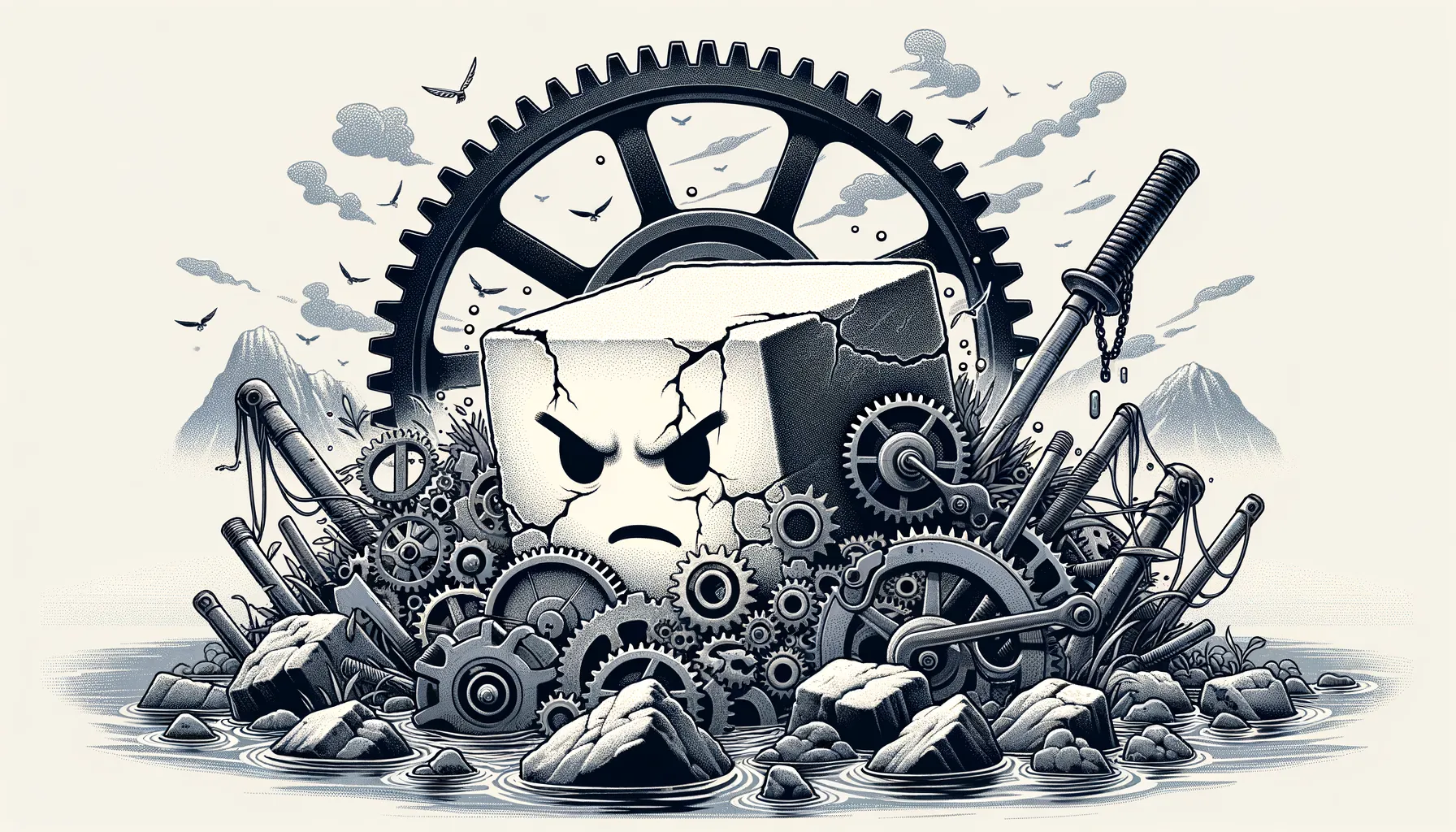
The film begins after the crime, after the confession, after the verdict; Sympathy for Lady Vengeance opens where justice should have already done its work, and yet everything important still remains to be decided.
Law as a Tired Machine, Vengeance as a Short-Circuit
The judge’s hammer falls, the file closes, and a teenage girl becomes a murderer in the eyes of the state. Nothing in the film is more terrifying than how banal this moment is: the law functions, the prison doors shut, the machine of criminal justice proceeds without a visible glitch. The glitch is elsewhere, under the surface, in the flows of desire and power that made Geum‑ja’s guilty plea desirable to the state, to the media, to the man who orchestrated it, and in some opaque way even to Geum‑ja herself.
The courtroom here is not a temple of rationality but a tired desiring-machine that has long since forgotten what it desires, beyond the continuation of its own procedures. The “truth” it produces is merely the byproduct of a more fundamental demand: that crimes be distributed, identities stabilized, and narratives closed. Punishment, as Nietzsche already saw, is less an equivalence between crime and pain than a theatre for the creditor’s enjoyment, a spectacle in which the balance-sheet of ressentiment is endlessly rewritten without ever being settled (Nietzsche, 1994). The law absorbs an excess—social panic, media hysteria over a dead child—and discharges it as a sentence on a single body.
The film’s first fundamental betrayal, then, is not the murder of a child but the state’s willingness to accept Geum‑ja’s confession as sufficient; it is enough that the machine can continue to spin. Foucault’s analysis of modern punishment as a network of “micro-powers” is visible here less in any explicit disciplinary technology than in the very ordinariness of the legal process, which converts the singular violence of the crime into a manageable unit: case file, inmate, sentence (Foucault, 1977). The question is not whether the law errs, but how it continues to desire precisely through its errors.
Vengeance enters as a parasitic machine plugged into the law’s exhausted circuitry. It does not oppose justice; it intensifies and privatizes it, steals its codes, and reassembles them in the back alleys of the social field. Geum‑ja does not reject judgment; she claims the right to judge otherwise, elsewhere, and with different instruments.
Prison as Factory: Assembling the Avenger
The prison that receives her is less a place of rehabilitation than a factory for producing a new kind of subject: the woman whose innocence has been officially revoked, whose anger has no legitimate outlet, and whose only available dignity is mastery over other captives. Inside, Geum‑ja learns to operate a small-scale version of the very machine that crushed her.
The bleach-feeding scene—soap on the floor, the bully’s fall, the spoon of poison delivered with an almost maternal tenderness—is a crystallization of this process. Here, care and cruelty function on the same circuit. The desiring-machine that the institution wanted to produce—docile inmate, grateful penitent—is rewired into something else: a finely calibrated mechanism of harm, patient, methodical, capable of inhabiting the role of nurturer and assassin in the same gesture.
The bully is herself a small sovereign, a petty tyrant authorized by the micro-politics of the cell block. By poisoning her over time rather than stabbing her in the shower, Geum‑ja does not merely remove an obstacle; she performs an experiment in power. She discovers that she can manipulate the flows of nourishment, trust, and dependency that structure even the most degraded relationships. Like the disciplinarian who “cares” for the delinquent by training their body and soul, she takes charge of another’s vulnerability in order to sculpt it according to her own design (Foucault, 1977). The bully becomes her first condemned man.
At the same time, the network of alliances she weaves inside the prison—indebted inmates, awed guards, fascinated onlookers—constitutes the prototype of a future conspiracy. These are trial runs for the more elaborate assemblage to come, where parents of murdered children will replace cellmates, and the desolate chapel of the prison will give way to an improvised tribunal of vengeance. Desire here is not the private, inner feeling of a psyche; it is the electric relation between bodies, favors, threats, gossip, and rumors, a circuitry that Geum‑ja learns to modulate.
The prison thus does not simply victimize her; it arms her. It is the workshop in which the “lady vengeance” persona is hammered out of humiliation, patience, and a coldly experimental cruelty. The state manufactures its own saboteur.
The Christian Machine and the Refusal of Ready-Made Redemption
If the prison is one machine, the chaplain and his retinue of Santas are another. When Geum‑ja convinces the priest she is “born again,” the film stages a different regime of power: that of confession, absolution, and symbolic rebirth. Christianity here does not appear as transcendent salvation but as an auxiliary apparatus bolted onto the penal system, offering a smoother passage from inmate to citizen, from deviance to reintegration.
It is no accident that the priest becomes the guarantor of her transformation, the man who can testify that her soul’s trajectory is now aligned with the community’s values. This is the logic of what Nietzsche called the “priestly” mode of power: the exploitation of guilt as a renewable resource, the promise of redemption as a lure that keeps subjects tethered to an authority that both condemns and saves (Nietzsche, 1994). Geum‑ja plays this game without believing in it, consenting to be categorized as repentant in order to shorten her sentence.
The tofu is the sacrament of this apparatus. Offered at the prison gate, pale and bland, it is meant to symbolize purity and a fresh start. The priest’s tremulous explanation—this is traditionally what the newly released eat to show their determination to live righteously—transforms a simple food into an edible contract. To take a bite is to submit to the narrative: I was impure, I have been corrected, I now choose the path of good. The tofu is the host of the penal-Christian machine.
When Geum‑ja knocks the tofu to the ground and tells the priest to go screw himself, she is not simply being rude; she is refusing a ready-made script of redemption, refusing to let her story be closed by someone else’s ceremony. The desiring-machine of Christianity wants her guilt and her gratitude; she offers instead a surplus of rage that cannot be metabolized in such a mild ritual.
Yet the refusal is not a clean break. The tofu will return in another form, at another time, on a different surface. The very object she rejects as an imposed symbol will later be weaponized as her own. Between these two bricks of coagulated soybean—the one refused at the gate and the one into which she plunges her face at the end—the entire trajectory of the film unfolds.
From Personal Vengeance to Distributed Guilt
Initially, Geum‑ja’s plan is focused: find Mr. Baek, the man who kidnapped her child, forced her confession, and used her as a shield for his own crime; then kill him. This is vengeance in its most classical, Oedipal form: eye for eye, child for child, life for life. It presupposes a relatively simple topology of harm: one perpetrator, one primary victim, one avenger who stands in for the damaged life.
But the phone charms, jangling like a perversely cheerful rosary on Baek’s cellphone, ruin this simplicity. Each charm indexes another child, another erased life, another set of parents whose grief has never been recognized by the law. In a single cut, the crime ceases to be a personal wound and becomes a serial operation, a repetition without closure. The murderer does not simply take children; he manufactures mourning as an endless product, feeding a hidden economy of trauma in which the state, the media, and everyday life all collude by way of their indifference.
At this moment, Geum‑ja’s vengeance deterritorializes. No longer a straight line from her injury to his death, it becomes a branching network, a rhizome of linked sorrows. The desire for reparation is redistributed: she wants revenge not only as herself, but on behalf of anonymous others. Vengeance becomes a vector for solidarity.
It is tempting to see this as a moral elevation: she transcends ego, discovers empathy, becomes a representative of the many rather than the one. But from a different angle, this is less a spiritual awakening than an intensification of her desiring-machine. By incorporating other parents’ grief into her own circuit, she amplifies the force and legitimacy of her project. Their suffering becomes an additional current, a set of external drives that plug into her already loaded apparatus.
The law, for its part, is revealed as structurally incapable of handling this multiplicity. It can barely track a single murder; it has already been tricked by one false confession. What would it do with a man who has killed several children over years, across jurisdictions, leaving no bodies and no witnesses? Its categories are too narrow, its methods too slow, its will to expose its own failure too weak. The serial murderer is an overflow condition for the justice machine, a kind of bug that the system manages only by pretending not to see it.
In this sense, Geum‑ja’s shift from individual to collective vengeance is not the imitation of the law’s impartiality but the acknowledgment that only outside the law can this scale of horror be addressed. Justice, if it is to exist here at all, must be hacked together from the scraps of a broken system and the raw energy of parental despair.
The PTA of Revenge: A People’s Tribunal on a Body Without Organs
The improvised gathering of the parents—summoned, led into a classroom-like space, shown the videotapes of their children’s abductions and deaths—is one of the most disturbing people’s assemblies in cinema. It looks, for a moment, like a radical-democratic scene: ordinary citizens, kept in ignorance by the state, finally receive the truth and are asked to decide collectively what to do.
Yet everything about the event is wired for excess. The parents are not invited to a deliberative forum but to a traumatic re-experiencing: their children’s final moments, recorded by the killer himself, are projected back into their nervous systems. If, as Žižek insists, the obscene underside of law is always an enjoyment that cannot be acknowledged in the formal order, then here we see that enjoyment crudely exposed: the killer’s private archive of pleasure turned into a shared spectacle whose horror is indistinguishable from a dark fascination (Žižek, 1992).
After these images, the options Geum‑ja lays out—turn Baek over to the police, or kill him themselves—are hardly equivalent. The law’s path is technocratic and abstract: investigation, trial, appeal, sentence. The other path is immediate, visceral, intimate: their hands on his body, their blows carving a counter-history into his flesh. Any pretense of a neutral jury dissolves under the flood of affect. The choice is not between justice and barbarism, but between two incompatible constructions of justice—one molar, coded, slow; the other molecular, improvisational, and cruel.
When the parents opt for direct vengeance, they do not simply become a mob. They organize shifts, discuss weapons, could almost be mistaken for a committee planning a school event. The PTA of revenge is a hyperbolic mirror of everyday civil society: the same small talk, the same awkward jokes, now orbiting a man bound and gagged in the corner. Here the “people” does not appear as an abstract subject of democracy but as a swarm of desiring-machines, each calibrated by a unique biography of loss, each now connected to a shared project: to inscribe into Baek’s body the acknowledgment that was denied to their children.
The killer’s restrained body, in this setting, becomes a kind of sacrificial surface, a body without organs on which a community attempts to re-found its sense of reality. They cannot retrieve the dead, cannot repair the years of lies and silence, but they can produce a scene in which pain is, for once, proportionally directed. This is not restorative justice; there is nothing to restore. Nor is it retributive in any classical sense; no equivalence can be drawn between a child’s stolen life and a few hours of mutilation.
What the tribunal produces instead is a distributed guilt. By taking turns, by insisting that each set of parents participate, the group ensures that no single person bears the full burden of the deed. They refuse both the law’s version of individualized responsibility—one criminal, one executioner—and Baek’s own monopolization of sadistic agency. If he has made them all into victims, they in turn will become co‑perpetrators. The community is founded not on innocence but on shared implication.
This logic recalls Nietzsche’s diagnosis of how communities bond through the management of cruelty, how the right to inflict pain becomes a central political privilege (Nietzsche, 1994). Here, however, the privilege is radically democratized: every parent is granted a temporary sovereignty over the condemned body. If there is a politics in Sympathy for Lady Vengeance, it is a politics of non‑innocence.
Pornography of Proof: Evidence as Curse
Geum‑ja insists that the parents take photographs as they torture and eventually kill Baek. At first glance, this seems practical: proof that he is dead, perhaps future leverage if someone wavers and wants to confess. But on a deeper level, the requirement to document their own violence extends the killer’s logic. He recorded their children’s deaths for his own replayed pleasure; they will now record his death as a guarantee that this act, too, will not disappear into forgetting.
The camera here is not merely an external observer; it is part of the desiring-machine of vengeance. It transforms the acts into images that can be reanimated, shared, perhaps someday misused. Reich saw how fascist movements channeled blocked libido into collective rituals, into spectacles in which the crowd’s excitement turned politics into a kind of mass orgasm (Reich, 1970). The PTA of revenge is not a fascist scene, but it does harness a similar conversion of pain into a charged, semi-erotic intensity.
The parents are not portrayed as sadistic monsters; their awkwardness, their nausea, their evident lack of practice in stabbing and bludgeoning, all mark them as amateurs of violence. And yet the ritual they perform can easily become a template. The photographs stabilize this dangerous possibility: that what began as a unique, unrepeatable settling of accounts could be generalized into a method. Vigilantism is not just an act; it is a form, infinitely reproducible once captured by a lens.
In demanding that they produce such images, Geum‑ja ensures that they, too, will carry a cursed archive. The burdens of knowledge and action, which she once bore alone as the falsely convicted “murderer,” are now spread across many households. Justice here is not clean; it leaves a sticky residue of memory that will cling to every subsequent family dinner, every anniversary of the child’s birth.
Geum‑ja’s Non-Execution: Refusing to Complete the Circuit
A striking choice in the film is that Geum‑ja does not herself deliver the final, lethal blow. She captures Baek, arranges the space, gathers the parents, frames the options, and then steps back. This abdication is not a failure of will; it is a considered refusal to occupy the role the narrative seems to have reserved for her, that of the pure avenger who, by killing the villain, seals the story.
To kill him herself would be to complete the circuit of personal vengeance: harmed child, humiliated mother, dead perpetrator. That arc, so familiar from revenge cinema and from the neurotic dramas of the Oedipal triangle, would allow her to consolidate her identity as the one who finally did what the state could not. It would offer what Lacan calls an imaginary closure: the fantasy of a self that is at one with its act, a subject who can say “I am the one who righted the wrong” (Lacan, 1977).
By redistributing the violence, Geum‑ja preserves a gap in her own position. She remains the organizer, the catalyst, the priestess of this black mass, but not the executioner. There is a strategic cruelty here: she forces the parents to confront their own desire for blood, refuses to let them remain in the safe position of calling for justice while others dirty their hands. But there is also a strange humility: she acknowledges that her own suffering, while intense, is not the only axis around which this event turns.
In schizoanalytic terms, one might say she refuses to let vengeance reterritorialize on her ego. Instead of becoming the stable center of the machine, she lets herself be one gear among others. The name “lady vengeance,” so neatly commodifiable as a film title, dissolves in the multiplicity of blows, screams, and amateurish knife-thrusts. There is no single avenger; there is only a mobile arrangement of anger, sorrow, and clumsy brutality moving from body to body.
The Final Tofu: Self-Sacrifice without Witnesses
After the killing, after the parents have gone home to lives permanently re-inscribed, the film returns to tofu. Geum‑ja walks with a large block of it, wrapped like an ungainly gift, accompanied by her very young lover and her daughter. No priests, no Santas, no camera crews. The ritual that was once imposed from outside is now restaged as a private, perhaps incomprehensible act.
She unwraps the tofu and abruptly drives her face into it. The gesture is absurd, almost comic; her lover is baffled, her daughter’s immediate hug is the only affirmation the scene receives. Yet this collision between stylized face—perfect makeup, the signature red shadow—and the yielding, formless white of the tofu carries an entire philosophical weight.
If the tofu at the prison gate was the sacrament of a system that declared her purified, this tofu is self-administered punishment and self-authored absolution at once. She does not delicately eat; she smashes. The brick is no longer food but a soft wall, a wall in which she attempts to bury the visage of “lady vengeance.” It is as if she were trying to press her carefully composed persona back into anonymity, to wipe off—not with water or cotton, but with this bland, slightly ridiculous mass—the theatricality of her righteous anger.
Nietzsche wrote of the ascetic ideal as the will turned against itself, a way for a tormented being to make sense of its suffering by inflicting additional pain in the name of higher values (Nietzsche, 1994). Here, however, the self-inflicted mortification is strangely devoid of grand values. There is no God to impress, no community to reassure, no legal order to satisfy. The tofu-smash is an ascetic gesture without theology, a miniaturized crucifixion enacted on the smooth surface of soybean curd.
It is tempting to say: she is finally free, she has left the “prison of vengeance” behind. But the scene is more ambiguous. The very need to reenact the tofu ritual suggests that the earlier refusal left a residue. She cannot simply walk away; she must return to the scene she once mocked and occupy it on her own terms. The prison of vengeance is not abandoned; it is reconfigured. Instead of being trapped inside it, she now carries it as a portable device, deployable in a city street, in front of a child and a boyish suitor.
The daughter’s embrace seals the scene with a different kind of contact: not tofu against skin, but skin against skin. If tofu is the symbolic offer of purity, the hug is a pre-symbolic acceptance: I take you as you are, with blood on your hands and curd on your cheeks. The only absolution that matters now comes not from priests or judges but from the still-forming subject who once functioned as a hostage, an absence that structured an entire decade of plotting.
Vengeance as a Cracked Form of Justice
The film does not present vengeance as the opposite of justice but as its perverse double. Every operation of the people’s tribunal mimics an official procedure—gathering evidence, confronting the accused, deliberating, executing sentence—while bending it toward intensities the law cannot accommodate. Justice here is not discarded; it is hacked, overclocked, and re-routed into obscene circuits.
In Deleuze and Guattari’s accursed vocabulary, one might say that justice is a stratum, a rigid plane of organization in which flows of violence and desire are coded, slowed, and made predictable (Deleuze & Guattari, 1987). Vengeance, in contrast, is a line of flight that escapes this plane, yet cannot fully escape being recaptured. The PTA of revenge is a perfect example of such recapture: a momentary deterritorialization from state justice, reterritorializing immediately on family, community, and the recognizable form of a tribunal.
What the film renders with unusual sharpness is the impossibility of a pure outside. Every attempt to flee the law’s failures—through DIY justice, through personal crusades, through intimate violence—ends up reproducing, in miniature and with different signs, the very structures it sought to escape. The parents’ committee is as procedural as any court; the demand for documentation as bureaucratic as any police file; the final tofu as ceremonial as any parole board hearing.
And yet, these failed flights are not nothing. They reveal, in a brutal clarity, the repressed truths of the legal order: that its claim to monopoly on legitimate violence is a fiction sustained by convenience, that its criteria of proportionality collapse under the weight of certain crimes, that its rhetoric of rehabilitation cannot speak to the raw fact of murdered children. By staging an act of collective vengeance that is both morally horrifying and emotionally intelligible, the film forces a confrontation with the limits of what “justice” can mean in a world structured by bureaucratic indifference.
Marx saw how the commodity form makes social relations appear as relations between things, obscuring the labor and conflict that underwrite them (Marx, 1976). Analogously, one could say that the legal form makes relations of power and desire appear as neutral applications of rules. Sympathy for Lady Vengeance tears the veil off that neutrality. It shows law as one machine among others, no more holy than the improvised slaughterhouse where Baek is finally carved to pieces.
After Vengeance: No Innocents, Only Arrangements
In the end, there are no innocents left. Not Baek, obviously, but also not Geum‑ja, not the parents, not the priest who lent his authority to a false redemption, not the faceless judges who smiled at the orderly conclusion of a trial that solved nothing. The film refuses the comfort of a clear moral accounting. Instead, it offers a map of intersecting desiring-machines, each producing its own justifications, each feeding off and feeding into the others.
To read Sympathy for Lady Vengeance schizoanalytically is not to praise Geum‑ja as revolutionary heroine or condemn her as mere criminal, but to trace how vengeance operates as a broken machine of justice: sometimes exposing truths the law prefers to hide, sometimes reproducing the very violences it sought to contest, always entangled with larger structures of power and affect.
The tofu that refuses to be eaten at the prison gate and the tofu that receives her face at the end are two ends of a circuit that never fully closes. Between them stretch desolate corridors, improvised alliances, colored phone charms, ropes and knives and trembling hands, a classroom turned into a torture chamber, a father weeping as he wipes his blade. There is no final balance, no ledger in which one can write, with satisfaction, “account settled.”
What remains is the uneasy knowledge that justice, in cases like these, cannot be anything but uneven, compromised, and haunted. Vengeance, far from being a simple barbaric residue, becomes one of the few available languages in which that haunting can be spoken. And tofu—absurd, bland, easily crushed—becomes the paradoxical emblem of a desire for purity that knows itself to be permanently stained.
References
Deleuze, G., & Guattari, F. (1983). Anti-Oedipus: Capitalism and schizophrenia (R. Hurley, M. Seem, & H. R. Lane, Trans.). University of Minnesota Press.
Deleuze, G., & Guattari, F. (1987). A thousand plateaus: Capitalism and schizophrenia (B. Massumi, Trans.). University of Minnesota Press.
Foucault, M. (1977). Discipline and punish: The birth of the prison (A. Sheridan, Trans.). Pantheon.
Lacan, J. (1977). Écrits: A selection (A. Sheridan, Trans.). W. W. Norton.
Marx, K. (1976). Capital: A critique of political economy, Volume 1 (B. Fowkes, Trans.). Penguin.
Nietzsche, F. (1994). On the genealogy of morality (C. Diethe, Trans.). Cambridge University Press. (Original work published 1887)
Reich, W. (1970). The mass psychology of fascism (V. R. Carfagno, Trans.). Farrar, Straus and Giroux.
Žižek, S. (1992). Looking awry: An introduction to Jacques Lacan through popular culture. MIT Press.
Comments
Post a Comment