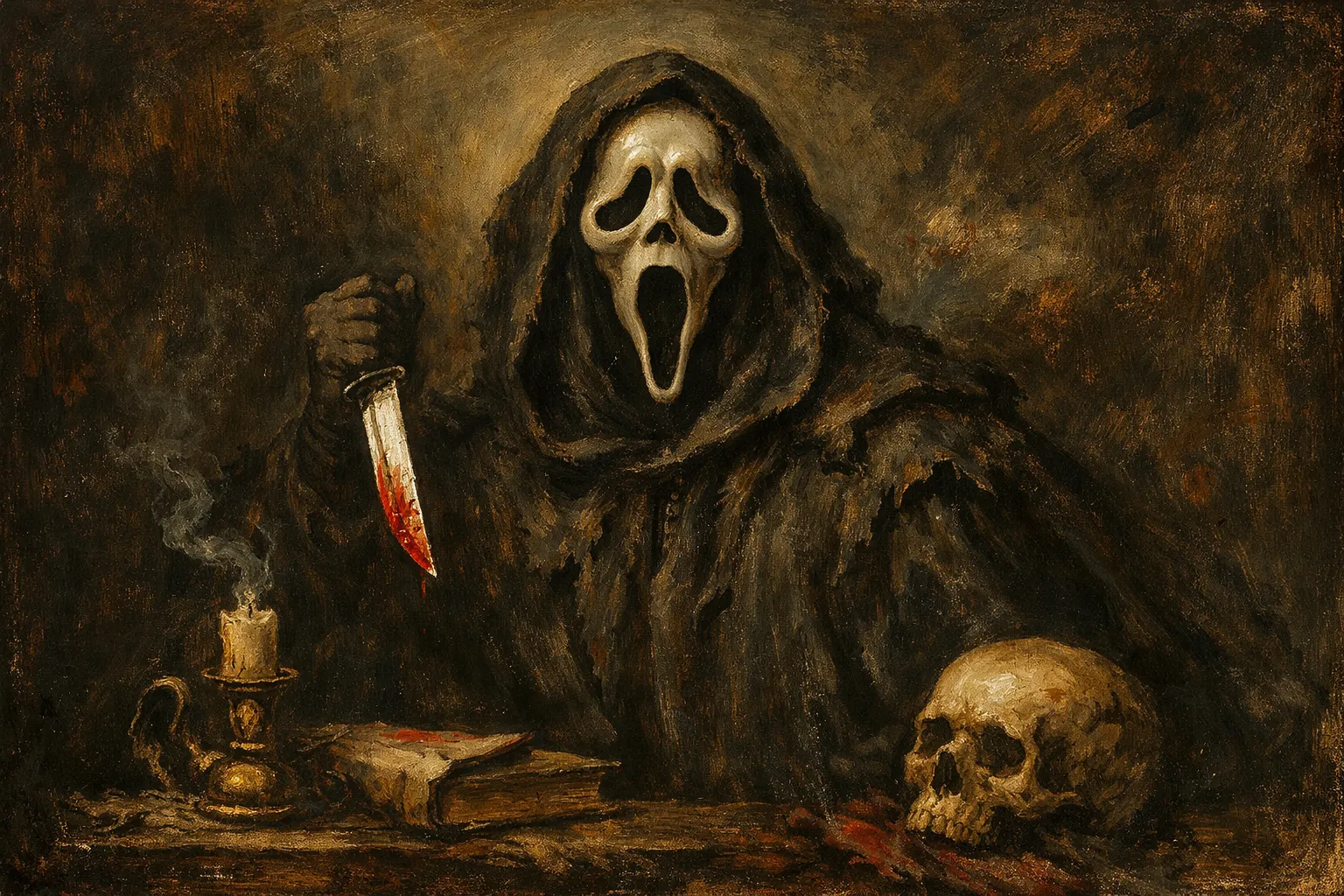
The fourth Scream film opens by murdering not people but epistemologies, and then spends the rest of its runtime proving how safely those murders have been contained.
Ghostface in the House of Mirrors
The nested opening of Scream 4—a film inside a film inside a film—does not simply announce “meta-horror”; it performs an industrial ritual in which cinema folds itself four times over to verify that, yes, there is still a kernel there to be carved. Each diegetic layer mocks the previous one’s clichés, each girl at a laptop or with a phone in hand ridicules the stupidity of the genre even as she moves with fatal obedience through the well-lit corridors of its choreography.
The game of “old horror versus new horror” is staged as banter: 80s slashers against so-called torture porn, Saw invoked and dismissed as “gross, not scary,” condemned for disgust, then briefly redeemed for creativity, only to be discarded again for weak characterization. The verdict is clear before the credits: what we are about to see is a superior horror object, a film that knows, that has learned, that can finally cash in on all this self-awareness.
This is the first cut: the assumption that reflexivity is already a line of flight. The camera pans across living rooms and teenage faces as if knowledge of clichés were a vaccine against them, as though naming the trope dissolved its binding power. But the opening deaths are indistinguishable, at the level of affect and framing, from the “bad” horror they deride. The knife still arcs the same way. The phone still rings like a destiny. The door is still opened when it should be locked.
Self-consciousness marks no exit; it is simply the latest layer of polish on the same industrial blade.
Franchises, Rules, and the Catechism of Capital
Scream did not invent the horror franchise, but it transformed it into a catechetical machine. Where Halloween and Friday the 13th multiplied installments around an icon—mask, date, setting—Scream multiplies itself around rules, bullet-pointed in dialogue, enumerated in breathless fanboy discourse, and treated as both revelation and scripture.
The famous “rules” of the original film—about sex, drugs, and survival—retroactively pretend to codify a genre that had always been more chaotic, more perverse, more inconsistent than such rules allow. The franchise functions like a bad theologian who discovers “laws” in Scripture by ignoring all the apocrypha and contradictions, then announces them as eternal verities.
By the time we arrive at Scream 4, the rules have become what Deleuze and Guattari would call a fully stratified surface: a compacted layer of clichés, market expectations, and fan discourse that channels what can and cannot happen in the diegesis (Deleuze & Guattari, 1987). The film’s characters explicitly discuss “remakes,” “reboots,” “rules of the remake,” and “rules of the new generation,” but this taxonomic frenzy does not destabilize the underlying apparatus; it lubricates it. The more the teens discuss formulae, the more tightly bound they become to the formulas that sell tickets.
A franchise is not simply repetition; it is accumulation of capitalized difference. Each Scream entry must be the same film, but with a new twist—new killer, new rules, new technology—so that the identical machine can be purchased again as novelty. Marx’s commodity fetishism is here given a slasher body: Ghostface as surplus-value in latex, each installment extracting a new quantum of fear labor from spectators who think they are “in” on the game (Marx, 1990).
If the first Scream pretended to “deconstruct” the slasher only by codifying it, Scream 4 doubles down on this catechism, treating its earlier rules as sacred text while feigning to savage contemporary horror for abandoning them. The film’s resentment toward “anything goes” modern horror—toward Saw, Hostel, and the post-9/11 boom of engineered suffering—masks its own terror that the old catechism may no longer hold the market together.
So it clings to the rules like a dying religion clings to doctrine, while pretending that this very clinging is the height of irony.
The Mask as Empty Set, or: Anyone Can Be Ghostface
Michael Myers’s blank white Shatner mask congeals a particular subject—silent, unstoppable, essentially one, even when sequels retcon his motives. Ghostface is different: the black cowl and screaming visage are a floating signifier, an empty algebraic X passed from hand to hand, film to film.
Each Scream reveals at least one killer under the mask, then rounds off the twist with the reassurance that this person, and their particular neurosis or trauma, can now be filed away. But the revelation never closes the question; it only deepens the sense that the mask is a kind of set that can always accept more elements. Anyone might be plugged into Ghostface, which means Ghostface is no one in particular.
In mathematical terms, the mask is an operator: a function that, given any teenage body and a sufficiently contrived motive, outputs a murderer. In schizoanalytic terms, it is a mobile Body-without-Organs, a skin that erases personal history and plugs its wearer directly into the flows of media, spectatorship, and death (Deleuze & Guattari, 1983). The mask does not hide the killer’s identity; it makes the killer’s identity irrelevant, because what matters is the role—“Ghostface”—within the franchise’s script.
This is where the user’s comparison to Anonymous is precise: a swarm of potential agents, each replacing the other, casually interchangeable behind the same stylized face. But where Anonymous once foregrounded an impersonal political agenda, Scream’s killers are organized around micro-fantasies of recognition, revenge, and celebrity.
In Scream 4, this logic is fully articulated: the killer is not just murdering; the killer is performing. The camera is always-already part of the crime scene. The project is not just to enact violence but to edit it, to gain followers, to become content. Here the mask functions not only as anonymity but as brand, a corporate logo of death whose value increases with every live-streamed attack. Baudrillard would recognize in this the perfect simulacrum: Ghostface is the copy with no original, a logo that persists through infinite interchangeable subjects (Baudrillard, 1994).
The horror is not that the mask conceals a monstrous essence; the horror is that the mask reveals the absence of any essence at all, only the empty demand to be watched.
Rules That Eat Themselves: Post-Postmodern Slasher Logic
If Scream (1996) was “postmodern” in the most undergraduate sense—self-referential, intertextual, smirking at its own devices—then Scream 4 inhabits what critics sometimes call the post-postmodern: a space where irony has became baseline, where meta-jokes feel mandatory rather than transgressive, and where sincerity must be smuggled in under layers of knowingness.
The new film delights in repeating the old gestures: Randy’s monologues return as film-club banter, the “rules” are revised as “rules of the remake,” and the generational gap is dramatized through arguments over which horror epoch “counts.” But somewhere in this ouroboros of quotation, the rule that there are rules collides with the contemporary rule that there are no rules.
The moment where a character asserts that “to survive a modern horror film you have to be gay,” only to be killed shortly after, condenses this contradiction. The movie cites a supposed contemporary “rule”—the overcompensatory survival of queer-coded characters as proof of liberal progress—only to annihilate it with a blade. The rule is invoked to be broken, but the breaking itself functions as the new rule: everything is a reversal, every expectation is set up for the pleasure of subversion, which then becomes its own expectation.
“Reversals are the new rules,” as your notes put it. The result is not chaos but a hyper-rational game-space in which every trope is both itself and its opposite. This is not the absence of structure; it is structure gone cancerous, metastasizing into a tangle of self-negating commandments.
Mark Fisher described capitalist realism as the condition in which it is easier to imagine the end of the world than the end of capitalism; Scream 4 staging a world in which it is easier to imagine infinite permutations of the slasher formula than a horror film that does not orbit the same teen bodies, suburban spaces, and corporate distribution channels (Fisher, 2009).
The “post-postmodern” slasher, far from overthrowing the genre, thus becomes its most obedient servant. It anticipates every critique in advance and reabsorbs it as content. You think torture porn is fascistic? We will say so ourselves. You think the final girl is a regressive figure? We will have characters debate her status on screen. You think rules are made to be broken? Our rules will say so.
And in the background, box office receipts track their familiar curve.
Torture Porn, Saw, and the Saturation of Rules
The film’s contempt for Saw and Hostel as examples of “gross, not scary” horror is a carefully staged disidentification, a bid to mark Scream as clever, character-driven, rooted in fear rather than sadism. Yet Saw is, in its own way, a far more rigorous exploration of rules than Scream ever manages to be.
Each Jigsaw trap is constructed as a problem in ethics and game theory, complete with explicit instructions, conditional outcomes, and an underlying (perverse) moral logic. The survivors’ bodies are diagrams of their compliance or failure, literal flesh graphs of rule adherence and transgression. If Scream prints a catechism of genre rules, Saw builds lethal machines out of them.
Your intuition that Saw “pushes the Screamic-rules to the end” is apt: Saw exaggerates the genre’s moralism—punishing drug use, laziness, selfishness—until the rules contradict themselves, criminalizing almost every minor flaw as death-worthy. In this way, Saw reveals the latent fascism of any system that believes suffering can be precisely calibrated to moral failure (Nietzsche, 1997).
Scream wants to have it both ways. It mocks Saw for its baroque cruelty while preserving a softer, more convivial moral ledger. Characters are introduced, their virtues and vices itemized in banter, their survival probabilities calculated according to adherence to the series’ lore. When the film departs from its own calculus—killing the “wrong” characters, allowing the “wrong” ones to live—it does so as a flourish, a bit of cheeky flair, but never in a way that truly threatens the underlying belief that horror can be systematized.
If Saw is a totalitarian bureaucracy of pain, Scream is a neoliberal marketplace of shocks. In the former, every death is rigorously justified within a sadistic ethics; in the latter, every death is a negotiable entertainment event, justified only by its contribution to the fan’s sense of cleverness. Both are rule-systems, but they instantiate different modes of power: one juridical, one consumerist.
Foucault taught that modern power works not just through prohibition but through the production of norms—statistical averages, health metrics, behavioral baselines—and in this sense, Scream’s rules are a kind of teen-slasher normativity, telling viewers what “counts” as smart, dumb, pure, or perverse within the diegetic field (Foucault, 1977). The difference is that here, normativity is sold as fun, as participatory fandom, as the pleasure of knowing the score.
In that light, Scream’s disdain for Saw is the disdain of one apparatus of normalization for another that makes the violence of its rules too explicit.
Republican Nostalgia in a Mask of Irony
Scream 4 enacts a “return to an original promised land” of 80s slasher purity, a move structurally analogous to republican nostalgia for an imagined golden age of bootstraps and small government. The analogy is not superficial.
The film’s longing for “real horror” against “gross-out violence” mirrors a political longing for “real values” against a supposedly decadent contemporary culture. The script claims lineage with the classic slashers even as it distances itself from their supposed “simplicity,” much like contemporary conservative discourse claims lineage with an idealized past that never existed while furiously legislating new controls.
In both cases, an imaginary past is constructed retroactively as a stable ground: the era when rules “meant something,” when you knew who the good guys and bad guys were, when community was intact and monsters were clearly marked. This fantasy past is then wielded to attack the present, all while the actual mechanisms of power become more flexible, pervasive, and unaccountable.
Žižek has argued that contemporary ideology often works through cynical distance: people know very well that the myth is false, and yet they act as if they believe, finding jouissance precisely in the gap between belief and knowledge (Žižek, 1997). Scream 4 inhabits this structure perfectly. Its characters loudly proclaim that the old rules are outdated, that horror has changed, that reboots and remakes follow new logics—yet the film itself behaves as though the old rules still anchor the world.
The supposed “rule” that “in order to survive a modern horror film, you have to be gay” is invoked with smirking acknowledgment of changing representational politics, only to be instantly revoked in blood. The film gestures toward inclusion but ensures that queerness remains a punchline, a red herring, a brief flare of topicality smothered by the knife. The result is not straightforward homophobia but a cynical use of queer survival as one more discursive move in the meta-game, one more talking point in the franchise’s chatter.
Republican nostalgia for a moral order that never was, Scream nostalgia for a genre purity that never existed: both are modes of managing anxiety in a field where capital has long since torn up the old maps.
Sick Is the New Sane: Celebrity, Victimhood, and the Algorithm of Pity
Where Scream truly innovates is not in its self-awareness but in its soap opera of fame. The killers are not merely vengeful; they are unashamed careerists, strategists of notoriety. In Scream 4, this thread becomes the film’s dark heart: “You don’t have to achieve anything anymore,” the logic runs, “you just have to have terrible things happen to you.”
Here the slasher intersects with the culture of reality television, viral videos, and proto-influencer economies. To be the “final girl” is no longer just to survive; it is to secure a book deal, a movie adaptation, a speaking tour. Trauma is monetizable content. Survival is a brand. “Sick is the new sane” because normal life—school, work, anonymous happiness—cannot compete with the symbolic capital of being the center of a massacre narrative.
Baudrillard would call this the triumph of the hyperreal: events are staged less for their immediate stakes than for their potential replay, their meme-ability, their capacity to circulate as images beyond any original site (Baudrillard, 1994). The killers in Scream 4 are early adopters of this logic, orchestrating carnage as if curating a feed, timing attacks for maximum shock value, filming and streaming whenever possible. Ghostface becomes a content creator.
From another angle, this is a reconfiguration of what Marx called primitive accumulation, the violent seizure of bodies and lands that constitutes the prehistory of capital (Marx, 1990). Here, the raw material is not labor-power but suffering. Bodies are ripped, voices scream, lives are ended, and from this destruction a new asset is born: a story, a headline, a legend. The killers do not want to destroy the franchise; they want to merge with it, to become shareholders in the Ghostface brand.
The film itself participates in this economy even as it mocks it. It sells us yet another cycle of Sidney’s trauma, Gail’s career woes, Dewey’s wounded masculinity, as if their accumulated scars were a loyalty program. We buy in, again, because the franchise has taught us to desire this very repetition, to cheer each new permutation of their suffering.
Nietzsche wrote of ressentiment as the slave’s revenge against the strong, a poisoning of value from within; here we see a new form, where ressentiment is privatized and leveraged as image. What is unique in Scream 4 is not the final girl’s endurance but the degree to which that endurance is pre-coded as future intellectual property.
Over-Intertextuality as Sedative
The film’s exuberant intertextuality—its constant referencing of other horror movies, its cameos by fictional franchises like “Stab,” its nods to fan discourse—creates the illusion of critical distance. To recognize a reference is to feel momentarily superior to the text, to imagine that you stand outside the machinery of its production.
But over-intertextuality, serves a numbing function. When every gesture can be situated within an existing matrix of citations, there is no remainder, no resistant kernel that could open onto the intolerable. The field of horror becomes a comfortable museum of prior shocks, each properly labeled, each safely governed by the friendly docent of meta-commentary.
Deleuze spoke of modern cinema’s potential to create “time-images” that break the sensory-motor schema, forcing thought to confront the unthinkable rather than merely recognizing the already-known (Deleuze, 1989). Scream 4 does the opposite: it constantly repairs the sensory-motor link through recognition, ensuring that every unsettling image is quickly folded back into a taxonomy of tropes.
This is why its apparent “critique” of torture porn remains so anemic. The film does not ask what it means that contemporary audiences consume images of protracted suffering, bodies turned into puzzles, flesh as artisanal craft; instead, it places Saw and Hostel on a shelf labeled “gross, not scary,” thereby neutralizing them as simply another variation in the horror supermarket.
The question “What purpose does over-intertextuality serve?” has a banal but devastating answer: it keeps the viewer busy. One is constantly scanning for references, meta-jokes, Easter eggs, and rule inversions. This prevents the kind of stillness in which a truly unassimilable image might lodge itself in the psyche. The film’s chatter is a defense mechanism, an anxious endless talk that keeps the real at bay.
The Final Girl as Franchise Asset
The “final girl” trope—codified by Carol Clover—was always more complex than the easy feminist or anti-feminist readings assigned to it, and Scream made that complexity part of its marketing, with Sidney Prescott as meta-aware survivor par excellence. In Scream 4, Sidney returns again, now as grown woman, author, trauma celebrity.
She is both subject and product: her inner life matters enough to anchor the narrative, but her public image is what sells the book within the film and the film itself outside it. Lacan’s point that the subject is constituted in and through the Other’s gaze resonates here: Sidney is perpetually staged for us, her survival only meaningful insofar as we witness it, buy it, circulate it (Lacan, 2006).
Yet the franchise also cannot let her go. To kill Sidney would be to risk the wrath of fans, to terminate a profitable thread; to retire her peacefully would be to admit that the cycle can end. So she is kept in a state of suspended trauma, forever returning to Woodsboro, forever re-confronting the mask. Her life is serialized PTSD.
In this sense, the final girl has been captured by the franchise as a kind of perpetual-motion engine. Each new installment siphons additional affect from her, charting the incremental erosion of her boundaries, her attempts at normalcy, her unwilling expertise in surviving meta-horror. There is a cruelty here subtler than any stabbing: the refusal to allow healing, because healing would render her narratively obsolete.
The killers’ desire to replace Sidney, to become the new face of the franchise, is thus not just pathological envy; it is structurally demanded by a system in which “sick is the new sane.” They understand, as aspiring influencers do, that to be content you must both suffer and display that suffering. The final girl is the original trauma influencer. Scream 4 merely updates her platform.
Lines of Flight That Never Quite Take Off
Is there, within Scream 4, any genuine rupture, any moment that threatens to escape the franchise’s gravitational pull? A schizoanalytic reading looks for lines of flight: errant gestures, stray affects, misfiring scenes that briefly open onto another possible horror.
One candidate is the opening’s recursive structure itself: by nesting films within films, the movie brushes against the vertigo of infinite regress, the possibility that there is no “real” outside the layers of mediated murder. If it followed this logic to its limit, it would have to confront the question: what if Ghostface is not a killer but a camera, not a person but a viewpoint? Yet the sequence resolves into a standard “real” layer—the “true” Woodsboro—thus reterritorializing the threat into a clever gimmick.
Another potential line of flight lies in the cracks where the rules fail. When a character who “should” live dies unexpectedly, or when a supposedly protected identity marker like queerness offers no immunity, the film momentarily gestures toward a horror without moral calculus, a violence that does not serve narrative justice or fan-service twists. But these moments are quickly narrated as “shocking,” “bold,” assimilated into the discourse of novelty that sustains the brand.
Deleuze and Guattari warn that lines of flight can always turn into lines of death, becoming captured in new regimes of control (Deleuze & Guattari, 1987). The path from slasher parody to franchised meta-slasher is one such mutation: the original deterritorialization of horror conventions has been folded back into the territory of studio logic, ratings boards, and fan expectations.
Perhaps the only truly unsettling possibility is the one the film cannot think: a horror cinema without Ghostface, without the final girl, without the suburban high school, without the perpetual return to Woodsboro. A horror that would not recognize itself in the mirror of its own history, that would not “break the rules” as a selling point but would simply move elsewhere.
In such a cinema, intertextuality would not function as a safety net but as a series of rope-bridges over an abyss: unstable, provisional, always at risk of collapse. The film would not know in advance what it was an example of. There would be no franchise, only singular events.
Scream 4 cannot go there, because its very existence depends on not going there.
Conclusion: The Knife That Writes the Franchise
Does Scream 4 “really” break the rules of horror? It breaks them only in the manner of a corporate strategist stress-testing a product line: every rupture is measured, marketable, reversible. The film’s intelligence is genuine but instrumental; its philosophical anxieties about representation, fame, and violence never jeopardize the underlying calculus of box office and brand continuity.
The schizoanalytic cut reveals a dense network of desiring-machines: Ghostface as mask-brand, Sidney as trauma-asset, rules as norm factories, intertextuality as sedative, franchise as accumulator of affective surplus. Desire here does not aim at liberation; it aims at circulation. The killers’ hunger for fame, the audience’s hunger for cleverness, the studio’s hunger for profit—these are not metaphors but literal flows that cross and reinforce each other.
In the end, Scream 4 stands as the Nirvana of slasher cinema: a band that simultaneously signaled the exhaustion of a genre and became its most commercially successful iteration, too busy playing with its own excrement to notice the historical pivot it embodied. Like grunge, the film both mocks and intensifies the very thing it targets, leaving us unsure whether we have witnessed critique or consummation.
What is certain is that by the credits, the “rules” are not shattered but more entrenched than ever. Future horror filmmakers will dutifully reference them, invert them, update them for each new media platform. Already by the time Scream 4 was released, franchises like Final Destination were systematizing death as Rube Goldberg inevitability, while Saw continued to proliferate traps and retcons, each a new spin of the same wheel.
The ghost that stalks Woodsboro is not a vengeful teenager or a wronged relative; it is the franchise-form itself, the incapacity of late capitalism to think anything but sequels. The knife writes the rules as it cuts, and the blood only thickens the ink.
References
Baudrillard, J. (1994). Simulacra and simulation (S. F. Glaser, Trans.). University of Michigan Press.
Deleuze, G. (1989). Cinema 2: The time-image (H. Tomlinson & R. Galeta, Trans.). University of Minnesota Press.
Deleuze, G., & Guattari, F. (1983). Anti-Oedipus: Capitalism and schizophrenia (R. Hurley, M. Seem, & H. R. Lane, Trans.). University of Minnesota Press.
Deleuze, G., & Guattari, F. (1987). A thousand plateaus: Capitalism and schizophrenia (B. Massumi, Trans.). University of Minnesota Press.
Fisher, M. (2009). Capitalist realism: Is there no alternative? Zero Books.
Foucault, M. (1977). Discipline and punish: The birth of the prison (A. Sheridan, Trans.). Pantheon Books.
Lacan, J. (2006). Écrits: The first complete edition in English (B. Fink, Trans.). W. W. Norton.
Marx, K. (1990). Capital: A critique of political economy. Volume 1 (B. Fowkes, Trans.). Penguin Books.
Nietzsche, F. (1997). On the genealogy of morality (C. Diethe, Trans.). Cambridge University Press.
Žižek, S. (1997). The plague of fantasies. Verso.
Comments
Post a Comment