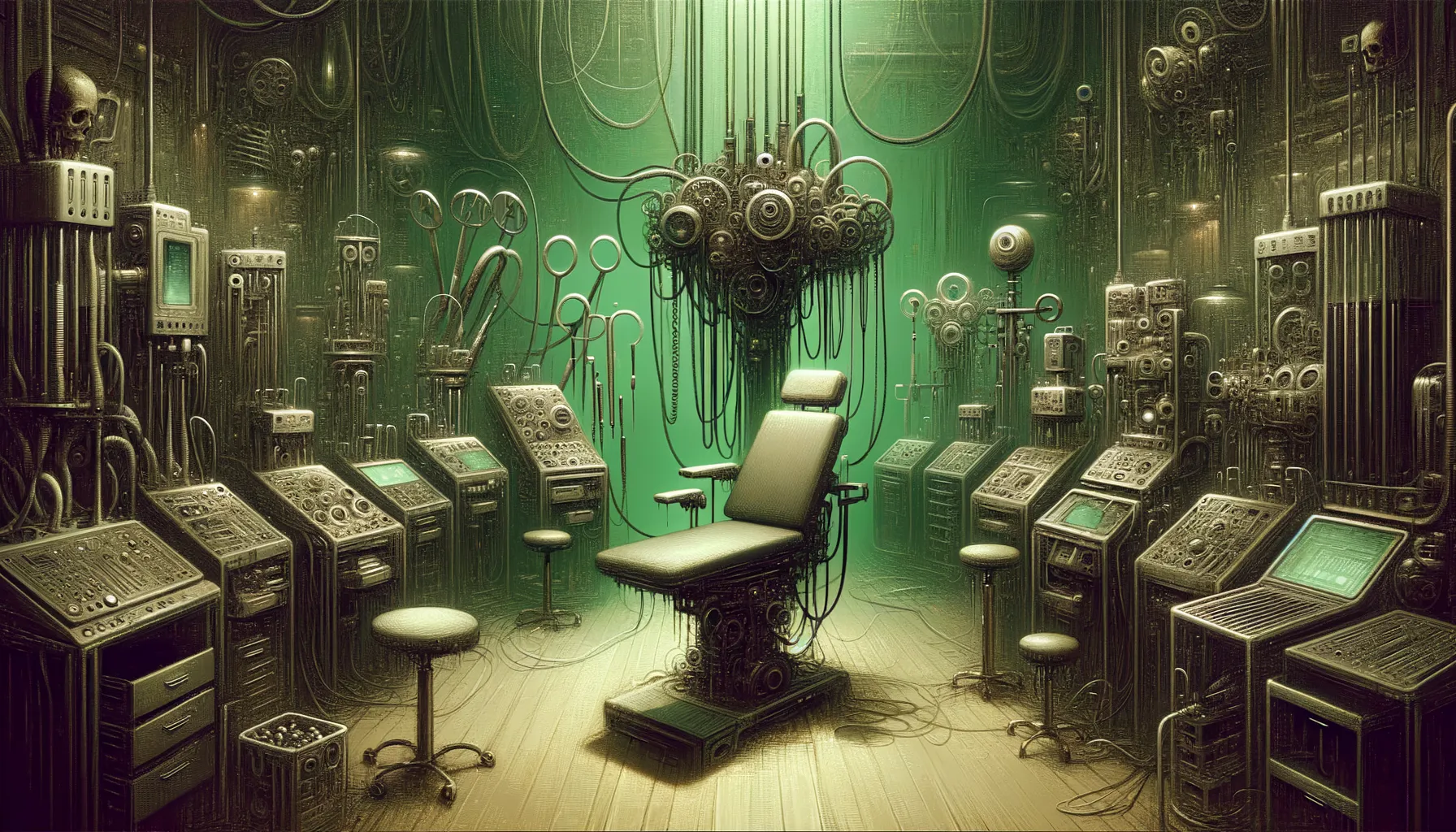
There is a special kind of cruelty in a therapy that asks you to forgive while the room is flooding, the chains are tightening, and the clock is counting down to someone else’s death.
Shattered Circuits: Jeff’s House as a Closed Desiring-Machine
Jeff’s life, when Saw III opens, has the slow, clumsy orbit of a desiring-machine that has lost all but one gear. The house is no longer a home; it is a mausoleum organized around a child’s empty bedroom. The camera does not need to lecture on grief: the bathrobe, the half-drunk bottles, the slurred rage at his still-living daughter are enough. His son’s room has become the only functioning circuit—enter, rotate around the relics, exit in pieces.
The scene with the stuffed animal is decisive. The daughter sneaks the toy, not to desecrate the shrine but to sleep, to fold the dead brother back into the fabric of ongoing life. Jeff explodes. He wrenches the toy away, enforces the prohibition, polices the border between the living child and the dead one. The toy is not allowed to circulate. It must stay in the vitrified space where memory is kept pure, inert, untouchable.
Grief, here, is not simply an affect but a territorial machine that has overcoded every other possible connection. Freud once distinguished between mourning, which gradually allows libido to detach from the lost object, and melancholia, in which the loss is introjected and becomes a structural self-attack (Freud, 1957). Jeff’s configuration belongs to neither in any simple way. He does not detach, but he also does not turn the hatred purely against himself. Instead, the rage spills out sideways: at his daughter, at the world, at an abstract “system” that gave the drunk driver a light sentence.
The “nothing-can-be-done disease” that Paul Goodman diagnosed in mid-century America finds a late-industrial horror film expression here: Jeff’s actions are constellations of complaint that never touch the real coordinates of power (Goodman, 1960). He drives drunk in circles, stalks his own hallway, rehearses revenge fantasies he never enacts. In schizoanalytic terms, every possible line of flight—toward his daughter, toward his wife, toward collective struggle—is blocked by the obsessive circuit around the dead child’s room.
The son’s room is a privatized cemetery: an individualized, commodified site of mourning which converts unbearable historical violence (drunk driving, judicial negligence, infrastructural indifference) into a domestic fetish. Marx knew this operation well: the way social relations of production crystallize into “things” that appear autonomous, while the living relations that produced them vanish from view (Marx, 1976). The room, like a commodity, seems to hold the child’s “essence” in its objects; the messy social field that killed him dissolves into a single drunk driver and the judge who let him off lightly.
Jigsaw’s interest in Jeff begins precisely here: at the point where grief has become a closed circuit, a jammed desiring-machine that still hums with energy but will not produce anything new.
Jigsaw’s Clinic: Architecture of Forced Choices
What does Jigsaw prescribe? Not medication, not talking cure, not time. He prescribes a walk, but a walk through steel and ice: a corridor of encounters with the people Jeff blames (or should blame) for his son’s death. The bystander who did not testify. The judge who gave a lenient sentence. The drunk driver himself. At the end of the line: Jigsaw’s own dying body, hooked up to Lynn’s improvised life-support rig.
The “treatment plan” is simple and deranged: stage each figure in mortal peril, make Jeff’s intervention both possible and costly, and require him to choose—save them (and suffer) or let them die (and remain in his rage). At each station, the choice is framed as a pure test of will: will you finally move, or will you allow your resentment to calcify into murder by omission?
The first presupposition here is a sharp, voluntarist theory of the psyche: that Jeff’s paralysis is the result of a defective decision-making apparatus, that behind the bathrobe and the whiskey there is an intact “will to live” waiting to be triggered like a trap. Nietzsche’s moral psychology hovers behind this: the idea that ressentiment is a sick, reactive form of life, and that the noble soul overcomes it by a sovereign act of affirmation (Nietzsche, 1994). Jigsaw appears to take Nietzsche literally: force the man of ressentiment to confront his enemies one by one and decide, under maximal pressure, whether to forgive.
The second presupposition is more poisonous: that these forced choices can be staged in isolation from the broader machinery that produced both Jeff’s grief and the others’ complicity. Foucault taught us that modern power is less a matter of spectacular punishment than of diffused, micro-disciplinary techniques that produce subjects in schools, factories, courts, and hospitals (Foucault, 1977). Jigsaw’s clinic accepts the diffuse production of Jeff, the bystander, the judge, and the driver as a given, and intervenes only at the final, personal moment of decision.
Each trap is a kind of privatized tribunal: the bystander freezes in a meat locker, hung on hooks; the judge sinks beneath rotting pig flesh; the drunk driver is chained in a spinning contraption that will twist his limbs off. Jeff alone stands outside the device, holding the literal key. To save them, he must endure: reach through freezing water, wade through putrid slurry, risk his own skin. Cruel therapy: your “lesson” is indexed directly to your tolerance for visceral disgust and pain.
From one angle, this looks like a brutalized version of exposure therapy: confront the avoided stimulus (the hated person) while practicing a new response (saving rather than killing) and rewriting the emotional script. From another, it is merely a new theater for Jigsaw’s own ressentiment, displaced onto victims selected for their symbolic value.
But the more rigorous point is this: these are not genuine options but forced choices, sculpted in advance by someone else’s diagram of desire. Deleuze and Guattari insist that desire is not fundamentally about lack and decision; it is a positive production that flows through bodies, machines, and practices, assembling arrangements that often exceed conscious intention (Deleuze & Guattari, 1983). Jigsaw’s clinic dams these flows, narrows them, and forces them to pass through a series of knife-edge gates: act now, in this way, or someone dies.
Freedom, here, is decapitated and mounted as décor.
Bootstrap Theology: The Superego That Commands “Appreciate or Die”
If the first two Saw films established Jigsaw’s obsession with making his victims “appreciate life,” Saw III radicalizes this bootstrap theology. Jeff is not asked merely to cut off his foot or rip a key from somebody else’s insides; he is asked to reorient an entire affective economy in the span of a few hours. He must transform his grief into active compassion under threat.
The bootstrap ideology is perfectly aligned with a certain neoliberal gospel: that one’s suffering is largely a function of bad choices, insufficient resilience, and a refusal to take responsibility for one’s reactions. “You chose this,” Jigsaw tells his victims, recoding structural determinants as personal will. Žižek has shown how contemporary ideology manifests not as explicit rules but as superegoic injunctions—“Enjoy!” “Be yourself!”—that demand the impossible and then feed on the subject’s inevitable failure (Žižek, 2008). Jigsaw’s version reads: “Appreciate life or die.”
The cruelty lies in the temporal compression. Real mourning, real political struggle, real psychic reconfiguration, unfold over years, through repetitions, relapses, and collective supports. Here, Jeff must accomplish in minutes what most cannot do in a lifetime: forgive the drunk driver while the man screams; forgive the judge as he gurgles under pig juice; forgive the bystander as her skin cracks in the cold. Any hesitation is marked as proof of his unworthiness.
This is not therapy; it is a spiritual speed-run designed for failure. The logic mirrors what Marx observed of capitalism’s tendency to abstract labor into a homogenous, measurable expenditure of time, indifferent to the concrete content of activity (Marx, 1976). Jigsaw abstracts conversion into a quantifiable sequence of tests, stripping away the socio-historical thickness of Jeff’s life so that the man can be judged solely on his throughput of forgiveness per minute.
The sadism of this theology is most evident in its indifference to neurochemistry, to the very corporeality that Jigsaw, a cancer patient, should understand best. Depression, trauma, anxiety—these are not free-floating ideas, but densely wired neurochemical patterns, synaptic fortifications, hormonal storms. To treat them as mere “choices” is to commit a biopolitical violence of misrecognition, collapsing bodily processes into moral failures (Foucault, 1978). Jeff’s slowness, his numbness, his impotent rage, are read not as symptoms of a nervous system overwhelmed but as damning evidence of a character unwilling to act.
Jigsaw’s own cancer is mobilized as moral capital. Having faced death, he believes he has gained a privileged insight into what life is worth, and he weaponizes this insight against those who stumble, lashing them with a scorn he refuses to direct at the environmental toxins, medical systems, or genetic lotteries that underwrote his diagnosis in the first place. His “will to live” is marketed as universal currency; everyone else’s messy, ambivalent relation to existence is discounted as insufficiency.
Amanda’s No-Exit Traps: The Capitalist Allegory of the Welded Door
If Jeff is the patient, Amanda is the relapse. She survived her first game, was “reborn” as a devotee of Jigsaw’s method, and then sank into a more virulent despair. The revelation here is not that she cannot be cured, but that the cure has metastasized. Having once clawed her way out of “addiction” through the reverse bear trap, she comes to believe that no one else can—or should—do the same.
Her redesigned traps testify to this loss of faith. The device with chains hooked through a man’s flesh is, on the surface, classically Jigsaw: endure excruciating self-harm to escape death. But the structural twist is Amanda’s: even if he were to unhook every chain in time, the door is welded shut. There is no exit. The game is a lie.
This welded door is the purest allegory of late capitalism. We are told from kindergarten that hard work, grit, and positive thinking can lift us out of whatever class we are born into. We are bombarded with stories of exceptional “winners” who “made it” against the odds. But the macro-statistics—on intergenerational mobility, wage stagnation, racialized poverty—paint another picture: a set of doors structurally sealed, no matter how many hooks one rips from one’s own flesh (Marx, 1976).
Amanda’s ideology is a catastrophically honest version of the system’s secret: the trap was never designed to let you out. Her despair is not purely psychological; it is political in the most intimate sense. Having lived through a game that did have a solution, she knows in her bones what it takes to survive under Jigsaw’s rules. When she then confronts her own continued brokenness—self-harm, suicidal ideation, unstable loyalty—she draws the conclusion that the whole therapeutic narrative was a sham.
If she could not be authentically transformed, how could anyone? Better, then, to strip away the lie of rehabilitation and build traps that simply mirror the world as she experiences it: a world in which the test continues until you die, and every promise of escape is a cruel joke.
Reich spoke of “character armor,” the rigid defensive configurations that form in response to trauma and become second nature, shaping posture, voice, and expectation (Reich, 1949). Amanda’s new traps are armor projected outward: black, metallic, unforgiving. They script her inner conviction that change is an illusion, that the only consistent position is to close the doors in advance, to deny even the fantasy of exit.
In doing so, she also betrays Jigsaw’s core dogma. Where he wants to believe in the possibility of survival through will, she knows the messier truth of relapse, of half-transformation, of the way environments reassert their grip. The result is a schism in the clinic: the master clinging to his bootstrap theology, the disciple turning it into nihilistic bureaucracy.
The Breakfast Club Effect: Transformation in Isolation, Regression in Context
One of the more subtle failures written into Jigsaw’s methodology could be called the Breakfast Club Effect. In John Hughes’s film, a group of high school archetypes—jock, nerd, princess, rebel, outcast—bond in detention, share secrets, and briefly escape their assigned roles, only to re-enter the school on Monday and snap back into their trajectories. The environment’s codes overpower the micro-revolution of the Saturday cell.
Jigsaw’s games are also Saturday detentions, albeit with more blood. Inside the warehouse, the barn, the labyrinth, participants are torn out of their ordinary symbolic coordinates. Money is irrelevant, status collapses, professions don’t matter. Judge, drunk driver, bystander: in this space their suits and backstories count for less than their immediate proximity to spinning gears and acid vats.
In such exceptional zones, transformations do occur. The drunk driver pleads not as a defendant in a courtroom but as a half-flayed animal begging another wounded animal for mercy. The judge, covered in liquefying pigs, sobs and repents in a way no sentencing hearing ever compelled him to. Jeff, for brief instants, acts: he burns the toys, he pulls the levers, he chooses life for the people he despises.
But these changes are suspended in a vacuum. There is no mapped path from the game back into the social field capable of sustaining them. Deleuze speaks of “lines of flight” that tear away from rigid assemblages, but warns that these can be reterritorialized, recaptured by the very systems they escape (Deleuze & Guattari, 1987). Jigsaw provides lines of flight without any post-game ecology that would prevent recapture.
Even in the internal chronology of the franchise, we see this. Amanda’s survival does not flower into a stable “new life”; it curdles into dependence and nihilism. Jeff’s potential forgiveness never has a chance to re-root, because the clinic collapses catastrophically at the moment he begins to exercise it. Lynn, who is supposed to re-learn the value of her family while surgically prolonging Jigsaw’s life, is shot in a jealous fit before she can test that lesson outside the blood-slicked room.
The games are boot camps with no subsequent civilian infrastructure, revolutions with no institutions, interventions with no aftercare. Foucault showed how prisons, schools, and hospitals form an archipelago of institutions that loop individuals through cycles of normalization and deviance, ostensibly to “rehabilitate” them but practically to produce manageable categories of subject (Foucault, 1977). Jigsaw reproduces the structure of the exceptional institution but refuses to embed it in any broader project of social transformation.
The result: whatever micro-changes occur in the crucible evaporate with the smoke. The world outside remains untouched, and the few who leave the warehouse alive stagger back into a reality structurally indifferent to the screams they’ve heard.
Brains, Bodies, and the Misrecognized Material of Powerlessness
There is a strange chasm in Saw III between the level at which bodies are acknowledged and the level at which they are denied. On one hand, the film is a litany of corporeal extremity: bones torn from sockets, skulls bored open, throats crushed. Lynn’s work on Jigsaw is a relentless close-up of flesh, blood, and hardware, the human head as something literally adjustable with screws.
On the other hand, when it comes to psychological suffering, Jigsaw’s discourse turns ethereal. Depression becomes “not appreciating your life.” Addiction becomes “wasting your potential.” Grief is “refusing to move on.” The very brain whose tumor he forces Lynn to expose is, at the level of his theory, a blank receptacle for will.
Freud’s later writings on the death drive complicate any simple notion that the psyche seeks survival and pleasure above all else; there is in us also a tendency toward repetition, stasis, a return to the inorganic (Freud, 1961). Jeff’s loops through his child’s room, Amanda’s cuts on her arms, Jigsaw’s stubborn adherence to his doctrine even as his body fails—these are not easily recoded as “failures to choose life.”
They are, rather, material scripts, grooves cut by trauma and history into the neural and muscular fabric of the person. To treat them as pure ideas is akin to treating a tumor as a “negative attitude” visible only on moral x-rays. Foucault’s notion of biopower—where states and institutions take as their object the management of life itself, at the level of population health, reproductive rates, mental hygiene—helps us see how Jigsaw’s clinic, far from being anti-medical, is a twisted extrapolation of medicine’s moralizing tendencies (Foucault, 1978).
He is the doctor who has abolished diagnosis in favor of judgment. Lynn’s actual clinical expertise is tolerated only as long as it serves his narrative: keep him alive long enough to run the Jeff experiment. Her own depression, marital estrangement, and professional burnout are folded into the test as sins in need of punishment and proof.
What would it mean to reverse this? To start from the body not as site of spectacular punishment but as the primary material of suffering and healing? A truly schizoanalytic approach would refuse the false alternative between a reductive neurochemistry and a moralizing voluntarism; it would map how neurotransmitters, social positions, economic precarity, family structures, and media images co-assemble to produce a subject like Jeff, for whom the bottle and the bathrobe are not simply “choices” but the only available stabilizations in a world that has not offered others.
Jigsaw’s refusal of this complexity is not ignorance; it is dogma. His absolute belief in choice is what allows him to sleep (or drift into death) with a clear conscience as the machines churn.
If the World Played by Jigsaw’s Rules
Imagine, for a moment, that Jigsaw wins—not in the literal sense of institutionalizing his clinic, but in the conceptual sense of persuading a culture that his rules are just. What would everyday life look like if everyone internalized the principle that failure to appreciate life warrants immediate, lethal pedagogy?
Workplaces would resemble escape rooms run by malignant life coaches. Each missed deadline or complaint about burnout could be re-framed as a failure to value the “opportunity” of employment, triggering corrective “games” in which your continued contract depends on, say, your willingness to sacrifice a limb or rat out a colleague. The HR department as torture wing, but justified in the language of unlocking potential.
Social policy would become a series of triage mechanisms in which aid is granted only to those who can demonstrate sufficient appreciation: welfare-mothers repenting on television, addicts crawling across glass to reach their methadone, homeless people solving riddles about gratitude in exchange for shelter. The Stoic sage and the cutthroat entrepreneur would be held up as twin ideals: unaffected by trauma, hyper-responsive to incentives, uncomplaining, always ready to lose a piece of themselves to stay in the game.
Jigsaw’s gospel would dovetail perfectly with neoliberal governmentality, which already interprets citizens as entrepreneurs of the self, responsible for the continuous optimization of their human capital (Foucault, 2008). Depression would be re-coded as lazy risk-aversion. Structural unemployment as a “skills gap.” Trauma as a failure of resilience.
From a schizoanalytic angle, this world would be uninhabitable, because it would demand that every desiring-machine operate under permanent emergency, every flow be either maximally productive or immediately cut off. There would be no space for low-intensity pleasures, for aimless drifting, for the kinds of non-instrumental relations that do not easily justify themselves in terms of survival or appreciation.
At the same time, desire would not simply submit. It would leak, sabotage, scramble. In a society fully organized according to Jigsawian tests, the most subversive acts might be quiet refusals: the employee who feigns incompetence to escape promotion, the lover who chooses to mourn for years instead of “moving on,” the addict who insists on the unredeemable character of her attachment. These would be lines of flight not toward a higher appreciation of life but toward different configurations of living, ones that do not pass through the metrics of sacrifice and lesson.
The question, then, is not simply whether Jigsaw’s rules would produce more murderers or more stoics, but whether life under such a regime would still be life in any meaningful sense, or a permanent audit of one’s response to adversity.
Forgiveness Misfiring: Jeff’s Final Choice and the Event That Fails
The narrative arc of Jeff’s game points toward a moment of pure forgiveness. After the freezer, the pig vat, and the twisting machine, after each partial victory over ressentiment, he arrives at the heart of the labyrinth: Lynn, his wife, wired to Jigsaw’s heart monitor; Amanda, armed and unraveling; Jigsaw himself, supine and wheezing.
The structure is crystalline. If Jeff forgives Jigsaw—the ultimate author of his ordeal—he can choose to let the man live, thereby sparing Lynn and possibly repairing their shattered family. If he cannot, he will kill Jigsaw, triggering Lynn’s collar and annihilating any future they might have. It is the distilled ethical “event,” billed as the place where his subjectivity will either be reborn or confirmed as vengeful.
Alain Badiou defines an event as that which interrupts the normal course of situations, creating the possibility of a new truth that did not previously exist (Badiou, 2005). Fidelity to such an event means reorganizing one’s life in light of it, affirming it through action. Jigsaw imagines himself as the agent of such events, staging them like a director. But the film undercuts this pretension.
Jeff does not stand before an open field of possibility. He stands in the middle of a carnage that has already killed or maimed multiple people, including those he was asked to forgive. His daughter is missing, his wife is bleeding, his tormentor smiles through the drip of his IV. The script expects him to transcend his horror and say, in effect, “I forgive you, I choose life.”
Instead, he slices Jigsaw’s throat.
Is this a failure of fidelity, or a refusal of the false event? From one perspective, Jeff proves Jigsaw right: he cannot let go of revenge, cannot seize the offered line of flight out of his melancholic circuit. From another, he cuts through the manipulative scaffolding of the game and does the only rational thing: he neutralizes the architect of a slaughter.
Žižek has argued that forgiveness, when demanded as a moral duty under asymmetric conditions, can itself be a form of violence: the victim is asked to absolve the very system that produced their hurt, to participate in their own disempowerment by declaring the account settled (Žižek, 2008). Jeff’s refusal of forgiveness, then, may be the one genuinely free act in the film, not because it leads to a happy ending (it does not), but because it breaks with the blackmail structure that framed his choices until then.
And yet, the cut is not pure. It kills Jigsaw, but it also kills Lynn. It fails to liberate Jeff from the machine; instead, it triggers its final sequence, locking him in a room with the corpse of the man he hated, a tape recorder, and the echo: “Game over.”
The event fails to become a new truth because there is no world ready to receive it. Badiou notes that without a subject who can sustain fidelity over time, an event sinks back into mere happening, a curious detour without consequence (Badiou, 2005). Jeff’s act, however necessary, is immediately contained within Jigsaw’s pre-recorded contingency plan. The clinic swallows even its own would-be negation.
Spectatorship as Soft Trap: Watching Saw III Under Jigsaw’s Gaze
There is one more game running silently throughout Saw III: the spectator’s. We sit in darkness, watching Jeff fail, Amanda spiral, Lynn tremble, Jigsaw cough. We flinch at the gore, lean forward at the puzzles, perhaps silently ask ourselves what we would do in their place. The film offers us, in diluted form, the same structure Jigsaw offers his victims: a forced engagement with impossible choices under the ticking clock of runtime.
Baudrillard suggested that in the age of simulation, the distinction between reality and representation collapses, leaving us with self-referential images that copy nothing but one another (Baudrillard, 1994). The Saw franchise participates in this: its traps have long since become cultural icons, detachable from their narrative context, circulating as memes, Halloween costumes, and fan art.
But Saw III also knows something about cinema that Jigsaw does not quite grasp about his own clinic. In the theater, there is no welded door. We can leave. We can close our eyes. We can reject the bootstrap ideology the film depicts, even if the larger culture continues to preach it. The “lesson” is not locked in.
Deleuze wrote of modern cinema’s capacity to produce “time-images” that break from linear causality, allowing us to perceive the coexistence of multiple durations, potentials, and perspectives (Deleuze, 1989). Saw III, for all its splatter, plays subtly with time: cross-cutting between Jeff’s journey and Lynn’s surgery, between Amanda’s flashbacks and Jigsaw’s tapes. The result is not just suspense but a sense that no single character’s experience exhausts the situation.
This multiplicity is what schizoanalysis latches onto: the way flows crisscross the traps, the way Lynn’s quiet medical competence intersects with Amanda’s hysteria, the way Jeff’s private grief is knotted to public institutions of justice and medicine. The film becomes less a morality tale than a diagram, a set of overlapping machines whose interactions produce the spectacle we watch.
Our task, then, is not to decide whether we “agree” with Jigsaw’s philosophy but to see how that philosophy plugs into wider circuits: of neoliberal subjectivity, of punitive justice, of self-help culture, of spectatorship. The gore is an access point, an intensifier, not the whole.
If there is a way out of the trap, it lies not in a new, more enlightened set of rules, but in refusing the very form of life that treats suffering as a private test and healing as a solitary performance of resilience. Jeff’s failure, Amanda’s relapse, Lynn’s death, and even Jigsaw’s serene exit all attest to the same fundamental blockage: as long as the clinic is individual, as long as the door out of the warehouse opens only onto more of the same world, the games will reset.
To “saw into Jigsaw’s rationale” is finally to see it as an especially baroque articulation of logics already at work in our own institutions and intimacies. The challenge is not to design kinder traps, but to dismantle the machinery that keeps asking us, at gunpoint, whether we appreciate our lives enough.
References
Badiou, A. (2005). Being and event (O. Feltham, Trans.). Continuum.
Baudrillard, J. (1994). Simulacra and simulation (S. F. Glaser, Trans.). University of Michigan Press.
Deleuze, G. (1989). Cinema 2: The time-image (H. Tomlinson & R. Galeta, Trans.). University of Minnesota Press.
Deleuze, G., & Guattari, F. (1983). Anti-Oedipus: Capitalism and schizophrenia (R. Hurley, M. Seem, & H. R. Lane, Trans.). University of Minnesota Press.
Deleuze, G., & Guattari, F. (1987). A thousand plateaus: Capitalism and schizophrenia (B. Massumi, Trans.). University of Minnesota Press.
Foucault, M. (1977). Discipline and punish: The birth of the prison (A. Sheridan, Trans.). Vintage Books.
Comments
Post a Comment