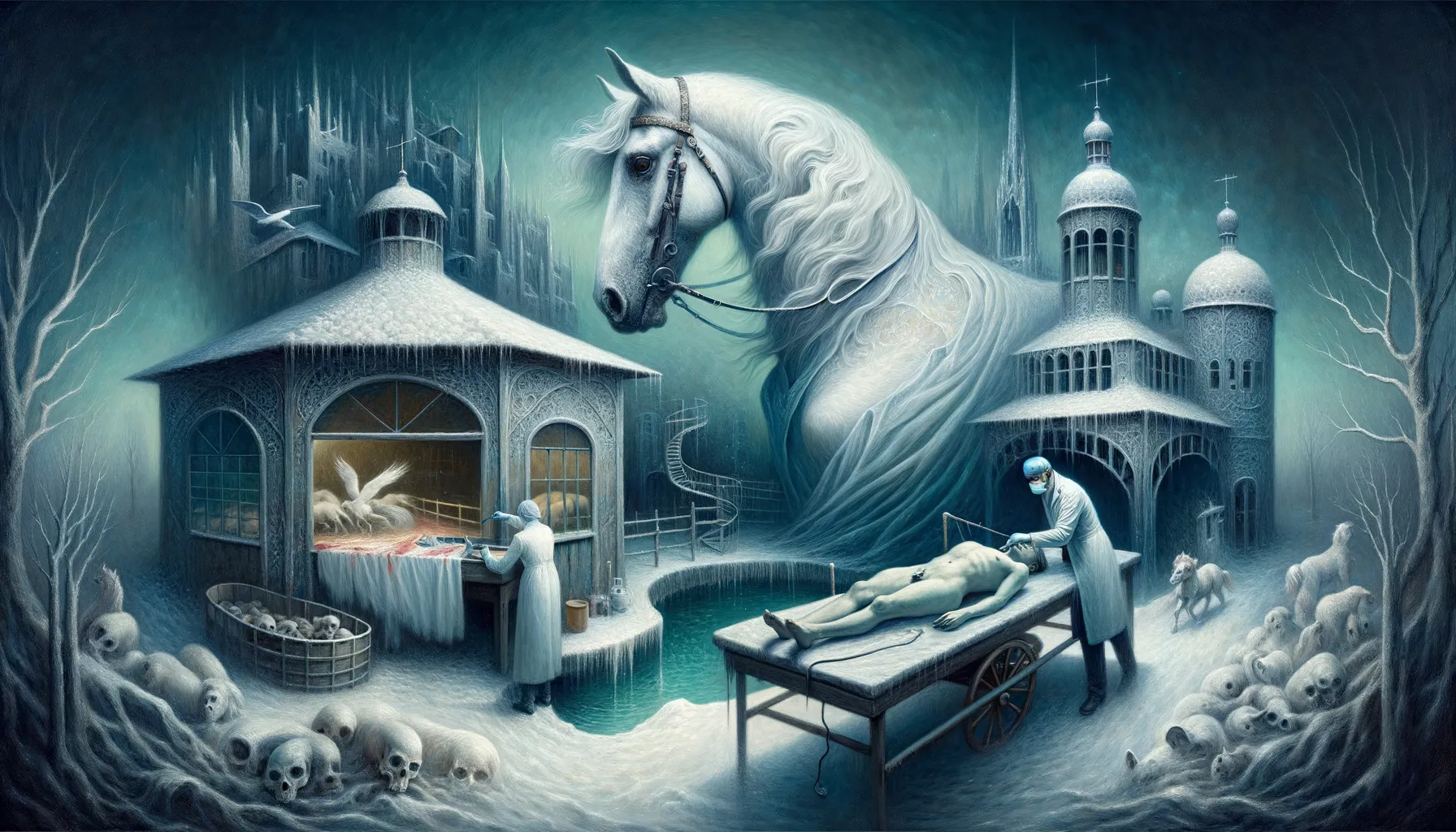
The cinematic trajectory of the slasher subgenre has historically been anchored in a moralistic framework that Gilles Deleuze and Félix Guattari would identify as the "Oedipal Clinic". In this traditional structure, exemplified by John Carpenter’s 1978 original, Michael Myers exists as "The Shape"—a metaphysical void or a "pure signifier" of evil that serves to striate the social space of Haddonfield. The 1978 film operates through a paranoiac recording of the suburban landscape, where the threat of the outsider reinforces the necessity of the nuclear family and the protective gaze of the State, personified by the clinical authority of Dr. Samuel Loomis. However, Rob Zombie’s Halloween II (2009), particularly in its Director’s Cut, represents a violent deterritorialization of this formula. It shifts the site of horror from the sterile, structuralist Clinic to the visceral, materialist "Slaughterhouse" of reality, where trauma is no longer a psychological "lack" to be healed, but a "desiring-production" that generates new, terrifying intensities of becoming.
By leaning into a rigorous schizoanalytic framework, it is possible to demonstrate that Zombie’s Michael Myers is not merely a "reimagined" villain, but a "Nomad War Machine" operating in a state of pure exteriority to the State Apparatus. Simultaneously, the psychological collapse of Laurie Strode is not a passive descent into clinical madness, but a "becoming-molecular" where her identity as a "final girl" is dismantled to reveal the "Body without Organs" she shares with her brother. Through the recurring motif of the White Horse, Zombie visualizes the "becoming-animal" of the Myers bloodline—a process that transcends Freudian symbolism to enter the realm of affective intensity and revolutionary trauma. This report analyzes the film as a radical departure from the "Oedipal triangle" of mother-father-child, proposing instead a "rhizomatic" understanding of violence that connects the rural dirt of the American Midwest to the "chaotic vertigo" of the schizophrenic unconscious.
The Failure of the Oedipal Clinic: Dr. Loomis and the Commodification of Trauma
In the foundational mythology of the Halloween franchise, Dr. Samuel Loomis represents the "Paranoiac" pole of the social investment. He is the agent of the State who seeks to overcode the "schizo-flows" of Michael’s violence with molar structures—clinical diagnoses, legal warnings, and pharmaceutical containment. In Rob Zombie’s 2007 remake, Loomis (Malcolm McDowell) is already a figure of questionable ethics, but by the 2009 sequel, he has fully transitioned from a clinician to a celebrity author. Loomis has become the ultimate "Anti-Loomis," a man who commodifies the "Nomad War Machine" for capitalistic gain.
The Dr. Loomis of Halloween II (2009) uses his "bestselling author persona" as a shield to avoid responsibility for his clinical failures. He forcefully asserts to the public that Michael Myers is dead because the narrative of Michael’s death is a more profitable "recording code" for the social machine. This is what Deleuze and Guattari describe as the "social machine" co-opting "desiring-production". Loomis does not want to heal Michael; he wants to "record" him into a book, thereby "reterritorializing" Michael’s chaotic violence back into the manageable domain of the suburban coffee house and the television talk show.
Clinical Evolution of Dr. Loomis | Carpenter’s "The Shape" (1978) | Zombie’s "Hobo Michael" (2009) |
Philosophical Pole | Paranoiac-State Agent: Seeks to warn and protect. | Capitalist-Schizoid: Seeks to exploit and market. |
View of the Patient | Metaphysical Evil: "The Devil's Eyes". | Commodity: A "case study" for fame. |
Spatial Movement | Striated Space: From the asylum to the house. | Smooth Space: The book tour and talk show circuit. |
Traumatic Outcome | Moral certainty and "good vs. evil" binary. | Nihilistic commodification and moral decay. |
The failure of the "Clinic" is most evident in the treatment of the psychiatric institution. The opening hospital sequence—a meticulously crafted homage to the 1981 sequel—is revealed to be a "traumatized delusion" of Laurie Strode. The real trauma exists in the "Slaughterhouse" of the material world. When Laurie visits a therapist, the interaction is not a "healing" encounter but a "collision of intensities". When the therapist offers Laurie Haldol instead of her usual prescription, Laurie’s "desiring-machine" snaps; she screams "don't fucking touch me" as she is physically restrained—a literal representation of the State Apparatus attempting to "capture" the "schizo-flow" of her trauma.
The Body without Organs: Unmasking the Nomad War Machine
The most polarizing choice in Zombie’s duology was the unmasking of Michael Myers. For the majority of Halloween II, Michael (Tyler Mane) is unmasked, sporting a thick beard and weathered rags, often referred to as "Hobo Myers". From the perspective of "faciality"—the Deleuzian concept of the face as a tool of social control—the mask in the original films was a "faciality machine" that assigned Michael an identity of "The Shape". By stripping away the mask, Zombie refuses to allow Michael to remain a "signifier." He becomes, instead, a "Body without Organs" (BwO).
The BwO is a "plane of consistency" that resists the "molar" organization of the human body. Michael’s unmasked, nomadic existence is a "becoming-molecular" where he ceases to be a person and becomes a "force of nature" or a "Nomad War Machine". He lives in abandoned barns, eats livestock, and moves through the rural fields of Illinois without aim or destination. He is "immobile" in the nomadic sense: he "grips hold of the earth" that has been deserted by the State.
The Strategy of the Nomad War Machine
Michael's movements are characterized by "celerity" and "secrecy," the hallmarks of the "War Machine". He does not move according to the "battle lines" of the police; he "holds space" and maintains the possibility of "springing up at any point". This is why the violence in Halloween II feels "futile and senseless". The Haddonfield police, represented by Sheriff Brackett (Brad Dourif), attempt to use "Chess" logic—guarding specific points and monitoring calls. Michael, however, operates on a "smooth space" where the boundaries between the real and the spectral are dissolved.
His survival is not "supernatural" in the traditional sense, but a manifestation of the BwO’s resistance to death. As Deleuze and Guattari posit, the BwO is "already a part of the burrow-machine," and "the problem is not that of being free but of finding a way out". Michael’s "way out" is the systematic destruction of the "faciality" of others—the "face-stomps" and "axe-blows" are not merely kills, but the dismantling of the social "images" that define Haddonfield.
Laurie Strode: Trauma as Desiring-Production and Becoming-Molecular
The depiction of Laurie Strode (Scout Taylor-Compton) in Halloween II is frequently hailed by survivors and therapists as the most accurate portrayal of PTSD in cinematic history. However, within a schizoanalytic framework, "PTSD" is a molar category that pathologizes the "desiring-production" of the survivor. Laurie is not "suffering from a disorder"; she is undergoing a radical "deterritorialization" of her subjectivity.
In the Director’s Cut, Laurie is "completely spun out," "messed up on drugs," and prone to "zero to a hundred rage". This rage is not a symptom to be cured, but a "line of flight"—a "schizo-escape" from the "Oedipal trap" of being the "golden-hearted virgin" survivor. Laurie is "becoming-Michael." This process is visualized through the "connective syntheses" of their shared hallucinations. When Laurie screams at Annie to "get the fuck out of my room" or has a "full-blown meltdown" in her car, she is refusing the "reterritorialization" offered by her domestic environment.
Comparative Breakdown of Survivor "Recording Codes"
Character | Mode of Reterritorialization | Traumatic Synthesis | Schizoanalytic Conclusion |
Annie Brackett | Domestic/Housebound: Refuses to leave the home. | Connective: Attempting to link the past to a "normal" future. | Failure of the "home" to protect against the "War Machine." |
Laurie Strode | Nomadic/Hallucinatory: Spun out on drugs and rage. | Disjunctive: Breaking the link with the social world of Haddonfield. | "Becoming-Imperceptible" through the Myers bloodline. |
Sheriff Brackett | Institutional/State: Using the badge to "fix" the family. | Conjunctive: Attempting to join the law with personal grief. | The State’s inability to "capture" the flows of trauma. |
The tension between Laurie and Annie is a clash of two different traumatic "recording codes." Annie represents the "Oedipal" attempt to survive by staying within the "interiority" of the home. Laurie, however, is already "outside." Her rage toward Annie stems from the fact that Annie’s scars serve as a "molar" reminder of the "Oedipal" violence they shared. Laurie’s "desiring-machine" wants to break that link, to enter into a "multiplicity" that is not defined by the "father" (Michael) or the "law" (Loomis).
The White Horse and the Becoming-Animal of the Pack
The much-maligned White Horse is defined in an opening title card as "linked to instinct, purity, and the drive of the physical body to release powerful and emotional forces, like rage with ensuing chaos and destruction". Within a "Dark Deleuzian" reading, the White Horse is not a symbol, but an "affective intensity" that facilitates a "becoming-animal". Deleuze and Guattari see the horse not as a substitute for the father, but as a "multiplicity" or a "pack" that the subject seeks to join.
In Halloween II, the White Horse is the "haecceity" of the Myers bloodline—a "non-personal individuation" that connects Michael, Laurie, and their dead mother. When Michael and Laurie see the horse simultaneously, they are entering into a "consensual kinship alliance" across the species barrier. This "becoming-animal" is a "line of escape" that is "part of the machine". By following the horse, Michael and Laurie are not seeking a "mother," but are seeking a "way out" of the "Suburban War Zone". The horse is the "vaporous halo" that abstracts the space of Haddonfield, turning it into an "any-space-whatever"—a desert where the "transcendence of the particular" can occur. In the final shot of the Director's Cut, Laurie sees the horse walking toward her as she dies; she has successfully "become-imperceptible," disappearing from the "recording code" of the State.
The Slaughterhouse Aesthetic: Materiality and Sonic Warfare
Rob Zombie’s "Slaughterhouse Aesthetic" is a radical departure from the "clean" violence of modern horror. Shot by Brandon Trost on 16mm, the film has the texture of a "washed-out Polaroid". This grainy materiality is a "cinematic (r)evolution" that reflects the Body without Organs. The 16mm grain makes the "griminess of the gore" palpable, but this gore is never a "spectacle." Instead, it is a "material property" of the "Nomad War Machine".
The film’s sound design operates as "sonic warfare," an "affective manipulation" that hacks the faculties of "thought, breath, and emotion". The "industrial sound design" and the use of "rapid editing" bleed worlds together, aligning the spectator with Laurie’s "fraying mind state". This is the "war of the senses". The "hauntingly beautiful" rendition of "Love Hurts" and the industrial grunts of Michael Myers are "militarized modulators of affect" that dismantle the "molar" comfort of the original Carpenter score.
Aesthetic Components of the Suburban War Zone
16mm Materiality: The grain functions as a "drawing body" that extends into the field of the viewer, replacing their own body with the "drawn body" of the screen.
Industrial Sonic Warfare: The "chaotic and screaming" shack scene creates a "spatial-temporal orientation" that is "unstable".
The Any-Space-Whatever: Lighting extremes prevent the viewer from seeing detail, provoking a "sense of terror" that cannot be "cognitively resolved".
The Slaughterhouse Motif: The literal collision with a cow in the opening escape sequence sets the tone for "senseless" and "futile" death.
The "Slaughterhouse" is not just a visual motif; it is a "political problem of animals" and humans being "routinely subjected to institutionalized violence". In Zombie’s Haddonfield, everyone is "meat." The "education-machine" of the town has failed, leaving only "multiplicities of machines forging students and animals together" in a "production process" of death.
The Director’s Cut vs. Theatrical Cut: Schizorevolution vs. Molar Capture
The existence of two drastically different versions of Halloween II illustrates the conflict between "deterritorialization" and "reterritorialization". The Theatrical Cut (TC) represents the "molar capture" of Zombie’s vision, where Laurie is "holding it together" and the ending is more "standard slasher territory".
The Director’s Cut (DC), however, is "schizorevolutionary". It re-integrates scenes where Laurie is an "incredible mess" and having "delusions". The DC ending is "entirely different" and "unapologetically bleak". In the DC, Michael speaks ("Die!")—a moment that marks Michael’s "final vision" as a "parody of the social code". Laurie dies in the DC, which "wraps the whole thing up in a nice little bow" of finality. Her death is the ultimate "line of flight," a transition into "becoming-imperceptible" alongside her mother and the horse.
References
Aleshafiee, S. R. (2016). A Deleuzian study of subject, time and philosophy of living in Slaughterhouse-Five as a text of becoming. Critical Language and Literary Studies, 12(16), 15–30.
Culp, A. (2016). Dark Deleuze. University of Minnesota Press.
Deleuze, G., & Guattari, F. (1983). Anti-Oedipus: Capitalism and schizophrenia (R. Hurley, M. Seem, & H. R. Lane, Trans.). University of Minnesota Press.
Deleuze, G., & Guattari, F. (1987). A thousand plateaus: Capitalism and schizophrenia (B. Massumi, Trans.). University of Minnesota Press.
Herman, J. L. (2015). Trauma and recovery: The aftermath of violence—from domestic abuse to political terror. Basic Books.
Powell, A. (2005). Deleuze and horror film. Edinburgh University Press.
Zombie, R. (Director). (2009). Halloween II [Film]. Dimension Films.
Comments
Post a Comment