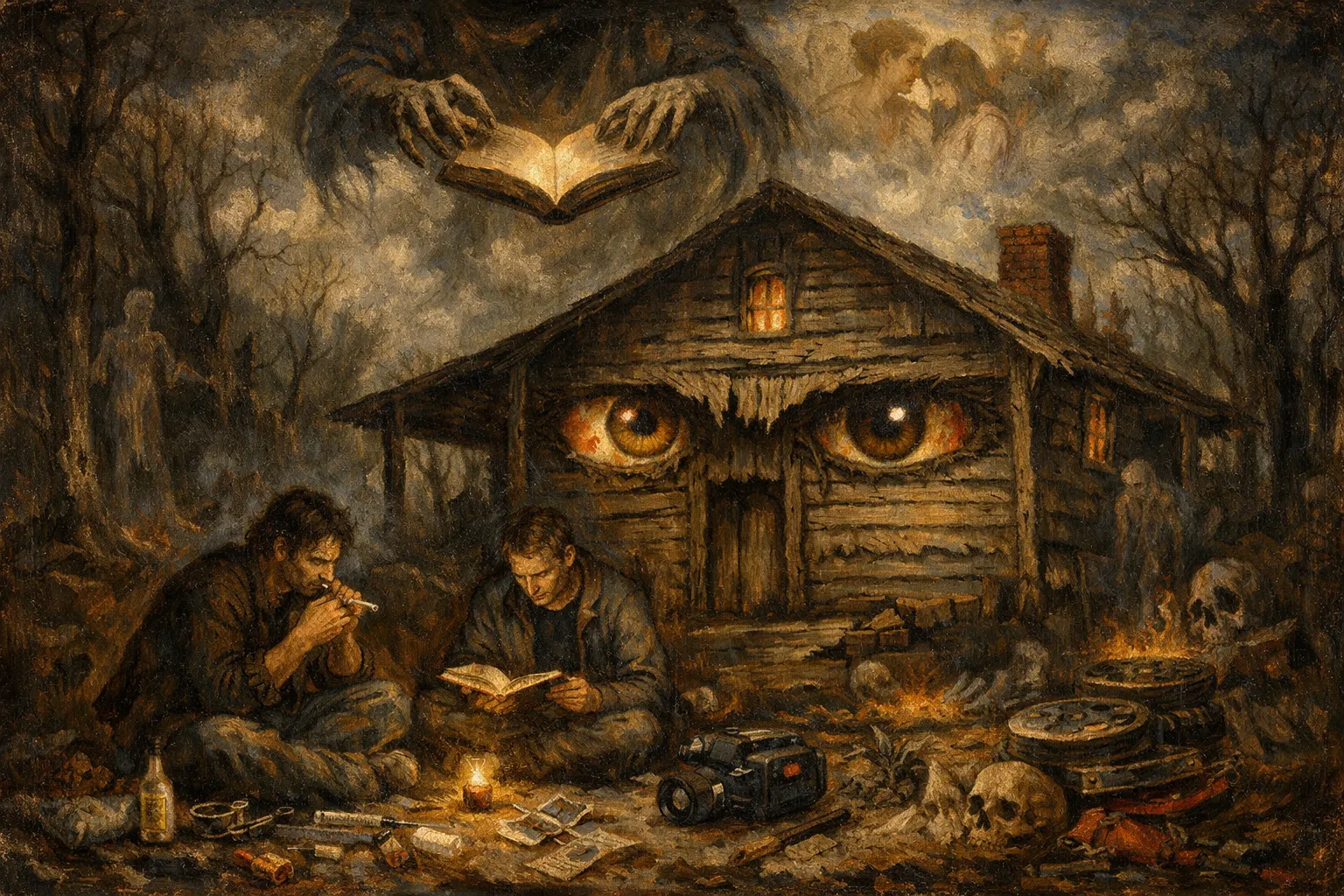
The terror of Resolution is not that something is hunting Michael and Chris in the woods, but that the film itself has already decided how their friendship will end and is patiently waiting for them to catch up.
Interruption as Assault: When Help Kicks Down the Door
Two friends, one shack, one pipe, one set of handcuffs: a small algebra of intervention.
Michael arrives at the edge of the reservation with a bourgeois fantasy of rescue: detox as narrative reset, a week in the woods as a secular retreat, friendship as last remaining sacrament. Chris, the addict, lives in a house that is already half-ruin, half-stage, an open wound in the landscape. Methamphetamine glows offscreen as the white sun of his micro-universe; every hit rewrites the calendar, every binge erases the plot that led there.
Michael’s intervention is itself a kind of bomb. If trauma is a violent reconfiguration of the coordinates through which reality is expected to appear, the moment the cuff clicks around Chris’s wrist is its own improvised explosive device. The low-intensity trauma of desks rearranged in a familiar classroom—a tiny insult to the continuity of the world—meets the high-intensity trauma of an IED tearing open a convoy: in both cases, a form-of-life discovers that it has been living on borrowed axioms. Michael does not simply “help” Chris; he detonates the only consistent story Chris has left about who he is and what his days are for.
Addiction has been Chris’s adaptive myth. The meth pipe is not just a chemical interface; it is a stabilizing device in a universe where every other narrative has failed or fled. There is an obscure dignity in his collapse: the addict as a minor sovereign over his own ruination. Michael arrives with a different addiction—addiction to coherence, to redemptive arcs, to the liberal conviction that no one should be left behind—and he is willing to perform a small act of violence to preserve the image of himself as the friend who did not abandon. Žižek writes of the uncanny moment when a familiar other suddenly becomes a stranger, a crack in the symbolic that reveals how little we ever knew of the person we loved, and Chris’s first reaction to his friend’s “help” is precisely this astonished horror at a face he no longer recognizes as his own scene partner in the old buddy-comedy script (Žižek, 1997).
Michael does not simply remove the drug; he confiscates the role Chris has been rehearsing for years. To chain a body to a pipe in the name of healing is to replace one master with another; the state has outsourced its paternalism to the guilt-ridden friend.
The Cabin as Body, the Pipe as Law
The squatter’s cabin is less a location than a diagram. Mould, rot, low ceilings, broken windows: the building is a visible cross-section of Chris’s nervous system, a materialized nervous breakdown. Every hole in the drywall is a small failed attempt at flight; every nailed-up board is a repressed alternative. The house is not haunted by some external entity; it is haunted by the routines that have sedimented there.
When Michael handcuffs Chris to the pipe, he welds three strata together: architecture, law, and flesh. The pipe, a piece of the cabin’s plumbing, becomes the spinal column of the intervention, an improvised juridical apparatus. If the state is nowhere openly present—this is, after all, a nowhere-place on Native land—it nevertheless infiltrates as technique: restraint, confinement, detox-as-quarantine. Foucault’s disciplines seep into the room through Michael’s anxious righteousness; the cabin folds into the long history of asylums, prisons, and clinics where wayward bodies are “helped” by being immobilized (Foucault, 1977).
From here, schizoanalytic cracks proliferate. The pipe is not only the law that binds; it is also an echo of the meth pipe, thin metal conduit of a different regime. The same word marks two machines of capture: one that carries water, one that carries crystal smoke, both structuring the rhythms of Chris’s days. Michael believes he has replaced the bad pipe with the good pipe, vice with virtue. But from the cabin’s perspective, both pipes are just channels through which flows are regulated: substances, affects, stories.
The reservation setting intensifies this layering. The land belongs to a people whose own narratives have been violently interrupted; treaties functioned as handcuffs on a continental scale. The white friends in the shack re-enact, in miniature, a drama of paternalistic control on stolen ground. This colonial substrate remains mostly offscreen, but it vibrates in the background every time a tribal representative or local inhabitant appears with a story of older violences mapped onto the same geography. The intervention of the real, here, is not only Michael’s intrusion into Chris’s life, but the land’s slow, indifferent reminder that this plot is itself a squatter.
Addiction as Narrative Immunity
Addiction, in Resolution, is less about craving than about narrative immunization. To smoke, to shoot up, to tweak for days is to erect a transparent membrane between oneself and the demands of legibility. The addict’s life, seen from outside, appears chaotic, unsustainable, unfinished. Seen from within, it has a perfect circularity: the next high is always already presupposed, every interaction either a means toward it or an obstacle in its way.
Chris’s isolation is not just the effect of social stigma; it is part of the immune system of the story he tells himself. Friends, lovers, jobs: each comes with the risk of alternate plots, rival mythologies in which he might have to become something other than “the guy with the problem.” Alone in the cabin, his addiction is a complete ecosystem, feeding on the dead wood of failed responsibilities and the occasional drop-in of Michael-as-guilty-audience.
Stories protect us from the real not by lying but by constantly pre-anticipating whatever could threaten them. Addiction is a particularly efficient story because it construes every external demand as an attack. “Get clean” is, at the level of narrative, structurally equivalent to “Die”: both require the annihilation of the only identity that makes daily pain bearable. Thus, when Michael storms in with his detox plan, Chris experiences not an offer of life but an attempted murder of his narrative organism.
In this sense, Chris’s addiction and Michael’s savior-fantasy are twin desiring-machines, each producing sequences of scenes, dialogues, excuses, and crises. Michael’s decision to spend a week in enforced recovery is also an intervention into his own crumbling self-story: impending fatherhood has disturbed his image of himself as ethical subject, and “fixing” Chris is how he tries to plaster over the crack. The cabin becomes a shared Body without Organs on which both men inscribe their frantic attempts at consistency.
H. Darby’s research paper on Todd Haynes describes how certain films demand an active, schizoanalytically open spectator, one who participates in decomposing and recomposing the self onscreen, and Resolution functions similarly by asking us to track not only the character arcs but the stories those characters are telling themselves about those arcs(Darby, 2013, pp. 330–347). The spectator is conscripted into the intervention; we are made to desire Chris’s salvation even as we witness the violence it requires.
Objects That Fall from Nowhere: Media as Possessed Archive
Then the real begins to fall, literally. A stone through the window, a photograph on the floor, a vinyl record where there was none before, a video that shows something we thought we had just seen live. The world of the film starts dropping artifacts as if it were shedding skin. Each object is not simply a clue but a temporal splice: evidence that another camera is running, another editor is cutting.
These intrusions have the texture of low-intensity trauma. Like walking into a familiar room and finding the furniture rearranged, the characters—and the audience—experience a micro-shock each time something appears where it should not be. The weirdness is not in the thing itself but in the violation of continuity. Someone has “fiddled with reality,” correcting the mise-en-scène like a fussy deity.
Olivia Landry, in her research paper on Bir Başkadır, argues that certain contemporary screen works function as museums, exhibiting objects as charged repositories of personal and collective history(Landry, 2023). Resolution is such a museum, but the curator is an invisible hand that leaves exhibits lying around for the protagonists to trip over. Each newly discovered medium—a slide projector, a cassette, a digital file—curates an earlier attempt to tell a story in this place: previous residents, previous breakdowns, previous interventions.
What stalks Michael and Chris is not a monster in the Lovecraftian sense but an archive that refuses to stay still. The “entity” arranges materials so that the friends will discover them in a precise order, just as a filmmaker arranges shots. Ferdinand Klüsener’s research on Tetsuo Kogawa and schizoanalytic radio art describes how airwaves and recording devices can become sites where subjectivity is modulated and dispersed, a schizodramaturgy in which sound and signal enact future possibilities(Klüsener, 2024). In Resolution, the proliferating media artefacts function similarly, turning the cabin into a node of haunted signal traffic where past, present, and possible futures are constantly being re-edited.
Each tape and photograph is a miniature film within the film, a nested diegesis that threatens to overwrite the “main” story. Carrol Fry’s research paper on Wings of Desire emphasizes how intertextuality—in Kristeva’s sense of texts built as mosaics of other texts—can expose the tension between religious and philosophical conceptions of desire(Fry, 2011). Resolution likewise builds itself as a mosaic of found footage, abandoned narratives, and half-finished horror films; the intertext is not an angelic library but a scrapyard of failed attempts to represent whatever lives in and around the cabin.
The horror here is archival: to realize that one’s most intimate decisions have been anticipated, filmed, perhaps even re-shot. The entity is less a demon than a director who cannot stop tinkering with the cut.
Trauma as Rearranged Room, Trauma as Detonated World
The film plays delicately with the spectrum of trauma. On the one end: the classroom whose desks have been subtly rearranged, a gentle insult to the subject’s assumption that tomorrow will look like yesterday. On the other: the roadside bomb, the deafening instant in which the convoy becomes a slaughterhouse and the soldier discovers that training is not enough to cushion the epistemic impact.
Michael and Chris oscillate between these poles. The clatter of a knife that should not be there, the sudden appearance of cave drawings depicting two figures: these are desk-rearrangements, minor ruptures in the consistent room of the cabin. But as these accumulate, the film edges toward the IED. The discovery of footage showing the very conversation we have just watched, the realization that someone—or something—is scripting at a meta-level, is the blast that tears open the narrative convoy.
The mind responds to such trauma with fragmentation, contradiction, narrative proliferation. Competing and incoherent explanations bloom: it’s a cult prank, a government experiment, Native retribution, alien surveillance, a ghost. Each theory is an emergency tourniquet thrown over the arterial spray of the real. Žižek speaks of fantasy as the plaster that covers a hole in reality, the screen that both conceals and stages the impossible kernel we cannot bear to confront (Žižek, 1997). Resolution externalizes this: the entity’s obsessive narrative-making is itself a fantasy built over some unspeakable non-sense at the heart of the valley.
From this angle, the falling objects, the rearranged scenes, the recursive footage are not the real but the film’s own fantasy defense against the real. The real is the sheer contingency that Michael could have stayed away, that Chris could have died unnoticed, that the reservation could have remained a peripheral detail. The horror is not that something must happen, but that nothing needed to happen at all.
Friendship, Guilt, and the Pornography of Helping
Michael’s intervention is staged, at first, as an act of love. Yet his persistence, his refusal to listen when Chris articulates his own limits, smuggles in a form of voyeurism. To “be there” for the suffering other is always tinged with the thrill of watching, of occupying the front row to another’s self-destruction and possible rebirth. The film flirts cruelly with the idea that Michael’s greatest fear is not that Chris will die, but that he will die offscreen, without Michael there to witness the tragedy and narrate his own noble attempt to prevent it.
Addiction recovery, in this cabin, becomes content. The entity’s apparent enjoyment of the spectacle—its careful placement of narrative devices, its quadruple exposures of past and future attempts—mirrors the entertainment industry’s hunger for stories of ruin and redemption. In this sense, Resolution is a horror film about the horror of being in a horror film: Michael and Chris discover that their most intimate crisis is raw material for a cosmic content-machine.
Beneath that, another question: when does helping become a form of domination? Michel Foucault would see in Michael’s project a micro-technology of power, a pastoral authority that individualizes, surveils, and corrects in the name of care (Foucault, 1977). The handcuff is not an aberration; it is the logical endpoint of a form of concern that cannot accept “no” as an answer. To rescue someone against their will is to strip them of the last measure of sovereignty they had over their own suffering.
In this, the film touches indirectly on the politics of representation dissected by feminist film theory. B. Özdemir’s research paper on Pelin Esmer’s İşe Yarar Bir Şey shows how female characters, when framed outside mainstream patriarchal codes, can resist being reduced to objects of narrative utility(Özdemir, 2019). In Resolution, by contrast, the two male friends risk becoming pure functions in someone else’s story. Their agency, already compromised by addiction and guilt, is further eroded by the discovery that their choices have been framed in advance for an unseen spectator.
Friendship, here, is less a mutual recognition than a competition over who gets to author whom. Chris wants the freedom to live and die according to his chosen plot; Michael wants to edit that plot into something he can live with. The entity wants to film them both until they stop squirming.
The Reservation as Suppressed Producer of the Real
The setting—a house on the fringes of a Native American reservation—is not incidental. It marks the cabin as a zone of layered dispossessions. The land’s original narrators have been over-written; casinos and marginal economies sprout like scar tissue over older cosmologies. Into this space come two white men importing their own crisis, as if the land were an empty stage awaiting their drama.
Yet traces of other stories leak in: local characters who speak obliquely of old rituals, buried histories, unresolved violences. These side figures are not given full narrative arcs; they pass through like ghosts. The film’s refusal to fully develop these threads is both symptom and critique: symptom of a culture in which Indigenous life is peripheral to the dominant story, and critique in that it leaves the viewer uneasily aware of the absent center.
E. Ciobanu’s comparative research on tables in Woolf, Greenaway, and Wong Kar-Wai notes how domestic spaces and their furniture organize power relations and gendered expectations(Ciobanu, 2019, pp. 47–68). In Resolution, the primary domestic space is already derelict, and the only consistent “furniture” that structures relations is the pipe and the mattress. There is no kitchen table around which a family negotiates meaning; there is only a couch on which Chris self-destructs and a metal fixture to which he is bound. The reservation’s own domesticities remain offscreen, hinted at in glimpses of nearby dwellings, suggesting a parallel world of tables and rituals that the film’s protagonists never really enter.
Mark Ryan’s research on William James and the transpersonal suggests that religious and mystical experiences often arise at the edges of established social orders, where individuals brush up against what feels like a larger, impersonal force(Ryan, 2008, p. 20). The “entity” in Resolution can be read, from this angle, as a darkly transpersonal presence of the land itself: not a Native deity per se, but a machinic condensation of all the stories told and untold in this valley, seeking ever-new vessels.
The film refuses to romanticize this. Whatever sacredness haunts the place does not come to save anyone. It comes to watch.
Meta-Cinema and the God of Stories
As Michael and Chris piece together the pattern—short films documenting earlier occupants, each ending in abrupt violence—the meta-cinematic gesture becomes explicit. They are characters in a found-footage franchise that stretches across time, each iteration a failed attempt at escape. The horror is not death but sequelization: to be forced to repeat the same gestures in slightly different configurations for the satisfaction of an observing Other.
The final confrontation, when they address the entity directly, is the film’s theological climax. They speak to the camera, but also to the editing suite, the archive, the god of stories that demands ever-fresh depictions of suffering and catharsis. This is where Deleuze and Guattari’s suspicion of Oedipal dramaturgy intersects with a critique of the culture industry: the story-machine does not care who you are; it only cares that you keep producing material it can cut.
H. Darby’s schizoanalytic reading of Todd Haynes underlines how certain films open a “schizo consciousness” that dismantles the idea of a unified subject and instead reveal a network of singularities performing selves(Darby, 2013, pp. 330–347). Resolution applies a similar pressure not only on its characters but on the concept of authorship itself. Who, finally, is “making” the film? The credited directors? The in-world entity? The landscape? The economic conditions that produce low-budget horror as a viable genre?
Ferdinand Klüsener’s emphasis on schizodramaturgy—where theatrical concepts unfold through dispersed media practices and radio waves—helps articulate this diffuse authorship as a field of forces rather than a sovereign decision(Klüsener, 2024). The entity is not a singular will; it is an emergent property of cameras, hard drives, editing software, urban legends, and the viewer’s own appetite for coherence. Every time we try to pin responsibility on “it,” we are also disavowing our complicity as consumers of narrative violence.
Carrol Fry’s intertextual analysis of Wings of Desire shows how angels in that film observe human life with a melancholic detachment, embodying a traditional religious perspective at odds with Hegelian desire(Fry, 2011). The camera-entity in Resolution is a fallen angel of another sort: not benevolent, not transcendent, but thoroughly immanent to media technologies. It wants more footage, more endings, more resolutions. If there is a Hegelian dialectic here, it is a grotesque one where each new synthesis is just another horror vignette.
Coda: Learning to Live in the Cut of the Real
By the time the entity reveals itself—if “reveal” is the right word for a shudder in the image, a roar in the soundtrack, a final, overwhelming cut—it is too late to separate trauma from narrative. The real has intervened not as raw, unmediated shock, but as the unstoppable insistence of mediation itself. Michael’s desire to intervene in Chris’s life, the cabin’s crumbling walls, the reservation’s history, the tapes and photos and drawings: all have been enfolded into a single apparatus that produces and consumes stories about people who think they are free.
What, then, would a line of flight look like in such a world? Not the naïve fantasy of stepping outside the film, for even that gesture—“refusing” narrative—is quickly metabolized as a plot twist. Perhaps it would be something smaller and stranger: a friendship that no longer justifies itself through rescue, an addiction that is neither romanticized nor reduced to pathology, a willingness to inhabit the rearranged room without immediately moving the chairs back.
If trauma is the moment when reality does not make sense, schizoanalysis is not the project of restoring sense but of learning to surf the non-sense without drowning in new certainties. Resolution ends, not with clarity, but with an obliteration that is simultaneously a cut-to-black and an opening onto the question: who, or what, will watch the next attempt?
The film does not answer. It leaves us in the cabin’s afterimage, in the valley’s echo, in the uneasy awareness that the most terrifying intervention of the real is not the monster in the woods or the bomb on the roadside, but the discovery that our most intimate acts of meaning-making may already belong to someone else’s archive.
To go on living after such a revelation is to accept that we are all, in some sense, already in the movie—and to decide, nonetheless, where to place the next piece of furniture.
References
Ciobanu, E. (2019). Kitchen and other tables to think with: The case of To the Lighthouse, The Cook, the Thief, His Wife and Her Lover and In the Mood for Love(Ciobanu, 2019, pp. 47–68).
Darby, H. (2013). I'm glad I'm not me: Subjective dissolution, schizoanalysis and post-structuralist ethics in the films of Todd Haynes(Darby, 2013, pp. 330–347).
Deleuze, G., & Guattari, F. (1983). Anti-Oedipus: Capitalism and schizophrenia (R. Hurley, M. Seem, & H. R. Lane, Trans.). University of Minnesota Press.
Deleuze, G., & Guattari, F. (1987). A thousand plateaus: Capitalism and schizophrenia (B. Massumi, Trans.). University of Minnesota Press.
Foucault, M. (1977). Discipline and punish: The birth of the prison (A. Sheridan, Trans.). Pantheon Books.
Fry, C. L. (2011). Angels in the Metroplex: Hegel, the Apocrypha, and intertextuality in Der Himmel über Berlin (Wings of Desire)(Fry, 2011).
Klüsener, F. (2024). Schizodramaturgy: On the phenomenology of the future in Tetsuo Kogawa’s airwaves-art(Klüsener, 2024).
Landry, O. (2023). Film as museum: One-of-a-kind objects in Berkun Oya's Bir Başkadır(Landry, 2023).
Özdemir, B. (2019). İşe Yarar Bir Şey filminin kadın karakterlerine ve ölüm olgusuna feminist film kuramı çerçevesinde anamorfotik bakış(Özdemir, 2019).
Ryan, M. B. (2008). The transpersonal William James(Ryan, 2008, p. 20).
Žižek, S. (1997). The plague of fantasies. Verso.
Comments
Post a Comment