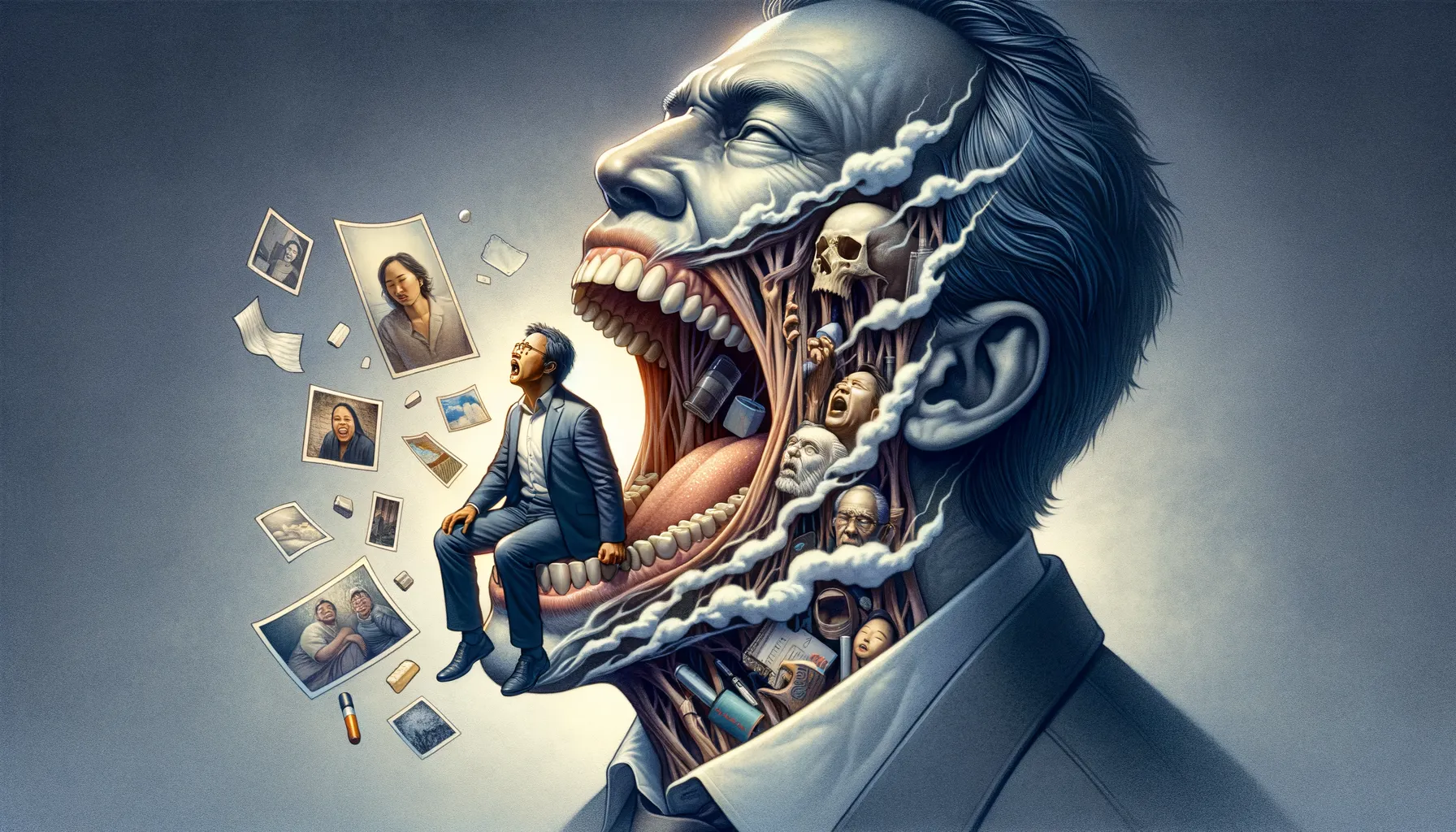
The hammer in Oldboy does not merely break teeth; it cracks open the idea that a life ever had a single, dignified cause holding it together.
The Drunk Without a World
Dae-su begins not as a tragic hero but as a minor disturbance in a police station, a man so drunk he tries to urinate on a potted plant and clown his way out of custody. The scene stages him already imprisoned, already seated under the fluorescent gaze of the state, yet in a farcical key. He is cuffed between “real” criminals whose faces bear the gravity of recognizable motives—robbery, assault, something that fits a file. He alone is there for nothing.
This “nothing” is not emptiness but a swarm of disconnected impulses. He is husband and father, but these coordinates do not yet function as anchors; they are names he wears without inhabiting. The family has not soldered him to the socius in the way the classical melodrama would like. He wanders through the evening in a stupor, missing his daughter’s birthday, more attached to the bottle than to any legible narrative of responsibility.
Desire here is noisy but unmoored, spilling out in petty aggression, bad jokes, and a refusal to let any face in the station really matter. Others are props for his spectacle. The desiring-machine that is Dae-su’s body consciousness does not yet plug coherently into anything beyond itself; there is intake (alcohol), discharge (urine, speech), but no circuit that folds back and demands accountability.
Arrest is merely an inconvenience. The police let him go. He staggers into the night, still unbound, and it is at precisely this moment of formless freedom that the real imprisonment begins—the anonymous abduction, the chloroform, the waking-up in a room that will be his world for fifteen years.
The man without a cause is about to be given one.
Fifteen Years of Television: Prison as Editing Suite
The room looks like a budget motel, but it is really an editing suite for a life. No bars, only wallpaper and a steel door. The window is a screen; the world arrives as television. The first desiring-machine to be installed is the flow of images: wars, news, cooking shows, talk shows, all flattened into the same shimmering surface.
In this sealed box, Dae-su’s body is hooked up to a simple but relentless apparatus: food slot, gas sedation, a hand punching through plaster until the knuckles bleed, a television drip-feeding representations of a world he can no longer touch. The room is a laboratory in which his drives are to be reorganized. It is not punishment in the classical sense; it is a factory for manufacturing a subject whose first and last question will be why.
Foucault’s prison diagrammed a disciplinary power that observes, catalogs, and reforms bodies through surveillance and routine (Foucault, 1977). Here the surveillance is strangely absent; Dae-su knows no visible guard, no camera, only the periodic gas that knocks him out and the hand that cleans, cuts his hair, changes his sheets while he sleeps. Supervision is impersonal, more like an environmental condition than a person. The result is not the internalization of social norms, but a vertiginous circling around the opacity of his situation.
The montage of TV images becomes his history. He learns to fight from watching martial arts programs and shadowboxing against the wallpaper. He traces news events in a notebook, aligns dates, reconstructs the world’s timeline to mark the duration of his captivity. The global scene seeps into his body as pure stimulus, stripped of political context, consumed as training material for a revenge fantasy.
Desire is rechanneled: the man without cause is given one in the simplest imperative—“Find out who did this, and make him pay.” It is an implanted question, the master-signifier around which all other drives begin to orbit. What Dae-su does not see is that this cause is already accounted for in someone else’s plan. The line of flight he imagines—tunneling through the wall, punching his way out, emerging reborn—has been pre-anticipated and folded into the architecture of his cage.
He hallucinates ants crawling under his skin, across the room, erupting from his flesh: a crowd of tiny, purposive creatures colonizing the formlessness of his isolation. They are the image of a sociality he lacks, and also the image of how his own desire is being organized—multiplicity compacted into a single crawling obsession.
Woo-jin’s God-Machine and the Manufacture of a Cause
When the door finally opens and Dae-su is let out—drugged, neatly dressed, deposited in a suitcase on a rooftop—freedom arrives as another trap. A man on the verge of suicide, clutching a small dog, stands at the railing. Dae-su seizes him by the tie and demands that he listen to “my story” before jumping. He pours out fifteen years of captivity, a torrent of narrative that he has rehearsed in his cell, and then, bored, walks away when the other man tries to tell his own story.
The asymmetry is perfect. He has discovered that his life has a cause, but he has not yet discovered that others do as well. His newfound sense of meaning is still solipsistic, his recognition still one-way. The other person is a function of his catharsis, not yet a subject with a claim on him.
Hovering above all this is Woo-jin, the millionaire orchestrator who has not only arranged the captivity but designed the escape, the encounters, the very coordinates of desire. He is less a villain in the moral sense than a transcendental director, a position reminiscent of the Lacanian “big Other,” that symbolic order in whose gaze our actions acquire legibility (Lacan, 1977).
Woo-jin has written a script whose genre is revenge tragedy but whose hidden engine is incest. The sushi chef Mi-do, the woman with whom Dae-su will fall in love and to whom he will attach his hard-won cause as protector and lover, is already folded into Woo-jin’s plan. Her apartment, her workplace, even the way she responds to his sudden appearance have been primed through hypnosis and manipulation.
Capitalist power here appears not as overt coercion but as an ability to choreograph environments, to set up seemingly spontaneous meetings, to install desire in advance. Woo-jin is not just a man with money; he is money personified, the abstraction that allows one to buy not only services but situations, not only images but the conditions under which images will be believed.
The primal scene, as far as Woo-jin is concerned, is not the fifteen-year imprisonment but the moment, decades earlier, when a schoolboy Dae-su saw him making love to his sister in an empty classroom and, later, let a rumor slip. That childish act, performed with the same careless disregard for the reality of others that we saw in the police station, detonates into a suicide and a lifetime of guilt for Woo-jin.
But notice: it is not the incest that scandalizes the film’s universe; it is the gossip, the circulation of the image through the school’s social network. Woo-jin frames his revenge not as punishment for moral condemnation, but as vengeance on the one who set in motion a chain of words that killed the only person he loved. Desire circulates as rumor long before it circulates as blood.
Incest without Oedipus
At the core of Oldboy lies an incest that has been meticulously engineered, not prevented. Everything in classical psychoanalysis insists on the incest taboo as the primal prohibition that structures kinship and law (Freud, 1953). Here we rediscover incest not as that which must be repressed, but as the hidden reward for pursuing a socially legible cause like revenge.
Woo-jin arranges for Dae-su to fall in love with Mi-do, to sleep with her, to imagine a future where he protects her from the shadows of his past. The affective arc here is melodramatic, even sentimental: a broken man finding new life in the love of a younger woman, a chance at redemption through care. The camera lingers on their intimacy, the gentle feeding of sushi, the shared loneliness, the tenderness of a man who has learned, in the crucible of captivity, that other people matter.
Then the revelation: Mi-do is his daughter, abducted and raised apart, kept in reserve as the ultimate instrument of vengeance. The incest is not a spontaneous eruption of desire but the endpoint of a carefully calibrated machine. Woo-jin’s revenge is to make Dae-su unknowingly repeat, in a different configuration, the very combination of sexuality and kinship that once destroyed Woo-jin’s world.
Deleuze and Guattari wrote that Oedipus is less an inevitable structure of the unconscious than a way of disciplining desire, corralling the wildness of social and libidinal flows into the narrow triangle of father-mother-child (Deleuze & Guattari, 1983). Woo-jin has done something even more perverse: he has weaponized the Oedipal form itself, making it the content of a game rather than an axiom of psychic life.
There is no analyst here to interpret a dream and rescue the subject from forbidden wishes. Instead, the analyst’s role is taken by a sadistic mastermind who reads Dae-su’s history and writes a scenario in which the desired object (Mi-do) and the forbidden object (daughter) are the same, and the discovery comes only after the fact, when no symbolic rearrangement can undo the act.
The incest does not express a latent wish in Dae-su’s unconscious; it expresses the malicious creativity of power over the unconscious of another. The Oedipal triangle is no longer a naturalized schema but a set-piece installed from the outside, like the furniture in the motel-room prison. What the film exposes is how easily “family romance” can be produced, not just interpreted, by an authority that controls the conditions under which bodies meet.
Teeth, Tongue, and the Body That Refuses to Signify
When Dae-su discovers the incest, when Woo-jin plays him the tapes and reveals the chain of manipulation, the reaction is not a simple cry of horror. It is a bodily implosion. The same mouth that once spat out careless rumors now becomes the site of self-mutilation. Dae-su drops to his knees, barks, crawls, begs; he literally becomes a dog for Woo-jin, promising to keep the secret, to kill himself, to erase any trace of what has transpired.
Then, in one of the most harrowing scenes in modern cinema, he takes the scissors and cuts out his own tongue. He offers the bloody piece up as if it were a sacrificial token, a pledge that he will never again speak the word that could destroy his daughter. The organ that set everything in motion—the talking mouth—must be excised to stop the nightmare.
Nietzsche once described how making a human being “capable of making promises” required first the creation of a memory through pain, through the engraving of obligations into the flesh (Nietzsche, 1994). Here, the tongue-cutting is an attempt to retroactively undo such an inscription, to make it so that the promise of silence can no longer be broken because the organ of speech is gone.
But the body does not simply become mute; it remains a surface on which the situation continues to write itself. Dae-su’s crawling, his howling, his tears—these are not only expressions of remorse but performative reconfigurations of subject position. He tries to reterritorialize himself as an animal, a slave, a creature without rights, so that Woo-jin might be satisfied and spare Mi-do from the knowledge that would shatter her.
The scene brushes against what Deleuze and Guattari call a body stripped of its usual functions, not in the sense of spiritual transcendence but as a desperate reorganization of how the body can be used and what it can mean (Deleuze & Guattari, 1987). The tongue is no longer an instrument of speech; it is an object that can be cut, held, offered. The doggish posture is no longer metaphorical; it is a way of bargaining with a sadistic Other who seems to hold all the codes.
Yet the offer fails to stop the chain entirely. Woo-jin spares Mi-do from the revelation, but he does not undo what has been done. He exits the scene by shooting himself in an elevator, leaving behind an empty command position, a god-machine that has carried out its program and then annihilated itself. The cut tongue does not restore any balance; it only marks, with unbearable clarity, the asymmetry of power between one who can design a life and one who can only mutilate himself in response.
Corridor, Ants, and the Crowd of Selves
Midway through the film sits the iconic corridor fight: Dae-su, hammer in hand, facing a hallway full of thugs hired by the mysterious agency that manages his prison. The sequence is filmed in a side-scrolling, almost video-game aesthetic, a single lateral tracking shot that compresses time and space into a brutal, rhythmic ballet. Bodies fall, get up, limp, stab; the hammer crunches bones, the knife slides between ribs, all in a suffocatingly narrow frame.
This corridor is another cage, another apparatus directing bodies into collision. The fight is not a free eruption of violence; it is an audition. Woo-jin is watching, evaluating whether the man he has cultivated for fifteen years is ready to follow the trail to its end. The hallway functions as a test of persistence, of willingness to endure pain, of commitment to the newly acquired cause of revenge.
At the level of image, however, the scene also undoes the unity of the self. Dae-su is one against many, but the many are strangely interchangeable; their faces blur, their bodies pile. The ants he hallucinated alone in his room have here been externalized into a crowd of attackers, each one a minor obstacle in the path toward a singular, impossible object: the answer to “why.”
There is a sense in which the corridor fight stages Dae-su against the multiplicity of his own previous indifference. Each thug is another version of the man who does not care, who will punch, hurt, obstruct for pay, who does not ask why he is being asked to stand in this hallway and prevent a stranger from walking through. The hammer swings through this anonymous mass as if to clear a path not just through enemies but through all the prior selves that never considered the consequences of their acts.
Žižek has remarked on how violence often functions as a short-circuit of thought, a way of leaping from impotence to an illusion of agency without passing through reflection (Žižek, 1992). The corridor scene both indulges and critiques this fantasy. The choreography is exhilarating; the exhaustion on Dae-su’s face, his staggering survival, give us a visceral sense of accomplishment. Yet what is “achieved” is only another step deeper into the labyrinth designed by another man’s idea of justice.
The ants return later, when Mi-do confesses that, in her own loneliness, she sometimes imagined herself as an ant among others, desperate not to be alone. The insect motif weaves together isolation, crowd, captivity, and the desperate hope that there is some swarm out there to which one might belong. In Oldboy, that swarm often turns out to be made of enemies or phantoms.
Cave without Exterior: Memory, Hypnosis, and the Ethics of Ignorance
If there is a philosophical allegory that hovers over Oldboy, it is less the usual story of “the truth will set you free” than a corruption of it. Dae-su begins in a cave—his motel-room prison—watching shadows on the wall (television), taking them in as reality. When he is released, when he follows the trail toward Woo-jin, he imagines he is walking toward the sun of knowledge, toward the real behind the manipulation.
But what awaits outside the cave is not a higher reality but a revelation so destructive that he wishes to return to unknowing. The discovery of the incest does not emancipate; it paralyzes, then drives him to plead for a new cave. Instead of trying to awaken Mi-do, he seeks a hypnotist to erase his own memory of the truth, to become again the man who can love her without the knowledge that makes that love unbearable.
Nietzsche warns of the dangers of too much history, of a saturation of consciousness with the past that crushes the capacity to act (Nietzsche, 1994). In this sense, Dae-su’s decision to seek forgetting is not simple cowardice but a twisted attempt at an “active forgetting,” an effort to cut the chain of causality that has linked his childhood flippancy to his adult catastrophe.
The hypnotist agrees to help, but the sequence is marked by uncertainty. We see him in the snow with Mi-do, smiling, then his expression flickers—something like terror or recognition passes across his face, quickly replaced by a forced grin. The film refuses to tell us whether the hypnosis has worked, whether he truly no longer knows who she is, or whether he is now imprisoned in an even more claustrophobic cave: one in which a part of him knows and another part must forever disavow.
Lacan spoke of the unconscious as structured like a language, a set of signifiers that continue to operate even when we consciously disavow them (Lacan, 1977). Hypnosis might rearrange the conscious narrative, but it cannot so easily overwrite the traces stored in the body, in mannerisms, in affect. If Dae-su’s smile at the end is split—one side happy, one side haunted—it is because the attempt to delete a signifier (father) from the chain does not eliminate what attaches to it (incest, guilt, love).
The ethics here is vertiginous. Is it better, for Mi-do, to remain ignorant of her father’s identity and their shared past? Is the conspiracy of silence Dae-su now constructs around her less violent than the revelation that would shatter her world? The film offers no comfortable answer, only a snow-filled landscape where two people cling to each other in a love that may now be supported by an absence rather than a truth.
Revenge and Its Failed Line of Flight
Revenge, in the standard genre formula, is supposed to be clarifying. A wrong is done; the hero pursues the wrongdoer; violence restores some equilibrium. Oldboy aborts this arc at every turn. Dae-su’s quest to find the person who imprisoned him and to understand “why” appears, at first, as a way of reclaiming agency, of refusing to remain a victim of an anonymous system. It is his line of flight from the initial senselessness of his capture.
But this line of flight has been pre-inscribed. Woo-jin has anticipated it completely; indeed, he counts on it. The more ardently Dae-su pursues his cause, the more tightly he is bound to the path laid out for him. His every act of discovery leads him closer to the one blinding revelation that will devastate him. His attempt to escape from the condition of being a plaything becomes the mechanism by which he is played.
Marx dissected how capitalist systems transform apparent freedoms into structured dependencies, offering workers the “choice” to sell their labor while organizing the entire field of options such that this choice is compelled (Marx, 1977). Woo-jin organizes the space of Dae-su’s possible actions in a similar way. Revenge becomes the only plausible avenue for a man in his position; it is the freedom that cages him.
Deleuze and Guattari invite us to distinguish between lines of flight that open new compositions of life and those that lead directly into black holes, into even more rigid forms of capture (Deleuze & Guattari, 1987). Dae-su’s revenge is of the latter kind. It is fast, intense, propulsive, but its destination has been fixed by another. He cannot see this because the question “why was I imprisoned?” has been allowed to eclipse every other question, including “who benefits from my pursuit of this answer?”
There is a political echo here: how many subjects in late capitalism are given “causes” that feel like authentic missions but function largely to reinforce the very structures they imagine themselves resisting? The film suggests that a cause can be a trap as much as an emancipation, especially when it threads directly back into a childhood wound someone else has chosen to activate.
Coda: Snow, Laughter, and the Smile That Doesn’t Belong to Anyone
The final image of Oldboy refuses to settle. Dae-su and Mi-do embrace in the snow, an image of purity superimposed on a history of contamination. The hypnotist’s intervention has supposedly severed the link between father and lover, restoring the possibility of a love unpoisoned by genealogy. Yet the fissure in Dae-su’s expression, that almost imperceptible twitch passing through his face, says otherwise.
Who smiles here? The devoted lover relieved of his burden? The father who has chosen ignorance as the price of his daughter’s happiness? The dog who has internalized Woo-jin’s command so deeply that he will now police his own consciousness forever?
In a sense, the film ends not with a character but with a desiring-machine whose components have been irreversibly scrambled—husband, father, prisoner, lover, avenger, dog, patient—all running at once on a snow-white screen. The body stands there as the only guarantee that something persists, that not everything has been narrated out of existence, even if its interior maps have been redrawn through violence and suggestion.
The schizoanalytic question is not whether Dae-su is now “healed” or “damned,” but what new assemblage has been produced out of the wreckage. A man without a cause was given one, pursued it, and found that at the heart of his quest lay not justice but an obscene intimacy engineered by another. In cutting his tongue, in consenting to hypnosis, in choosing to go on loving in the aftermath of revelation, he has participated in the making of a subject that no morality tale could have anticipated.
There is no moral to this story in the traditional sense. There is, instead, a map of how desire can be captured, redirected, weaponized, and then asked to forget that this ever happened. The hammer hangs in the air, the corridor stretches on, the TV remains on in an empty room, the ants continue their invisible march across the walls of consciousness.
In the distance, somewhere beyond the snowy hill, another man without a cause is getting drunk, another careless word is being spoken, another rumor takes flight. The machinery is already turning, quietly, patiently, waiting for another Dae-su to stumble into its indifferent embrace.
References
Deleuze, G., & Guattari, F. (1983). Anti-Oedipus: Capitalism and schizophrenia (R. Hurley, M. Seem, & H. R. Lane, Trans.). University of Minnesota Press.
Deleuze, G., & Guattari, F. (1987). A thousand plateaus: Capitalism and schizophrenia (B. Massumi, Trans.). University of Minnesota Press.
Foucault, M. (1977). Discipline and punish: The birth of the prison (A. Sheridan, Trans.). Vintage Books.
Lacan, J. (1977). Écrits: A selection (A. Sheridan, Trans.). W. W. Norton.
Marx, K. (1977). Capital: Volume 1 (B. Fowkes, Trans.). Vintage Books.
Nietzsche, F. (1994). On the genealogy of morality (C. Diethe, Trans.). Cambridge University Press.
Park, C. (Director). (2003). Oldboy [Film]. Show East.
Žižek, S. (1992). Looking awry: An introduction to Jacques Lacan through popular culture. MIT Press.
Comments
Post a Comment