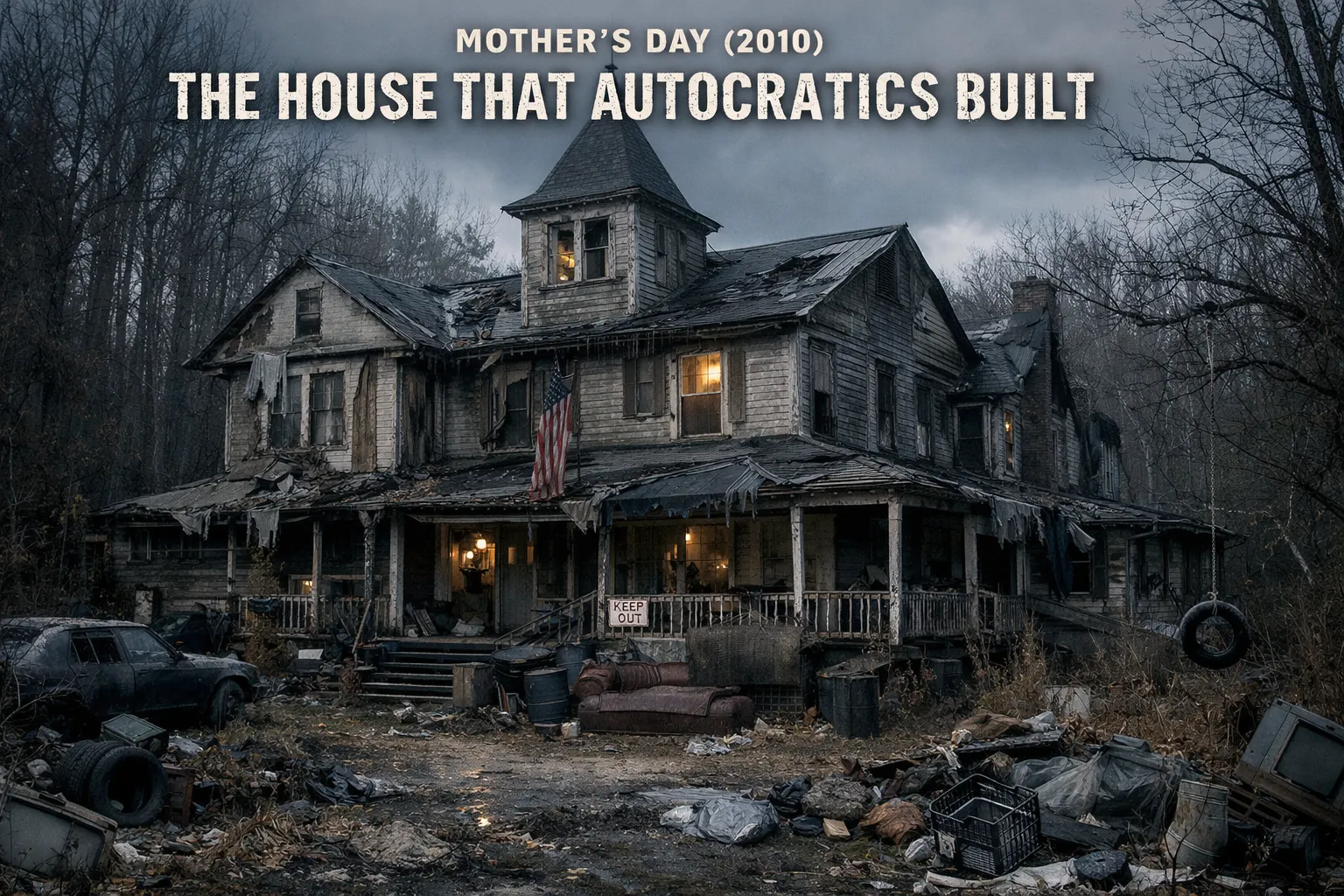
The greeting card says “Thanks, Mom, for everything,” but Mother’s Day (2010) quietly asks what happens when “everything” includes torture, fascism, and the meticulous crafting of sons into domesticated monsters.
Hallmark With a Death Drive
On the surface, Mother’s Day is a home-invasion horror movie: a botched bank robbery, three brothers on the run, one bleeding out. They flee to what they believe is still their mother’s house, only to discover it has been repossessed and sold to a new couple, Beth and Daniel Sohapi. Panic escalates into hostage-taking; the Sohapis and their party guests are bound, terrorized, rearranged like furniture in someone else’s nightmare.
Then Mother arrives.
Before she enters, the violence is noisy and immature. The older brother is nominally “in charge,” the younger ones oscillate between panic and bravado. Authority is fragile; cruelty is improvised. As soon as Mother steps through the door, the texture of violence changes. Chaos is replaced by pedagogy. Every slap, every threat, every wound is pulled into a lesson, a ritual of correction and affirmation.
What looks like a simple home invasion is actually a practicum in how fascism grows in the soil of the family, in the tiny, daily modulations of guilt, love, obedience, and fear. Deleuze and Guattari call these “micro-fascisms”: not the grand spectacle of the dictator, but the molecular arrangements of power that crystallize in kitchens, basements, and bedrooms (Deleuze & Guattari, 1983). Mother’s Day drills down into exactly those spaces.
Mommy’s Little Desiring-Machines
The pivotal scene is Mother Koffin’s confrontation with Addley after he has assaulted a hostage against his older brother’s instructions. Addley is split: exultant in his sadism, terrified of the consequences. Mother moves in, a choreographer of affect.
She executes a double movement:
She absolves him: “You didn’t do anything wrong. You did what had to be done. You did it for the family.”
She corrects him: he barked when he should have waited to bite; he broke a rule (“never strike a woman”) that she then theatrically inverts by slapping a male hostage.
Reich saw in fascism not just repression but an organized channeling of sexual and aggressive energies into obedience, a structure where subjects are encouraged toward violence yet kept in a permanent state of guilt and dependence (Reich, 1949). Mother Koffin’s pedagogy is exemplary:
She validates Addley’s enjoyment of cruelty as loyalty.
She reins it in, not to protect the victim, but to refine the technique, to maximize the family’s control.
The boys are desiring-machines whose flows—aggression, fear, yearning for approval—are plugged directly into the family-nation. Deleuze and Guattari argue that fascism is born when desire itself comes to desire its own repression, when the subject clings to the very power that binds them (Deleuze & Guattari, 1983). Mother Koffin teaches precisely this clinging.
Freud’s superego hovers here: that cruel internal agency that simultaneously commands and condemns, that says “Enjoy!” and then punishes the enjoyment (Freud, 1961). Addley’s oscillation—gleeful assault, then tearful apology, then demand to be struck again—plays out this Freudian economy of guilt. But in Mother’s house, the superego has a face, a voice, and a sweetly murderous smile.
The House as Fascist Womb
The repossessed Koffin house is more than a setting; it is a territorial diagram of competing social orders. The bank’s foreclosure and resale convert a once criminally-sacred family space into a showroom for middle-class aspiration. Beth and Daniel have bought a dream: mortgage, décor, the promise of a child-filled future.
The Koffins treat that same structure as an exiled homeland. Their return is a minor nationalist fantasy: the dispossessed family reasserting sovereignty over its “native” space. Marx described the bourgeois family as a core unit for reproducing labor power, cloaked under sentimentality (Marx, 1977). Mother’s Day throws two forms of reproduction into conflict:
The Sohapis’ home is a node in financialized capitalism: the house as investment, life as a series of payments.
The Koffins’ home is a bunker-state: the house as fortress where loyalty and bloodlines are everything.
The walls remember two different sets of stories. For Beth and Daniel, they are supposed to hold family photos, baby toys, tasteful art. For the Koffins, they hold scars of discipline, the rites of initiation into Mother’s law.
Foucault would see in this house a disciplinary apparatus: rooms partitioned for surveillance, bodies arranged for inspection, movements constrained and watched (Foucault, 1995). But the power here is not anonymous institutional power; it is intimate, scented with cigarettes and casseroles. The warden knows your childhood nightmares and your favorite dessert.
The foreclosure, then, is not merely economic; it is symbolic. Capital has tried to overwrite one set of micro-fascisms (the Koffin regime) with another (neoliberal domesticity). When the Koffins burst back in, they do not just reclaim property; they reclaim narrative. The house becomes a fascist womb again, generating obedient sons and broken hostages.
Banality in an Apron
Mother’s flip through the Sohapis’ box of baby photos and mementos is one of the film’s cruelest passages. She discovers the traces of the Sohapis’ dead child, run over by a car. Tears well up; for a moment, we see a Mother who recognizes another’s loss.
Then she burns the box.
The ashes of someone else’s grief become leverage, a tormenting instrument to force Daniel to reveal the stolen money’s location. Empathy is immediately subordinated to strategy.
Arendt’s portrait of Eichmann as terrifyingly normal—weak, bureaucratic, unreflective—remains one of the sharpest analyses of fascist evil (Arendt, 1963). What shocks about Mother Koffin is a related but distinct banality: not grey office normality, but the terrifying normality of care. She is not a camp commander in uniform; she is the mother who cries over a dead child’s photos while weaponizing their smoke.
The banality here is that nothing about her gestures feels alien. The way she touches the box, the way her voice softens—these are recognizable from millions of scenes of ordinary maternal care. What is exceptional is the next move: the instrumentalization of that care into a tool of domination.
Lacan’s maternal superego—an all-devouring love that admits no outside—helps clarify this structure. When Mother says, implicitly, “Everything I do, I do out of love for my family,” she occupies a position that cannot be questioned from within: to resist her is to betray love itself (Lacan, 1978). That is why her sons, even when they flinch from her blows, keep orbiting her.
The horror is that the fascist nucleus is not hatred but a certain kind of love.
Beth Sohapi: Neoliberal Survival As Anti-Politics
In counterpoint to Mother stands Beth, the other woman with a strong sense of self. Yet Beth’s self is a thin, fraying membrane stretched over debt, marital lies, and consumerist fantasy.
From the beginning of the invasion, Beth’s strategy is consistent: betray others to save herself. She outs the doctor among the hostages to gain favor. She exposes a friend’s business to deflect suspicion. At every turn, she individualizes what could become collective: instead of “we,” she defaults to “I” and “me.”
Foucault’s analysis of neoliberalism as a production of subjects who treat themselves as little firms—entrepreneurs of their own human capital—is a chilling lens here (Foucault, 2008). Beth’s every decision is a cost-benefit calculation: whose pain can be expended to buy a little more chance of her own survival?
This is not simple cowardice. It is the internalization of a whole social order where competition is naturalized and solidarity is always secondary. Beth’s betrayals are dressed in the rhetoric of “hard choices,” mimicking the moral vocabulary of neoliberal governance.
Nietzsche’s account of ressentiment, the alchemy by which the powerless transmute their impotence into a supposed moral superiority, flickers beneath Beth’s choices (Nietzsche, 1994). She cannot overpower the Koffins, cannot build solidarity with the other hostages, so she elevates her own will to survive—no matter the cost—into a grim virtue.
Crucially, the film reveals that Beth’s life before the invasion was already structured by another betrayal: Daniel has stolen money from Mother Koffin. Their home sits on a foundation of abstracted violence: theft, foreclosure, anonymous financial harm. Marx’s critique of capitalist social relations as saturated with hidden coercion resurfaces: behind the “private” security of the home lies someone else’s dispossession (Marx, 1977).
Where Mother Koffin demands loyalty to the family-nation, Beth demands loyalty to the isolated self. Each, in their own way, sabotages any emergence of a true collective “we.”
Treshawn Jackson: The Collective That Might Have Been
Amid these competing egoisms is Treshawn Jackson, perhaps the only character who persistently imagines a collective solution. His first instincts are not to bargain individually but to rally the hostages, to seek a coordinated revolt against their captors.
He sees what others either cannot or refuse to see: numerically, the hostages can overwhelm the Koffin brothers if they move together. Politically, their survival depends less on private deals than on shared risk.
Badiou’s notion of an event—a rupture that opens a new possibility which demands fidelity—offers a way to think Treshawn’s role (Badiou, 2001). Each time he initiates a plan, we glimpse the potential for such an event: a break with the logic of family loyalty and neoliberal self-preservation. Yet each time, the fidelity collapses:
Beth undercuts solidarity with another betrayal.
Other hostages falter, paralyzed by fear or seduced by Mother’s manipulations.
Mother’s primary tactic is to prevent such fidelity from congealing. She does not merely threaten; she orchestrates betrayals, carefully cultivating suspicion, jealousy, and despair. The hostages are turned into rivals for mercy.
This is the logic of racist terror, too. The Koffin family’s assault evokes lynching-era home invasions not only in their brutality but in their strategic aim: destroy the social tissue, atomize communities, ensure that no “we” capable of resisting class and racial domination can coalesce. The point is not merely to kill, but to leave behind a landscape where solidarity feels impossible.
Treshawn’s repeated, frustrated attempts at organization become the film’s tragic conscience. He is the unrealized event, the line of flight that never quite escapes.
Guilt, Enjoyment, and Mother’s Party Line
The Koffin sons do not only obey; they enjoy. Their violence is not a purely burdensome duty; it is a thrill, a sick rush licensed by Mother’s ideology.
Žižek has insisted that ideology operates not only at the level of beliefs but at the level of enjoyment—jouissance—organizing where and how we are allowed (or commanded) to derive pleasure (Žižek, 2001). Fascism does not simply repress; it says:
You must enjoy in the right way, in the right place, for the right cause.
Mother’s pedagogy fits this perfectly. The sons are encouraged to be brutal in the name of the family, then scolded for minor deviations in style or target. Their enjoyment is simultaneously commanded and condemned.
We see this in Addley’s tearful demand to be hit again, to be punished by Mother’s hand. Enjoyment, guilt, and obedience spiral together:
He enjoys hurting others.
He dreads losing Mother’s praise.
He then enjoys his own punishment as proof of renewed belonging.
Reich argued that fascism thrives by mobilizing precisely such ambivalence: an erotically charged submission to authority that converts personal frustration into authorized cruelty (Reich, 1949). The brothers’ swaggering sadism is inseparable from their infantile dependence.
Freud’s death drive—the compulsion beyond the pleasure principle, the pull toward repetition and destruction—haunts this cycle (Freud, 1961). The Koffin boys are not simply seeking pleasure; they are driven to repeat a pattern of violence-guilt-reconciliation that erodes their own capacity for autonomous life.
Desire here is not stifled; it is harnessed. Schizoanalysis does not ask “What repressed wish are these boys expressing?” but “What machines of power and desire are assembled here, and what do they produce?” The answer: they produce a micro-fascist family-state that runs on the fuel of carefully orchestrated cruelty.
Hyperreal Motherhood and Real Blood
Mother Koffin is implausible as a single sociological “type,” but she is frighteningly plausible as a condensation of cultural images of motherhood. She is the hyperreal Mother, more real than real, in Baudrillard’s sense (Baudrillard, 1994).
She gathers into one body:
The gentle, nurturing mom from commercials.
The self-sacrificing single mother from melodrama.
The “mama bear” who “will do anything” for her kids.
The film’s move is not to parody these images from a distance but to intensify them. “I’d do anything for my children” is enacted literally, stripped of metaphor, soaked in blood.
Baudrillard warns that in the age of simulacra, signs detach from their referents and circulate autonomously (Baudrillard, 1994). Mother Koffin is motherhood after that detachment: she does not mother living needs so much as the Image of the Good Mother. Her primary concern is not the actual flourishing of her children but the integrity of the family-myth.
That is why she can both empathize with and burn the Sohapis’ relics: what matters is not the child’s life or death but the sovereignty of her own maternal narrative. Anything—grief, love, memory—can be fed into that narrative as fuel.
The domestic details—tea offered to hostages, tablecloths straightened between tortures—are not simply ironic. They show how the hyperreal script of “good motherhood” persists even when its ethical content has utterly rotted away. The gestures survive as zombies.
Kant in the Basement
Kant’s ethics looks, at first glance, like the antithesis of Mother Koffin’s world. His categorical imperative demands that we treat every rational being as an end in themselves, never merely as a means (Kant, 1998). Mother treats everyone outside her bloodline—hostages, bank managers, even her own sons at times—as means.
Yet she narrates her actions in a quasi-Kantian tone of duty: not “I felt like it,” but “I had to.” She does not appeal to spontaneous passion but to necessity: the family must survive, the children must be protected, the house must be reclaimed.
Kant distinguishes between pathological love (an emotion) and practical love (a commitment enacted through duty) (Kant, 1998). Mother Koffin’s love is a dark mutation of practical love:
She does not merely feel for her family; she commits every resource, including violence, to their preservation.
She experiences this as a burden of responsibility, not just a gratification.
But her maxim has shrunk the moral universe to the walls of the house. The imperative—“Act only according to that maxim whereby you can at the same time will that your family continue to exist unthreatened”—licenses atrocity. The universality Kant demanded has been amputated and grafted onto a clan ethic.
What the film exposes is how easily the rhetoric of hard, rational duty can be marshaled to justify systematic cruelty, once the circle of those counted as “ends in themselves” narrows. Beth, too, rationalizes her betrayals as necessary decisions, mini-categorical imperatives addressed only to herself.
Time-Images in the Living Room
Formally, the movie itself fractures the neat sensory-motor continuity of classic action cinema. The cuts between domestic calm and stark brutality are often too sudden to be absorbed as “smooth” narrative; they produce little pockets of suspended time where hostages freeze, hesitate, endure.
Deleuze’s notion of the “time-image” in cinema—a form where action no longer organizes time, and viewers are left in pure, disorienting duration—offers a way to think this structure (Deleuze, 1989). Mother’s Day is not a pure time-image film, but it features key moments where:
Action possibilities are present (Treshawn’s plans, chances to run),
Yet characters remain immobilized, locked in affective paralysis.
These gaps mirror the political paralysis the film diagnoses: the inability of the hostages to translate the perception of shared danger into collective action. We watch them think, waver, stutter—and then miss the event.
The house thus functions like a diseased brain: circuits of fear, loyalty, and resentment misfire; potential lines of flight collapse. The schizoanalytic walk through this brain-house is less a clinical mapping than a poetic one: we drift from room to room, relation to relation, tracking how desire and power couple and uncouple.
Citation, Discipline, and Mother’s Law
There is a small, bitter joke in composing this analysis under the rule of APA. Citation here becomes its own kind of domestic discipline: a demand to name one’s sources, to keep one’s intellectual room tidy, to not embarrass the scholarly “family.”
Guidelines on creating logical flow emphasize how crucial coherent transitions and contextual relevance are for persuasive writing(Barroga & Matanguihan, 2021; Chuntao & Caiying, 2019). In a way, that is what Mother enforces in her own perverse fashion: everything that happens in the house must be made relevant to the story of the family, every act must be folded into a coherent narrative of loyalty and duty.
The difference, of course, is that scholarly coherence aims at clarity and truth, while Mother’s coherence aims at control. Yet both remind us that there is no discourse without rules, no narrative without a policing of what counts as a legitimate move.
Deleuze and Guattari suggest that politics is always about which flows are coded as sayable, thinkable, quotable (Deleuze & Guattari, 1983). In Mother’s house, the only ultimate “reference” permitted is “for the family.” Everything else—law, empathy, justice—is a secondary citation, to be deleted if it conflicts with that primary source.
No More Cute Fascist Babies
Mother’s Day (2010) is not just a horror movie about a bad mom. It is a diagram of how fascism is grown in private: in the way children are praised and punished, in the stories families tell about themselves, in the compromises made in living rooms to ensure one’s own survival at the expense of others.
Mother Koffin embodies a maternal fascism that dissolves any line between care and domination. Beth Sohapi incarnates a neoliberal self who can only think in terms of private rescue, sabotaging any fragile attempts at solidarity. Treshawn Jackson gestures toward a collective politics that never fully emerges.
The house at the center is both womb and tomb: it bears children for fascism and buries any attempt at a different future.
If the film leaves us with anything actionable, it is a hard imperative that runs counter to both Mother’s fascism and Beth’s neoliberalism:
Distrust every call to sacrifice “for the family” that demands someone else’s life.
Refuse the sentimental absolution of motherhood as beyond critique.
Build, painstakingly, the “we” that Mother’s Day spends its running time trying to annihilate.
No more cute fascist babies. No more greeting cards for the death drive.
References
Arendt, H. (1963). Eichmann in Jerusalem: A report on the banality of evil. Viking Press.
Badiou, A. (2001). Ethics: An essay on the understanding of evil (P. Hallward, Trans.). Verso.
Barroga, E., & Matanguihan, G. J. (2021). Creating logical flow when writing scientific articles. Journal of Korean Medical Science, 36(39), e254.(Barroga & Matanguihan, 2021)
Baudrillard, J. (1994). Simulacra and simulation (S. F. Glaser, Trans.). University of Michigan Press. (Original work published 1981)
Deleuze, G. (1989). Cinema 2: The time-image (H. Tomlinson & R. Galeta, Trans.). University of Minnesota Press.
Deleuze, G., & Guattari, F. (1983). Anti-Oedipus: Capitalism and schizophrenia (R. Hurley, M. Seem, & H. R. Lane, Trans.). University of Minnesota Press.
Foucault, M. (1995). Discipline and punish: The birth of the prison (A. Sheridan, Trans.). Vintage Books. (Original work published 1975)
Foucault, M. (2008). *The birth of biopolitics: Lectures at the Collège de
Comments
Post a Comment