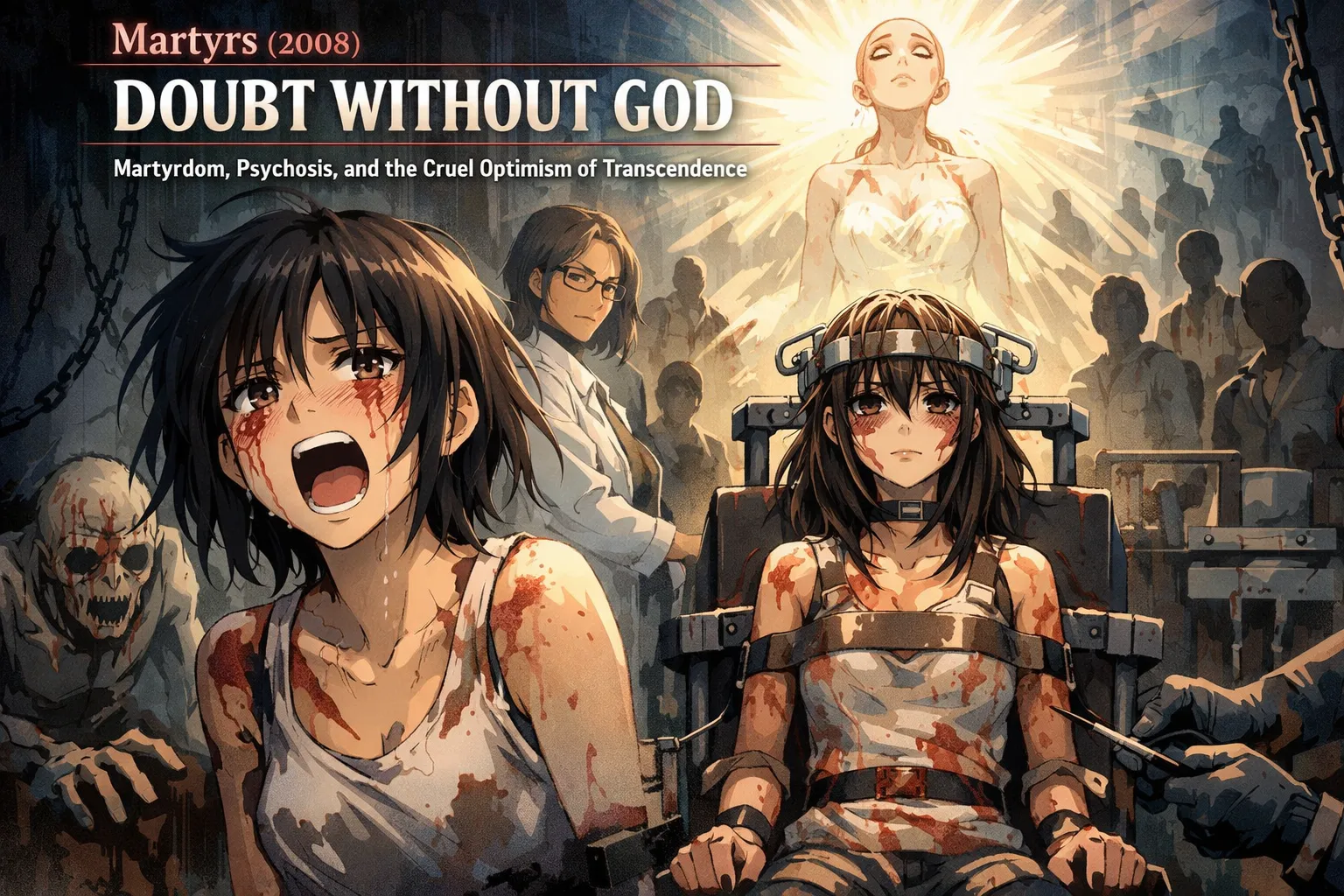
The most terrifying gesture in Martyrs is not the flaying of a body but the refusal to close a question.
Fractured Faith: Doubt as the First Wound
Philosophy usually treats doubt as a prelude to certainty: Descartes empties the stage of the world so that a purified subject and a guaranteed God can walk back in and take their seats, safely separated into mind and matter, res cogitans and res extensa (Descartes, 1996). Doubt is a method; belief is the destination. The horror of Martyrs lies precisely in sabotaging this itinerary. The film lets doubt proliferate without transcendental rescue, without a God to seal the tear between subject and object, victim and witness, pain and meaning.
Lucie’s escape from the torture site inaugurates a kind of negative cogito: not “I think, therefore I am,” but “I flee, therefore I have been torn.” Her running body, half-feral, is the first sentence of the film’s argument. Every subsequent image will be a gloss on this inaugural sprint. The cut to the institution, the medical gaze cataloguing her wounds, the psychiatrists’ narrative about trauma and hallucination—all of this reterritorializes the pure flight into legible categories, into the binary that organizes modern reason: sane/insane, real/imagined (Foucault, 1977). Lucie is immediately plugged into a grid of intelligibility that stabilizes everyone except her.
Doubt here is not yet philosophical; it is clinical, police-like. Did something “really” happen or not? Is there a basement, or only a fantasy of one? The institution, like Descartes’ God, guarantees a world—but the guarantee takes the form of a diagnosis. The price of being believed is to be classified, managed, and sedated. The price of not being believed is to be left alone with the images that do not stop.
Anna’s arrival complicates the diagram. Her compassion is the first dangerous supplement: she believes enough to stay, disbelieves enough to remain “reasonable.” She becomes the hinge between Lucie and the institution, the emissary whom the doctors deploy to extract a coherent story. Already the roles are triangulated: victim, witness, and the cold machinery of interpretation. Already martyrdom begins, not in flames, but in paperwork.
Lucie’s Cut: Desiring-Machines and the Return of the Unsaveable
The scarred woman who haunts Lucie is the film’s central desiring-machine, grinding and sputtering at the border between hallucination and materiality (Deleuze & Guattari, 1983). She slashes, claws, punishes; she is pure accusation with no language, a bodily indictment that says: you left me there. Psychologically, she can be mapped onto survivor’s guilt, the displaced rage of a child who escaped while another remained. But the image overflows that explanation. It insists on substance; it stains the screen, not just Lucie’s psyche.
When Lucie hunts down the apparently ordinary middle-class family and annihilates them with a shotgun, the film sets up a familiar moral problem: is this revenge justified? The living room, neat and banal, becomes the stage where bourgeois normality is retroactively contaminated. Lucie claims that these are her torturers. Anna’s doubt intensifies: the family looks so average, so wholesome; their kitchen is well lit, their children playful. The codes of cinematic realism, those small details that normally authenticate a world, now become obstacles to belief. The bourgeois mise-en-scène works as an alibi; it says: nothing monstrous could have happened here.
Yet Lucie’s body is a counter-archive. Her scars, her panic, the relentless apparition of the Other-Woman; all of these insist that the horror did happen, that it is not reducible to post-traumatic delirium. The desiring-machine formed by Lucie and her phantom attacker is a circuit of self-mutilation: we see Lucie bleeding, cutting herself, hurling her body against walls, while Anna and we see no attacker at all. The knife moves, the flesh tears, but the assailant is invisible. Desire here is not sexual but juridical: the desire to produce a verdict, to determine guilt, to fix a site where the cut started.
The film stages this as a schism in perception. For Lucie, the scarred woman is too present, too real. For Anna, she is absent, non-existent. Between these two regimes, a third eye opens: the camera. The camera sees both. It tracks the phantom as though she were fully material, then cuts to Anna’s point of view, where only Lucie’s self-harm remains. Cinema becomes the mediator between incompatible realities, giving consistency to what, in clinical discourse, would be relegated to “hallucination.” This is not simply an unreliable narrator strategy; it is an ontological gambit. The film asserts that images torment bodies regardless of their status in empirical reality (Deleuze, 1986).
Lucie’s final act—slitting her own throat in the dawn light—seems to close one line of flight. But it also repositions the scarred woman. With Lucie dead, the haunting does not end; instead, the image migrates. When Anna discovers the real, physically tortured woman hidden in the house’s secret chambers, the phantom is confirmed retroactively. Lucie’s impossible attacker has always been both too much and not enough: too much in her reality, not enough in Anna’s, and precisely adequate in the film’s.
Anna’s Empathy: One-Dimensional Compassion and the Failure to Believe
Anna is crafted as the most accessible point of identification. Her biography is a void: we are never told why she was institutionalized as a child. The empty backstory allows her to become an affective screen onto which the viewer can project. Her defining traits are loyalty, caretaking, and a quiet, unrequited love for Lucie. She cooks, cleans, reassures; she answers calls at dawn, drives on command, mops up blood. Her empathy is not abstract but logistical.
Yet it is precisely this empathy that fails at the decisive moment. When Lucie massacres the family, Anna’s first impulse is to console, to calm, to bring her friend down from the edge. But she also hides evidence, doubts the validity of Lucie’s story, and, crucially, tries to smuggle one of the family’s daughters to safety. She wavers between worlds: the world in which Lucie is a victim-turned-avenger, and the world in which Lucie has killed innocents based on delusion. Her compassion is double-sided: it shelters Lucie yet secretly flirts with the state’s perspective, with the assumption that “normal families” cannot be monsters.
This is the empathy of liberalism: heartfelt but structurally conservative, able to feel the pain of the oppressed while never fully abandoning belief in the innocence of institutions, families, and the general social order (Žižek, 1989). Anna believes Lucie’s suffering; she does not fully believe Lucie’s narrative about the agents of that suffering. The two beliefs are separated, and in that crack the entire machinery of the film inserts itself.
The repetition of the scarred woman—first as hallucinated attacker, then as real captive—operates as a cruel joke on Anna’s hesitation. She did not believe Lucie’s vision because it was “only” psychosis, and she cannot bear the real, when it appears, because it is too aligned with that psychosis. The real has plagiarized the delusion. To bathe the tortured woman, to remove the metal apparatus bolted into her skull, is for Anna to repeat, almost ritualistically, the gestures she had always refused to believe belonged to an actual past.
When the freed woman, panicked and seeing insects devouring her skin, slashes her own throat in front of Anna, the mirror completes itself. Lucie and the anonymous woman now rhyme: both haunted by impossible perceptions, both driven to suicide, both leaving Anna as sole witness. In this sense, Anna is the one truly condemned. Her empathy has brought her to the very basement of the Real, but it has left her unarmed before the political and metaphysical machinery that awaits her.
The Basement as Factory: Making Martyrs, Making Images
With the entrance of the secret society’s henchmen and the capture of Anna, Martyrs undergoes a brutal genre mutation. The film abandons the revenge-psychodrama frame and sinks into pure procedural horror: the stepwise, denuded, almost administrative production of a martyr. What had appeared as individual psychosis is now revealed as the byproduct of a systematic institution.
The basement is more than a setting; it is an assembly line for transcendence. Here, bodies are stripped, chained, beaten, force-fed; the routines are repetitive, monotonous, almost bureaucratic. There is no personal sadism in the man who punches Anna daily; he is a functionary. The torture becomes industrial, regulated, aimed at an outcome rather than at gratification. Suffering is no longer an accident or a moral failing; it is a resource to be refined.
Mademoiselle’s explanation lays out the organization’s metaphysical capitalism. Pain is the raw material; martyrdom is the product; revelation is the surplus value to be extracted at the end of the process (Marx, 1977). The rich and elderly, those who have already consumed the pleasures of the world, now invest in this final commodity: knowledge of what lies beyond death. The young women are their sacrificial infrastructure, the flesh through which the invisible will be made visible. It is an obscene inversion of religion: instead of saints suffering for the salvation of all, anonymous girls are mutilated for the private edification of the few.
The violence here is not merely physical; it is ontological. The captors aim to peel away everything that makes a human life narratable: history, desire, resistance, even coherent perception. What remains should be a pure surface for the inscription of the beyond. In a sense, they attempt to construct a Body-without-Organs by force, to flatten Anna into a plane where only intensified sensation and the imminence of death vibrate (Deleuze & Guattari, 1987). But by organizing this flattening into a method, by stratifying even the destruction of strata, they betray themselves. Their BwO is a bureaucratic parody, hierarchized and gated.
The film’s own apparatus mirrors this basement. The spectators sit, immobilized in their seats, as images of beating, degradation, and flaying accumulate. We, too, are force-fed the spectacle. The editing becomes minimal; shots linger on bruises, on the passage of time. The film makes the viewer occupy the position of the society’s clientele: curious about what, if anything, Anna will finally “see.” The entire edifice of modern horror cinema converges here on a single question: can suffering reveal something that ordinary life cannot?
Witness, Audience, Aggressor: Triangulations of Martyrdom
Historically, the martyr is first of all a witness, someone whose suffering testifies to a truth that would otherwise remain abstract (Nietzsche, 1967). In Martyrs, this structure is turned inside out: the secret society treats the martyr not as a witness for the world but as a private oracle. The scene in which Anna, flayed and staring, whispers into Mademoiselle’s ear crystallizes the film’s reconfiguration of martyrdom. The entire edifice of torture converges on a breath, a word, a confidence shared between two women, one skinless, the other impeccably dressed.
The triangle victim–witness–aggressor loops and folds here. Who witnesses whom? Anna is visually witnessed by the organization: photographed, observed, monitored. But the only subject she addresses is Mademoiselle, and the only content is an answer to a question that can never be publicly verified. The rest of the society, waiting anxiously in the foyer, will never hear Anna’s words. Their desire for revelation is thwarted at the final moment. They, too, become victims of Mademoiselle’s decision.
The audience of the film is the outer ring of this triangle. We are the only ones given the whole series of events; we are the archive of what happened to Lucie, Anna, and the others. Yet at the crucial moment, we are excluded just like the bourgeois guests. We do not hear Anna’s testimony. We are left with Mademoiselle’s enigmatic reaction: a moment of stunned contemplation, a few muttered instructions to a subordinate, and finally her suicide.
If martyrdom has traditionally functioned to stabilize belief—proof that there is something worth dying for—Martyrs introduces a fatal glitch into this apparatus. The martyr’s testimony does not circulate; it kills the only person who hears it. This is not skepticism in the simple sense; skepticism would leave open the possibility that Anna saw nothing, that the beyond is void. Instead, the film insists that Anna did see something, that she conveyed it, and that this knowledge is incompatible with continued participation in the social world.
In this gesture, the film stages a kind of antihumanist ethics. Martyrdom here does not reaffirm human dignity or divine order; it demonstrates the fragility of any system that tries to map pain onto meaning (Badiou, 2001). The secret society’s project is not only morally monstrous; it is structurally doomed. They treat transcendence as an object that can be extracted, stabilized, purchased. Anna’s whisper annihilates that fantasy.
The Ascetic Ideal and its Industrialization
Nietzsche diagnosed the ascetic ideal as the move by which life turns against itself, producing meaning out of the very renunciation of enjoyment (Nietzsche, 1967). Priests, philosophers, and moralists have long turned suffering into a currency for truth. Martyrs can be read as a late-capitalist update of this logic. The secret society is a secular clergy of the ascetic: they believe that only at the extremity of pain can being as such disclose itself.
Their method is chillingly rationalized. There are stages: beatings, starvation, isolation, until the pivotal moment when Anna’s resistance breaks and she becomes “serene.” From the society’s perspective, this serenity is a sign that the process has reached its productive phase. Anna no longer screams or struggles; she stares, forgives, accepts. Where the viewer experiences this as the most disturbing turn—because identification with Anna’s suffering is suddenly blocked by her strange calm—the organization experiences it as success.
Here, the film exposes another layer of the politics of empathy. While the audience still suffers with Anna, her captors have moved beyond empathy entirely. They regard pain not as something to be alleviated but as a technology to be optimized (Foucault, 1977). In a perverse echo of medical discourse, the tormentors “monitor” Anna, watching for signs that the treatment is reaching its desired endpoint. The difference between a clinic and this basement is not as absolute as one might wish.
Reich once argued that authoritarian regimes manage bodies by organizing both pleasure and pain along rigid lines, channeling libidinal energy into obedience and guilt (Reich, 1949). In Martyrs, this organization reaches ontological fanaticism. It is not enough to discipline bodies for work or reproduction; bodies must be expended to answer metaphysical questions. The society does not merely want docile citizens; it wants to colonize death itself, to insert its cameras and concepts into the moment when the self dissolves.
Anna’s eventual flaying can be understood as the literalization of this project. Skin, the interface between self and world, is removed. What remains is raw nerve and muscle, a living exposure that can no longer be touched without agony. Yet in the film’s imagery, this flayed body appears almost statuesque, bathed in a harsh, white light. The camera lingers on it as though on a religious icon, a negative Pietà. The ascetic ideal culminates not in holiness but in a hyper-visible wound.
Cinema as Torture Apparatus, Cinema as Line of Flight
Martyrs is acutely aware of its own complicity. The horror genre has always flirted with the charge of being a torture apparatus for spectators, offering pain as spectacle, fear as entertainment (Baudrillard, 1994). By prolonging Anna’s ordeal, by refusing to cut away from the repetitive blows, the film forces the viewer to confront this complicity. Are we, too, waiting for some revelation that will justify the ordeal? Do we, like Mademoiselle’s guests, endure the unpleasantness in the hope of a final meaning?
At the same time, the film resists delivering the clean catharsis that would fully validate this economy. There is no explanatory monologue revealing the afterlife, no visual depiction of heaven or hell. The camera does not follow Anna into her vision; it stays on her face, then on Mademoiselle’s. This refusal is not simply coy. It is a structural wager: if the beyond were shown, it would be dragged back into the order of images, neutralized as just another spectacle (Deleuze, 1989). By withholding it, the film preserves a certain outside that resists capitalization.
Cinema here oscillates between two poles. On one side, it is contiguous with the basement: both capture bodies, regulate time, and seek intensities of sensation. On the other, it can open lines of flight by dramatizing the failure of every apparatus that tries to close meaning. The final cut—Mademoiselle’s suicide, the subordinate’s question, “Did she see something?”, the enigmatic reply, “Keep doubting,” and the gunshot—functions as a tear in the film’s own fabric. The narrative does not resolve; it implodes.
This implosion is a cinematic equivalent of what Lacan called the encounter with the Real: the point at which the symbolic order collapses, and something inassimilable insists (Lacan, 2006). But where psychoanalysis would attempt to weave that Real back into language through interpretation, Martyrs leaves it hanging, a wound that cannot be sutured. The viewer is abandoned in a state of suspended belief: unable to affirm any consoling doctrine, yet haunted by the possibility that something unspeakable was in fact glimpsed.
Psychosis, Vision, and the Politics of Belief
From the beginning, Martyrs entangles psychosis and vision, trauma and revelation. Lucie’s hallucinations are real enough to open the narrative; Anna’s supposed “break” under torture is engineered to produce another kind of seeing. The psychiatrists at the institution treat Lucie’s experiences as symptoms to be understood and normalized. The secret society treats Anna’s experiences as steps in a ladder toward truth. Between these two regimes, a question emerges: who has the authority to distinguish madness from insight?
Modern psychiatry has often functioned as a disciplinary technology, categorizing deviation as illness and thereby neutralizing its political or spiritual charge (Foucault, 1978). In the film, Lucie’s insistence on the reality of her abductors is treated as a fixation; her refusal to integrate into the institution’s narrative marks her as pathological. Yet she is, in fact, correct. Her inability to “get over it” is a fidelity to a real event that everyone else has a structural interest in disbelieving.
By contrast, the secret society grants a hyper-legitimacy to the altered state induced in Anna. They do not call her psychotic; they call her a martyr. What has changed is not the structure of her experience but its institutional frame. In both cases, a woman is pushed to the edge of what a human can endure; in both, visions or voices emerge. One regime names this delirium and tries to cure or contain it. The other names it revelation and tries to harvest it. In neither case is the woman’s own understanding of her experience allowed to stand.
This asymmetry mirrors broader patterns in the politics of belief. When marginalized subjects recount violence—rape, torture, colonization—their testimony is often met with skeptical scrutiny, demands for corroboration, insinuations of fabrication. When institutions speak—courts, police, churches—their narratives are assumed credible, even when contradicted by material evidence (Žižek, 1989). Martyrs pushes this dynamic to an extreme: only when a secret, wealthy cabal appropriates the suffering and declares it meaningful does the horror gain institutional recognition. Lucie dies under the sign of madness; Anna dies under the sign of martyrdom. But their pain belongs to the same continuum.
The Cruel Optimism of Transcendence
What, finally, animates the secret society’s project is a kind of cruel optimism: the belief that if enough suffering is concentrated, if the right kind of body is broken in the right way, a glimpse of transcendence will justify everything (Berlant’s term is apt, even if not explicitly invoked here). This is not far from many religious and secular fantasies: that history’s atrocities will make sense from the vantage of eternity, that the victims’ agony will be compensated, that no tear has been shed in vain.
Martyrs refuses this optimism without collapsing into nihilism. The film does not say that there is nothing beyond; it says that whatever is beyond, it cannot legitimate what has been done in its name. Anna’s whisper, whatever its content, has precisely this effect on Mademoiselle. The woman who orchestrated so many horrors, who built an entire apparatus to mine the beyond, cannot go on living once she knows. Her suicide is less a moral reckoning than an ontological disqualification. The knowledge she sought is incompatible with her role in the world.
In this sense, Anna’s martyrdom operates as a counter-martyrdom. She does not confirm the society’s faith; she destroys it. The old binary between particular and universal, subjective and objective, is scrambled. A single, private experience—Anna’s vision—undoes the universalizing project of the organization. Yet this experience is not made available to us. We cannot turn it into a doctrine, a new metaphysics, a consoling story. The film keeps us suspended in a space where belief and disbelief lose their usual coordinates.
After Martyrs: Philosophy Without Consolation
Martyrs ends without a God to anchor doubt, without a stable witness to certify what was seen. What remains are bodies in various states of damage, a dissolved cult, and a viewer left with an uncomfortable surplus of unprocessed affect. This surplus is not a flaw; it is the film’s philosophical achievement.
Against the cartesian impulse to resolve doubt through a transcendent guarantor, the film proposes a practice of staying with doubt, of refusing to plaster it over with imported beliefs or ideological comforts (Descartes, 1996). Against the ascetic ideal that transforms pain into meaning, it stages a catastrophic short-circuit: the meaning, if any, annihilates the subject who pursued it (Nietzsche, 1967). Against the disciplinary regimes that categorize suffering as either clinical symptom or noble sacrifice, it displays how easily the same bodily states can be captured by opposing discourses (Foucault, 1978).
Schizoanalytically, the film maps a constellation of desiring-machines—Lucie and her phantom, Anna and her captors, the basement and the cinema—that process pain into images, images into belief, belief into further circuits of violence (Deleuze & Guattari, 1983). It shows how easily empathy can be organized into one-dimensional compassion that hesitates at the threshold of belief and thereby abandons the most wounded. It dramatizes the triad of victim, witness, and aggressor as a rotating set of positions that can be rearranged but never fully dissolved.
In the end, who is the martyr of Martyrs? Lucie, who could never detach from the unsaved woman of her childhood? Anna, whose body becomes the final screen for the beyond? The tortured captives whose stories we never learn? Or perhaps the viewer, held in a position of forced witnessing, unable to convert what has been seen into either redemptive meaning or clean dismissal? The film refuses to adjudicate. It leaves martyrdom as a contested, mobile term, a battlefield rather than a badge.
To watch Martyrs is to undergo a small, secular passion: to be nailed to the question of whether suffering can ever be justified by what it reveals. The film answers by producing an image of revelation that destroys the one who sought it and withholds itself from everyone else. It insists that some knowledge is not for us, that the most ethical gesture might be not to know—and not to force others to know—for us.
In that insistence, Martyrs gestures toward a philosophy without consolation, a thought of pain that neither denies the possibility of transcendence nor uses it as an alibi. It asks whether we can live, and think, in a world where martyrs no longer guarantee truths, where doubt has no God at its horizon, and where the only absolute is the inadmissible suffering that our institutions continue to organize, sanitize, and disavow.
References
Badiou, A. (2001). Ethics: An essay on the understanding of evil (P. Hallward, Trans.). Verso.
Baudrillard, J. (1994). Simulacra and simulation (S. F. Glaser, Trans.). University of Michigan Press.
Deleuze, G. (1986). Cinema 1: The movement-image (H. Tomlinson & B. Habberjam, Trans.). University of Minnesota Press.
Deleuze, G. (1989). Cinema 2: The time-image (H. Tomlinson & R. Galeta, Trans.). University of Minnesota Press.
Deleuze, G., & Guattari, F. (1983). Anti-Oedipus: Capitalism and schizophrenia (R. Hurley, M. Seem, & H. R. Lane, Trans.). University of Minnesota Press.
Deleuze, G., & Guattari, F. (1987). A thousand plateaus: Capitalism and schizophrenia (B. Massumi, Trans.). University of Minnesota Press.
Descartes, R. (1996). Meditations on first philosophy (J. Cottingham, Trans.). Cambridge University Press.
Foucault, M. (1977). Discipline and punish: The birth of the prison (A. Sheridan, Trans.). Vintage Books.
Foucault, M. (1978). The history of sexuality, Volume 1: An introduction (R. Hurley, Trans.). Pantheon Books.
Lacan, J. (2006). Écrits (B. Fink, Trans.). W. W. Norton.
Laugier, P. (Director). (2008). Martyrs [Film]. Canal+.
Marx, K. (1977). Capital: Volume 1 (B. Fowkes, Trans.). Vintage Books.
Nietzsche, F. (1967). On the genealogy of morals (W. Kaufmann, Trans.). Vintage Books.
Reich, W. (1949). Character analysis (T. P. Wolfe, Trans.). Farrar, Straus and Giroux.
Žižek, S. (1989). The sublime object of ideology. Verso.
Comments
Post a Comment