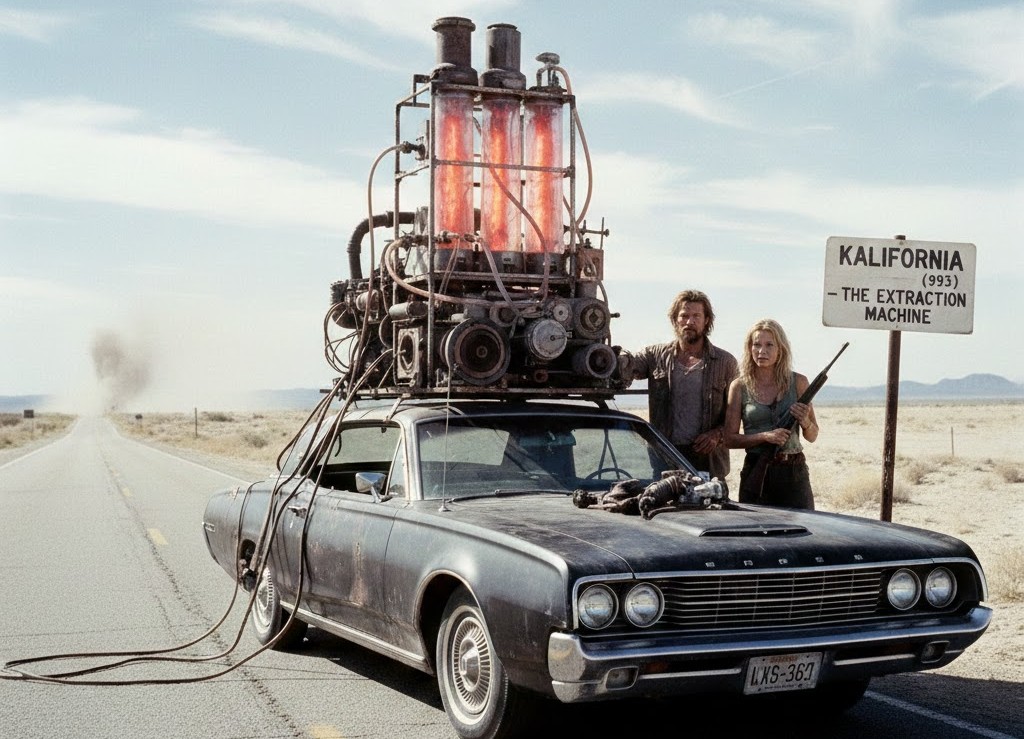
The Peace Dividend was never a de-escalation; it was a folding-inward where the desert’s nuclear scars became the motherboard for a domestic occupation of the American psyche.
I. The Molar Fracture
When Los Angeles burned in 1992, the promised “end of history” caught fire with it, and the smoke drifts through every frame of Kalifornia even though the film never shows a single riot.
Set on the highways, motels, and trailer parks of early‑1990s America, Kalifornia takes the loose form of a serial‑killer road movie, but internally it behaves like a diagram of a state‑machine that has lost its external enemy and begun to mine its own interior for surplus horror. Brian, a would‑be cultural critic writing a book on serial killers, and Carrie, his photographer partner, assemble a cross‑country research trip to California; the project is funded not by the Pentagon but by the art/academic complex, a miniature “peace dividend” that turns demobilized Cold War paranoia into content for coffee‑table sociology. Early Grayce and Adele, the hitchhikers they recruit to split gas money, arrive as human residue of that same geopolitical shift—unemployed, marginal, half‑visible casualties of base closures and deindustrialization, trailing parole officers instead of commanding officers.
Deleuze and Guattari write that “the state is not a thing, but a process of capture… it must find new territories to decode once the old ones are exhausted” (Deleuze & Guattari, 1987, p. 448). The Cold War had provided a planetary outside for this process, a gigantic enemy-field against which American power could organize production, identity, and desire. With the Soviet Union gone, the capture apparatus does not slow; it swivels. The new “territory to decode” is interior: the American psyche, the intimate couple, the leftover military landscapes of the West, and the obscure lives of men like Early who drift through the ruins.
Kalifornia unfolds precisely across these new internal frontiers. The car that carries Brian, Carrie, Early, and Adele is not a neutral vehicle but a compact assemblage of extraction. In its trunk: books and research notes, photographic equipment, and Early’s tools of violence. In its cabin: two educated coastal creatives whose project is to translate murder into knowledge and image, and two discarded subjects whose bodies and affects will be the raw material. The road trip is a traveling laboratory; the United States is its field site.
The film’s central tension is not simply that the researchers do not know their subject is an actual serial killer. The deeper tension is that everyone in the car is already caught in the same extraction machine. Brian believes he is decoding the violence of others; in fact, he is part of a more general process by which the state‑capital nexus, having lost the geopolitical theater of the Cold War, reinvests its energies in the detailed mapping, categorization, and capitalization of domestic risk. The serial killer, the parolee, the photographer, the critic, the gas station attendant, and the museum curator all become elements in a single, distributed apparatus of capture and circulation.
Biopolitics is the name Foucault gives to this turn, when power organizes itself around the management of life as such—its health, its pathologies, its statistical norms—rather than around territory in the classical sense (Foucault, 1978). Kalifornia stages a moment when this biopolitical regime is still sticky with older residues: the abandoned test sites of Nevada, the missile silos repurposed as tourist curiosities, the hollowed‑out company towns and military bases. But instead of treating these as mere backdrops, the film makes them active matrices through which the car, and the lives in it, must pass. The Peace Dividend does not abolish violence; it redistributes it, rerouting the flows from foreign battlefields into freeways, motels, prisons, and research grants.
II. Methodology
Brian and Carrie are not only characters; they are the film’s embedded methodology. He is writing a book that aims to “understand” serial killers; she will supply photographs of crime scenes and landscapes. Their stated aim is quasi‑ethnographic: they will visit prisons, talk to experts, tour the sites where atrocities occurred. From the first planning scenes, we see them surrounded by books and slides, their apartment a small archive of other people’s suffering.
The problem is not simply that they are voyeurs. The problem is that their gaze is fully integrated into a late‑20th‑century knowledge economy in which trauma is a mineable resource. Foucault’s dictum that “knowledge is not for knowing; knowledge is for cutting” lands here with particular force (Foucault, 1977, p. 154). Brian’s project slices into the archive of American crime, excising exemplary cases, anatomizing the subjectivities of killers, reassembling them into a coherent narrative that can be sold as a book, taught in classrooms, displayed as an exhibition. Carrie’s images will be the lures and the proofs, the seductive surfaces that both authenticate and aestheticize the material.
Traditional ethnography posited a distance between observer and observed, a geographic and cultural gap that justified the detached gaze. Kalifornia systematically collapses that distance. The “field” is no longer an elsewhere; it is the four seats of the car and the open road. The “informant” is not a tribal elder but an armed man in the back seat whose violence actively shapes the itinerary. By agreeing to share expenses with strangers, Brian and Carrie do not merely close an economic gap; they fold the object of study into the very machinery of research. The captive native is replaced by the captive hitchhiker—except that in this case, the captivity is illusory, and the researcher is far less safe than he imagines.
This inversion exposes a more general logic of 1990s scholarship, what might be called the “captive-machine.” Universities and cultural institutions increasingly turned to prisons, psychiatric hospitals, decaying industrial towns, and marginalized communities as rich sites of data, testimony, and cultural products. The subjects of study—prisoners, patients, the poor—were doubly captive: constrained by institutional or economic structures, and then further captured discursively by waves of analysis, representation, and theorization. Brian and Carrie’s road trip literalizes this: they appropriate Early and Adele as cheap labor and colorful local color, presuming a one‑way flow of insight from the observers to their objects.
But the film refuses to leave the power relation that simple. Early, in his own crude way, practices a counter‑ethnography. He watches Brian and Carrie, tests their limits, probes their morals. His killings on the road are not only expressions of psychopathy; they are experiments in how far he can retool the trip’s methodology for his own ends. Each crime site doubles as research material for Brian and Carrie and battlefield for Early. When Carrie, camera in hand, photographs the aftermath of Early’s violence—unaware at first that it is his—she turns the crime into an image, and the image into a commodity. Early, meanwhile, turns the research apparatus into cover and logistics, using the car’s movement, the legitimate pretext of the book project, and the trust extended to intellectuals to shield his own line of flight.
In this sense, the researcher’s supposed distance is exposed as a fantasy. To gaze is already to be plugged in, to be part of the circuit of affects and interests that make the gaze possible. Brian’s underestimation of Early is not just naïveté; it is the structural blindness of a position that believes it can extract knowledge without being transformed—or contaminated—by the extraction process. Kalifornia insists on the contrary: knowledge production is a high‑risk endeavor because it takes place within the same violent fields it studies, with the same infrastructures, the same fragile vehicles, the same compromised maps.
III. The Socio‑Economic Void
If Kalifornia feels haunted even in its brightest daylight scenes, it is because the film is traversing territories that have been vacated twice: first by the retreat of industrial and military investment, and second by the evacuation of collective narratives that might make sense of that retreat.
The early 1990s saw the implementation of multiple Base Realignment and Closure (BRAC) rounds, in which scores of U.S. military installations were downsized or shut, especially in the South and West (U.S. Department of Defense, 1991). Around each base was an ecosystem: contractors, service workers, bars, trailer parks, motels, cheap housing for enlisted personnel and their families. When a base closed, the ecosystem did not neatly reorient; it sagged. What remained were partial infrastructures: ghost housing, half‑abandoned commercial strips, skill sets attuned to wartime logistics and discipline now misaligned with the service economy’s softer demands.
Kalifornia never names BRAC, but its landscapes bear all the marks: rusty industrial yards, remote trailer parks abutting derelict facilities, barracks‑like motels whose thin walls leak arguments and televisions. Early comes out of this world: a convicted criminal with fragmentary employment, moving from odd job to odd job, habituated to authority but cut loose from any stable institutional frame. Adele’s naïve optimism—her excitement about California, her delight at small kindnesses—floats against a backdrop of chronic underemployment and infrastructural decay.
Deleuze and Guattari distinguish between “smooth” and “striated” space: the open, unregulated expanse of the steppe or sea versus the gridded, policed order of the city or camp (Deleuze & Guattari, 1987). The American interstate highway system seems, at first glance, like a smooth space: long unfurling lanes, minimal borders, motels and rest stops repeating endlessly. But Kalifornia shows how, in the wake of deindustrialization and BRAC, the highway becomes a hybrid: smooth for capital flows and mobile professionals, harshly striated for those like Early and Adele. They experience it as a controlled corridor punctuated by checkpoints: gas stations where they must charm or intimidate attendants, restrooms where class and gender lines are policed, border crossings where parole status and license plates can trigger scrutiny.
At the macroeconomic level, the same period is witnessing a transition from a manufacturing-military economy to what might be called a service/paranoia economy. As defense spending stagnates or reorients, new industries arise to monetize risk and fear: private security, gated communities, sensationalist news, true‑crime books, serial‑killer films. Brian’s book proposal depends precisely on this market: publishers eager to feed an audience hungry for stylized access to horror. Carrie’s photographs will not go to a forensic archive but to galleries and glossy spreads.
The workers who staff this paranoia economy are a mix of old and new types: ex‑cops turned private investigators, ex‑soldiers turned guards, journalists recast as “crime analysts,” academics specializing in deviance and risk. Brian slots aspirationally into this world: he wants to be a critic of violence whose work circulates as both documentation and entertainment. Early, in a darker key, is also a worker in the paranoia economy—though he is paid in affect rather than wages. Every time he kills, he contributes raw material to the circuits Brian wishes to exploit. Every future news story, FBI profile, or art exhibit that references such killings extends the chain.
Here the film crystallizes a crucial insight: once the state‑machine turns inward in search of new material to decode and capture, it begins to rely on the very pathologies it claims to combat. The serial killer becomes a kind of negative laborer in the system, an unwitting generator of value for therapists, cops, TV producers, scholars, and novelists. Early is an anomaly, but he is also a resource. His existence justifies budgets, research programs, surveillance technologies, and entire cultural genres.
The American West through which the car travels is thus not an empty backdrop but a socio‑economic void carefully engineered by policy and capital. The closure of bases and factories has punched holes in the old order; the new order has not filled them with jobs but with narrativized anxiety. Kalifornia makes this visible in the way violence keeps reappearing not as a shocking intrusion but as an expected, almost routine possibility—discussed at dinner, theorized in the car, staged in motel parking lots. The extraction of horror has become itself a form of work, one that binds Brian, Carrie, and Early into a perverse collaboration.
IV. Gendered Assemblages
If the extraction machine reorganizes territories and economies, it also reconfigures bodies, especially along gendered lines. Kalifornia arranges its two women, Adele and Carrie, as differently positioned within the same apparatus: one apparently immobilized in low‑income domesticity, the other apparently free in artistic mobility. Neither, finally, escapes capture, but the modes of capture differ.
A. Adele
Adele lives in a trailer decorated with kitsch, pastel fantasies of a life she will never experience. Her days are structured by boredom, television, minor chores, and Early’s moods. The kitchen and the bedroom are her primary territories, and the film’s camera repeatedly frames her in doorways, half‑inside and half‑outside, as if she were perpetually on the threshold of a life that does not quite arrive.
This boredom is not an empty neutral state; it is a mode of policing. The 1990s ideal of domestic stability, stripped of New Deal promises and saturated with surveillance rationales (“children must be kept safe,” “the home is the safest place”), functions as a low‑intensity control mechanism that keeps women like Adele spatially and economically constrained. Her lack of formal employment is not liberatory leisure; it is dependency, enforced by both state institutions (welfare eligibility rules, parole conditions that tie her to Early’s compliance) and intimate terror (the constant threat of Early’s anger).
Sadie Plant suggests that “the woman‑machine is the first to be decoded by the state, and the last to be permitted to flee” (Plant, 1997, p. 52). Adele has already been decoded: her reproductive and emotional capacities have been mapped, valued, and targeted. She is expected to stabilize Early, to provide sex, affection, and a simulacrum of domestic normality that might keep him within the statistical boundaries of manageable risk. Her presence in the car reassures motel clerks and gas station attendants; she is part of Early’s camouflage.
Yet Adele does attempt micro‑escapes. She is fascinated by Carrie’s camera, by the idea of having her image taken and perhaps preserved. Their interactions—sharing makeup, trying on clothes, giggling over small transgressions—sketch a fragile line of flight, a potential reconfiguration of Adele’s subjectivity outside Early’s orbit. But every such movement is quickly folded back into control. Early monitors her conversations, directs her dress, disciplines her with sudden bursts of contempt or violence.
When Adele finally becomes too curious, too connected to Carrie, and starts to glimpse Early’s monstrosity not as a quirky temperament but as lethal, he kills her. The murder is both personal and systemic. On one level, it is Early’s desperate assertion of ownership; on another, it mirrors a broader logic by which the apparatus discards surplus femininity that no longer stabilizes the male subject. Adele’s death is a kind of internal expenditure, a sacrifice that allows Early’s line of flight with the researchers to continue a little longer. She is no longer needed as cover; the system finds her redundant.
B. Carrie
Carrie appears, at first, to be Adele’s opposite. Urban, educated, financially independent, she moves freely between coasts, carries expensive equipment, negotiates with publishers and gallery owners. Her relationship with Brian is not obviously coercive; she challenges his abstractions, criticizes his romanticizing of killers, asserts her own aesthetic priorities. She is the figure of “flight,” the woman who left small‑town constriction for cosmopolitan mobility.
Yet Carrie’s mobility is tightly bound to the art‑market/academic complex. The photographs she takes are commissioned indirectly by publishers and galleries; their circulation will depend on curators, critics, and buyers. Her freedom to traverse the country is underwritten by an economy that has found in the representation of violence a profitable niche. When she raises ethical questions—about glamorizing killers, about the impact on victims’ families—those questions are absorbed as added value, deepening the perceived seriousness of the project.
Carrie is thus “mapped territory,” to use the outline’s phrase: her routes, her gaze, her affects are already anticipated and inscribed in funding proposals, marketing plans, and exhibition designs. Her very capacity for empathy is put to work as a selling point: this is not exploitative sensationalism, the pitch will say; this is a nuanced, critical exploration of America’s dark side. The apparatus needs her sensitivity as much as it needs Brian’s theories.
Over the course of the film, Carrie’s relationship to Early shifts from analytic curiosity to visceral fear to lethal resolve. She is the one who ultimately kills him. But even this act is folded back into the extraction machine. In the epilogue, we learn that her photographs, including images of Early and of the journey’s final violence, become central to Brian’s published work and to her own artistic reputation. The trauma is not sealed off; it is processed, curated, and circulated.
Carrie’s “flight” from the nightmare of the desert confrontation leads her not outside the machine but into a different segment of it. She leaves the physical danger behind but remains bound to the symbolic economy that thrives on proximity to danger. The system permits her to flee the literal killer but reclaims her as a producer of images and narratives about that killing. Unlike Adele, she is not expendable; she is too valuable an interface.
In this gendered configuration, Kalifornia sketches a double bind. Women at the precarious lower end of the socio‑economic hierarchy are immobilized, their potential lines of escape policed at the molecular level of domestic habit and affect; women at the professionalized upper end are encouraged to move, to see, to feel, but only along paths already anticipated by market and institution. In both cases, “flight” is carefully channelled, and when it threatens to exceed its assigned lane, it is either violently terminated (Adele) or gently reterritorialized as style and content (Carrie).
V. The Nevada Synthesis: Absorption of the Anomaly
If the deserted test town initially appears as a space beyond formal authority, Kalifornia quickly makes clear that this absence is itself a product of authority, a delegated zone where the decision over life and death has been subcontracted to chance, radiation, and now Early’s gun. The state has withdrawn its visible functionaries, but it has left behind a landscape programmed for experiment, a topology designed to expose bodies to forces they do not control.
Mike Davis’s account of the “ecology of fear” in Southern California emphasizes how landscapes are engineered to stage and manage disaster, from fire corridors to flood channels to freeways that double as evacuation routes (Davis, 1998). The Nevada test town belongs to the same genealogy: it is a built environment optimized not for habitation but for witnessing destruction, an infrastructural camera obscura in which the blast wave once played the starring role. When Kalifornia inserts its quartet into this space, it does not simply borrow a striking location; it plugs its micro‑drama into a macro‑history of experimental violence.
Early functions here as a successor to the nuclear device, an anomaly whose behaviors are to be observed, documented, and, crucially, profiled. The early 1990s were the FBI profiler era, when psychological categorization of serial killers became both investigative technique and pop culture staple. The state’s relation to anomalies like Early is no longer limited to capture and execution; it strives to index them, to fold their peculiarities into typologies that can be stored, searched, and used to refine risk management. The anomaly is not simply punished; it is rendered legible.
This is why Brian’s book project aligns so neatly, if unwittingly, with the profiler apparatus. His interviews, site visits, and theoretical models mirror in miniature what federal agencies were doing at scale: assembling databases of aberrant behavior, cross‑referencing them with socio‑economic and geographic variables, turning singular horrors into patterns. The test town sequence is the point where this alignment becomes unbearable. Brian’s failure to recognize, in time, that his traveling companion is precisely the type of subject he has been abstractly analyzing exposes the gap between indexical knowledge and lived danger.
Carrie’s camera, which has been alternately fascinated and repulsed by traces of past crimes, now documents a crime in which she is directly implicated. Her eventual act of killing Early is recorded less by the camera than by the narrative itself, which treats it as both catharsis and data point. In the film’s epilogue, Brian’s published work and Carrie’s exhibition quietly absorb this apex of terror. The Nevada event becomes another chapter, another series of prints. The anomaly has been neutralized physically and captured symbolically.
The test town thus operates as a synthesis point where several lines converge: Cold War spectacle, domestic serial killing, academic research, and art‑market consumption. It is not that the state ceases to be interested in nuclear fire and becomes interested only in aberrant individuals; rather, it learns to treat both as elements in a single spreadsheet of risk, a continuous field of events to be monitored, categorized, and leveraged. The desert, in Baudrillard’s sense, is the pure form of this absence/presence of the state—its bodies gone, its desires and calculations thick in the air (Baudrillard, 1988).
In killing Early, Carrie does not destroy the extraction machine; she completes one of its cycles. The dangerous element is eliminated; the knowledge and affect it generated are preserved and circulated. The Nevada test town, built to register explosions, has registered another one—a small, human‑scale detonation of fear and resolve—and the film invites us to imagine the invisible sensors clicking on: publishers, gallery owners, criminologists, all ready to absorb the shockwave.
VI. The Millennium Threshold: 1999 as Event Horizon
By the time Kalifornia was released in 1993, the period it anatomizes—roughly from the 1992 L.A. riots through the end of the decade—was still in formation. In retrospect, that span appears as a peculiar interregnum: the Cold War finished, the “War on Terror” not yet declared, a window in which the American state‑machine recalibrated its instruments and targets.
The L.A. riots marked a visible molar fracture: images of tanks on American streets, neighborhoods in flames, and the National Guard patrolling domestic territory punctured the fantasy that violence had migrated cleanly to distant deserts and jungles. Davis reads the riots as both rebellion and feedback, an eruption produced by decades of racialized policing, economic abandonment, and speculative urbanism (Davis, 1998). In Kalifornia, these forces are never directly shown, yet they saturate the backgrounds: shuttered gas stations, tense exchanges with cops, marginal communities living one paycheck or one parole violation away from catastrophe.
The “Peace Dividend” was sold as a reallocation of resources from military to social needs, but in practice it often meant base closures, defense industry layoffs, and a scramble to repurpose military technologies for civilian markets. Surveillance systems, data‑analysis techniques, and psychological operations found new homes in advertising, policing, and media. The extraction machine did not downshift; it changed substrates. The state, understood in Deleuzo‑Guattarian terms as a process of capture and coding, turned increasingly to the intimate and the informational once the geopolitical enemy dissolved (Deleuze & Guattari, 1987).
Kalifornia foreshadows three specific extraction techniques that would define the post‑9/11 security state:
Data‑Mining: Brian’s compulsion to catalog, cross‑reference, and theorize serial killings is the analog precursor of later algorithmic profiling. His notebooks and cassette tapes anticipate databases and dashboards. Each story, each detail of a killer’s childhood, is a data point waiting to be correlated with others. The film reveals the fragility of this fantasy of total knowledge: even inside the same car, with the “data source” drinking beers in the back seat, Brian fails to connect the dots. Yet the drive to collect persists, paving the way for more automated, and more opaque, forms of analysis.
Domestic Surveillance: The road trip’s constant encounters with petty authority—sheriffs, highway patrol officers, motel managers—trace a mesh of local observation that will, within a decade, be augmented by digital networks. The idea that one can be monitored anywhere within national space, not just at borders or in “high‑risk” zones, is already present in the film’s atmosphere of low‑level suspicion. Carrie’s camera, too, is a surveillance device, though it is legitimated by art and scholarship rather than law. Together they prototype a culture in which every interaction, every landscape, is potentially an image or a record.
Psychological Profiling: The effort to understand killers’ motives, to delineate types and risk factors, to translate singular traumatic histories into generalized models, culminates after 2001 in a sprawling apparatus of behavioral detection—no‑fly lists, “see something, say something” campaigns, airport interviews. The profiler’s gaze is extended to entire populations. What Kalifornia shows, in miniature, is how such profiling is always playing catch‑up with emergent forms of subjectivity like Early’s, and how easily the profiler himself becomes entangled in the dynamics he claims to describe.
1999 appears, in this light, as a threshold year not just because of its calendrical symbolism, but because the infrastructures sketched in the early 1990s—interstate mobility, digitized archives, flexible labor, militarized policing—had by then cohered into a platform ready to be repurposed under new pretexts. The shift from the serial killer as emblematic figure of domestic dread to the terrorist as figure of global dread did not dismantle the extraction machine; it extended its range and intensified its operations.
The desert of Kalifornia shades seamlessly into the deserts of Afghanistan and Iraq, not only at the level of landscape but at the level of technique. The same logics of targeting, profiling, and risk management applied to men like Early will be scaled up and grafted onto foreign populations. The same decomposition of life into patterns of movement, communication, and affective intensity will underpin both TSA screenings and drone strike algorithms. Foucault’s biopolitics, initially a theory of how states manage domestic populations, slides almost effortlessly into geopolitics once the interior and exterior lose their clean separation (Foucault, 1978).
The final voice‑over in Kalifornia, which informs us of Brian’s book success and Carrie’s artistic recognition, is delivered in a tone of sober reflection. Yet under its calm lies an unsettling implication: the system has learned from what happened. It has harvested the experience and converted it into models, warnings, and styles. The extraction machine, having tested its capacities on the psyches and bodies of a few marginal Americans in the 1990s, is ready to go digital, planetary, and permanent.
To say that the extraction machine “went digital” after 1999 is not to claim that violence became virtual or bloodless. It is to say that the primary site of capture shifted to flows of information: phone records, credit card histories, GPS traces, search queries, social networks. The car in Kalifornia—with its tapes, photographs, police scanners, maps—is a primitive prototype of this assemblage. Its passengers are already living inside a system that understands them less as citizens than as carriers of signals: risk signals, market signals, affective signals.
In this sense, Kalifornia is not only a film “about” serial killers or even about the 1990s; it is an origin myth of our present, where every movement across a border, every online interaction, every aesthetic engagement with violence is a potential point of extraction. The Peace Dividend was a mirage; the real dividend was epistemic and infrastructural, a vast expansion of the state‑capital machine’s capacity to read, record, and reroute desire. The film closes its narrative, but the circuits it sketches remain open, humming, waiting for the next car to set out onto the highway.
References
Baudrillard, J. (1988). America (C. Turner, Trans.). Verso.
Davis, M. (1998). Ecology of fear: Los Angeles and the imagination of disaster. Metropolitan Books.
Deleuze, G., & Guattari, F. (1987). A thousand plateaus: Capitalism and schizophrenia (B. Massumi, Trans.). University of Minnesota Press.
Foucault, M. (1977). Language, counter-memory, practice: Selected essays and interviews (D. F. Bouchard, Ed.). Cornell University Press.
Foucault, M. (1978). The history of sexuality, Volume 1: An introduction (R. Hurley, Trans.). Random House.
Plant, S. (1997). Zeros and ones: Digital women and the new technoculture. Doubleday.
U.S. Department of Defense. (1991). Base realignment and closure report. U.S. Government Printing Office.
Comments
Post a Comment