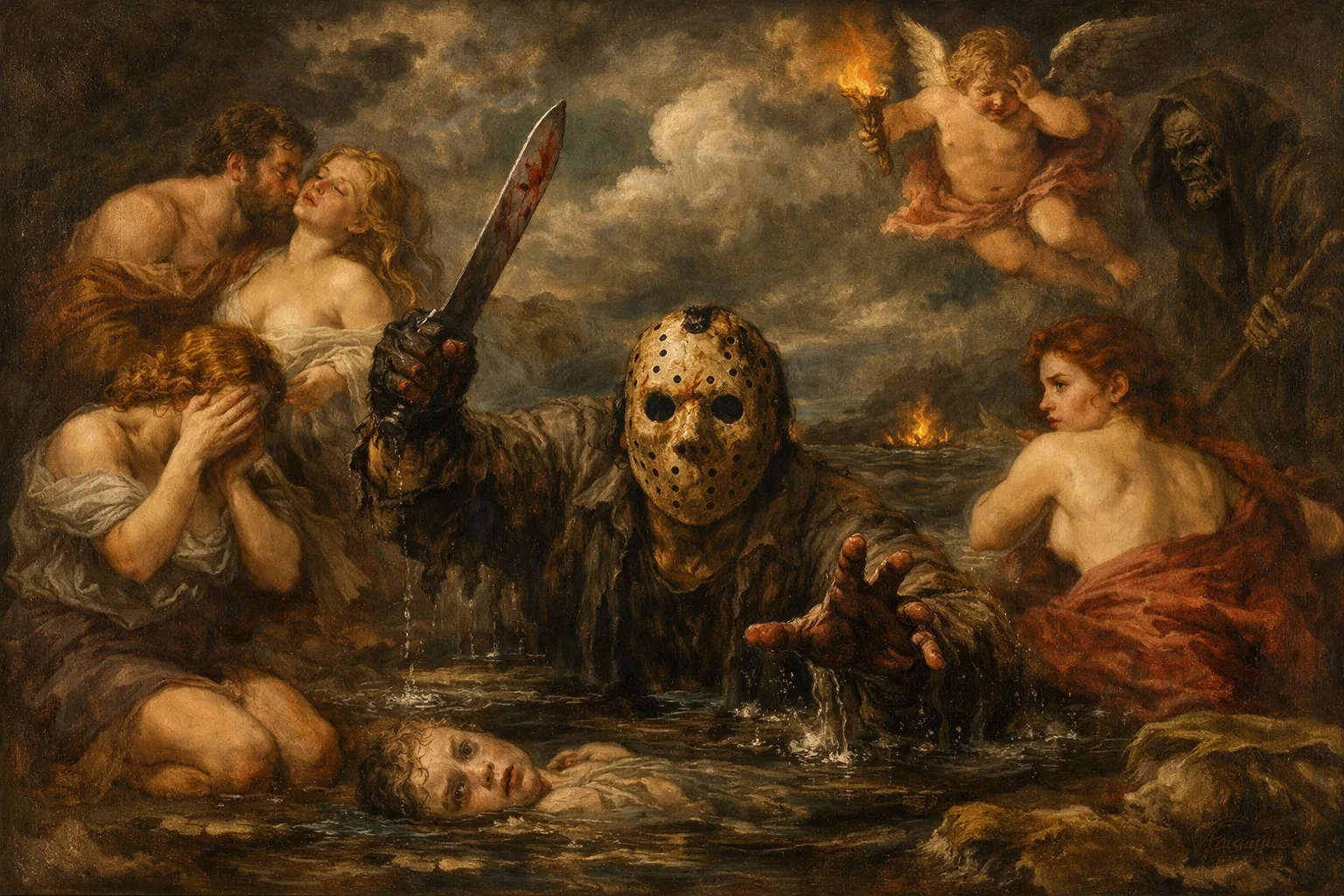
The first scream in Friday the 13th does not belong to Jason Voorhees, or even to his knife, but to the summer camp itself, startled to discover that its own innocence has been carrying a drowned child in its foundations.
The Camp as a Machine for Producing Innocence and Corpses
Camp Crystal Lake is supposed to be a pastoral reset button: trees, cabins, a dock, some canoes, a place to cleanse adolescents of urban noise by giving them sanctioned proximity to sex, gossip, and water. The counselors are hired to manage this small republic of freedom so that it does not remember how close freedom always is to disaster.
The camp is a factory that transforms parental anxiety into a purchasable service: “your kids will be wild, but supervised.” It is a disciplinary apparatus dressed as leisure, with rules about curfews, buddy systems, schedules for crafts and swimming (Foucault, 1977).
The first time Jason dies, he dies in the blind spot of this apparatus.
The counselors meant to guard him are too busy with their own bodies, knitting their mouths together in a kiss while the boy follows the pull of the lake. The camp’s promise—safety wrapped around permissiveness—is revealed as a lie, but only for Jason. The others grow up; the camp closes and reopens; the legend circulates like local weather. Jason’s body is claimed by the water; his story is claimed by the town.
From the perspective of the social machine, Jason is an acceptable casualty, a leak quickly patched by myth. From the perspective of his own body, however, nothing is patched. Something continues to walk at the bottom of the lake, feeling the pressure of the water as the delayed weight of all the eyes that refused to see him.
The Child Who Drowned in Other People’s Desire
Jason does not drown in water alone. He drowns in other people’s enjoyment. The teenagers’ desire edits the world; the crying boy is cropped out of the frame.
This is where the film is most obscene: not in the later cut-up bodies, but in the earlier cut-up field of perception, where the camp learns to focus on flirting and forget the existence of the deformed child. Jason’s body is marked as abject, a stain on the smooth surface of youth, and the most efficient way to deal with a stain is to not look at it (Kristeva, 1982).
The bullies who taunt him, the counselors who neglect him, the parents who send their children to a camp built on an accident—none of them need Jason to be evil. They need him to be absent. His disfigurement is not simply physical; it is a social lesion that the group responds to with expulsion instead of treatment.
This is where Nietzsche’s genealogy of morals slides under the story like a submerged root (Nietzsche, 1994). The beautiful, the “normal,” the coordinated adolescents affirm themselves by taking Jason as their negative. He is the not-us against which they become a “we.” Their cruelty is not an aberration; it is structural, as if the playground itself were a small prefiguration of the later camp—an arena where belonging is engineered through sacrifice.
Jason is made to absorb the community’s cruelty and insecurity so thoroughly that he becomes the negative image of the camp’s brochure photos. Instead of sunlit group shots, Jason is the solitary, dripping boy whom no one wants in the picture.
When he finally disappears under the surface, the camp can tell itself the story that he was an accident, an unfortunate oversight. But in Jason’s timeline, the oversight is not an event; it is an ongoing condition. He does not die once; he is continually pushed out of the scene.
Pamela’s Knife: Maternal Ventriloquism and the First-Person Killer
In the original film, the killer is not Jason but his mother, Pamela Voorhees, whose knives and axes carve out a path of mourning through the fresh-faced staff. This displacement—mother killing in the name of dead child—is often read as a simple case of maternal over-identification or pathological grief, an Oedipal inversion where the parent kills the sexual transgressors to avenge the innocent son (Freud, 1920).
But Pamela’s voice is more complex than that. She speaks in the second person to the counselors (“You let him drown”), but in the first person when channeling Jason (“Kill her, Mommy”). Her speech is a ventriloquism in both directions: she throws her words into the absent child, and she throws the child’s supposed voice back into her own arms.
She is not simply possessed by Jason; she manufactures Jason as a voice for her rage. The “Jason” who commands her is an effect of her refusal to let his story be closed by the lake’s surface. In this sense, Jason’s first reappearance is not bodily but grammatical. He emerges as a pronoun, a “he” in whose name the mother can attack the social order that abandoned them.
This is where the schizoanalytic vector slices through the film’s psychology. The killing-spree is not the expression of a deep, repressed trauma so much as the assembly of a new machine: mother, knife, camp legend, whispered slurs about the “freak” child, rusty infrastructure—all of it wired together to keep producing the event of his death in different forms (Deleuze & Guattari, 1983).
Pamela’s body is the first site on which this machine is installed. Her arm swings the weapon, but the arm belongs just as much to the circulating stories, the gossip, the rumors. The camera’s frequent first-person shots—where the killer’s gaze substitutes for an identifiable face—make this clear. We don’t see Pamela while she stalks; we see the camp itself looking, a disembodied subjectivity scanning cabins, showers, shadows.
The POV shots do not belong to a person; they belong to a function: the function of returning the gaze to the space that failed to see Jason when it mattered.
From Ghost Child to Goalie: The Mask as Becoming-Function
Jason only becomes the iconic “Jason” in the sequels, and the moment of his transformation is almost laughably casual: a hockey mask lying around, a killer in need of a face, a shrug. He puts it on, and suddenly a legend has a logo.
A hockey goalie’s mask is not just protective gear; it is a position on the field. The goalie is the last line of defense, the one who is allowed to touch the forbidden object—the puck—with the full authority of the rules. The goalie stands between inside and outside, between “we scored” and “they scored,” absorbing impacts for the team.
When Jason adopts the goalie mask, he does not merely hide his disfigured face; he occupies a role in an invisible game. He becomes the goalie of a different kind of net: the boundary between the drowned child and the teenagers who repeat the circumstances of his death. His job is to ensure that no desire gets through without paying the price.
The mask is not hiding his identity; it is giving him one. Before the mask, Jason is a boy who fell out of every category: too deformed to be a “normal” camper, too young to be a counselor, too absent to be a full ghost. With the mask, he becomes a function: the one who blocks, the one who cuts, the one who guarantees that the story of his drowning will be replayed on every body that tries to reenact carefree summer love at Crystal Lake.
Reich would have recognized in this mask a literalization of character armor: the frozen defensive structure that once protected the child against humiliation has condensed into a physical shell (Reich, 1949). But here the armor does not merely block incoming pain; it also channels outgoing violence.
What is striking is the emptiness of the design. Jason’s mask, unlike real goalies’ custom-painted gear, is almost entirely blank: a white, slightly yellowing surface with a few red chevrons, some drilled holes, dark eye sockets. It is a standardized product, a piece of mass-produced plastic.
If, for the professional goalie, the mask often becomes a canvas for personal flair—team colors, mascots, aggressive designs—Jason’s mask is the opposite: a retreat from the personal into the generic. It is not “his” mask in any biographical sense; it is anyone’s. It could be bought at a sporting goods store, copied as a cheap Halloween accessory, flickering as an image on countless posters.
The more generic it is, the more terrifying. Because its very anonymity says: this could be on anyone’s face.
The Horror of Being Seen: Disfigurement, Shame, and the Panic of Empathy
Why does Jason need a mask at all? He carries the machete, controls the terrain, moves silently, strikes before his victims realize he is in the room. He has almost all the power. Yet again and again, whenever his mask is removed, the films linger on his exposed face as a moment of vulnerability, confusion, even paralysis.
Lacan’s meditations on the gaze help articulate this moment (Lacan, 1978). The horror is not only that others will see his deformity; it is that, in being seen, Jason must confront himself as an object in a field of vision that has always been hostile to him. The gaze is not just an optical phenomenon; it is a social verdict, a confirmation that one is, indeed, the monstrous thing that playground taunts named.
The mask allows Jason to occupy the position of seeing without being seen, to weaponize the asymmetry that once victimized him. It is his revenge on the mirror stage: if others once constructed their ego coherence against the background of his abjection (“at least I don’t look like Jason”), he now destroys that coherence by appearing as a blank, unreadable surface (Lacan, 1977).
Without the mask, his face threatens to reinsert him into the old game. The teenagers’ startled reactions, their recoiling from his features, repeat the original scene of ostracization. To show his face is to risk being dragged back from the function “killer” into the position “freak,” and that is intolerable.
Better to be experienced as pure malice than as a damaged person. Better to be myth than pity-object.
Shelly, the prankster in Friday the 13th Part III, makes this logic verbal. He wears grotesque masks, stages fake attacks, tries to shock his friends into noticing him. When confronted about his behavior, he confesses that it is better to be regarded as a freak than to be ignored as himself. Jason, whose mask he inadvertently donates to the franchise, radicalizes the strategy: instead of using the freak persona as a bid for attention, he uses the impersonal mask as a bid to erase the hurt self altogether.
Both, however, are responding to the same underlying economy of empathy: in a world that has already shown itself unwilling to meet their vulnerability with care, self-presentation becomes a question of choosing the least unbearable misrecognition.
The truly frightening thing about Jason’s face is not its deformity; it is what that deformity says about everyone else. It says that the community’s capacity for compassion has limits, and that beyond those limits lies a zone where the only possible identities are “monster” or “victim.” Jason refuses both by becoming something third: an instrument.
From Victim to Martyr-Maker: Over-Identification with Victimhood
Bullies need victims to consolidate their own shaky sense of self. By making someone else the receptacle of pain, they convert diffuse anxiety into concrete domination (Nietzsche, 1994). In Jason’s childhood, he is that receptacle. Every taunt, every shove, every whisper about his face adds another layer to the image of himself as the one who absorbs.
Pamela’s revenge begins as an attempt to reverse the polarity: to make the careless counselors and future campers taste the fear that once saturated Jason’s days. However, revenge often fails to liberate the avenger from the structure it repeats. The more Pamela kills, the more she confirms that Jason’s story is centrally about his being wronged by others.
It is only when Jason himself takes up the knife that the vector bends. He does not simply continue his mother’s vengeance; he proliferates victims beyond any rational accounting, far beyond those directly responsible for his drowning. At first glance, this looks like a loss of focus, a psychotic drift away from the original injustice. But from another angle, it is a radicalization.
Žižek describes over-identification as the act of taking an ideological role more seriously than the system itself does, exposing its contradictions by living out its logic to the point of absurdity (Žižek, 2008). Jason over-identifies with the role of victim—not by wallowing in passivity, but by producing victims everywhere he goes.
He no longer seeks merely to “get back” at those who wronged him; he insists that everyone who reenacts the structural conditions of his death—unsupervised sex, negligence, the presumption of safety at Crystal Lake—must be translated into his position. He does not want to be the only one who drowned. He wants the whole apparatus, the entire model of pleasure and risk that produced him, to drown with him.
Each impaled counselor, each slashed adolescent, becomes less an enemy and more an unwilling participant in a mass liturgy of victimhood. Jason is not content with individual revenge; he demands that victimhood itself be generalized to the point where it cannot be used as a marginalizing category anymore. If everyone is a potential victim, the sharp line between “freak” and “normal” blurs.
Of course, this is a terrible and impossible politics. But it is politics nonetheless. Jason’s indiscriminate killing is not random; it maps the contours of a social order where vulnerability is unevenly distributed and then disavowed.
Camp Crystal Lake as Body without Organs
The geography of Friday the 13th is oddly repetitive: dock, forest path, cabin interior, shower, bunk bed, generator shed, the same spaces resurfacing across sequels like recurring nightmares. The camp is resilient; no matter how many murders, it can be sold, reopened, rebranded. Each new group of teenagers arrives as if the past were only rumor.
Deleuze and Guattari describe a kind of body that resists stable organization, a zero-degree surface where organs can be reattached to new functions (Deleuze & Guattari, 1987). Camp Crystal Lake behaves like this. The dock no longer just launches canoes; it becomes the place from which bodies fall into water and out of narrative. The cabins are not merely sleeping quarters; they are small theaters for the performance of both seduction and execution.
The camp’s infrastructures—ropes, archery equipment, kitchen knives, shower curtains—are reassigned from their intended recreational or domestic uses to the service of Jason’s itinerary. They become his “organs,” extensions of a body that is no longer contained by his flesh. When a sleeping bag becomes a weapon, or a pier becomes a trap, we are watching the camp deterritorialize its own furnishings.
This is why Jason is so often described as “part of the lake” or “part of the woods.” He is not merely hiding in them; he is them. His subjectivity, if we can still call it that, has smeared across the material of the camp. When he walks, the crunch of leaves is as integral to his being as his heartbeat.
Capitalism famously subsumes everything into its flows, transforming even resistance into new commodities (Marx, 1976). The slasher franchise does something similar: every attempt to close the camp, to “finally kill Jason,” becomes a selling point for the next film. The supposed end of the story is immediately folded back into the camp’s capacity to attract new groups of paying consumers—both in-universe, as campers, and outside, as audiences.
Jason’s body, masked and machete-bearing, is only the most striking node in a much larger desiring-machine that binds together real estate speculation (who would buy this property again?), tourism, local legend, and the film industry’s hunger for repeatable formulas (Deleuze & Guattari, 1983).
To speak of Jason’s “motivation” in psychological terms is to individualize what is clearly a collective, distributed production.
Cheap Plastic Transcendence: The Hockey Mask as Simulacrum
The hockey mask, initially an accident of prop choice, becomes the franchise’s primary symbol. Over time it detaches from the messy details of Jason’s biography—the drowned boy, the smothering mother, the specific camp—and circulates as a free-floating sign of “horror” itself.
Baudrillard would call it a simulacrum: a copy without an original, an image that no longer points back to a unique, prior reality but to a network of other images (Baudrillard, 1994). On a party store shelf, the Jason mask no longer refers to a particular traumatized child; it refers to an affective package: slasher vibes, retro thrills, 80s nostalgia, the safe danger of Halloween.
The irony is brutal. The very object Jason supposedly uses to escape being seen as a freak becomes a mass-produced way for others to play at being him. The bullied child’s armor is turned into a toy. The trauma that gave birth to the mask is erased in favor of the mask’s “coolness.”
This is how capitalism metabolizes even its own critique. The slasher, which might have begun as a dark parody of middle-class suburbia’s repressed violence, ends up as a brand that suburbs consume at will (Žižek, 2008).
The goalie-mask as marketed commodity completes Jason’s journey from abject outsider to aesthetic resource. Children who might once have mocked someone like Jason now happily wear his face one night a year. What was once a sign of deformity is now a badge of belonging to horror fandom.
And yet, a small remainder persists. In the films themselves, the moments when the mask is knocked off are still charged, ugly, uncomfortable. The prosthetics that create Jason’s face are deliberately excessive, pushing his disfigurement into the realm of the grotesque. They stage, for a few seconds, the return of something the mask’s clean lines had suppressed: the possibility that the monster is still, somewhere under there, a hurt child.
The plastic mask, then, mediates between two incompatible economies: the narrative economy of revenge and victimhood, and the capitalist economy of amusement and iconography. It sutures them together, allowing the audience to enjoy the fantasy of pure, motiveless killing while ignoring the history of bullying, negligence, and ableism that spawned the killer.
Sex, Death, and the Penalty Box
“Have sex, die later” is the vulgar formula often assigned to Friday the 13th and its peers. While simplistic, it captures a genuine correlation: those who are most absorbed in their own pleasure, most oblivious to their surroundings, are the ones most likely to be killed. Jason’s machete seems to function as a punitive superego, slashing through premarital enjoyment (Freud, 1920).
But this moralistic reading misrecognizes what is at stake. Jason does not kill because the teens are sinful; he kills because their oblivion repeats the oblivion that killed him. Their sex is not the crime; their tunnel vision is.
The erotic scenes in the camp are not tender explorations of mutual vulnerability; they are hurried, secret, guilty pleasures snatched in the cracks of duty. The counselors neglect their jobs to pursue them. Jason’s body learned, in the most literal way possible, that when others are lost in their desire, he becomes invisible.
His violence is thus not the expression of religious prudery but a war against a particular distribution of attention. Each time he interrupts a tryst, he is interrupting the scene where someone like him would again be forgotten. The machete is an instrument for cutting holes in the bubble of adolescent lust, not because lust is evil, but because bubbles kill kids in lakes.
The hockey metaphor returns here. In hockey, the penalty box is where players are sent for infractions, forcing their team to play “short-handed.” Jason functions like an inverted referee-goalie hybrid: he identifies what he considers structural infractions—negligence, inattention, the assumption that the camp is safe—and then enforces an impossible penalty: removal from the game itself.
The horror is not that sex is punished, but that the very conditions that made Jason suffer—being overlooked, being left alone in dangerous circumstances—cannot be rectified without attacking the pleasures of others. The film offers no utopian scenario in which Jason’s suffering could have been acknowledged and remedied without someone else’s fun being curtailed, someone else’s fantasy of carefree summer being broken.
That is the true deadlock: not sex vs. chastity, but pleasure vs. responsibility in a world that refuses to distribute care evenly.
Psychiatry, Police, and the Management of Monsters
Although Friday the 13th features fewer doctors and cops than some of its successors, the absent presence of these institutions hovers at the margins. The local townies warn about the camp’s “death curse,” functioning as the superstitious counterpart to expert discourse. But behind every “You’re all doomed” is the shadow of a system that has failed to integrate Jason into any therapeutic or protective network.
Jason’s mother does not seek psychiatric help for her son’s trauma; she seeks a knife. When later films introduce mental hospitals, they are depicted as holding pens, not sites of genuine care. Psychiatry appears as a technology for warehousing the impossible subject, not for healing him (Foucault, 2006).
Similarly, the police in the franchise are perpetually late, underinformed, or outmatched. They exist to clean up the aftermath, catalog bodies, warn of dangers they cannot neutralize. The so-called “experts” of order and health form a belt around Crystal Lake but never penetrate its core dynamic.
Jason thus occupies a space that has slipped through both law and medicine. He is not successfully criminalized (he cannot be captured, tried, executed) nor successfully pathologized (no diagnosis contains him, no treatment modifies him). He is, in Badiou’s sense, an event that the situation cannot count, a rupture that the existing state of knowledge and power cannot absorb without remainder (Badiou, 2005).
The repeated “endings” of Jason—in lakes, in barns, under piles of rubble—are false closures, narrative equivalents of declaring a case solved when the underlying conditions persist. The machinery that produced Jason—the camp’s negligent structures, the town’s prejudices, the families’ abdications—remains unchanged.
As long as these machines hum, Jason will be there, mask or no mask. The films literalize this by resurrecting him again and again, but the logic is already present in the first drowning boy: once a social field has decided that some lives are disposable, that decision returns in the form of a figure who disposes of lives indiscriminately.
Lines of Flight: Can Anyone Leave the Lake?
Is there any escape from this circuit of drowning and revenge, masking and merchandising?
Survivors in Friday the 13th are often final girls, young women who, through a mix of luck, caution, and resilience, manage to outlast the killer. They are marked by a certain partial disinvestment from the camp’s libidinal regime: less promiscuous, more watchful, somewhat apart (Clover, 1992).
Their survival is not just a reward for chastity; it is an index of their capacity to perceive that something is wrong with the setup long before the bodies start accumulating. They sense the camp’s bad vibes, the rumor fossilized in the “Camp Blood” nickname, the way the trees lean in too close.
In schizoanalytic terms, they are lines of flight: vectors that slip away from the dominant organization of desire, neither fully captured by its promises nor yet free of its reach (Deleuze & Guattari, 1987). Their survival, however, is always ambivalent. They leave the camp physically, carried off in ambulances or police cars, but the experience leaves a mark that the films rarely explore beyond a few shock endings or asylum scenes.
The question is not whether an individual can escape Jason’s knife—that happens, statistically, in every film—but whether anyone can escape the conditions that make Jason necessary. As long as communities rely on exclusion to define normality, as long as leisure spaces are built on effaced tragedies, as long as empathy is distributed according to beauty, class, and normativity, the child in the lake will keep floating back up.
Jason without his mask would be a boy whose pain exceeds the camp’s capacity to respond. Jason with his mask is that same excess translated into a function: the camp’s darkly efficient way of remembering what it wants to forget.
The mask cannot be taken off without confronting the face; the face cannot be met without confronting the gaze that first condemned it. For the audience, then, the true horror is not Jason’s machete, but the momentary glimpse of ourselves in the wet lenses of his eyeholes, realizing that the goalie from the lake is guarding not just his own lost childhood but the border we all participate in drawing—between those we see and those we choose not to see.
References
Badiou, A. (2005). Being and event (O. Feltham, Trans.). Continuum.
Baudrillard, J. (1994). Simulacra and simulation (S. F. Glaser, Trans.). University of Michigan Press.
Clover, C. J. (1992). Men, women, and chain saws: Gender in the modern horror film. Princeton University Press.
Deleuze, G., & Guattari, F. (1983). Anti-Oedipus: Capitalism and schizophrenia (R. Hurley, M. Seem, & H. R. Lane, Trans.). University of Minnesota Press.
Deleuze, G., & Guattari, F. (1987). A thousand plateaus: Capitalism and schizophrenia (B. Massumi, Trans.). University of Minnesota Press.
Foucault, M. (1977). Discipline and punish: The birth of the prison (A. Sheridan, Trans.). Vintage.
Foucault, M. (2006). Psychiatric power: Lectures at the Collège de France, 1973–1974 (G. Burchell, Trans.). Palgrave Macmillan.
Freud, S. (1920). Beyond the pleasure principle. International Psycho-Analytical.
Kristeva, J. (1982). Powers of horror: An essay on abjection (L. S. Roudiez, Trans.). Columbia University Press.
Lacan, J. (1977). Écrits: A selection (A. Sheridan, Trans.). W. W. Norton.
Lacan, J. (1978). The four fundamental concepts of psychoanalysis (A. Sheridan, Trans.). W. W. Norton.
Marx, K. (1976). Capital: A critique of political economy. Volume 1 (B. Fowkes, Trans.). Penguin Books.
Nietzsche, F. (1994). On the genealogy of morality (C. Diethe, Trans.). Cambridge University Press.
Reich, W. (1949). Character analysis. Orgone Institute Press.
Comments
Post a Comment