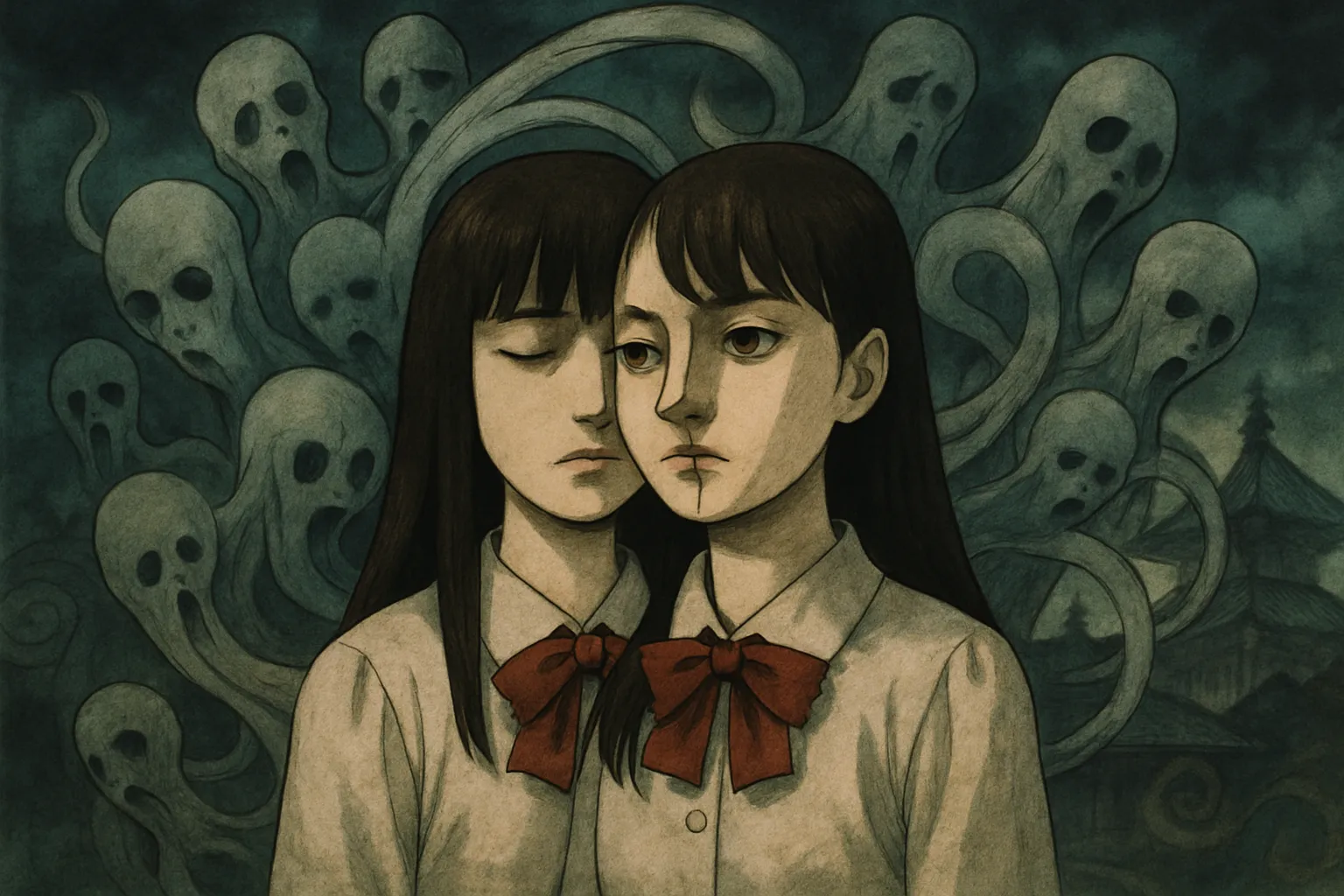
There comes a point where the soul looks less like a luminous essence and more like a corrupted file endlessly copied onto unstable media.
Haunted Imports: When Horror Crosses Borders With Someone Else’s Theology Still Attached
The Exorcist arrives in Japan like a missionary without a map: Latin prayers, pea soup, an entire cosmology of sin smuggled inside a child’s convulsions. Someone, somewhere, reportedly asked a very reasonable question: “Why did you take 2000 years to tell us this?” Pre-globalization lag, you might say; the demon had bad distribution.
Now the flows are faster. Capital and images circulate with the same predatory efficiency. But the direction is still skewed: American cinema exports its anxieties, its gaudy Christianity and its self-devouring individualism, while whatever returns is first dipped in an American glaze—re-titled, re-cut, or outright remade, like REC being held back until Quarantine had trained the domestic eye to accept it. A foreign fear must be reborn as our fear before it’s granted screen time.
Film titles are one of the quietest border checkpoints. Translators and marketers shear, soften, and rewire names so that they function as brands, signals, promises within a new semiotic economy. Shumenko and Serdiuk describe film titles as proper names that “identify a movie and [are] its own brand,” whose translation must balance nominative, advertising, and informative functions(Shumenko & Serdiuk, 2024). A horror title must not only denote a film; it must sell a feeling, pre-script an affective posture in an audience.
Tamil cinema knows this intimately. Komalata and Nian show how Tamil movie title posters fuse typography, color, and iconography into compressed narrative teasers that hint at plot, tone, and ideology before a single frame is watched(Komalata & Nian, 2024). The poster is itself a little reincarnation: a film’s sprawling temporality squeezed into one charged image, a spectral promise of what is to come.
Global horror circulates through this mesh of translation and rebranding. Anisimov, working on French films and their localized counterparts, maps a hierarchy of film discourse where the “source film text” (title, synopsis, poster, dialogue) and the “localized film text” are layered, competing subspaces in a broader semiotic system(Anisimov, 2025). The localized horror film is a palimpsest: under the Americanized or Europeanized surface, another discursive body still breathes, half-erased but not dead.
Rinne, or Reincarnation, drifts into this economy of spectral export and import. It is a J-horror film about reincarnation, yes, but also about what happens when images themselves reincarnate across cultures, markets, and formats. Like the souls it portrays, the film is condemned to return on different platforms: theatrical release, DVD, streaming, fan edits, remakes that will never happen and therefore haunt the margins as pure possibility.
The Barbie campaign, hailed as a masterclass in convergent marketing, shows us how meticulously a film’s worldly body can be constructed(Hudson, 2024). Collaborations, events, meme-ready imagery: everything orchestrated to produce desire before narrative even arrives. Horror operates in the same circuitry, but with a darker electricity. E. Imanjaya’s work on Indonesian exploitation cinema under the New Order regime shows how “low” genres with graphic, provocative images were both censored and exported, becoming a battlefield for the politics of taste(Imanjaya, 2024). Horror films like Rinne inhabit that battleground: too culturally specific to be fully digested by global markets, yet too globally legible (ghosts, blood, guilt) not to be circulated.
Between Barbie’s pink deluge and the dank hallways of a haunted Japanese hotel, something shared pulses: an apparatus for sculpting affect, arranging gazes, and disciplining what kinds of desire are allowed to be seen(Hudson, 2024; Imanjaya, 2024). Rinne simply chooses a different color palette for that same machinery.
Nagisa’s Split Soul: Reincarnation as Industrial Error Handling
Nagisa is an actress, which already marks her as someone paid to host other people’s desires on her face. She auditions for a role in a film reenacting a decades-old hotel massacre, unaware that she is the reincarnation of the killer himself. Innocent actress, murderous soul: casting director as minor god.
Reincarnation is usually sold as a transcendent bureaucracy. You live, accumulate karma like a line of credit, die, and are redistributed into new matter—human, goat, grain of sand—according to your balance. The cycle persists until the books close and you slip past the revolving door of life and death. It’s cosmic accounting as soteriology.
Christianity, by contrast, runs on a hereditary virus: original sin as a sexually transmitted disease. Guilt is not earned but inherited; the bloodline itself is dirty. Marx, dissecting another kind of inheritance, saw how accumulated capital moves across generations, congealing past labor into present domination (Marx, 1977). Where Christianity says “your ancestor sinned,” capitalism says “your ancestor extracted,” and you live in the shadow of both.
Nagisa’s plight fuses and scrambles these logics. She bears the karmic residue of a mass murder, but with total amnesia; she is treated, by the ghosts, as fully identical with the man who killed them, yet her conscious life knows nothing of his acts. This is not generational guilt but a kind of metaphysical identity theft: someone else’s ethical credit history stapled to her subjectivity.
Freud would be tempted to see in her flashbacks and hallucinations the return of repressed content: the unconscious surfacing prior traumas with symbolic distortion (Freud, 1955). But the neat psychoanalytic story falters here because the “repressed content” is not hers. She did not live it. She is like a patient tormented by another person’s dreams.
Nietzsche, ferociously hostile to the cultivation of guilt as a weapon against the strong, saw in the “bad conscience” a sickness where the instinct for aggression, unable to discharge outward, turns back upon the self (Nietzsche, 1967). Nagisa’s aggression, however, is outsourced; it floats in the air of the hotel, crystallized in Super 8 footage, waiting for a warm body to colonize. She begins the film as a docile, self-effacing woman with low self-worth, the perfect host for weaponized guilt.
The average Japanese Buddhist viewer watching The Exorcist might not see a demonic outsider breaching the domestic, but a previous life clamoring for embodiment—karma insisting on a second performance. The spinning head becomes less a sign of Satan and more an ontological glitch: two incarnations, one body, a scheduling error in the transmigration of souls.
Rinne literalizes this by placing Nagisa in a hotel that is both set and crime scene, both present and past. She is called to lie down where the previous victims fell, to inhabit the exact coordinates of their extinguished lives. Cinema here becomes ritual: each shot a small, secular puja to the spirit of repetition.
Marx once remarked that history repeats itself, “the first time as tragedy, the second time as farce” (Marx, 1977). Rinne suggests a third repetition: the second time as horror, where tragedy itself is re-performed not as parody but as compulsion. The massacre is not just remembered; it is reenacted, re-shot, re-animated, as if the past were dissatisfied with its own staging.
Dolls, Eyes, and Super 8 Loops: Every Object a Little Machine
Schizoanalysis refuses to treat Nagisa as a unified psyche with a spooky secret. Instead, it follows the connections: child, doll, camera, hotel corridor, director’s command, ghost’s gaze. The film is crowded with doubles: a little girl and her doll, both with eyes bashed in and red; the “real” hotel and its studio recreation; the murder as grainy Super 8 and as glossy digital reenactment.
The doll is not a metaphor; it is a working part. Its empty eye sockets are tiny projectors where the film’s unspoken demand flickers: see what you refuse to see. When Nagisa encounters the doll, she is encountering an object that has already undergone the violence she is about to remember. It is a pre-emptive victim, a stand-in for every body that will lie down in the director’s meticulously marked spots.
Lacan placed the gaze not simply in the eyes of the subject, but in the object that seems to look back, structuring the field of visibility itself (Lacan, 1998). The doll’s eyes, painted and then smashed, are a compact instance of that external gaze: a piece of the world that insists, “You are being seen from where you cannot see.” Nagisa is less possessed by a demon than by a network of gazes: dead children, cameras, ghosts, the director’s “Action!”
There is a scene where Nagisa’s agent watches the actual murder tape while Nagisa performs on set. On one screen, the original massacre unfurls; on another, Nagisa’s present reenactment.
Two images, staggered in time, converge on a single nervous system. She is pulled into a space that is not quite hallucination, not quite memory: a kind of cinematic Zwischenreich where victims taunt her from both reels. It is here that the subject fractures; the one who kills and the one who acts begin to coincide.
Deleuze’s writing on cinema describes the “crystal-image,” where the actual and the virtual fuse in a way that renders their distinction undecidable (Deleuze, 1989). Rinne’s overlapping footage produces such a crystal: the actual footage of fictional murders, the fictional footage of actual reincarnated guilt, sliding over each other until the viewer cannot cleanly say which layer is reference and which is copy.
Adaptation theory usually concerns novels becoming films, plots refitted for new media. Wardani and colleagues analyze A Little Princess as it transforms from Burnett’s 1905 novel into Cuaron’s 1995 film, shifting motives and ideologies in the process(Wardani et al., 2021). In Rinne, the “source text” is not a novel but a previous life; the “adaptation” is Nagisa’s current embodiment. The film-within-the-film is just the visible layer of a much longer adaptation chain: crime → karmic residue → reincarnated actress → metacinematic reenactment(Wardani et al., 2021).
Every camera in the film is a relay station in this chain. The Super 8 used by Nagisa’s previous incarnation to record his massacre is a crude little desiring-machine, chewing light and spitting out ghosts. The modern film camera used by the director repeats the gesture with better lenses and a higher budget. Viewers of Rinne, in turn, become the next camera: their retinas catching and circulating this spectral loop, carrying it into conversations, analyses, dreams.
Baudrillard suggested that in the age of simulacra, the copy precedes the original; we live amid images that no longer refer back to a solid reality, but to other images (Baudrillard, 1994). In Rinne, there is no authoritative massacre, only proliferating versions: hotel memory, ghost memory, Super 8, HD, offline gossip, online synopsis. The “real event” is lost in a maze of its own reincarnations.
The film’s final shot, where Nagisa smiles into the camera with a gravity that no longer belongs to the timid actress, is the last twist of the screw. The original killer has not merely reappeared; he has updated his firmware. The body is new, the gender is different, the media landscape is transformed, but the killing drive has adapted perfectly. He wears her face like a region-coded DVD finding the right player.
Ghosts Don’t Care About Your Character Arc
We are told repeatedly that Nagisa has self-esteem issues, that she is “mostly clueless and submissive.” She seeks validation through the role, through the recognition of the director, through being good at embodying other people’s pain. This is the standard arc of the struggling actress narrative: timid woman finds her voice, her power, her “authentic self” through performance.
Foucault, examining modern institutions, saw how power produces “docile bodies” that can be trained, normalized, and optimized for productivity (Foucault, 1978). Nagisa is precisely such a body: punctual, compliant, eager to please, ready to slot into the machinery of film production. The director’s demand that actors lie in the exact spots where the real victims died is both a sadistic flourish and a disciplinary command: your body will align with historical violence, down to the centimeter.
Reich, writing on character armor, describes how social repression solidifies in muscular tensions, postures, chronic ways of holding oneself that limit the flow of energy and desire (Reich, 1970). Nagisa’s stooped shoulders, hesitating speech, and ingrained politeness are her armor. They have kept her safe, or at least unnoticed, in a world that would punish overt assertion.
The ghosts have no patience for this armor. They erupt into her life as jump-scare visitations, flashes of otherness that puncture her cautious routines. Faced with phenomena her everyday reality cannot accommodate, she reaches for spiritual explanations. Trauma is fed into the karmic machine: “I must have done something in a past life; I must deserve this.”
Žižek has argued that the undead figure—vampire, zombie, cursed revenant—embodies a kind of obscene persistence of enjoyment, a drive that refuses to be pacified by symbolic resolutions (Žižek, 1989). The child ghosts in Rinne are precisely this: little bundles of unresolved enjoyment, eternally replaying their murder, ever demanding that someone be blamed, that the score be settled.
The metaphysical cruelty is that they address their demand to Nagisa-as-killer, not Nagisa-as-this-life. For them, the distinction does not matter. The subject, in Lacan’s sense, is not the empirical individual but the point where signifiers converge; “the killer” is a slot that now has her name attached (Lacan, 1998). The ghosts do not sue the man; they sue the position, and Nagisa is the current bearer of that position.
Kant would insist that moral responsibility attaches to the rational agent who wills the act, not to some metaphysical continuity of soul (Kant, 1996). To hold someone accountable for deeds they do not remember and did not consciously choose is, by this standard, unjust. Yet the film’s universe is indifferent to Kantian rigor. It follows a rougher logic: blood calls to blood, hurt calls to its cause, and if cause has changed faces, so be it.
Badiou distinguishes between situations governed by “state of the situation” (the existing order of being-counted) and eruptive events that create new truths and subjects (Badiou, 2005). Nagisa’s confrontation with her past life is not such an event; it does not open a new universalizable truth, but rather encloses her in a tailored hell. There is no emancipatory fidelity possible here, only possession.
Her eventual smile into the camera is not a heroic assumption of truth, but a surrender to a script older than she is. And yet, perversely, it is the only moment when she looks genuinely confident. Possessed Nagisa is more self-possessed than timid Nagisa ever was.
The film twists the empowerment narrative beyond recognition. The woman “finds herself” only by becoming someone else altogether—the killer whose will is stronger than hers, whose desire refuses to be archived. What looks like character development from one angle is, from another, the foreclosure of her autonomy.
Karma As Obscene Accounting: The Political Economy of Reincarnation Horror
In reincarnation, as popularly understood, karma is both ledger and algorithm: a vast, impersonal calculus of deeds, intentions, and consequences that redistributes souls accordingly. One could almost see it as a cosmic market where ethical capital accretes interest and moral debt demands payment.
Marx’s analysis of capital accumulation is ruthless precisely because it reveals how every shiny commodity is soaked in the past labor and suffering that produced it (Marx, 1977). There is no “clean” dollar bill; each carries the ghost of exploitation. Karma does something similar with actions: no deed is ever fully over; its resonance persists, seeking embodiment.
Baudrillard, skeptical of such tidy equivalences, would warn us that in a world of simulacra, systems like karma risk becoming mere screens that hide the absence of any real referent (Baudrillard, 1994). The problem is not that karma is false, but that it may function like money under late capitalism: a symbolic system that claims to quantify value while severing itself from any stable ground.
In Rinne, karma is spectacularly local and personal. The ghosts do not appear to a random bystander; they track down the reincarnated killer. The horror resides in this obscene precision. You cannot bankrupt the past; there is no metaphysical debt relief. The ledger will find you, even if you have changed gender, career, social circle, and personality.
This hyper-personalization of guilt mirrors what contemporary neoliberal ideology does with structural problems. Systemic poverty, racism, and precarity are recoded as individual failings: you didn’t work hard enough, you made bad choices. The demand for justice is re-routed from institutions to psyches. In this sense, Nagisa’s persecution is eerily familiar: a system’s failure condensed into one fragile body.
Foucault traced how modern power operates less by spectacular punishment and more by internalized norms, self-surveillance, and confession (Foucault, 1978). The reincarnation logic here pushes that internalization to its limit: the guilty subject and the punished subject are literally the same soul. No external judge is needed; the universe itself is an omnipresent CCTV.
Yet even here the machinery breaks down. If guilt is tied to soul rather than to conscious agency, then no act can ever truly be atoned for. You may forget, but that forgetfulness is irrelevant to the cosmic database. In a twisted way, this resonates with Nietzsche’s critique of Christian moralism as a “slave revolt in morality” that traps humanity in endless self-reproach (Nietzsche, 1967). Karma, as depicted in Rinne, is just as unforgiving, just as totalizing.
Badiou would ask: where is the event that could interrupt such a cycle, that could introduce a truth not already accounted for in the karmic calculus (Badiou, 2005)? The film offers no answer. There is no collective uprising of ghosts and living to abolish the reincarnation machine. There is only the quiet victory of repetition: massacre, film, massacre-through-film.
Imported Hellscapes: The Exorcist, Oppenheimer, and Misplaced Scriptures
When The Exorcist first flickered on Japanese screens, its theology arrived already late. A demon bound to the specific narrative of Christian eschatology enters a culture with its own deep reservoir of spirits, curses, and karmic entanglements. The question “Why did you take 2000 years to let us know?” is not only logistical; it is metaphysical. Why would the universe allow such a time-lag in divine customer support?
Chinyoung Kim’s analysis of the Bhagavad Gita quote deployed in Oppenheimer—“Now I am become Death, the Destroyer of Worlds”—shows how a single scriptural line, wrested from its context, can become a global icon of catastrophe(Kim, 2024). Children learn this line in school, not through Hindu practice but through a Hollywood biopic of an American physicist(Kim, 2024). Scripture is reincarnated as cinematic catchphrase.
The demon in The Exorcist undergoes a similar metamorphosis when viewed through non-Christian eyes. It ceases to be an emissary of a personalized Satan and becomes, perhaps, a figure of unresolved past life, a karmic remainder fighting for “a fully realized embodiment,” as you put it. The same moving image, screened in Tokyo or in Texas, does not carry the same ontology.
Anisimov’s notion of a hierarchical system within film discourse helps here: the same film text occupies different subspaces when integrated into different cultural discourses(Anisimov, 2025). The Exorcist in Catholic America reinforces one set of beliefs about evil and redemption; in largely secular or Buddhist Japan, it might catalyze quite another reading(Anisimov, 2025).
Rinne, conversely, would be read differently in an American multiplex. The reincarnation framework might be exoticized, psychologized, or simply ignored in favor of surface scares. In order to “work” at the box office, such a film would likely be re-narrated, its karmic intricacies smoothed into a simpler possession narrative. The American glaze, once again.
The Oppenheimer example is instructive for another reason. Kim notes how the film’s use of the Gita, combined with slow-motion nuclear explosions, constructs an apocalyptic aesthetic that can overshadow the complex philosophy of the original text(Kim, 2024). A line about the nature of duty and divine manifestation is collapsed into a meme of pure destructive awe(Kim, 2024).
Rinne operates at a smaller scale but with similar mechanics. The complex metaphysical problem—what does it mean to be held responsible across lives?—is compressed into a series of chilling set-pieces, a woman’s haunted face, a final sinister smile. Cinema has no obligation to resolve theproblematics it raises; it need only keep the image moving.
Cinema As Reincarnation Factory: Titles, Posters, Remakes, Ghost Markets
Every time Rinne is subtitled, streamed, remastered, or excerpted on social networks, it is reborn. Variants proliferate: fan edits focusing on the creepiest kids, academic clips framed under “J-horror and memory,” recommendation engines that slot it under “If you liked The Ring…”
Shumenko and Serdiuk remind us that film titles are not inert labels but active components in this circulation, shaping expectations and aligning products with market niches(Shumenko & Serdiuk, 2024). A comedy’s punny English title may be swapped for something more literal in Ukrainian to preserve clarity, or vice versa(Shumenko & Serdiuk, 2024). Horror titles, too, are tuned to local sensibilities: some cultures prefer subtlety, others blunt threat.
Anisimov’s work on the semiotic hierarchy of original and localized film texts suggests that title, synopsis, slogan, and poster form a stratified front-facing system that mediates between the film and its social reception(Anisimov, 2025). For Rinne, the international title “Reincarnation” flattens cultural nuance, foregrounding the metaphysical hook and leaving the local resonances of the Japanese term to evaporate(Anisimov, 2025).
Komalata and Nian’s analysis of Tamil movie title posters shows how visual design elements carry narrative and ideological hints(Komalata & Nian, 2024). One can imagine a Western distributor re-postering Rinne with more explicit gore, darker tones, a more aggressive tagline, shifting the affect from quiet dread to spectacle(Komalata & Nian, 2024). Each such transformation is a little violent rebirth.
Wardani and colleagues’ study of A Little Princess notes how adaptations inevitably alter motives and ideologies when moving from page to screen(Wardani et al., 2021). The same is true when films cross borders: meanings are not simply transported; they are gutted and repacked(Wardani et al., 2021). Rinne in an American horror anthology, Rinne in a theology classroom, Rinne in a YouTube “Top 10 Scariest J-Horror Moments” list—all are different incarnations sharing a common karmic residue.
E. Imanjaya’s work on Indonesian exploitation cinema emphasises how genres considered “low” were simultaneously censored at home and celebrated abroad, becoming cult objects in Western markets(Imanjaya, 2024). These films lived double lives, shamed domestically and fetishized internationally(Imanjaya, 2024). Rinne, though more restrained, risks a similar split: in Japan, part of a broader J-horror tradition wrestling with domestic anxieties; abroad, a collectible artifact of “Asian horror” to spice up a streaming queue.
Cinema, in this light, is not merely a medium but an afterlife management system. It stores, replays, and redistributes images long after their originating contexts have shifted or died. Every screening is a seance where past labor, past fears, and past desires are summoned into the present for a brief, trembling hour.
The Demon as Previous Script: Who Is Fighting for Embodiment Here?
You suggested that, for a Japanese Buddhist viewer, the demon in The Exorcist might be read not as a wandering transcendental evil, but as “a previous life fighting for a fully realized embodiment.” This is the key that unlocks Rinne’s particular nightmare.
In classic possession stories, an alien force breaks into the tenant, defiling the purity of the host. In Rinne, nothing foreign enters; something immanent awakens. The killer was always in Nagisa, but not as repressed childhood trauma or genetic predisposition. He was there as an uncashed check, a karmic remainder waiting for the right balance of conditions to clear.
In one sense, this is the most terrifying possible reading of the self: you may be hosting not just your own unconscious, but an entire prior life’s unresolved narrative. Your phobias, obsessions, and sudden attractions might not be “yours” in any meaningful sense. They could be echoes of someone else’s final hour.
Freud’s late musings on the death drive already hinted at something like this: a compulsion to repeat that seems to exceed the organism’s interest in survival (Freud, 1955). Rinne externalizes this compulsion into a metaphysical account: repetition is not just psychological but ontological. The universe itself wants its scenes replayed.
And yet, there is strange consolation in your reading: the demon as a previous life fighting not to possess an innocent, but to finish its own unfinished business. In that case, Nagisa is less a victim of invasion than an unwilling stage on which an ancient play demands an encore.
The tragedy is that her own play—her attempt to become a “whole person” through her craft, relationships, and choices—is truncated. The previous script elbows hers aside. Schizoanalysis might say: too many lines of desire converged on one fragile node, and the system crashed.
Rinne leaves us with an image not of cathartic exorcism but of malignant continuity. The killer survives every cut, every fade to black. He has found the perfect distribution channel: modern media, global horror fandom, the endless afterlife of cult cinema.
The karmic system, ostensibly designed to purify and eventually liberate, here functions as a guarantee of endless content. No sin is so heinous that it cannot be milked for another sequel, another remake, another think piece. The ghosts get their partial revenge; the killer gets his new body; the audience gets its shiver. The wheel turns.
Somewhere, in a different cinema, The Exorcist plays to an audience who no longer believes in its God but still flinches at its images. Somewhere else, Oppenheimer’s borrowed Gita line detonates in a classroom, detached from Sanskrit metrics, welded to IMAX fire(Kim, 2024). And in a half-forgotten video store of the mind, Rinne sits on a shelf, its cover art a promise that someone else’s sins might, for ninety minutes, wear your face.
References
Abdazova, G. (2023). “A sentence of Babur” interpreted by English translators. Zahiriddin Muhammad Bobur Merosining Sharq Davlatchiligi va Madaniyati Rivojida Tutgan O‘rni(Abdazova, 2023).
Anisimov, V. (2025). Hierarchical system in the semiotic space of the original and localized film text (based on the material of the French film discourse). NSU Vestnik. Series: Linguistics and Intercultural Communication(Anisimov, 2025).
Badiou, A. (2005). Being and event (O. Feltham, Trans.). Continuum.
Baudrillard, J. (1994). Simulacra and simulation (S. F. Glaser, Trans.). University of Michigan Press.
Deleuze, G. (1989). Cinema 2: The time-image (H. Tomlinson & R. Galeta, Trans.). University of Minnesota Press.
Deleuze, G., & Guattari, F. (1983). Anti-Oedipus: Capitalism and schizophrenia (R. Hurley, M. Seem, & H. R. Lane, Trans.). University of Minnesota Press.
Foucault, M. (1978). The history of sexuality, Volume 1: An introduction (R. Hurley, Trans.). Pantheon.
Freud, S. (1955). Beyond the pleasure principle. In J. Strachey (Ed. & Trans.), The standard edition of the complete psychological works of Sigmund Freud (Vol. 18, pp. 7–64). Hogarth Press.
Hudson, E. C. (2024). From doll to screen. M/C Journal(Hudson, 2024).
Imanjaya, E. (2024). The paradoxical policies, politics of tastes, and classic Indonesia exploitation cinema of the new order regime
Comments
Post a Comment