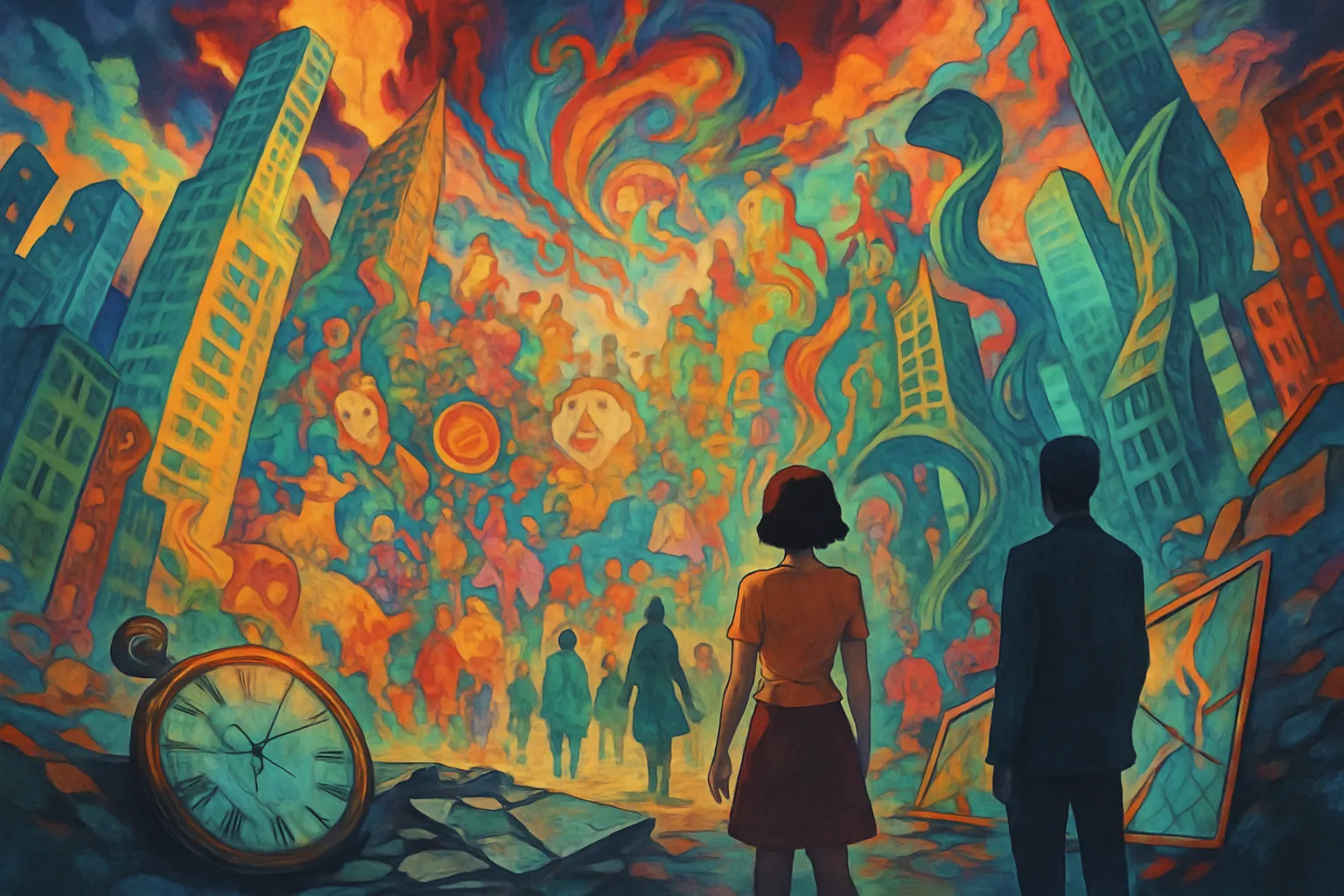
Sometimes the most violent act is not killing the dream, but replaying it in high definition.
Paprika analysis: when your unconscious gets a playback button
You say: I don’t remember most of my dreams, but I know I am telling stories to myself at night. Already the split is there: a body writing nocturnal scripts, a daylight subject waking into amnesia, like a bad editor cutting reels without ever seeing the rushes.
Freud thought this gap between dream-work and recollection was the very space where psychoanalysis lives: the analysand speaks fragments, distortions, displacements, and the analyst listens for the circuitry of desire underneath (Freud, 1900/2010). The dream is not a film to be watched but a symptom to be spoken. There is no “original version,” only retroactive construction.
Paprika walks in and burns the clinic down.
The DC Mini: a pretty toy, a desiring-machine that lets you enter the dream directly, record it, replay it, share it. No more stumbling morning recollections, no more clumsy metaphors about teeth falling out or oceans rising. Instead: cinema. Smooth tracking shots through your neuroses, surround sound guilt, a director’s cut of the unconscious.
If psychoanalysis was built on the fragile, partial translation from dream to language, what happens when the dream can be recalled “as if it was a movie,” exactly as you asked? What happens when the subject becomes a spectator of her own oneiric production, sitting in the red seat where the analyst once sat?
The answer in Paprika is simple and catastrophic: the border collapses. Dream leaks into waking life, cinema into city street, parade into office corridor. Desiring-machines that were once half-muted begin to scream.
Deleuze and Guattari write that desire is not lack but production, machines coupling and uncoupling, “everywhere machines and not metaphorically” (1972/1983, p. 1). The DC Mini is one such machine among others, but dangerously plugged in: not only to the sleeping subject but to networks, institutions, corporate ambitions. It turns the nocturnal workshop into public infrastructure.
Freud wanted the dream to be interpreted; Paprika’s world wants it to be played.
From couch to console: the DIY analyst and the risk of going insane
In the classical analytic scene, you have a division of labor. The analysand remembers badly; the analyst listens too much. Between them circulates the half-rotten currency of words, slips, hesitations. Interpretation is slow, almost geological.
You describe it perfectly:
The analysand begins by speaking from the memory of the dream… The psychoanalysis pokes and prods for symbolism, meaning and associations in order to connect the seemingly discordant.
This poking and prodding is not decoration. It is the condition of possibility for psychic work. The very distance between event and narration gives the unconscious time to disguise, to project, to misdirect. The analyst enters precisely where the recollection falters.
Enter the DC Mini. Suddenly the recollection is perfect. No need to recount: you watch. No need to interpret: you rewind. The dream becomes an object, an audiovisual specimen. You can scrub through your own trauma like a YouTube tutorial on how to be unhappy.
At that moment, something is amputated from psychoanalysis: its dialogic structure. “When you become a third party observer to your own memories you in effect enter the role of the therapist,” you write. Exactly. The subject internalizes the gaze of the analyst, becomes both patient and clinician, but without the asymmetry of knowledge that once protected the scene.
Foucault’s analysis of modern power as internalized surveillance comes to mind: we no longer need the guard in the tower; we watch ourselves, discipline ourselves, confess to ourselves (1976/1978). In Paprika, the DC Mini turns the unconscious into a panopticon with no outside. The analyst doesn’t disappear; she is multiplied and implanted.
And like all technologies that promise self-knowledge, it runs into the same problem: the self is not a stable object to be known. It is a process, a moving contradiction, an overdetermined knot of social, libidinal, and historical forces. To treat dreams as films is to risk freezing this movement into spectacle.
Reich warned that character armor—rigid patterns of posture, speech, and affect—develops precisely when the flow of energy is blocked, when the organism becomes too defended against feeling (1933/1970). The DC Mini, supposedly a device for liberating desire, risks armoring it in images: you become attached to your own recorded dreams, hoarding them, fetishizing them, replaying them instead of living.
There is another risk you already named: psychosis. In Paprika, we watch Chiba/Paprika hop a cute little fence in a carnival dream, only to realize mid-air that it is actually the railing of a skyscraper. No useful border between dream and waking, only a glitch of perspective.
Lacan insisted that psychosis emerges when the symbolic order fails to install a reliable cut between subject and world, when certain “names of the father” are foreclosed rather than repressed (1981/1993). Here, the symbolic cut between dream and waking is what fails. The DC Mini drills holes in the screen; the real pours through.
Malena Segura Contrera speaks of contemporary media creating a “hypnogenic consciousness,” a state where mimetic identification with images overrides critical distance (2014, pp. 176–184). Paprika literalizes this: the characters are hypnotized not by an external media stream but by the flood of their own visualized unconscious, mimetically captured in a parade of animated junk.
To watch your dreams as movies is to put your psyche on autoplay.
The parade as jam session: schizoid marching bands and Deleuzian jazz
The most notorious sequence in Paprika is the parade: refrigerators dancing, broken dolls clapping, corporate logos waltzing with Shinto icons. An obscene ecology of discarded objects, sacred residues, mass-produced trash, all marching to a cheerful tune through the psychic and urban landscape.
If Freud thought dreams were wish-fulfillment, what kind of wish is this? Certainly not a simple sexual or infantile fantasy. It is a wish of the machines themselves: a delirious convergence of semiotic scraps. The parade is desire as remix.
Ola Harstad, thinking through Deleuze and jazz, uses the notion of “jam” to describe a method where world and research co-emerge in improvisation, each participant both structuring and being structured by the event (2017). The parade is such a jam: heterogeneous elements thrown into a shared rhythm, without a pre-given score. No transcendent conductor. Just an immanent beat that sweeps people into trances.
Deleuze’s cinema books talk about the time-image, where sensory-motor schemas break down and images link directly to thought, producing a crystalline, delirious montage (1985/1989). Paprika’s parade is a time-image gone full carnival: it roams across temporal and spatial coordinates, linking shrine gates, office cubicles, highways, and hospital corridors into one continuous, impossible procession.
This is not mere surrealism. It is a diagram of contemporary media flows, where advertising slogans, folk memories, and personal fetishes cohabit the same psychic bandwidth. The unconscious is not a private theater; it is a pirate stream.
Contrera again highlights how media mimesis today doesn’t just imitate reality; it induces a “hypnogenic” state, short-circuiting rational distance and folding viewer into spectacle (2014, pp. 176–184). Paprika pushes this to ontological meltdown: the spectacle invades the diegetic world. Characters become possessed by the parade, repeating its slogans, attempting suicide as if obeying a contagious meme.
Žižek loves to note that ideology is not just in the explicit message but in the material rituals, the little practices we perform even when we “don’t really believe” (1989). Here, the ideology is one of seamless flow: no more gaps between subject and image, work and dream, clinic and market. March, consume, hallucinate.
Techno-oracles and the death of the slow question
“What happens to dream interpretation if the dream can be recalled to memory as if it was a movie?” you ask. Another way: what happens to slowness?
Interpretation, at its best, is not about decoding symbols like a dictionary. It is about dwelling with ambiguities, letting associations unfurl, resisting premature closure. It is fundamentally slow. It honors forgetting, silence, resistance.
The DC Mini, in contrast, is acceleration. You harvest dreams nightly, archive them, search them. You outsource remembering to the machine, much as we outsource memory to smartphones, calendars, cloud servers. Heather Leary and colleagues note how Web 2.0 and open education platforms enable new forms of collaborative content production, where anonymous “good Samaritans” and experts co-create knowledge resources (2009). Imagine the DC Mini plugged into such a platform: crowdsourced dream databases, tagged, annotated, visualized.
Olena Zinkevych, writing on electronic music, argues that a purely technological analysis—spectral graphs, models, exosemantic diagrams—misses the aesthetic and philosophical dimensions of the work (2023). Likewise, a purely technological handling of dreams (record, replay, categorize) misses the lived weight of guilt, desire, ambivalence. It hears the frequencies but not the question.
Ethics enters here too. Giuseppe Pulina reminds us that notions of good and evil are cultural constructs, historically variable, especially in domains like animal welfare, where “ethical meat” is negotiated at the intersection of biology, economy, and moral imagination (2020, pp. 34–38). The ethics of dream-tech will likewise be constructed, contested: Is it good to mine employees’ dreams for productivity insights? Is it evil to market dream-sharing as entertainment?
Kant might say the dream, like any representation, is part of the play of imagination that mediates between sensibility and understanding, but without the structuring concepts that make judgment possible (1781/1998). To solidify dreams into images and feed them back as oracles is to short-circuit this play, to congeal the fluid into pseudo-knowledge.
Detective Konakawa’s director’s cut: editing guilt, choosing a life
Midway through Paprika, Detective Konakawa tells his story in a bar: how he once co-directed an amateur film, a detective chase that never ended. How jealousy of his talented friend paralyzed him, how the project remained unfinished, how the friend died while Konakawa ran away into “real” detective work.
Haunted for years by a recurring dream of an endless chase through film genres—a parade of film history before Paprika’s parade of objects—Konakawa believes he abandoned his true calling. He carries guilt like a secret subtitle.
Then, in that bar, he performs a cut. He reframes the narrative: in becoming a real detective, he did, in fact, finish the movie. He brought the role into life. The dream of being a detective was realized historically, not cinematically. The guilt, therefore, loses its object.
Badiou would say a subject is what emerges through fidelity to an event, a break that cannot be reduced to existing knowledge (1988/2005). For Konakawa, the event is not the dream or the unfinished film; it is the bar-story where he treats his own past as editable, where he wagers on a new truth: that living the role can redeem abandoning the film.
Nietzsche’s challenge of eternal return hovers here: can you affirm your life so completely that you would live it again, exactly as it was, forever (1901/1967)? Konakawa’s reframing is a small “yes” whispered into the machinery of ressentiment. He stops saying, “I should have been a filmmaker,” and starts saying, “I have always been completing that film, differently.”
Žižek likes to insist that sometimes the most radical act is not to change the facts but to change their symbolic frame (1989). Konakawa doesn’t resurrect his friend or finish the literal film; he edits the guilt. The DC Mini functions here not as a recording device but as a projector that forces confrontation. Without the dream, the guilt would remain shapeless. With it, he can cut.
Capitalism wants your nightmares: DC Mini as desiring-machine in captivity
To treat Paprika as a mere cautionary tale about technology would be too simple. The DC Mini is not evil. The real question is: who owns it? What circuits of power and capital it is plugged into?
Marx taught us that under capitalism, every new productive force—steam engine, assembly line, algorithm—is rapidly subsumed into the logic of profit, turning human capacities into sources of surplus value (1867/1977). The DC Mini is a productive force of the unconscious: it can generate content, gather data, predict behavior, cure or create pathologies.
Baudrillard saw in contemporary capitalism a shift from production to simulation, where signs and codes circulate independently of any firm reference to reality, creating “hyperreality” (1981/1994). The DC Mini accelerates this: your dreams become another layer of simulacra, feeding into a system already saturated with images.
Deleuze and Guattari warned that capitalism is uniquely good at decoding flows (of money, people, images) only to recode them under the axiomatic of profit (1972/1983). The unconscious is deterritorialized only to be reterritorialized by brands, platforms, markets.
Intertextual dreams: film noir, anime, and the unconscious as citation machine
Paprika is drenched in cinephilia. Konakawa’s dream noir, the silent film gag, the jungle adventure: an entire compressed history of cinema flickers through his unconscious. Dreams cite movies; movies cite dreams.
Scholars of intertextuality in drama, such as Maslo and Volkova (2021) in their analysis of V. Vynnychenko’s plays, note how historical and literary allusions build layered meanings that require decoding networks of references rather than isolated texts (pp. 123–129). Paprika operates similarly: the unconscious is revealed as intertextual, stitching together film genres, pop culture, and personal memory.
Michael Vater, commenting on Fichte, describes sensation as arising from a “wavering of imagination” where the I both extends itself and reflects upon itself, producing objectivity in a “dark, unreflected intuition” (1997). Paprika’s dreams are that wavering made visible.
Sublime overload: when the dream becomes too big to think
Kassam and colleagues, exploring the “emotions of the spiritually sublime,” suggest that certain experiences—vastness, unity, existential significance—can reshape our understanding of self and world (2013). The dream-parade’s apocalyptic expansion has that structure: a quasi-sublime event, hinting at a new order where inside and outside collapse.
But where the Kantian sublime ultimately reaffirms the transcendence of reason over nature (1790/2000), Paprika’s sublime has no such consolation. Reason is one more float in the parade.
Bente Martinsen and Dreyer (2012) define “care dependence” as a subjective need for support to compensate for a self-care deficit. The dreamers in Paprika are care-dependent in a new register: they cannot navigate their own unconscious without help. Paprika’s interventions are micro-care actions in a cosmos indifferent to their frailty.
Animal ethics, dream ethics: who gets eaten by whose desire?
Giuseppe Pulina emphasizes how ethical judgments hinge on cultural constructions of good and evil, which evolve over time (2020, pp. 34–38). The unconscious in Paprika is treated similarly: as a resource to be exploited, a “meat” to be processed by technology and expertise.
S. Havrilyuk, discussing the philosophical concept of error in law, notes that error has long been treated as an “aberration,” a deviation from correct thought often implicated in questions of responsibility (2021). In Paprika, the line between error and crime blurs: who is responsible when someone under dream-possession jumps out a window?
References
Badiou, A. (2005). Being and event (O. Feltham, Trans.). Continuum. (Original work published 1988)
Baudrillard, J. (1994). Simulacra and simulation (S. F. Glaser, Trans.). University of Michigan Press. (Original work published 1981)
Contrera, M. S. (2014). Medios y mimesis: La conciencia hipnogénica. Universidad de Sevilla.
Deleuze, G. (1989). Cinema 2: The time-image (H. Tomlinson & R. Galeta, Trans.). University of Minnesota Press. (Original work published 1985)
Deleuze, G., & Guattari, F. (1983). Anti-Oedipus: Capitalism and schizophrenia (R. Hurley, M. Seem, & H. R. Lane, Trans.). University of Minnesota Press. (Original work published 1972)
Foucault, M. (1978). The history of sexuality, Volume 1: An introduction (R. Hurley, Trans.). Pantheon. (Original work published 1976)
Freud, S. (2010). The interpretation of dreams (J. Crick, Trans.). Oxford University Press. (Original work published 1900)
Harstad, O. (2017). Deleuze and jazz: A jam session on the immanence of music. Palgrave Macmillan.
Havrilyuk, S. (2021). Philosophical concept of error in law. Legal Philosophy, 14(2), 45–60.
Kant, I. (1998). Critique of pure reason (P. Guyer & A. W. Wood, Trans.). Cambridge University Press. (Original work published 1781)
Kant, I. (2000). Critique of the power of judgment (P. Guyer, Trans.). Cambridge University Press. (Original work published 1790)
Kassam, K. S., Markey, A. R., Cherkassky, V. L., Loewenstein, G., & Just, M. A. (2013). Identifying emotions on the basis of neural activation. PLOS ONE, 8(6), e66032.
Lacan, J. (1993). The psychoses: The seminar of Jacques Lacan, Book III, 1955–1956 (R. Grigg, Trans.). W. W. Norton. (Original work published 1981)
Leary, H., Walker, A., Shelton, B. E., & Fanoos, M. (2009). Exploring the relationships between self-regulation, motivation, and professional learning in Web 2.0 environments. International Journal of Self-Directed Learning, 6(2), 22–34.
Martinsen, B., & Dreyer, P. (2012). Dependence on care: Experiences of people with spinal cord injury. Journal of Clinical Nursing, 21(15-16), 2352–2361.
Marx, K. (1977). Capital: A critique of political economy (Vol. 1, B. Fowkes, Trans.). Vintage Books. (Original work published 1867)
Maslo, O., & Volkova, N. (2021). Intertextual discourse in V. Vynnychenko’s dramas. Humanities Bulletin, 123–129.
Nietzsche, F. (1967). The will to power (W. Kaufmann & R. J. Hollingdale, Trans.). Vintage Books. (Original work published 1901)
Kon, S. (Director). (2006). Paprika [Film]. Madhouse.
Pulina, G. (2020). Ethical meat: A philosophical and economic inquiry. Springer.
Reich, W. (1970). Character analysis (V. R. Carfagno, Trans., 3rd ed.). Farrar, Straus and Giroux. (Original work published 1933)
Vater, M. (1997). Fichte’s doctrine of science: A commentary. State University of New York Press.
Zinkevych, O. (2023). Technological vs. aesthetic analysis in contemporary electronic music. Journal of Musicology, 12(1), 88–104.
Žižek, S. (1989). The sublime object of ideology. Verso.
Comments
Post a Comment