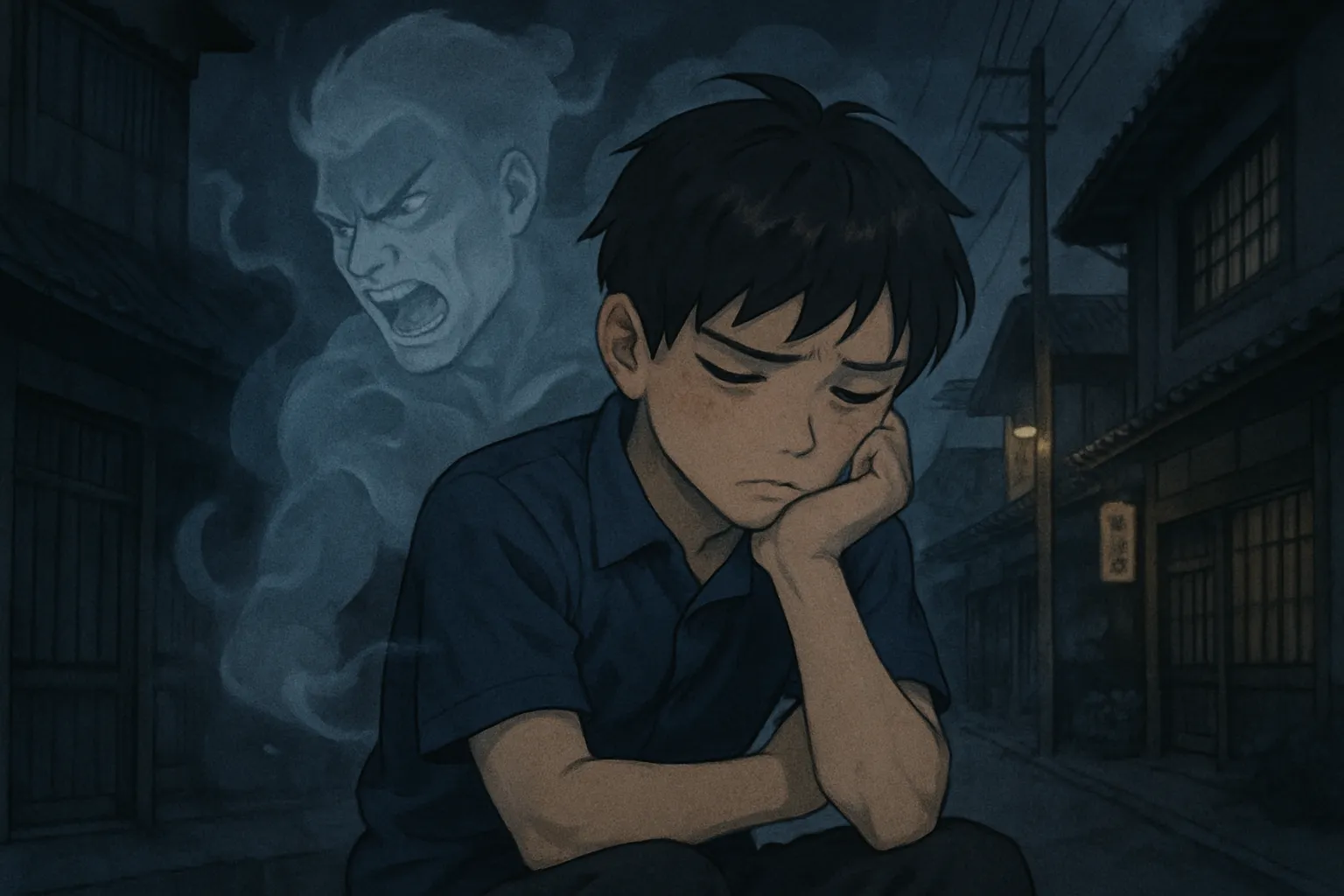
Every schoolyard is a low-budget horror film that never stops shooting; sometimes a director walks out of the victim’s skull.
How To Manufacture A Ghost In A School Stairwell
Neighbor No. 13 is not a psychological thriller so much as an instruction manual for producing an internal neighbor, a parasitic roommate in the psyche who never pays rent and never leaves. The film shows us Juzo twice: once as that numb, flattened salaryman trudging to a construction site, and once as the violent double, the tattooed, smirking specter that only he seems to see. The bullied child never really “grows up”; he simply relocates into a darker hallway and waits. The opening constellation of scenes—acid hissing on teenaged skin, boys chanting a living funeral over his desk, the hose blasting through the shuddering bathroom stall—are not backstory. They are the factory floor. This is where the desiring-machines of boyhood are wired together: shame, laughter, spectacle, and that quiet click when humiliation is recorded as a permanent setting rather than a passing event.
Bullying here is not an individual vice. It’s a distributed performance. Aggressor, target, spectators: all of them cooperate to stabilize one fragile thing—hierarchy. The bully organizes the social body into a visible pyramid; the others nod, look away, laugh at the right time, and the world holds. Status needs witnesses like a ritual needs worshippers. Without the boy’s tears and the classroom’s smirks, the bully’s victory would evaporate. Juzo’s ghost is born exactly where the rest of the class looks away.
Acid On The Face, Acid In The Symbolic Order
There is a particular cruelty in choosing acid. It is not content to bruise; it rewrites the surface of the body, creates a new face that will keep the event blazing long after the school gates close. The bullying is inscribed in flesh, turned into a mask that makes forgetting anatomically impossible. The film stages this as a double inscription. On one screen: Juzo in a dark, bare shack, naked, sobbing, clutching himself like a wound that gained consciousness. On the other: the “functional adult” Juzo, years later, trudging into a new job, past new co-workers, into yet another stratified environment. The shack is not a flashback; it is an interior set, a cramped theater where the memory continues to play in real time.
This split is often explained with the gentle language of “coping mechanisms.” But the film doesn’t show a coping self; it shows a self under arrest. Juzo’s refusal to fight back, his mute endurance, does not heal him. It curls back inward, congealing around the trauma until it calcifies into an autonomous figure: Neighbor No. 13, the alter that carries all the rage that the “good boy” version was forced to suppress. Reich’s image of “character armor” is useful here: muscles, postures, and emotional reflexes harden into a defensive shell that both protects the organism and blocks its capacity to feel and respond freely (Reich, 1949). Juzo’s quietness, his downward gaze, his apparent passivity—these are not neutral traits but armored stances. But armor is heavy; the psyche, like the body, eventually tries to offload its weight. The offload, here, appears as a second body. The ghost-Juzo is the armor walking around on its own.
Boys Don’t Cry, They Outsource
The social script for boys is a primitive little algorithm: when hit, don’t flinch; when mocked, laugh along; when humiliated, turn it into a joke or a scar story later. Pain must be transformed into narrative capital or hidden entirely. The only unforgivable sin is visible weakness. Thus, when Juzo is drenched, burned, degraded, the proper masculine reaction would be to “take it”—to metabolize it into toughness or silence. The problem is that the organism doesn’t comply. Somewhere beneath the armored surface, the nervous system is still screaming. The boy cannot simply choose not to register agony; he can only choose not to show it. So the affect gets subcontracted.
Neighbor No. 13 literalizes that outsourcing. All the rage, the murderous fantasies, the desire to see the bully’s face rearranged by something sharp—those are handed off to the double. The “primary” Juzo can remain blank, vaguely polite, even when he finds himself working on the same site as his old torturer, now a cheerful adult with a wife and a child. The anger does not disappear; it stalks the premises as a second figure. Freud once wrote of the return of the repressed as a kind of involuntary repetition, where what the subject refuses to know at one level comes back as symptoms, dreams, or compulsive acts (Freud, 1955). But repetition is too weak a word for what happens here. The ghost is not a mere symptom; it is an active decision that has been disowned. Every time Juzo “lets it go,” every time he swallows his rage instead of speaking or striking, he is voting—tacitly—for the ghost to grow teeth. The film refuses to let us say: “He snapped.” Nothing snaps. Something is carefully, slowly constructed.
Complex PTSD: When Time Becomes A Loop With Teeth
Ordinary trauma cuts once and leaves a scar. Complex trauma drags the knife in circles until time itself forgets how to move forward. C-PTSD is not about the singular catastrophe but about entrapment in a long corridor of smaller, interlocking catastrophes: the daily taunt, the locker shove, the silent lunch, the hundredth time your name is a punchline. The school system is a machine for such corridors. It bars the doors for twelve years and calls it compulsory education. The boy who is bullied in this setting is not confronting discrete incidents; he is inhabiting a structure. Every bell, every hallway, every group assignment is an ambush in potentia. The nervous system learns that there is no safe zone, no outside to the field of threat. So it does the only thing available: it tries to create one internally.
The shack where Juzo’s naked, shivering inner child lives is that internal outside. It is a private exile, carved out of the mind. But exiles have a habit of organizing, of plotting returns. The alter ego is not content to remain in the shadows; it wants to cross the threshold, to drag the “functional” Juzo back into the scene of the offense and rewrite it. From a certain angle, the violence that follows is simply the traumatic loop trying to close. The boy who could not fight back then is manufacturing a delayed fight now. But delay is not justice. It is distortion. Revenge has no statute of limitations; but the further it travels from its origin, the less it remembers what it was supposed to correct. This is the obscenity of complex trauma: the way it pushes the subject into actions that are responses to a past environment, deployed against a present that cannot possibly fix it.
The Bully As Small-Time Capitalist Of Pain
Bullying in Neighbor No. 13 is not random sadism. It is highly rational within the micro-economy of the male classroom. The bully invests effort—planning humiliations, recruiting accomplices, staging pranks—in order to secure returns: laughter, fear, deference, the thrill of seeing someone lower than himself. He is an entrepreneur of cruelty. Marx reminds us that capital is not a thing but a social relation, a process by which value is extracted and accumulated (Marx, 1977). In the tiny market of the classroom, the valuable resource is not money but recognition. The bully corners the market on recognition by using Juzo as a perpetual negative example. “At least you’re not him” becomes the invisible slogan under every boy’s day.
Every act of aggression is also an advertisement: look at my power, my ability to define who counts and who doesn’t. The classmates, by laughing or by hurriedly leaving the room, pay their subscription fee. They confirm the bully’s authority. They also quietly tell themselves a lie: that they are merely passive spectators, not participants in production. But nothing about this economy is passive. The bystanders are the consumer base that makes the bully’s desiring-production profitable. Without them, humiliation would have no audience and thus no use value. In adulthood, the same bully reappears as a cheerfully oblivious foreman, an overseer of concrete and scaffolding rather than bodies and desks. Yet the structure is the same. He commands, jokes, backslaps; others obey, laugh along, do not quite meet Juzo’s eye. The schoolyard factory of domination has simply been upscaled into the wage labor machine. The old cruelty runs in the background like legacy software.
Bystanders: Liberal Individualism Chickens Out
One of the most disturbing images in Neighbor No. 13 is not overtly violent at all: the shot of the classroom as the bully and his lieutenants stage their fake funeral at Juzo’s desk. They pray loudly, theatrically, turning his absence into a death ritual. The rest of the boys laugh, squirm, and then, one by one, drift out the door. There are enough of them to stop the performance at any moment. They could surround the bully, shout him down, grab the flowers from his hand, end it. Instead, they evacuate. The majority behaves as if it were a powerless minority. This is where the ideology of individualism does its most insidious work. If each boy understands himself primarily as a separate unit, responsible only for his own survival and advancement, then acting collectively becomes unthinkable. To intervene would be to take on personal risk for a non-personal gain: someone else’s dignity, someone else’s safety. The calculus feels irrational.
But that calculus has been trained. Schools, especially those with autocratic teachers and rigid hierarchies, condition children to accept vertical authority while discouraging horizontal solidarity. It is acceptable, even noble, to endure hardship as an individual—“work hard,” “tough it out”—but it is suspicious to organize together against injustice, whether that injustice comes from peers or from above. The same structure that would panic at a student union calmly absorbs daily acts of peer brutality. The bystanders’ inaction is not pure cowardice. It is obedience to a deeper curricular demand: do not disrupt the order, even when the order is visibly obscene.
Masculinity As Noise-Canceling Headphones
“Walk it off.” “Man up.” “Don’t be a crybaby.” These are not just phrases; they are tiny spells, linguistic micro-fascisms that tell the boy exactly what is permitted to appear on the surface of his body. Limping is okay—if it proves you’re still in the game. Crying is not. Admitting fear is out of the question. The acceptable masculine emotions are anger (as long as it looks strong), boredom, and a thin band of ironic humor. Neighbor No. 13’s entire horror hinges on this narrow emotional bandwidth. If Juzo had been allowed, at any point, to experience and express vulnerability—to say “I’m terrified,” “I’m ruined,” “Help me”—the ghost might not have formed. But the only states available to him are submission and rage, silence or explosion.
Nietzsche warned of the “internalization” of drives that can’t find outward expression, how instincts turned inward become “bad conscience,” self-laceration, and eventually a kind of psychic sickness (Nietzsche, 1994). Here, the internalized, forbidden desire to strike back is not turned into guilt but into a doppelgänger. The boy is prevented from directing anger outward in a socially acknowledged moment—telling the teacher, resisting in front of his peers, appealing to adults—so anger takes a subterranean route. The double is masculinity’s forbidden scriptwriter. He authorizes what the “good boy” is not allowed to authorize. He wields the knife that the social code keeps insisting doesn’t exist. Masculinity, in this sense, is not simply toxic; it is structurally dissociative.
The Construction Site As Repeating Dream
The adult setting of Neighbor No. 13—a concrete skeleton of a building, elevators in mid-install, scaffolding like exposed nerves—is not neutral. It is the school reappearing in drag. Grey, unfinished, full of blind corners and power hierarchies, it becomes a topographical echo of the classroom: a place where someone higher up gives orders, someone lower down absorbs them, and everyone pretends this is natural. Trauma has a knack for architectural repetition. The psyche gravitates, almost magnetically, toward spaces that resemble the original site of injury. Not because it enjoys suffering, but because it is still secretly looking for an edit. Maybe this time, in this slightly different corridor, the body will turn left instead of right. Maybe this time someone will intervene.
Juzo’s decision to take a job where his childhood bully is the foreman is not just a coincidence of plot. It is the traumatic circuit insisting on another run. He is throwing his adult body into the old layout, hoping unconsciously for an alternate ending. The double is there to guarantee that, if no one else changes the script, he will. But the space itself resists change. The foreman-bully is still affable and cruel in equal measure; the other workers still circle around him; jokes still carry more weight than ethics. The building is a verticalized classroom, and Juzo is still the boy at the bad desk, only now with a hard hat. Foucault wrote that modern institutions—schools, barracks, factories—are not separate entities but variations on a single disciplinary diagram that arranges bodies, gazes, and movements to produce obedient subjects (Foucault, 1995). The film confirms this diagram, but twists it: the obedient subject has smuggled a saboteur inside.
Revenge As Illicit Curriculum Design
You could say that Neighbor No. 13 is a fantasy about curriculum reform from below. The school clearly failed to teach justice; the legal system, if it even noticed the acid incident, has long since filed it away; the adult world shrugs at trauma as a private matter. So the ghost designs his own course: Introduction to Consequences. The syllabus is simple: Re-enter the bully’s life. Destabilize his comfort. Escalate until his suffering begins to approximate yours. This is not justice; it is pedagogy by mutilation. The alter ego is not interested in apology, reconciliation, or even understanding. It wants replication. It wants the bully to feel—not the abstract wrongness of his actions—but the concrete texture of terror and helplessness he once induced.
Badiou makes a sharp distinction between vengeance, which reacts to harm and mirrors it, and fidelity to an event, which opens a new truth that cannot be reduced to tit-for-tat (Badiou, 2001). Juzo’s ghost is entirely on the side of vengeance. It takes the original event—acid in the face—and refuses to let anything genuinely new emerge from it. Everything is oriented toward replay. What is tragic is not that the ghost kills or injures; in the abstract, we can imagine narratives where the oppressed strikes back and something liberatory unfolds. What is tragic here is that the strike-back never leaves the orbit of the bully. Juzo’s world shrinks to the exact proportions of the man who hurt him. The line of flight that might have carried him out of the trauma spiral is folded into a noose. Revenge, in this sense, is a pedagogy that teaches nothing but the fact that hurt circulates.
Citation, Originality, And The Plagiarized Self
There is another layer to all this violence that our contemporary obsession with originality makes hard to see. Juzo’s suffering is not unique. It is almost boringly generic: boy bullied by boys, school looks away, adulthood pretends the past is past. And yet, when he finally acts, his revenge arrives as something that feels singular, shocking, “unthinkable.” Academic culture loves to mark the new, the original, the never-before-articulated. Journals demand that an article show it has not simply copied what came before, that it cites properly while adding its own spin (Sairally, 2025). There is a whole industry now of checking references, ensuring APA compliance, tracing whether works are accurately cited or sloppily misquoted (Nicoll et al., 2021; Scheinfeld et al., 2025). Even the use of AI tools like this one is being scrutinized for how transparently they are acknowledged in manuscripts (Hosseini et al., 2023; Zohny et al., 2023).
Neighbor No. 13 exposes a different kind of citation crisis: the way violence endlessly cites prior violence without ever footnoting it. The bully’s cruelty is itself a plagiarized form, absorbed from older boys, from media, from a culture that has already written the script of masculine domination. Juzo’s ghost, in turn, is a plagiarized figure from horror cinema, from urban legends of the “quiet guy who finally snaps.” None of this is truly original. The originality lies only in the particular configuration of bodies and timing. Yet the legal and moral apparatus insist on treating Juzo’s final acts as individual decisions, authored purely by him, detachable from their intertext. If we took citation seriously in life the way we pretend to in scholarship, every act of harm would come with a bloated reference list: parents, teachers, institutions, ideologies. This does not erase responsibility, but it refuses to let the final actor be the only name on the paper.
The Neighbor As Concept: Who Lives Next Door In Your Skull
The title, Neighbor No. 13, invites a kind of cheap numerology—who are the other 12?—but the more interesting question is: what does it mean to be a neighbor inside one’s own subjectivity? The double is not a split-off personality in a clinical sense; it is more like a tenant in a crowded tenement where the walls are thin. He shares memories with Juzo but not ethics, shares a body but not a life plan. He is always nearby, sometimes at the periphery of the frame, sometimes stepping into the foreground with a weapon.
Lacan suggested that the ego is itself a misrecognition, a construct formed in the mirror stage where the child identifies with an image of itself as whole and coherent, masking its actual fragmentation (Lacan, 2006). The neighbor in this film is what leaks out when that imagined coherence fails to metabolize certain experiences. Instead of one stable “I,” we see a hallway of I’s, some of them uninvited. The neighbor is also spatial: he occupies the threshold between inside and outside. He is part of Juzo and yet stands across from him. That ambiguity is precisely what allows him to do what Juzo “cannot.” Each time the film shows Juzo standing still while the neighbor advances, we witness an internal outsourcing of agency. But the outsourcing is never total. The law, if it were to intervene, would not recognize the neighbor as a separate subject. It would pin everything on Juzo. This is another dimension of horror: the knowledge that, no matter how much you experience your violent impulse as alien, you will be held accountable as if you had authored it in cold blood.
Kant would insist on this point: the capacity for moral choice, and thus for guilt, rests precisely on our ability to treat maxims—rules for action—as something we endorse or reject, regardless of inclinations (Kant, 1998). The neighbor may feel like an inclination turned creature, but his actions still express a maxim: that revenge is permissible, perhaps necessary. The film offers no easy way for Juzo to deny that maxim in court. He can say, “It wasn’t me,” but the bruises will disagree.
Trauma, Desire, And The Possibility Of Another Script
If this were a redemption story, here is where we would pivot to healing: therapy, solidarity, restorative justice. But Neighbor No. 13 is not interested in easy resolutions. It follows the line of trauma until it crosses into blood. Still, the film does smuggle in small indicators that another path could have existed. Moments when a co-worker might have noticed Juzo’s discomfort. Glances that linger a second too long on the bully’s oblivious grin. The bare fact that the other laborers are numerically many and the bully only one. These are micro-chances for different lines of flight: speaking out, forming alliances, refusing to rerun the school script.
Žižek has argued that the true violence of a situation often lies not in the spectacular acts that break the law, but in the quiet, “objective” violence of the structures that define what is thinkable in the first place (Žižek, 2008). In this sense, the real scandal in Neighbor No. 13 is not the ghost’s rampage but the long, dull consent of everyone else—the consent to let school be a prison, to let masculinity be a choke point, to let trauma be a private hobby. We can imagine, almost in spite of the film, a different kind of neighbor emerging: not the vengeful double, but a collective presence, a we that refuses to let any boy be isolated as Juzo was. The neighbor as comrade, not specter. That figure never materializes on screen. But the absence is instructive. It tells us where our own work lies, outside the theater: not in pathologizing the Juzos of the world, nor in pretending that bullies are monsters beyond comprehension, but in dismantling the micro-economies and ideologies that make their dance feel inevitable. The ghost is not a glitch. It is a feature of a system that prefers internal breakdowns to external revolts.
References
Badiou, A. (2001). Ethics: An essay on the understanding of evil (P. Hallward, Trans.). Verso.
Deleuze, G., & Guattari, F. (1983). Anti-Oedipus: Capitalism and schizophrenia (R. Hurley, M. Seem, & H. R. Lane, Trans.). University of Minnesota Press.
Foucault, M. (1995). Discipline and punish: The birth of the prison (A. Sheridan, Trans.). Vintage Books.
Freud, S. (1955). Beyond the pleasure principle (J. Strachey, Trans.). In J. Strachey (Ed.), The standard edition of the complete psychological works of Sigmund Freud (Vol. 18, pp. 1–64). Hogarth Press. (Original work published 1920)
Hosseini, M., Resnik, D., & Holmes, K. L. (2023). The ethics of disclosing the use of artificial intelligence tools in writing scholarly manuscripts. Research Ethics, 19(4), 449–465.
Inoue, Y. (Director). (2005). Neighbor No. 13 [Film]. Amuse Soft Entertainment.
Kant, I. (1998). Groundwork of the metaphysics of morals (M. Gregor, Trans.). Cambridge University Press. (Original work published 1785)
Lacan, J. (2006). Écrits: The first complete edition in English (B. Fink, Trans.). W. W. Norton.
Marx, K. (1977). Capital: A critique of political economy (Vol. 1, B. Fowkes, Trans.). Vintage Books. (Original work published 1867)
Nicoll, L., Oermann, M., Carter-Templeton, H. D., Wrigley, J., & Owens, J. K. (2021). Exploring the accuracy of cited references in a selected data set of nursing journal articles. Advances in Nursing Science, 45(2), 209–217.
Nietzsche, F. (1994). On the genealogy of morality (C. Diethe, Trans.). Cambridge University Press. (Original work published 1887)
Reich, W. (1949). Character analysis (T. P. Wolfe, Trans.). Farrar, Straus and Giroux.
Sairally, B. S. (2025). Editorial: Demonstrating originality in research. International Journal of Islamic Finance and Sustainable Development.
Scheinfeld, L., Chung, S., Fena, C., Tran, C. Y., Kretz, C., & Reisman, M. R. (2025). Assessing formatting accuracy of APA style references: A scoping review. Evidence Based Library and Information Practice.
Semantic Scholar. (2025). Data source: Philosophical and ethical trends in citation accuracy. https://www.semanticscholar.org
Zohny, H., McMillan, J., & King, M. (2023). Ethics of generative AI. Journal of Medical Ethics, 49, 79–80.
Žižek, S. (2008). Violence: Six sideways reflections. Picador.
Comments
Post a Comment