IT (1990/2017): The Derry-Machine and the Cannibalistic Re-Territorialization of the American Pastoral
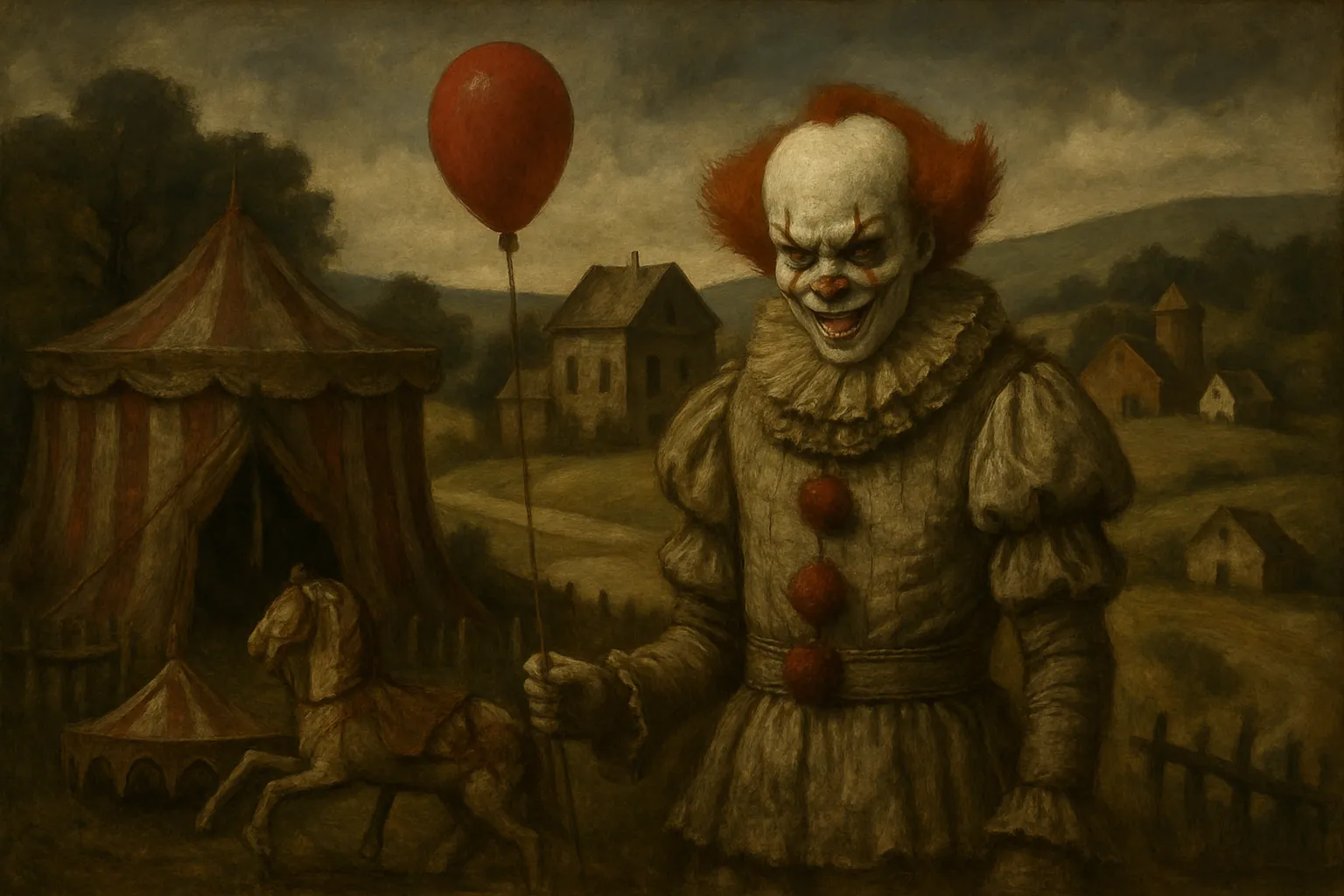
The sewer is the anus of the State-form, a subterranean Body without Organs (BwO) where the excremental flows of suburban repressed desires achieve a terrifying, predatory haecceity. To speak of Pennywise is not to speak of a character, but of a specific mode of capture—a desiring-machine that has successfully grafted itself onto the tectonic plates of a small Maine town, transforming a geographic coordinate into a functional apparatus of consumption. The clown is the molar face of an abstract machine, a mask of sanity worn by a void that requires the intensive heat of childhood terror to catalyze its own continuity.
We must immediately discard the psychoanalytic impulse to view the clown as a mere manifestation of the "inner child" or a projection of trauma; such a reading re-Oedipalizes the monster, tucking it back into the neat folds of the family unit. No, the IT-assemblage is a nomadism turned inward, a line of flight that has curdled into a black hole. As Deleuze and Guattari (1983) remind us in Anti-Oedipus:
"The schizophrenic is not a person who has lost his sense of reality, but a person who has discovered that reality is a machine, a desiring-machine that works only by breaking down."
Derry is precisely this machine. It is a town that works only by breaking down every twenty-seven years. The "it" of IT is the third-person pronoun of the impersonal flow, the neuter energy of a cosmic parasite that recognizes no subjects, only parts. The children of Derry are not subjects to the clown; they are "partial objects"—limbs, fears, adrenal secretions—to be harvested by a mouth that is less a biological organ and more a functional break in the flow of time.
The suburban environment of Derry serves as a rigid segmentarity, a grid of picket fences and silent libraries designed to muffle the screams of the molecular. Here, the adults are the most efficient components of the machine. Their apathy is not a moral failing but a structural necessity; they are the "socius" of the predator, a collective surface of recording that refuses to register the blood in the sink because the blood is the oil that keeps the gears of the local economy turning. The adult is the territorialized subject par excellence, so deeply striated by the demands of labor, taxes, and domesticity that they can no longer perceive the smooth space of the supernatural. They have lost the "becoming-child" that allows for the perception of the monstrous.
When Beverly Marsh sees the blood erupting from her drain, she is witnessing a rupture in the domestic strata. The sink is the point where the private interiority of the home connects to the public exteriority of the waste-machine. To the adult, a sink is a functional object within a capitalist utility grid. To the child, it is an orifice. The blood is the return of the repressed flow—the literalization of the violence that sustains the patriarchal household. It is only when the Losers' Club forms its rhizomatic alliance that the blood becomes a shared reality. Their connection is not a "group" in the sociological sense; it is a "war machine" as defined in A Thousand Plateaus. They connect not through identity, but through their shared deterritorialization: the stutterer, the Jew, the fat boy, the orphan. They are the "refuse" of the molar social order, and it is precisely this status that allows them to navigate the smooth space of the Barrens and the sewers.
The clown, Pennywise, is a mimicry-machine. He is the "Man of the Crowd," a Baudrillardian simulacrum that precedes the reality of the predator. Why a clown? Because the clown is the ultimate figure of the liminal; he is the inverted King, the sacred fool who stands at the threshold of the social. In the suburban sprawl, the clown is a "haunting" of the festive, a signifier that has been detached from its signified and re-attached to a predatory impulse. He is the "Deadlights" disguised as a commodity.
"Everything is a machine. Celestial machines, the stars or heavens in the projection of the astronomer's fingertips; a remote-control machine... the breast is a machine that produces milk, and the mouth a machine coupled to it." (Deleuze & Guattari, 1983).
Pennywise is a fear-machine coupled to the child-machine. This coupling is a libidinal investment. The fear is not a reaction to the monster; the fear is the fuel that allows the monster to materialize. Without the investment of the child’s imagination, the clown is nothing but a "spider-like" residue, a cosmic accident. The "floatation" promised by the clown is the ultimate deterritorialization—a literal lifting of the body off the earth, away from the gravity of the State, but into the digestive tract of the void. To "float" is to be suspended in the undifferentiated intensity of the Deadlights, a state of absolute BwO where all organs are dissolved into a singular, agonizing glow.
We must contrast this with "The Thing." While John Carpenter’s Thing is a parasitic-assimilation machine that seeks to dissolve all boundaries into a singular biological mass, IT is a territorial-harvesting machine. IT does not want to be you; IT wants to eat the affect you produce. The Thing is a becoming-other that threatens the integrity of the species; IT is a sovereign-consumer that reinforces the hierarchy of the food chain. Pennywise has a personality because personality is a lure, a "face" (visageity) that the machine uses to navigate the social strata of Derry.
The Ritual of Chüd, then, is not a battle of wills but a clash of planes. It is the attempt by the nomadic war machine to force the predator into a state of "becoming-finite." By biting the tongue of the predator—a literal organ of the machine—the children attempt to fix the flow, to stop the "it" from becoming "everything." They use the power of the "false"—the imagination—to create a counter-mythology. This is what Nietzsche (1887) describes as the "active forgetting" required to overcome the weight of history. The children must forget the "reality" of their powerlessness to enact the "truth" of their victory.
However, the 1985/2019 return reveals the tragedy of re-territorialization. Upon leaving Derry, the Losers are sucked back into the molar world. They become successful architects, fashion designers, and comedians. They are "cured" of their schizophrenia, which is to say, they are successfully integrated into the capitalist machine. Their amnesia is the price of their sanity. To return to Derry is to undergo a "schizoid breakthrough" in reverse. They must dismantle their adult identities—their "molar masks"—to re-access the molecular power of the Losers.
The final form of IT—the spider—is the realization of the grid. The spider is the weaver of the web, the architect of the traps that striate the earth. It represents the terminal point of the Derry-machine, the moment where the predator can no longer hide behind the mask of the clown. The destruction of the heart of the spider is the destruction of the central processor of the Derry-assemblage. But as the machine dies, the town collapses. The infrastructure falls. This proves that there was never a "Derry" independent of "IT." The town was the exoskeleton of the parasite.
In the end, the "it" of IT remains the pronoun of the unnamable flow. Even after the heart is crushed, the flows of fear remain, looking for new machines to inhabit. The American pastoral is not a peaceful landscape occasionally visited by monsters; it is a monstrous landscape that occasionally simulates peace. We are all floating in the sewers of the socius, waiting for the next eruption of the deadlights to remind us that the "I" is merely a temporary component of a much larger, much hungrier "IT."
References
Baudrillard, J. (1981). Simulacra and Simulation. University of Michigan Press.
Deleuze, G., & Guattari, F. (1983). Anti-Oedipus: Capitalism and Schizophrenia. University of Minnesota Press.
Deleuze, G., & Guattari, F. (1987). A Thousand Plateaus: Capitalism and Schizophrenia. University of Minnesota Press.
Foucault, M. (1975). Discipline and Punish: The Birth of the Prison. Vintage Books.
King, S. (1986). IT. Viking Penguin.
Lacan, J. (1977). The Seminar of Jacques Lacan: Book XI. W. W. Norton & Company.
Nietzsche, F. (1887). On the Genealogy of Morals. Penguin Classics.
Žižek, S. (2006). The Parallax View. MIT Press.
Comments
Post a Comment