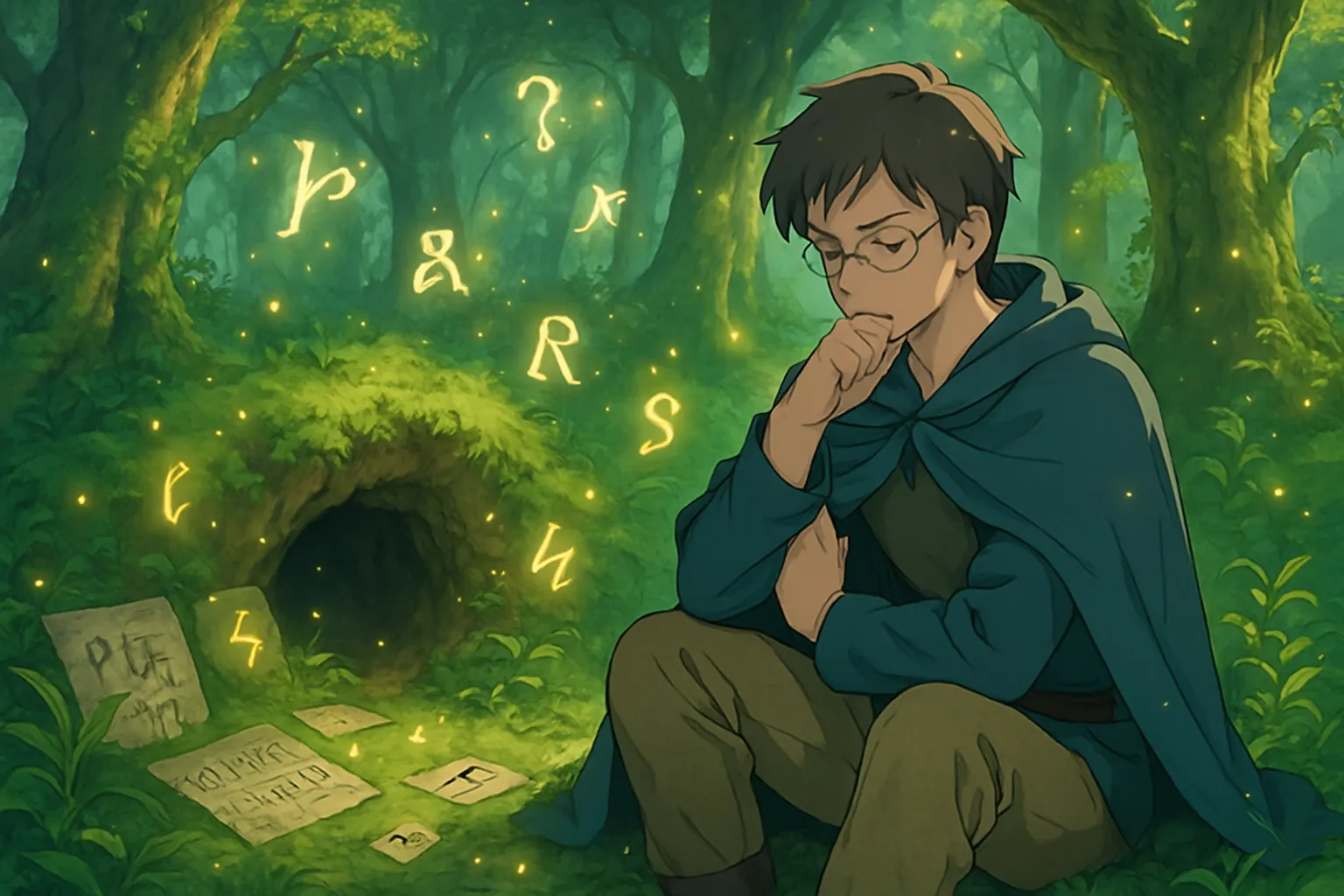
I’ve never felt the urge to pray, not even ducking mortar shells or lying awake in the mud—certainly not when there’s a story about doomed hobbits or a philosophical foxhole debate to distract me. Yet, while faith never landed for me, something in Tolkien’s tireless grind to invent languages while literal shells fell around him makes me pause. There’s almost something dogged about that focus—if there’s salvation in words, maybe it’s just in the act of constructing them, not in believing they contain anything magical. So what’s to be admired (or mocked) about Tolkien’s all-consuming passion for grammar as the true backbone of Middle-earth? Pull up a sandbag, let’s get unholy and nerdy about it.
Trenches, Not Temples: Inventing Languages Instead of Seeking Meaning
As shells thundered and mud swallowed boots in the trenches of World War I, some men clung to faith, whispering prayers to distant gods. J.R.R. Tolkien, however, found his devotion elsewhere. While others reached for meaning in the heavens, Tolkien’s hands were busy with the bones and sinews of language—Quenya and Sindarin, the tongues of elves, born not in temples but in foxholes. His was a faith not in gods, but in grammar.
It’s easy to overlook how radical this was. In a world where meaning was often sought in the divine, Tolkien’s obsession with philology—his love for the structure and history of language—became his own form of worship. He didn’t just dabble in invented words; he constructed entire linguistic systems, complete with shifting pronunciations, etymologies, and dialectical quirks. For Tolkien, language was not just a tool for storytelling. It was the story.
Philological Passion as Secular Zeal
Tolkien’s dedication to his invented languages rivaled the fervor of any missionary. While the world around him was torn apart by war, he painstakingly mapped the evolution of Elvish phonetics, tracing how the trilled r might fade in some dialects but persist in others. He wrote grammars and dictionaries, invented alphabets, and even composed poetry in his constructed tongues. This was not a hobby—it was a calling.
There’s something almost monastic about Tolkien’s discipline. Imagine him, hunched over a notebook by candlelight, not praying but conjugating verbs, not seeking salvation but perfecting syntax. The trenches were his cloister, the battlefield his scriptorium. While others sought comfort in the familiar rituals of faith, Tolkien found solace in the intricate rituals of language creation.
- Quenya: The “High Elvish” tongue, inspired by Finnish, with its own rules for vowel harmony and case endings.
- Sindarin: A “Grey Elvish” language, drawing on Welsh phonology, with a history of sound shifts and regional accents.
- Phonetic Evolution: Tolkien delighted in details like the dropping of the trilled r—a nod to his own non-rhotic English accent and a subtle marker of Elvish age and heritage.
“The invention of languages is the foundation. The ‘stories’ were made rather to provide a world for the languages than the reverse.” — J.R.R. Tolkien
This was not escapism. It was a kind of resistance. Where others sought meaning in gods or grand philosophies, Tolkien built meaning from the ground up, syllable by syllable. There’s an almost anarchic pleasure in this: to assemble new grammar from the chaos around you, to impose order not by divine decree, but by the logic of vowels and consonants. In the trenches, where certainty was scarce, the rules of Quenya and Sindarin offered a strange, secular comfort.
Inventing Grammar in the Foxhole
The contrast with his contemporary, Ludwig Wittgenstein, could not be sharper. Wittgenstein, crouched in a different trench, was writing the Tractatus Logico-Philosophicus, a work that would inspire the logical positivists to declare that only empirically verifiable statements had meaning. For Wittgenstein, language was a tool for describing reality; for Tolkien, it was a reality unto itself. Where Wittgenstein sought to strip language of metaphysical excess, Tolkien reveled in its creative possibilities.
Tolkien’s foxhole was not a place of prayer, but of invention. He did not look to the heavens for answers—he built new worlds with grammar as his mortar and lexicon as his bricks. The act of creation became its own meaning. In the mud and fear of war, Tolkien’s faith was in the enduring, evolving beauty of language itself.
Perhaps that is why his languages feel so alive. They are not static codes, but living systems, complete with irregular verbs, dialectal quirks, and the ghosts of lost sounds. In a world obsessed with seeking meaning from above, Tolkien found it in the trenches—by inventing languages instead of seeking gods.
Foxhole Test: Why Grammar Outlasts Myth
Imagine two men in the trenches of World War I. One, Ludwig Wittgenstein, is scribbling the seeds of modern logic and philosophy. The other, J.R.R. Tolkien, is sketching the first outlines of Elvish grammar. Both are surrounded by chaos, but their minds are busy building worlds—one of reason, the other of myth. Yet, what truly survives the foxhole? Is it the gods of myth, or the grammar that underpins every story?
Accountability vs. Faith: Languages You Can Argue With
Unlike gods, constructed languages can be poked, prodded, and even improved. There’s a kind of accountability in grammar that myth can never match. Faith offers stories that can’t be tested or falsified. You can’t prove or disprove the existence of Valinor or the Valar. But you can challenge the internal logic of Quenya or Sindarin. If a verb tense doesn’t make sense, or a sound change contradicts itself, someone will notice. Tolkien’s languages invite scrutiny, debate, and even revision. They’re living systems, not sacred relics.
- Constructed languages are open to critique. Anyone can learn the rules, spot inconsistencies, and propose improvements.
- Myths are closed systems. They rely on belief, not evidence. Their rules bend to the needs of the story or the storyteller.
- Grammar is a toolkit. It’s something you use, test, and refine. Myth is a tapestry—you admire it, but you can’t pull at the threads without unraveling the whole thing.
Middle-earth’s Linguistic Puzzle: More Methodical Than Magic
Tolkien’s obsession with language wasn’t just a quirk—it was the engine behind Middle-earth. He didn’t start with gods or heroes. He started with phonemes, cases, and verb endings. Old English, Finnish, and Welsh grammar became the DNA of his invented tongues. The mythos grew around the languages, not the other way around.
Consider how Tolkien wove real-world linguistic history into his fantasy:
- Old English: The language of the Rohirrim is basically Anglo-Saxon with a new coat of paint. Tolkien wanted their culture to feel ancient and earthy, so he gave them a language rooted in real history.
- Finnish: Quenya, the high Elvish tongue, borrows its grammar and sound from Finnish. Tolkien loved the way Finnish felt—its cases, its rhythms—and used it as a template for his most “noble” language.
- Welsh: Sindarin, the language of the Grey Elves, draws heavily from Welsh. The lilting sounds and mutations of Welsh grammar gave Sindarin its musical quality.
This wasn’t magic. It was method. Tolkien mapped out sound changes, invented etymologies, and even explained why certain Elvish dialects dropped the trilled r. He cared about the details—sometimes more than the stories themselves. As the comic at Existential Comics jokes, you could almost guess an elf’s age by how they pronounced their rs. That’s not myth; that’s historical linguistics in action.
From Personal Aesthetic to Historical Linguistics
Tolkien’s craft was never about belief. It was about building. He wasn’t asking readers to worship his gods or accept his cosmology on faith. He was inviting them to explore, question, and even tinker with his languages. The pleasure was in the details—the shifting pronunciations, the irregular verbs, the subtle echoes of real-world tongues. For Tolkien, the beauty of a language was in its structure, its history, its logic.
“The invention of languages is the foundation. The ‘stories’ were made rather to provide a world for the languages than the reverse.” — J.R.R. Tolkien
This is the foxhole test: When the world is falling apart, what do you cling to? For Tolkien, it wasn’t gods or myths. It was grammar—the rules, the patterns, the puzzle that could always be solved, improved, or rebuilt. Grammar outlasts myth because it’s something you can share, argue about, and make your own. It’s for the builder, not the believer.
Personal heresy: What Tolkien’s Linguistic Mania Means to a Skeptic
For the atheistic anarchist, the foxhole philosopher, or anyone who has ever found themselves staring up at a blank, godless sky and wondering what’s left to believe in, Tolkien’s linguistic obsession offers a peculiar kind of solace. It’s not the solace of transcendence or cosmic meaning—there’s no divine decree, no grand metaphysical narrative. Instead, it’s the comfort of something stubbornly, almost defiantly real: the intricate, obsessive, and deeply human act of building a world from the ground up, one syllable at a time.
While Ludwig Wittgenstein was scribbling the Tractatus in his trench, laying the groundwork for logical positivism and the cold clarity of empirical verification, Tolkien was, in his own muddy foxhole, dreaming up languages for elves and dwarves. Wittgenstein’s heirs would go on to declare that any sentence not directly tied to observable facts was meaningless. Tolkien, meanwhile, was busy making up words that had never been spoken, for people who had never existed, in worlds that could never be found on any map. To the rationalist, this might seem like the height of folly—a retreat into fantasy when the world demanded hard, testable truths.
But here’s the heresy: for the skeptic, Tolkien’s mania for language feels more honest than any sermon or philosophical treatise. There is no pretense of divine revelation here, no claim to ultimate truth. Instead, there is the sheer, unfiltered joy of creation for its own sake. Tolkien’s elves don’t roll their r’s because a god told them to, or because it’s written in some cosmic law; they do it because Tolkien cared enough to imagine a world where such details mattered. He poured over the history of his invented tongues, tracing the shift of a trilled ‘r’ through centuries of imagined phonetic drift, not because it would save anyone’s soul, but because it was beautiful, and because it was his.
Watching elves roll their r’s—especially when you realize that Tolkien mapped out who would trill and who would not, based on imagined historical linguistics—is a reminder that awe doesn’t have to come from the heavens. It can live in the details, in the dedication, in the willingness to be a nerd about something utterly useless and yet deeply meaningful. The magic isn’t in the miracle; it’s in the meticulousness. It’s in the way a single sound can carry the weight of centuries, even if those centuries only ever existed in the margins of a notebook.
For the foxhole skeptic, Tolkien’s philology is a kind of fulfillment. It’s not transcendence, but immersion—an invitation to lose oneself in the concrete beauty of words, the logic of grammar, the music of invented names. There’s a purity to this kind of devotion, a refusal to pretend that meaning must come from on high. Instead, meaning is something we make, painstakingly, joyfully, and sometimes obsessively, out of the raw material of language.
In a world that so often demands belief in the unbelievable, Tolkien’s linguistic mania is a quiet rebellion. It says: you don’t need gods, or grand narratives, or metaphysical certainties. You just need a willingness to care, to pay attention, to find wonder in the small and the specific. The elves’ r’s, the shifting spellings, the footnotes and appendices—these are not just nerdy indulgences. They are acts of devotion, not to a deity, but to the possibility of meaning itself.
So for the skeptic, Tolkien’s greatest gift isn’t his mythology or his epic battles. It’s the reminder that meaning can be made, even in the mud and the dark, even when the gods are silent. All it takes is the courage to invent, the patience to perfect, and the humility to know that sometimes, the most honest awe is found not in the heavens, but in the grammar.
TL;DR: You don’t need gods to find awe—sometimes, just tracing how geeks like Tolkien lose themselves in made-up grammar is more than enough wonder.
Comments
Post a Comment