The first sin of adulthood is pretending that children are not already philosophers of cruelty.
The Homeroom as Church, Courtroom, and Abattoir
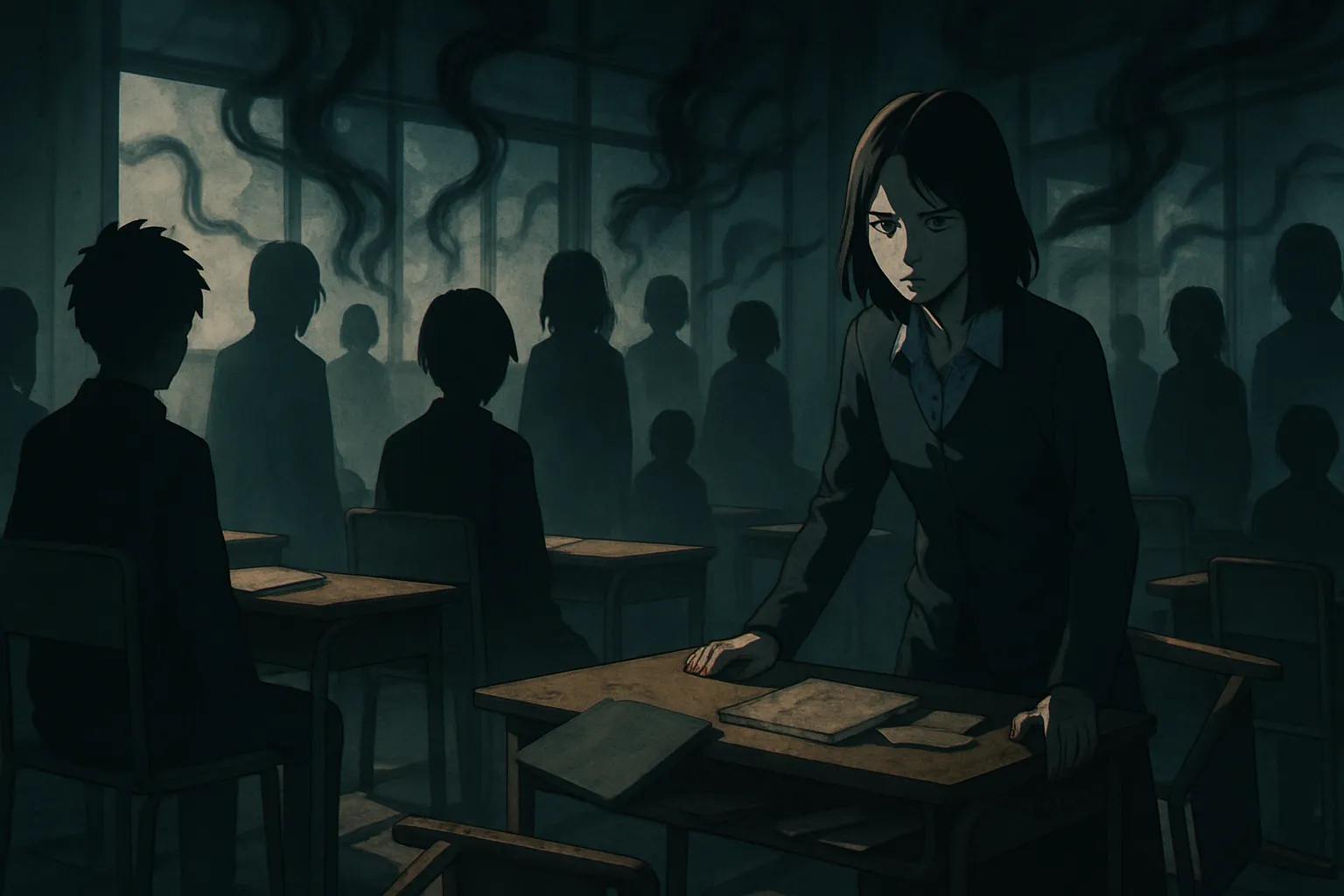
The opening classroom in Confessions (2010) looks like every other homeroom in the global education-industrial complex: fluorescent lights, bored faces, milk cartons sweating on cheap desks. Then Ms. Moriguchi does what priests, judges, and directors all do with the same gesture: she begins to speak.
She does not scold. She narrates.
Her “lesson” is a monologue that doubles as homily, indictment, and script read-through. The students, initially submerged in noise and petty revolt, slowly incline their attention toward the story of a murdered child. Attention here is not a neutral act. It is an extraction of psychic energy. It is the first tax of discipline.
Foucault long ago noticed that modern power does not merely punish; it produces subjects by arranging spaces, postures, and gazes, turning schools into “enclosed, segmented space, observed at every point” where bodies are trained and normalized (Foucault, 1995). The classroom in Confessions is this panopticon turned inside out: the inmates have learned to ignore the guard; discipline has curdled into farce; authority arrives late, as melodrama rather than rulebook.
So Moriguchi devises a more archaic technology of power: the curse.
The poisoned milk, laced with her HIV-positive husband’s blood, is less a medical threat than a symbolic virus. It infects the boys with the possibility of death, with the idea that they may have already been condemned. The point is not the epidemiological likelihood; the point is the narrative certainty. They must now live as if they were guilty, contaminated, marked.
Freud would call this the superego’s work: the internalization of an accusing voice that is at once law and sadistic enjoyment, demanding not just obedience but suffering (Freud, 1961). Moriguchi externalizes that voice for one last time, speaking it aloud so that it can burrow under their skin.
And she does it, crucially, through story.
Confession is the great Christian technology that Foucault saw at the heart of Western subjectivity, a machine for extracting truth from bodies through speech, binding them to authority by making them narrate their own guilt (Foucault, 1978). Moriguchi perverts this machine. Instead of coaxing the students to confess, she confesses to them: “I know who killed my daughter, and here is what I have done to you.”
The children are dragged into a script where they never asked for a role, but their earlier crime had already assigned them one. The film refuses to let us rest in the comfort of “they are only kids.” The boys are not passive clay. They are scriptwriters, too, directors of their own small disasters.
The homeroom is no longer a place of learning. It is a theatre of revenge. It is a factory of guilt. It is an abattoir of innocence.
Tiny Anarchists, Tiny Fascists: Kids Who Know Exactly What They’re Doing
Confessions (2010) leans hard into an unnerving thesis: the children are not naïve. They have watched the documentaries, played the games, seen the late-night specials on bullying and suicide. They know the language of trauma awareness. They know “what it means” to kill. They just don’t care.
This is not the adolescent as misunderstood angel; it is the adolescent as early adopter of a fully mediated cruelty.
Baudrillard saw late capitalism as the age in which signs no longer refer to any stable reality but circulate in self-referential loops, creating a “hyperreality” where everything—including violence—arrives already coded, already aestheticized (Baudrillard, 1994). The students’ casual jokes and shrugs in the face of Moriguchi’s grief carry this texture: murder is not an unspeakable rupture but one more clip in the endless stream.
The boys’ prankish drowning of the child is, in their minds, a scenario. A test. A hack. As if reality were a sandbox game and death only a level reset.
Žižek has described how contemporary ideology increasingly enjoins us not just to obey, but to enjoy; the superego no longer says “do your duty,” but “have fun, be yourself, realize your potential”—and then blames you viciously when that fun turns destructive (Žižek, 1989). The boys embody this twisted injunction. They pursue enjoyment (attention, stimulation, notoriety), and their environment, from school to TV, tells them they are supposed to. When the consequences arrive, they scramble to reframe themselves as victims.
The film’s most chilling gesture is not the crime, but the composure: the way the class continues to slurp milk, scribble, text, half-listen as Moriguchi calmly shreds their illusions of invulnerability. This is not ignorance; it is what Nietzsche would call the “coldest of all cold monsters”—not the state this time, but a subjectivity that knows the value of values and chooses nihilistically to cash them out anyway (Nietzsche, 1966).
They are not little anarchists in the romantic sense, tearing up an unjust order to make room for something new. They are much closer to miniature fascists of the self, experimenting with sovereignty in the most accessible currency they have: another child’s life.
The temptation is to blame “society,” “media,” “parents”—all the usual suspects. And yes, the film supplies these contexts. It shows broken homes, negligent institutions, a juvenile system that overprotects. But again and again, Confessions yanks our gaze back to the moment of decision, to the hand holding the device, the foot on the edge of the pool.
At some point, responsibility has to land somewhere. The question is where, and how many bodies it has to climb over to get there.
Oedipus with a Science-Fair Project: Child A and the Mother Who Left
Child A, the precocious bomb-maker, is offered a script ready-made by the culture: the boy genius with the cold mother, the lonely prodigy whose brilliance is unrecognized and who strikes back in spectacular violence. We’ve met him before in school-shooter lore, in techno-thrillers, even in tragic biographies of misunderstood inventors.
But Confessions refuses to let that script solidify into destiny. It shows us the contingencies.
We see the mother, a celebrated engineer, pouring her frustrated ambitions into the boy like acid, berating him when he fails to match her fantasies. We see the father’s absence, the divorce, the quiet humiliation of trophies not quite earned. The film is generous enough to outline the structural violence in which Child A’s personal cruelty is incubated.
This is where traditional psychoanalysis would pounce: the failed mother imago, the castrating woman, the boy’s drive to recover lost love by forcing the world to recognize him. The entire Oedipal pyramid could be rebuilt here: father absent, mother overwhelming, child caught in desire and rage.
Deleuze and Guattari warned, though, that such Oedipalization is precisely how the social order shrinks the vast machinic complexity of desire into a three-person melodrama (Deleuze & Guattari, 1983). Desire, they insist, is not about mommy and daddy at its core. It is about flows and connections: electricity, prestige, peer admiration, televised competitions, laboratory equipment, the juvenile legal code, the glow of the cell phone screen that will someday display his name.
Child A’s bomb is not only a symbol of his mother’s neglect; it is also a little desiring-machine plugged into the circuits of science fairs, terrorism news cycles, school hierarchies. His fantasy is not just “make mother look at me,” but “enter the grand parade of mediated catastrophe.”
Reich might say that such a boy has built a “character armor,” a rigid pattern of emotional and muscular tensions that both protect and imprison him, formed in response to chronic humiliation and blocked tenderness (Reich, 1949). The obsessive tinkering, the clenched jaw, the rehearsed disdain: all part of an armor that allows him to treat other bodies as components in an experiment.
The film is careful, however, not to declare the armor invincible. It cracks in the face of Moriguchi’s counter-experiment: the revelation that his blood, his body, his beloved bomb have been placed in a new frame. He thought he would explode himself in a glorious martyrdom, forcing the world—and especially his mother—to witness his importance. Instead, Moriguchi relocates his device under that mother’s desk.
Suddenly, the desiring-machine is forced into a different circuit. The explosion will no longer be a monument to his genius; it will be a knife in the only still-lingering point of attachment he has left.
He is left with a choice that no structural or Oedipal mythology can fully dictate: detonate or disarm, kill the mother or kill the fantasy of being finally understood. The film suspends us cruelly in that gap.
The Traumatic Freefall: When Meaning Shears Away from the Event
The essay you are reading is already haunted by your earlier question: Is a mother’s abandonment enough to “cause” a murder? Confessions answers by dismantling the notion of a direct moral causality between trauma and atrocity.
The event of the mother’s departure, like any trauma, is a naked point—too bright to look at directly. Kant, when he speaks of “radical evil,” insists that the capacity to choose against the moral law is itself rooted in our freedom; no chain of inclinations can excuse it away (Kant, 1998). The boy’s injury does not force his hand. It only rearranges the field of possible narratives.
In the moment when the mother leaves, Child A’s symbolic coordinates disintegrate. Lacan would say that the Name-of-the-Father—here less a person than the whole stabilizing structure that tells a child who he is in the family story—fails to guarantee meaning; the signifiers scatter (Lacan, 2006). He is hurled into what you aptly called “raw freedom.”
What happens then is not automatic pathology. It is improvisation.
Badiou might call this a moment of evental rupture, when the situation as structured cannot fully account for what has happened, and a subject is called to fidelity—not to the wound itself, but to a new truth that might be built in its aftermath (Badiou, 2001). For Child A, the “truth” he chooses to serve is bitter: the world is unjust, the mother is cruel, he is doomed to be misunderstood. He constructs a subjectivity of aggrieved genius and then sets about proving it in blood.
But the same raw freedom could have been seized differently. The film hints at this by juxtaposing Child A’s reaction with Child B’s breakdown: agoraphobia, self-erasure, a withdrawn implosion rather than an explosive attack. Two boys, two trajectories, same initial wound of being implicated in murder, very different uses of the cut.
Nietzsche suggested that what defines us ethically is less the suffering we undergo than the way we “interpret” and “digest” it, whether we turn it into a weapon of resentment or a spur to create new values (Nietzsche, 1994). Confessions is merciless in showing how both boys metabolize pain into fresh harm, but it never quite says they had no alternative.
Trauma, then, is not destiny. It is a vertiginous fall during which we grab for whatever narrative handholds are within reach. Some lead us back to the ledge. Some drag others down with us.
Revenge as Curriculum: The Pedagogy of Viral Guilt
What is Ms. Moriguchi teaching?
On the surface, her lesson is the most primitive law: blood for blood, child for child. She looks at a system that coddles juvenile offenders and decides to step outside of it, reintroducing the archaic lex talionis. Anarchists might cheer the refusal of bureaucratic justice; conservatives might applaud the restoration of “real consequences.”
Yet Moriguchi is not simply an avenger; she is a pedagogue. She stages a multi-phase educational program more intricate than any civics class:
Public revelation of guilt in the classroom.
Private unraveling of Child B’s household, driving his mother to a desperate murder-suicide attempt.
Strategic manipulation of Child A’s bomb fantasy, converting it into matricidal terror.
Revenge is not a single act. It is a curriculum with escalating modules.
Marx taught us that under capitalism, education is itself a kind of factory, “a production of labor-power” calibrated to produce compliant workers (Marx, 1977). Here, Moriguchi seizes that machinery and repurposes it for the production of remorse. The students, once trained to memorize formulas and recite platitudes about responsibility, are now trained to feel haunted.
But will they learn what she wants them to? Or will they simply become more sophisticated monsters?
Žižek has warned that attempts to confront people with the “truth” of their complicity often backfire, producing not genuine ethical transformation but cynical distance: “we know very well what we are doing, but still, we are doing it” (Žižek, 1989). Confessions toys with this possibility. The class’s reaction to her revelation is not pure horror; there is also morbid fascination, gossip, an almost erotic excitement at being close to a real crime.
Moriguchi’s lesson risks becoming another spectacle in the hyperreal curriculum, another story to be retold online, dramatized, memed.
And yet, there are cracks. The boy quarantined in his room, slipping into psychosis. The classmates who begin to ostracize Child A, however crudely. The mother who realizes, too late, the cost of “not knowing” her son. These are not uplifting signs of moral awakening, but they are disruptions.
Foucault argued that power is never monolithic; where there is domination, there is also resistance, often in the same gesture (Foucault, 1995). Moriguchi’s revenge-pedagogy is saturated with domination, but it also forces fissures in the smooth functioning of adolescent nihilism. She does not redeem anyone. She merely makes it harder to float.
The ethical scandal of the film may be that this is the most we can expect from pedagogy in a world where children already know the score: not salvation, not enlightenment, but blockage. A slowing of the stream of cruelty. A hesitation in the hand holding the bomb.
Postmodern Revenge: Fragmented Storytelling and the Death of the Innocent Narrator
Formally, Confessions (2010) is a fractured object. The initial classroom monologue splinters into multiple retellings, each segment re-framing the same events: from Moriguchi’s perspective, Child A’s, Child B’s, the grieving mother, the doomed girlfriend. There is no single authoritative account, only interlocking, sometimes contradictory testimonies.
This narrative strategy echoes the postmodern novels that Artur Novikau studies in his comparison of Mark Z. Danielewski’s House of Leaves and Roberto Bolaño’s 2666, where multilayered discursive structures, paratexts, and shifting voices stage a “death of the author” and a diffusion of interpretive authority (Novikau, 2025)(Novikau, 2025). Confessions borrows that logic: Moriguchi is never permitted to be the final, sovereign voice. Her confession is one discourse among many.
In this sense, the film enacts what Baudrillard would diagnose as a crisis of reference: every narrative points to another narrative rather than to some stable truth. We do not get “what really happened” in any simple sense. We get simulations of memory, rehearsed explanations, retrospective justifications.
The aesthetic effect is noir pushed through a kaleidoscope. Padraic Killeen remarks that the use of “noir” for certain contemporary films signals not just a visual style but a concern with bodies in states of passivity that are “also vivid states of transition and potency” (Killeen, 2025)(Killeen, 2025). Confessions dwells on such suspended states: the boy staring at his door, unable to cross the threshold; the classroom held in the hush after Moriguchi’s announcement; the frozen instant before a bomb might go off.
These are moments of noir stasis that are also schizoanalytic crossroads, points where multiple possible lines of flight flicker: confession, denial, breakdown, politicization, further cruelty.
The film’s refusal to choose a pure point-of-view aligns it with a postmodern skepticism toward the innocent narrator. There is no place outside the crime from which to speak. Every voice is implicated: teacher who weaponizes care, mother who abandons, student who looks away.
This is not moral relativism. It is a cartography of contamination.
Who Owns the Children? Law, Parents, or Their Own Desires
Moriguchi’s rage is directed at more than the boys. She condemns the juvenile justice system that treats fourteen-year-olds as incapable of true responsibility, the “complex bureaucratic systems intended to protect children” that now, she believes, shield them from the consequences of their cruelty.
We are back in Foucault’s territory: the shift from sovereign power (which cuts off the head) to biopower (which manages and optimizes life) (Foucault, 1978). Juvenile law is a quintessential biopolitical apparatus. It classifies young bodies as “not yet fully accountable,” subject to special regimes of correction and care. In the name of childhood, it introduces a legal category that simultaneously infantilizes and surveils.
The film asks the ugly question: at what point does this protection become license?
Marx would remind us that under capitalism, childhood itself is a kind of commodity, a sentimental resource relentlessly marketed and defended even as actual living children are fed into exploitative systems (Marx, 1977). The rhetoric of “protecting the children” often masks a deeper indifference to what those children actually do, want, or suffer.
In Confessions, parents orbit their offspring like satellites: distant, intermittently communicative, overloaded with their own economic and emotional precarity. The state, meanwhile, appears primarily as a faceless exonerator: the police who declare the drowning an accident, the laws that would shrug at the boys’ intentions.
Lacan’s bleak insight that “the big Other does not exist”—that there is no ultimate guarantor of justice or meaning—echoes through Moriguchi’s disillusionment (Lacan, 1992). She realizes there will be no grand parental, legal, or divine figure who will step in and say, “This is wrong, and it will be made right.” So she assumes that mantle herself, grotesquely.
But the film does not let her off the hook either. By taking on the role of executioner, she confirms the absence of the Other rather than repairing it. Her revenge produces no new symbolic order; it only deepens the void.
The final, bitter lesson is that no one “owns” the children—not the parents, not the state, not even their own past traumas. They are nodes in a web of desiring-machines, legible and manipulable but never fully determined.
Responsibility here is not a property to be assigned; it is a burden that flickers, shared and disowned in the same breath.
Cruelty without Excuse: The Youth of Today and the Choice to Add Terror
You end with a provocation: “The youth of today is intentionally becoming and renewing their commitment to cruelty… They are fully aware of the horrors that are embedded in their words and deeds, and yet they choose to add terror into the world as if it was a noble truth.”
Confessions (2010) stages that thesis and then warps it.
On one hand, it fully agrees: the boys are not stumbling in the dark. They are informed, media-savvy, perfectly capable of understanding the link between push and drowning, between bomb and corpse. Their nihilism is not naive; it is, in Nietzsche’s sense, a willed refusal of responsibility masked as cool detachment (Nietzsche, 1966).
On the other hand, the film suggests that this commitment to cruelty is not purely self-generated. It is constantly solicited and mirrored by the adults’ own practices: a teacher who turns her classroom into a deathtrap, a mother who tries to murder her own son, a society that treats legal loopholes as a game.
Baudrillard would say we are witnessing not a spontaneous youth pathology but the logical extension of a culture that has long treated violence as content, ethics as branding, and suffering as spectacle (Baudrillard, 1994). The kids are simply faster at downloading the update.
What, then, is left for “adults” to do, besides wring their hands?
Perhaps the only truly radical move is to interrupt the flow where we can. Not with moralizing speeches—those are already another genre in the feed—but with the kind of micro-resistances that schizoanalysis values: sabotaging the little fascisms in ourselves, refusing the cheap thrill of cruelty, cultivating sensitivities that do not immediately flip into weaponized shame.
Reich dreamed of a politics that would dismantle the “emotional plague,” the frozen patterns of resentment and fear that make authoritarianism attractive (Reich, 1949). Today, that dream looks almost utopian. But Confessions shows that another path—Moriguchi’s path of meticulously engineered revenge—leads only to more ruins.
There is no catharsis in the final scenes, no sense that justice has been done. Only more broken lives, more carefully arranged debris.
The youth of today, like the youth of every day, are offered a handful of scripts: victim, bully, genius, monster, activist, ghost. Confessions does not give them—or us—a new script. It does something more unsettling: it shows how every role can be played with full awareness and still be catastrophic.
Responsibility, then, is not about choosing the right part but about refusing, as much as we can bear, to make our pain the raw material of someone else’s horror.
In that refusal, fragile and unfashionable, another kind of confession might begin.
References
Badiou, A. (2001). Ethics: An essay on the understanding of evil (P. Hallward, Trans.). Verso. (Original work published 1993)
Baudrillard, J. (1994). Simulacra and simulation (S. F. Glaser, Trans.). University of Michigan Press. (Original work published 1981)
Deleuze, G., & Guattari, F. (1983). Anti-Oedipus: Capitalism and schizophrenia (R. Hurley, M. Seem, & H. R. Lane, Trans.). University of Minnesota Press. (Original work published 1972)
Foucault, M. (1978). The history of sexuality, Volume 1: An introduction (R. Hurley, Trans.). Pantheon.
Foucault, M. (1995). Discipline and punish: The birth of the prison (A. Sheridan, Trans.). Vintage Books. (Original work published 1975)
Freud, S. (1961). Civilization and its discontents (J. Strachey, Trans.). W. W. Norton. (Original work published 1930)
Kant, I. (1998). Religion within the boundaries of mere reason (G. di Giovanni, Trans.). Cambridge University Press. (Original work published 1793)
Killeen, P. (2025). Ecology, materialism, and transfiguration. M/C Journal.(Killeen, 2025)
Lacan, J. (1992). The seminar of Jacques Lacan, Book VII: The ethics of psychoanalysis, 1959–1960 (D. Porter, Trans.). W. W. Norton. (Original work published 1986)
Lacan, J. (2006). Écrits: The first complete edition in English (B. Fink, Trans.). W. W. Norton. (Original work published 1966)
Marx, K. (1977). Capital: A critique of political economy (Vol. 1, B. Fowkes, Trans.). Vintage Books. (Original work published 1867)
Nakashima, T. (Director). (2010). Confessions [Film].
Comments
Post a Comment