The monkey in the cage is the first philosopher of the new millennium. Clamped to the table, eyelids forced open in a bio-technical parody of the Ludovico Technique, it is not being taught to love Beethoven; it is being fed the "Absolute Survey" of the human disaster. Political protests, police brutality, the pixelated gore of the nightly news—these are not "images" in the Platonic sense, but direct injections of libidinal intensity. The activists who break in are the accidental priests of a new deterritorialization. When they "free" the monkey, they aren't releasing an animal; they are unlocking a desiring-machine that has been overcoded with the pure, distilled essence of the State’s own violence. The Rage Virus is not a disease; it is the truth of the social contract when the fine print is finally read aloud by a predator.
I. The Desolate Pavement: London as a Body-without-Organs
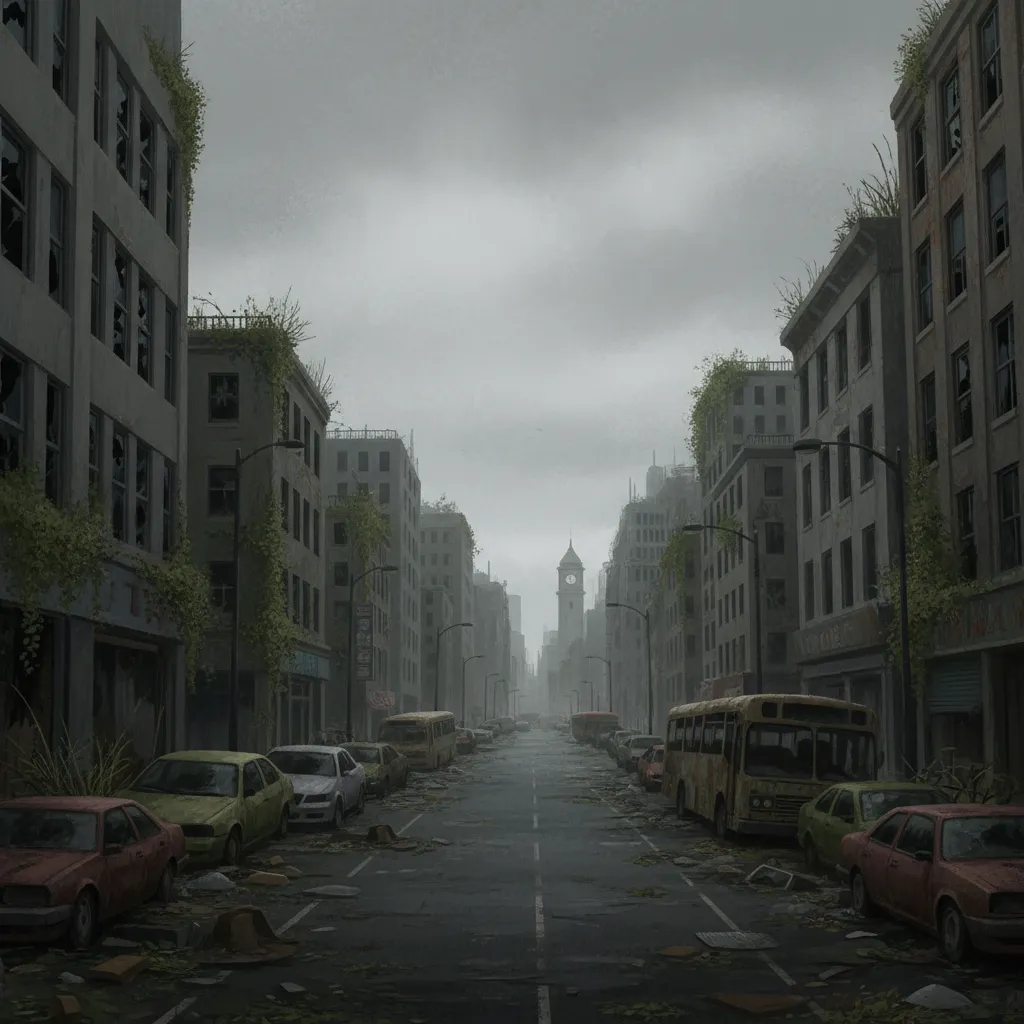
Jim wakes up into a London that has been successfully "emptied." The skyscrapers are no longer centers of capital; they are tombstones for a vanished strata. This is the ultimate "Body-without-Organs" (BwO). The city has been stripped of its molar functions—no police, no banks, no commuters, no Church. As Deleuze and Guattari (1983) remind us in Anti-Oedipus:
The BwO is not a scene, a place, or even a support on which something comes to pass. It has nothing to do with phantasy... It is the field of immanence of desire, the plane of consistency specific to desire.
Jim’s walk through the abandoned streets is the "schizo out for a walk" realized on a metropolitan scale. He picks up a wad of cash from the street—worthless paper, a signifier that has lost its signified. The "Political Economy" has collapsed into a "Libidinal Economy" of pure survival. The empty streets represent a massive "line of flight" that has gone wrong. It is a deterritorialization so total that it has left nothing but the asphalt. The "zombies"—though as the dogmatic fans point out, they are merely "Infected"—represent the pure "flow" of desire, but it is a desire that has been captured by a single, monochromatic frequency: Rage.
II. The Rage-Machine: Beyond the Dogma of the Shambling Corpse
The frustration of the Romero purists—that these "zombies" run—is a failure to understand the change in the technological apparatus. The Romero zombie was a consumer; it shambled through malls, a slow-moving critique of the sluggish, late-capitalist subject. The 28 Days Later Infected is a "user." It is fast, reactive, and hyper-connected to the environment. It is the subject of the "Society of Control" (Deleuze, 1992), where the individual is no longer a "signature" but a "dividual," a piece of data in a viral stream.
These are not "undead" in the sense of a soul-diaspora. They are "over-alive." Their metabolism is at a breaking point. They are "desiring-machines" that have been hacked. As Wilhelm Reich (1933) argued in his analysis of the fascist character structure, the suppression of natural flows leads to a "secondary drive" of pure destruction. The Rage Virus simply deletes the "inhibitory" software of civilization, leaving only the "muscular armor" and the primal scream.
The rage is a "transference" that bypasses the brain’s empathic circuits. In the film, the monkeys were forced to watch war zones. They were "becoming-war." When the human is infected, they do not "lose their mind"; they lose the scaffolding of the Mind. They become a "rhizome" of violence. They don't want to eat your brains for nourishment; they want to destroy your "Face." In schizoanalytic terms, the Infected are the ultimate anti-faciality agents. They tear at the face because the face is the landscape of the State.
III. The Priest, the Cop, and the Sublime Retaliation
Consider the image of the priest pummeling the cop. This is a "rupture" in the symbolic order. Normally, the Priest and the Cop are two poles of the same repressive apparatus: the "Internal Judge" and the "External Guard." When they collide, the "Sublime" emerges. As Peter Sloterdijk (2014) notes:
The well-constructed story of rage provides the sublime for the people... They provide satisfying proof that the modern person does not always have to travel the windy roads of resentment.
The Infected have no "windy roads of resentment." They have no "Judiciary Process." They are the "quicker form of retaliation." They are the "avengers" who have forgotten what they are avenging. This is the danger of the "Revolutionary Flow" when it lacks a "Body-without-Organs" to land on. It becomes a "Black Hole." The rage of the protester—intended to be a surgical strike against an oppressor—is transformed by the virus into a "generalized aggression" that eats its own tail.
The "Empathy Avoidance" described in the prompt is the mechanism by which we survive the news cycle. We "insta-frame" the context to lower our stress. But the virus removes the frame. It forces the subject to "feel" the rage of the monkey, the rage of the nun, the rage of the sweatshop worker, all at once, without the "slow, formal application of the rule of law." The result is not a liberated subject, but a "shattered" one.
IV. The Military-Oedipal Complex at the End of the World
When Jim, Selena, and Hannah reach the military blockade, they think they have found "Territory." They find Major West and his men. This is the "Molar" re-assertion of the State. The soldiers have created a "Refortified Zone." But what is the "libidinal" fuel of this zone? It is not "safety"; it is "Oedipus."
Major West’s plan—to use the women as "breeders"—is the ultimate "Overcoding." He wants to restart the "Family-Machine" in the middle of a graveyard. He is the "Despotic Signifier" who tries to turn the "Viral Flow" back into a "Domestic Flow." As Freud (1930) noted in Civilization and Its Discontents, the price of civilization is the "renunciation of instinct." West demands this renunciation from his men, but only so he can monopolize the "instinct" for himself.
Jim’s escape and subsequent "becoming-infected" (without the virus) is the "Revolutionary" turn. Jim doesn't need the virus to Rage; he just needs to "deterritorialize" his own humanity. When he hunts the soldiers in the rain, he is moving as a "nomad." He uses the "smooth space" of the forest to dismantle the "striated space" of the mansion. He becomes the "monster" to destroy the "General." This is a "War Machine" (Deleuze & Guattari, 1987) that has been turned against the "State Apparatus."
V. The Post-Modernization of the Zombie: Peanut Butter and Signifiers
Is the word "zombie" dead? The prompt asks if the "Post-Modernization" has destroyed its usefulness. If we look at the "Epic Chart" of zombies—demon zombies, emo zombies, alive zombies—we see a "Multiplicity." The "Signifier" (the word 'zombie') is sliding all over the "Signified" (the actual creature).
But this is exactly how "Desire" works. Desire is "multifarious." It does not care about "Dogma." The Romero fans are like the "Psychoanalysts" who insist that every dream must lead back to the Father. They want the "Zombie" to always be a "Signifier" of the "Social Corpse." But 28 Days Later says: "No, the zombie is a Signifier of the Neural-Network."
If it quacks like a zombie and eats brains like a zombie—or in this case, vomits blood like a zombie and runs like a track star—then the "Context and the Label" are in sync. The "Peanut Butter" is the "Violence." The "Jar" is the "Film." The "Label" is "Rage." To argue over the "Purity" of the zombie is to fall back into "Kantian" categories of "Transcendental Logic" that have no place in a world of "Viral Immanence."
VI. The Final Walk: From Resentment to the Great Health
Nietzsche (1887) spoke of "Ressentiment"—the reactive "no" of the weak. The Infected are not "weak" in this sense; they are "Pure Affirmation" of a "Pure Negative." They are the "Great Health" gone cancerous. They represent a world where the " judicial civilization" has finally been outrun by the "Thymotic Emotions."
The "28 Days Later" structure—the flash-forward to a "desolate and abandoned London"—is the "Zero Point" of the Schizoanalysis. It is the moment where the "Social Factory" stops. The tragedy of the film is not the virus; the tragedy is the "Rescue" at the end. The jet flying overhead, the "HELLO" sign made of sheets—this is the "Re-territorialization" by the "Global State." They are being brought back into the "Molar" world of "28 Days Later... and then back to work."
The "Post-Modern" zombie is the "Zom-B-Real" (to borrow from Cypress Hill/Manson's aesthetic). It is the realization that the "Social" was always a "Viral" construct. We were always "Infected" with the "Signifiers" of the State. The Rage Virus just gave us the "Speed" to catch up with our own "Extinction."
"It is not the slumber of reason that engenders monsters, but vigilant and insomniac rationality." (Deleuze & Guattari, 1983).
The "Rage" is the "insomniac rationality" of the monkey, watching the TV, realizing that the only "Line of Flight" left is to "Chew Through the Cage."
References
Badiou, A. (2001). Ethics: An Essay on the Understanding of Evil. Verso.
Baudrillard, J. (1983). In the Shadow of the Silent Majorities. Semiotext(e).
Deleuze, G. (1992). Postscript on the Societies of Control. October, Vol. 59.
Deleuze, G., & Guattari, F. (1983). Anti-Oedipus: Capitalism and Schizophrenia. University of Minnesota Press.
Deleuze, G., & Guattari, F. (1987). A Thousand Plateaus: Capitalism and Schizophrenia. University of Minnesota Press.
Freud, S. (1930). Civilization and Its Discontents. Hogarth Press.
Nietzsche, F. (1887). On the Genealogy of Morals. Vintage Books.
Reich, W. (1933). The Mass Psychology of Fascism. Orgone Institute Press.
Sloterdijk, P. (2014). Rage and Time: A Political Investigation. Columbia University Press.
Žižek, S. (2008). Violence: Six Sideways Reflections. Picador.
Comments
Post a Comment