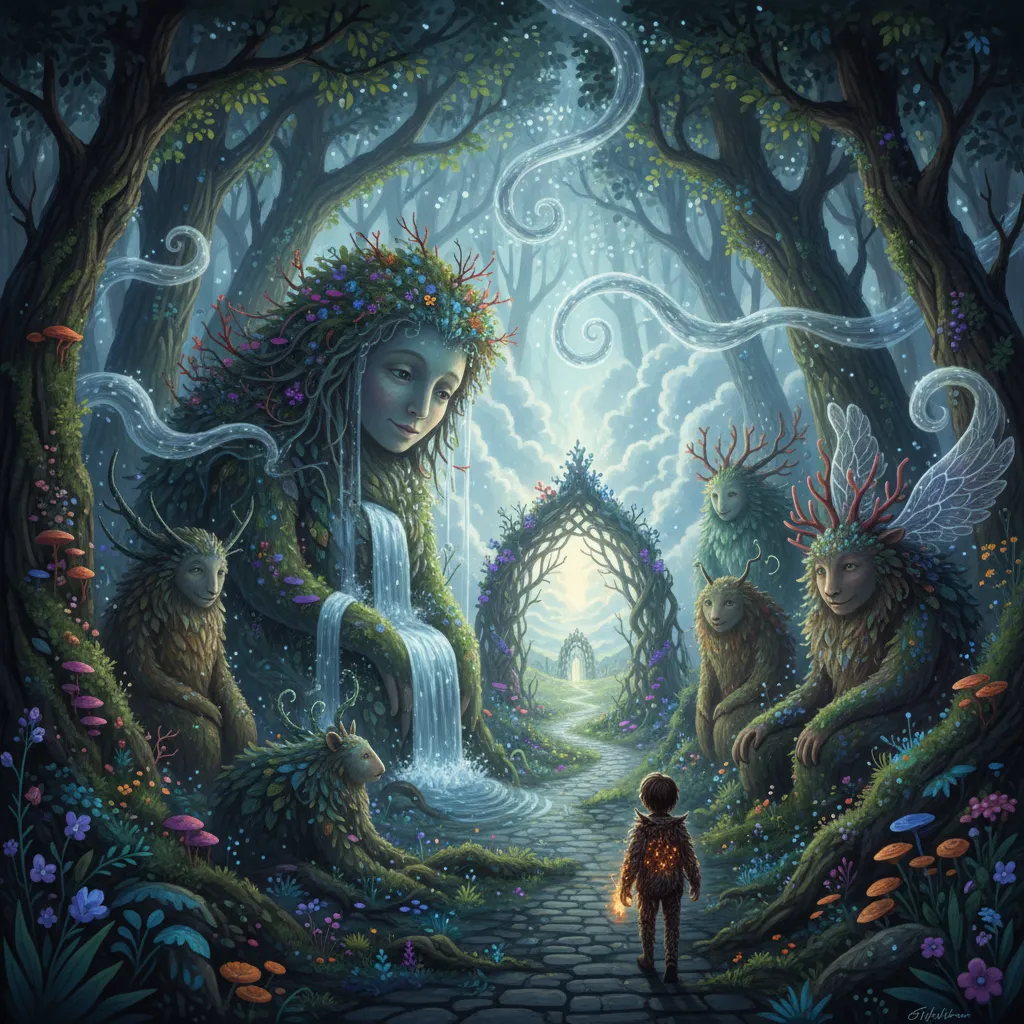
Spike Jonze's 2009 film Where the Wild Things Are transcends its origins as a beloved children's book to offer a profound cinematic exploration of the tumultuous inner world of childhood. It delves into the raw, uncodified flows of desire that animate a young boy's imagination, portraying it not merely as an escape, but as a vibrant battleground where nascent subjectivity confronts the stratified realities of the adult world. The film invites a deep dive into the psychological and philosophical undercurrents of youthful rebellion, the search for belonging, and the complex interplay between fantasy and reality. Indeed, Jonze's adaptation moves beyond a simple retelling, becoming a cinematic exploration of the child's machinic unconscious, where the Wild Things are not just projections but fully realized desiring-machines in their own right. This perspective, which a film scholar might elaborate upon, highlights how the film's medium amplifies the philosophical concepts of desire, power, and the construction of self, making the Wild Things more complex and emotionally resonant than their literary counterparts.
Max's journey to the land of the Wild Things can be understood as a molecular insurrection against the Oedipal structures of his domestic life. His dissatisfaction with the established order of adults and siblings propels him into an imaginative realm where the very fabric of reality is rewoven by the raw, uncodified flows of desire. This analysis will explore how Max's "bad behavior" and subsequent adventure represent a deterritorialization from the constraints of his home, a temporary immersion in a Body-without-Organs, and a complex re-engagement with the world.
I. The Oedipal Home as a Stratified Machine: Max's Molecular Rupture
Max's initial environment is a meticulously constructed oedipal machine, a domestic apparatus designed to channel and contain the unruly flows of childhood desire within predetermined familial and social circuits. His home, with its rules, expectations, and the subtle, often unconscious, power dynamics between mother, sister, and child, functions as a territoriality that seeks to "recode, to rechannel persons who have been defined in terms of abstract quantities" (Deleuze & Guattari, 1983, p. 46). Max's "bad behavior"—his wolf-suit antics, his biting, his defiant screams—are not merely childish tantrums; they are molecular ruptures, micro-insurrections against the molar organization of his family unit. These acts are the "explosive" manifestations of desire, capable of "calling into question the established order of a society" (Deleuze & Guattari, 1983, p. 16), even if that society is initially confined to the kitchen table.
His mother's attempts to discipline him, to "put him in his place," are the mechanisms of stratification, seeking to impose order upon the chaotic flows of Max's burgeoning subjectivity. This familial drama, seemingly benign, is a microcosm of the larger societal processes where "desire is repressed... because every position of desire, no matter how small, is capable of calling into question the established order" (Deleuze & Guattari, 1983, p. 16). Max's frustration, his feeling of being misunderstood, can be understood through R.D. Laing's concept of ontological insecurity. He experiences a profound "despair[ing] efforts... to put his disintegrated self and world together again" (Laing, 1960, p. 22), a sense that his authentic self is not recognized or validated within the existing relational structures. This insecurity drives him to seek a world where his being can be affirmed, even if that affirmation comes from the monstrous projections of his own psyche. As Laing notes, some individuals are "not fighting to win an argument, but to preserve her existence: in a way, Julie was not simply trying to preserve her existence, she was trying to achieve existence" (Laing, 1960, p. 195), a struggle that resonates deeply with Max's own quest for self-affirmation. Complementing this, insights from child development and attachment theory, such as John Bowlby's work, suggest that a child's perceived lack of secure attachment can lead to behavioral expressions of distress and a search for alternative sources of security. From this perspective, Max's "bad behavior" is often a desperate communication of unmet needs, a signal of a perceived threat to the security of their attachment bonds, driving them to seek compensatory experiences in fantasy or alternative relationships. This links Max's wolf-suit antics and defiance not just to a Deleuzian rupture, but also to a developmentally understandable response to perceived emotional neglect or misunderstanding within his family unit.
The wolf suit itself is a desiring-machine, a prosthetic extension of Max's will to power and escape. It is not merely a costume but a line of flight, a temporary deterritorialization from his human form and the constraints it implies. Donning the suit, Max sheds the "anthropomorphic and anthropological armoring" (Deleuze & Guattari, 1983, p. 12) of the "good child" and taps into a more primal, animalistic flow of desire. This is a direct challenge to the character armor that society attempts to impose, the "habitual defense mechanisms [that] harden into a social identity, blocking authentic emotional and desiring flow" (Reich, 1949, p. 150). Max's refusal to be "good" is a refusal to accept the muscular armor of compliance, a desperate attempt to keep his desiring-production unblocked. His flight from home, a literal and metaphorical journey across a "raging waters of the sea" (Jonze, 2009), is the ultimate act of deterritorialization, a plunge into the unknown where the "fortress totters and succumbs" (Jonze, 2009) to the immense strength of his own unchained desires. This act of escape is a desperate attempt to avoid becoming "congealed for a moment into someone definite" (Laing, 1960, p. 131), a fear of being fixed and defined by the external world.
II. The Island as Body-without-Organs: The Wild Rumpus and the Production of Desire
Max's arrival on the island of the Wild Things marks a radical shift from the stratified Oedipal home to a provisional Body-without-Organs (BwO). This island is a "plane of consistency" where the usual social codes and hierarchies are initially dissolved, giving way to a raw, unmediated expression of desiring-production. The Wild Things themselves are magnificent desiring-machines, each a unique assemblage of affects, drives, and intensities. They are "a combination of various elements and forces of all types" (Deleuze & Guattari, 1983, p. 16), embodying the "nonhuman in man, his desires and his forces" (Deleuze & Guattari, 1983, p. 12). Their monstrous forms, their guttural sounds, their unpredictable emotional swings—from destructive rage to tender affection—are the uncodified flows of the BwO made manifest.
The scene of the exploding buildings is the quintessential moment of pure desiring-production, a schizophrenic breakthrough that shatters the repressive forces of the molar world. This is not mere destruction; it is a joyous, collective act of deterritorialization, where the rigid structures of civilization are dissolved into a chaotic, yet intensely productive, flow of energy. The Wild Things, in their collective "rumpus," are "content to be objective, merely objective: they know that desire clasps life in its powerfully productive embrace, and reproduces it in a way all the more intense because it has few needs" (Deleuze & Guattari, 1983, p. 21). This is the "awesome schizophrenic accumulation of energy or charge" (Deleuze & Guattari, 1983, p. 46) that capitalism constantly seeks to inhibit, yet simultaneously allows free rein. For a brief, exhilarating period, the Wild Things exist in a state of uninhibited flow, their "muscular armor" (Reich, 1949, p. 150) completely dissolved in the ecstasy of collective creation/destruction. This destructive phantasy, unchecked by reality, can rage on "until the world and the self are reduced, in phantasy, to dust and ashes" (Laing, 1960, p. 87), a perfect description of the Wild Rumpus. Furthermore, post-structuralist interpretations of childhood and play could be explored here, suggesting that childhood play, far from being mere escapism, constitutes a vital 'heterotopia' where the rules of the adult world are suspended, allowing for the radical re-imagining of social and subjective formations. This perspective reinforces the idea of the island as a space of resistance, where Max and the Wild Things engage in a form of play that actively challenges and reconfigures established norms, making the Wild Rumpus not just a chaotic outburst but a politically charged act of becoming.
Max, in declaring himself king, initially attempts to reterritorialize this BwO. His proclamation, "I'm a king!" (Jonze, 2009) is an act of imposing a new molar structure onto the molecular chaos. The Wild Things, in their own ontological insecurity and desire for a guiding force, readily accept him. They are "without autonomy" (Jonze, 2009), having "never... developed ways of their own" (Jonze, 2009), and thus are susceptible to the imposition of a new order. This dynamic reflects the constant tension in schizoanalysis between the liberating potential of deterritorialization and the inherent tendency towards reterritorialization, where "everything returns or recurs: States, nations, families" (Deleuze & Guattari, 1983, p. 46). Max, the child-king, becomes the new despotic machine, attempting to channel the wild flows of desire into a system he can control. This mirrors the way a person can be seen "not as a person but an organism" (Laing, 1960, p. 23), stripped of their personal agency and reduced to a functional component within a system.
III. The King's Armor and the Neuroticization of the Wild
Max's reign as king, however, quickly reveals the inherent contradictions of imposing a molar order onto molecular flows. His attempts to "master" the Wild Things, to establish rules and maintain control, are the very mechanisms of neuroticization. He promises to create a world where "only good things happen" (Jonze, 2009), a utopian vision that immediately clashes with the Wild Things' inherent nature as desiring-machines, whose flows include aggression, sadness, and destructive impulses. Max's lies, his inability to truly understand or manage the complex emotional landscape of his subjects, lead to a new form of character armor—his kingly persona—which, paradoxically, isolates him. He becomes trapped within the "residual or artificial territorialities" (Deleuze & Guattari, 1983, p. 46) of his own making, reducing the vibrant, multifaceted desires of the Wild Things to a simplified, oedipalized framework where he is the benevolent (or sometimes tyrannical) father figure.
The Wild Things, in turn, begin to exhibit symptoms of their own divided selves and ontological insecurity. Carol's destructive outbursts, Judith's anxieties, KW's withdrawal—these are not merely character traits but expressions of their struggle against Max's imposed order. They are "petrified into a 'thing', too terror-stricken to become a person" (Laing, 1960, p. 46) when their authentic desiring-flows are stifled or misunderstood. Max's inability to provide the "tangible love, as violent as the sea itself" (Jonze, 2009) that they truly need, leads to a growing sense of alienation and resentment. The initial "pure, genuine act" of their souls pouring out to him, their "truly needing" him (Jonze, 2009), begins to curdle under the weight of his inadequate kingship. This dynamic is a clear manifestation of the "divided self," where "the imaginary self breaks in pieces and disappears at contact with reality, yielding its place to the real self. For the real and the imaginary cannot coexist by their very nature" (Laing, 1960, p. 86). The Wild Things, like Julie in Laing's case studies, are struggling for their "true possibilities [which] were being smothered, strangled, murdered" (Laing, 1960, p. 195) by Max's rigid expectations.
This dynamic mirrors the "banking education" model, where Max, as the "depositor," attempts to fill the "receptacles" of the Wild Things with his own ideas and rules, rather than engaging in a transformative dialogue (Freire, 1970, p. 58). He seeks their "worship, and submission" (Jonze, 2009), rather than their genuine participation in the co-creation of their world. This imposition of a singular perspective, however well-intentioned, ultimately leads to a "death-in-life" (Laing, 1960, p. 131) for the Wild Things, a state where "there was no hope, no future, no possibility" (Jonze, 2009) for their uncodified desires. The island, once a vibrant BwO, begins to re-stratify under Max's rule, becoming a new form of Oedipal territory, albeit one of his own design. The "great nausea, the will to nothingness, nihilism" (Nietzsche, as cited in Deleuze & Guattari, 1983, p. 15) threatens to engulf the kingdom as the initial joy of deterritorialization gives way to the despair of re-territorialization. The Wild Things, in their struggle, are like the patient who feels "guilty 'simply at being in the world in the first place'" (Laing, 1960, p. 131), their very existence questioned by the imposed order.
IV. The Limits of Reterritorialization and the Return Journey
The inevitable breakdown of Max's kingship is a testament to the inherent resistance of desiring-machines to permanent stratification. The Wild Things, in their collective and individual expressions of discontent, demonstrate that "desire is explosive; there is no desiring-machine capable of being assembled without demolishing entire social sectors" (Deleuze & Guattari, 1983, p. 16). Max's attempts to control their flows, to impose a narrative of "goodness" and "happiness," ultimately fail because they deny the full spectrum of their desiring-production, including their capacity for aggression and sadness. The "porous or seeping triangle" (Deleuze & Guattari, 1983, p. 99) of his makeshift kingdom cannot contain the escaping flows of desire.
Max's decision to return home is not a defeat, but a crucial moment of re-evaluation and becoming. It is a recognition of the limits of his own reterritorializing impulse and an acknowledgment of the need for a different kind of connection. His journey back across the "raging waters" (Jonze, 2009) is a process of integrating the deterritorializing experience of the island with the stratified reality of his home. He has experienced a form of "ego-loss" (Laing, 1960, p. 131) and the forging of a "collective subjectivity" with the Wild Things, even if that subjectivity was fraught with conflict. This experience, though challenging, serves as a "healing process" (Deleuze & Guattari, 1983, p. 15, citing Laing), allowing him to move beyond the "oedipalized and neuroticized individual dependencies" (Deleuze & Guattari, 1983, p. 15) that initially drove him away. He has learned that "personal relatedness can exist only between beings who are separate but who are not isolates" (Laing, 1960, p. 28), a profound lesson in the balance between individuality and connection.
His return is a re-entry into the Oedipal home, but with a transformed subjectivity. He has traversed the "desert of the body without organs" (Deleuze & Guattari, 1983, p. 130) and, though he "fail[s] to complete the process" of pure deterritorialization, he has gained a new understanding of desire, power, and connection. This is the essence of the "schizophrenic process," which is "inseparable from the stases that interrupt it, or aggravate it, or make it turn in circles, and reterritorialize it into neurosis, perversion, and psychosis" (Deleuze & Guattari, 1983, p. 289). Max's journey is a cycle of deterritorialization and reterritorialization, each iteration creating a "new land" (Deleuze & Guattari, 1983, p. 289) within his own psyche. He has confronted the "split between phantasy and reality" (Laing, 1960, p. 87) and, by returning, begins the difficult work of integrating these two realms, preventing his "self whose relatedness to reality is already tenuous [from becoming] less and less a reality-self, and more and more phantasticized" (Laing, 1960, p. 87).
V. The Lotus Blossom and the Endless Process of Becoming
Max's return to his mother, to a warm meal and a comforting embrace, signifies not a regression, but a re-territorialization on new terms. The Oedipal home, though still a stratified machine, is now re-entered by a subject who has experienced the raw, uncodified flows of desire and the complexities of collective desiring-production. The initial despair and alienation have been confronted by the vibrant, if chaotic, life of the Wild Things. Max has learned that "if his roots are in the current of life he will float on the surface like a lotus and he will blossom and give forth fruit" (Deleuze & Guattari, 1983, p. 16).
The film's ending is not one of simple resolution, but of becoming. Max has not eradicated the Oedipal structures, nor has he permanently escaped them. Instead, he has engaged in a schizoanalytic stroll, a "line of escape or breakthrough" (Deleuze & Guattari, 1983, p. 288) that has allowed him to "cause flows to circulate, to traverse the desert of the body without organs" (Deleuze & Guattari, 1983, p. 130). His experience with the Wild Things has provided him with a nascent critical consciousness (Freire, 1970, p. 81), an understanding of the power dynamics inherent in relationships and the importance of authentic connection over imposed control. He has moved beyond the "abdication of ecstasy, the betrayal of our true potentialities" (Laing, 1960, p. 14) that often characterizes "normal" adjustment, embracing a more authentic, if complex, self.
The "process is everything" (Deleuze & Guattari, 1983, p. 16). Max's journey is an affirmation of desiring-production as an "endless, eternal process" (Deleuze & Guattari, 1983, p. 16). The Wild Things, as externalized aspects of his own desiring-machines, have taught him that true connection lies not in mastery or repression, but in the acceptance of the full, untamed spectrum of desire. The film, therefore, is a profound meditation on the molecular insurrection of childhood, a poetic exploration of how the "schizophrenic out for a walk" can, through associative leaps and deterritorializing flows, re-imagine and re-engage with the stratified world, transforming despair into a renewed capacity for life and connection. The "real toads invade the imaginary gardens... and ghosts walk in the real streets" (Laing, 1960, p. 87), signifying that the boundaries between Max's inner and outer worlds have become permeable, allowing for a richer, more complex engagement with reality.
References
Deleuze, G., & Guattari, F. (1983). Anti-Oedipus: Capitalism and schizophrenia (R. Hurley, M. Seem, & H. R. Lane, Trans.). University of Minnesota Press. (Original work published 1972)
Fischer, P. (2012). Douglas R. Clark, Larry G. Herr, Øystein S. LaBianca and Randall W. Younker (eds): The Madaba Plains Project: Forty Years of Archaeological Research into Jordan's Past. Norwegian Archaeological Review, 45(1), 129–132.
Freire, P. (1970). Pedagogy of the oppressed. Herder and Herder.
Hopwood, N. (2011). Book Review: Social Work and the Body. Qualitative Health Research, 21(9), 1295–1296.
Jonze, S. (Director). (2009). Where the Wild Things Are [Film]. Warner Bros. Pictures.
Laing, R. D. (1960). The divided self: An existential study in sanity and madness. Tavistock Publications.
Reich, W. (1949). Character analysis. Orgone Institute Press.
Stanford, J. (2015). Towards an Activist Pedagogy in Heterodox Economics: The Case of Trade Union Economics Training. Journal of Australian Political Economy, (76), 233.
Comments
Post a Comment