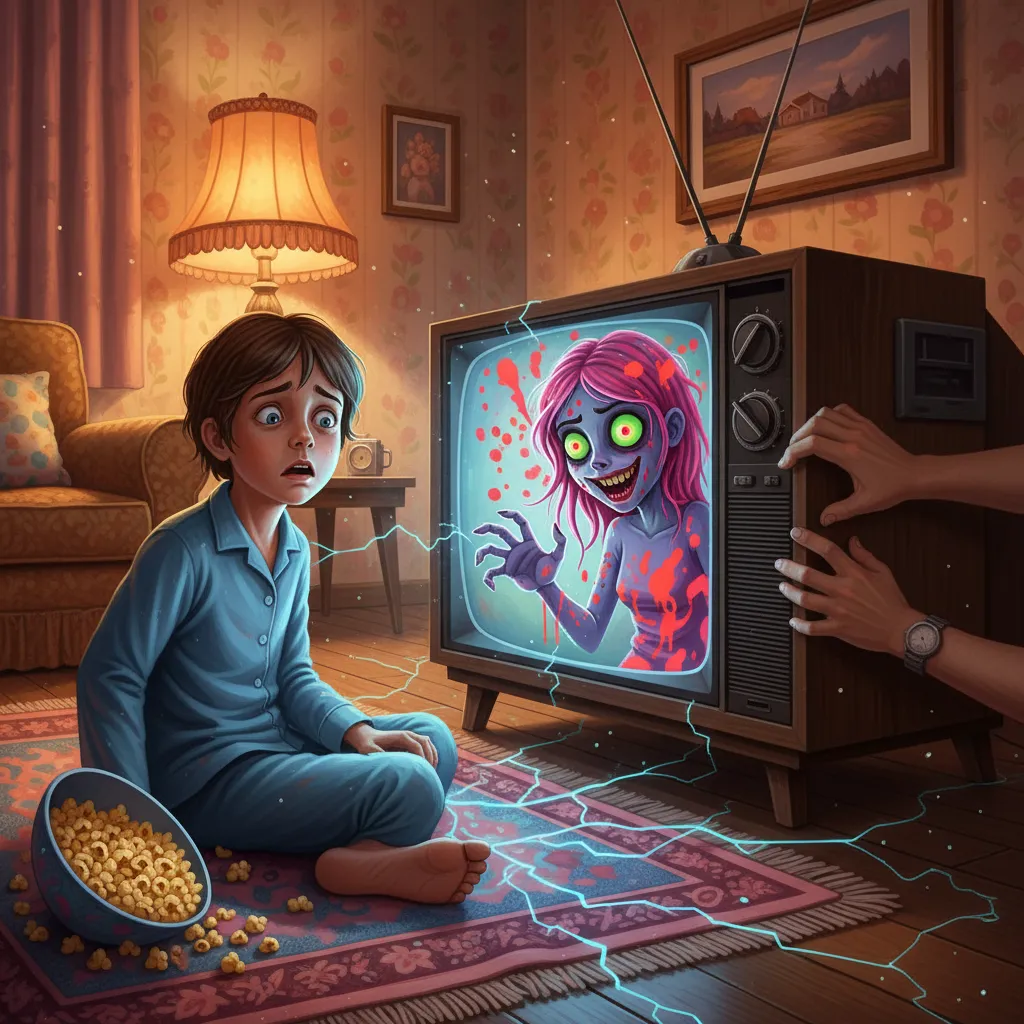
Imagine this: You’re seven, eating soggy popcorn in a bubble of Saturday night TV security, when a bloodied zombie girl lurches onto the screen. The world’s rules shudder. Annoyed parents, who promised this was ‘just a movie’, fumble to switch the channel. But the rupture is done: you’re not in Kansas anymore (not that you ever were—Kansas is a state of mind). This is more than a jump-scare. It’s a psychic earthquake, the membrane between comfort and monstrosity now terrifyingly thin. This is not a post about zombies being scary, but about how their horror scrambles our inner architecture, demanding answers from the stories we didn’t know we were telling ourselves. Let’s take a look at why absolutely nothing is safe—and why that’s oddly liberating.
Section 1: The Cinematic Membrane—Why Living Rooms Feel Unsafe
The concept of the cinematic membrane sits at the heart of schizoanalytic readings of trauma in horror cinema. This membrane is not just the physical screen separating the viewer from the film; it is a fragile psychological boundary that maintains the illusion of safety within the living room. According to "The Necro-Aesthetic and the Schizo-Threshold: Trauma as the Desiring-Machine of Ontological Permeability (2025)," horror films—especially those featuring the zombie—are uniquely equipped to destabilize this membrane, exposing viewers to a sudden and profound sense of vulnerability.
The author’s anecdote of encountering a blood-stained zombie girl on television before the age of ten illustrates this rupture. The living room, usually a space of routine comfort—filled with the predictable rhythms of news, sports, and sitcoms—suddenly becomes a site of ontological crisis. The zombie image does not respect the boundaries of the screen or the psyche. Instead, it invades the domestic sphere, shattering the expectation that horror is safely contained within fiction.
This moment is not simply about being startled; it is about experiencing what the text calls an ontological rupture. The viewer’s sense of reality is momentarily destabilized. The living room, once coded as safe, is revealed to be permeable and unpredictable. This is the trauma of ontological insecurity, as theorized by Laing: the realization that the world can transform into something monstrous without warning.
The Body-without-Organs (BwO) is a key concept here. The sudden appearance of the zombie is a violent cut through the body’s habitual organization—its routines, defenses, and expectations. Trauma, in this sense, is not a deficit but a molecular surge that disrupts the stratified self. The living room’s collapse is the collapse of psychic order, a moment when the self is forced to confront the world’s capacity for radical change.
It is important to note why bland horror movies fail to achieve this effect. When a horror film does not rupture the cinematic membrane—when it merely recycles clichés or relies on predictable scares—it fails to produce real psychic disturbance. Instead of triggering an ontological crisis, it only tests the viewer’s patience. Genuine horror, by contrast, is defined by its ability to break through the membrane, to force the viewer into a new relationship with reality.
The contrast between routine and disturbance is central. The living room, with its familiar programming, represents the coded world—the Oedipal home, as the text puts it. The zombie, as a necro-aesthetic sign, is the decoded flow that refuses containment. Its intrusion is a reminder that safety is a construct, always at risk of collapse.
In sum, the cinematic membrane is a metaphor for the boundaries we rely on to feel secure. Horror films, at their most effective, threaten these boundaries and reveal the living room as a space of potential ontological rupture. The suddenness of trauma, the collapse of the BwO, and the psychic disturbance caused by the zombie all point to the same truth: the world is never as safe or as stable as it seems.
Section 2: Blood-Stained Girls, Schizo-Gothic Subjectivity, and the Birth of the Necro-Aesthetic
The figure of the blood-stained girl stands as horror cinema’s most potent necro-aesthetic sign. In the schizoanalytic reading found in The Necro-Aesthetic and the Schizo-Threshold, this image is not just a trope, but a rupture—a visual event that tears through the “cinematic membrane” and destabilizes the viewer’s sense of reality. The blood-stained girl, with her vacant stare and crimson-soaked dress, is more than a character; she is a signifier of ontological crisis, a living wound that marks the collapse of everyday meaning.
To illustrate this, the author invents a memory: “I was under ten, and she appeared in the blue flicker of the living room. Nightmares followed—her face pressed against the window, her hands leaving red smears on the glass. I could not recall if this was a dream or a memory. The living room, once safe, now felt porous, as if she might step through at any moment.” This blending of fantasy and memory is not accidental. It demonstrates how horror images, especially those as charged as the blood-stained girl, bypass rational defenses and etch themselves into the psyche as traumatic flows.
This process gives rise to what the text calls schizo-gothic subjectivity. Here, the self is split—caught between the desire for safety and the thrill of collapse. The horror genre, especially zombie cinema, acts as a desiring-machine that produces a divided self. The viewer is both terrified and fascinated, experiencing what Laing described as the “disequilibrium of an otherwise safe living room.” Trauma, in this context, is not simply a wound but a force that creates new psychic arrangements. The blood-stained girl is the ambassador of this schizo-threshold, inviting the subject to inhabit a space where boundaries are always at risk of being breached.
Philosophically, zombies are described as “decoded flows”. They are bodies stripped of social meaning, reduced to pure appetite. Unlike vampires, who maintain a sense of seduction, hierarchy, and even romance, zombies are the ultimate proletariat—driven only by the urge to consume. The blood-stained girl, as a zombie or revenant, embodies this loss of meaning. She is not a villain with a plan, but a force of nature, a reminder that the structures we rely on (family, home, identity) can be swept away in an instant.
This raises a provocative question: Is loving horror secretly a love for losing one’s psychic footing? The text suggests that the “satisfying thrill” of horror is not about desensitization, but about embracing the collapse of certainty. To love the blood-stained girl is to love the possibility of rupture—to find pleasure in the very thing that threatens to undo the self.
As a side note, the text observes that vampires never quite trigger the same rupture as zombies. Vampires are coded, aristocratic, and seductive; they play by rules, even if those rules are dark. Zombies, and especially the blood-stained girl, are pure deterritorializing flux—engines of chaos that refuse all systems. The necro-aesthetic, then, is born at the moment when horror ceases to be about monsters and becomes about the collapse of meaning itself.
Section 3: Character Armor and Psychic Reconfiguration—Growing Up with Horror
The journey from childhood terror to adolescent fascination with horror is not a simple path of getting used to scary images. According to The Necro-Aesthetic and the Schizo-Threshold: Trauma as the Desiring-Machine of Ontological Permeability (2025), this transformation is a process of psychic reconfiguration, shaped by both personal experience and cultural forces. The text uses the metaphor of "ten years between viewings" to illustrate how the initial shock of horror—like the sudden appearance of a "blood-stained girl" zombie—gets re-encoded over time. The first encounter, especially in early childhood, is raw and unfiltered: a pure, contextless trauma that disrupts the safe boundaries of the living room and the self.
As the years pass, this trauma does not simply fade. Instead, it is layered over with what Wilhelm Reich called Character Armor. This armor is the psyche’s way of building protective layers after a shock. It is not just about forgetting or ignoring the horror; it is about absorbing it into a new structure of self. Imagine the adolescent who, instead of doing homework, hoards stacks of horror DVDs—each disc a piece of cultural armor, a way to systematize and contain the chaos first unleashed by that early zombie image. The living room, once a site of ontological rupture, becomes a personal archive of horror, now organized and catalogued.
This process is deeply influenced by what the text calls the Oedipal archive. Family, tradition, and culture all work to contain the threat of horror’s chaos. Parents might explain away nightmares, teachers might rationalize fear, and society as a whole codes horror as mere fantasy. The adolescent’s growing library of horror films and philosophical texts is not just a collection—it is a symbolic defense, a way of re-territorializing trauma within the safe boundaries of the home and mind. The "safe living room" depends on this coding, on the ability to manage and explain away what once felt monstrous and unpredictable.
But does rewatching scary movies mean we have grown stronger, or simply more creatively defended? The text suggests two main defense strategies: numbing and phobia formation. Numbing is the act of pushing the zombie girl into the realm of fantasy—"Zombies aren’t real"—while phobia is the hardening of psychic armor, redirecting fear into more manageable anxieties. Both strategies reflect the divided self described by Laing, where reality is mediated by persistent defenses.
There is, however, a strange pride that comes with being able to laugh at horror now. The second encounter with the zombie, years later, is not just less frightening—it is thrilling. This signals what the text calls a "becoming-minoritarian," a shift from terror to critical consciousness. The adolescent, now armed with a library of horror and theory, can see the cracks in the "safe living room" and recognize the artificial boundaries that once seemed so solid. In this way, trauma is not just survived; it is integrated, becoming a source of new meaning and possibility.
Section 4: Numbing Out and Phobia Formation—Defense Strategies in a Haunted World
When the living room collapses under the weight of the zombie’s arrival, the psyche scrambles for safety. The text, “The Necro-Aesthetic and the Schizo-Threshold,” explores two classic defense strategies that emerge in response to the trauma of ontological rupture: numbing and phobia formation. Both are attempts to restore order after the “cinematic membrane” is shattered by the undead, but they take radically different forms.
Numbing: Making Zombies Just Fantasy
Numbing is the mind’s way of containing the threat. After the initial shock—like the author’s childhood encounter with the “blood-stained girl” zombie—numbing steps in as a rationalizing voice: “Zombies aren’t real. If people die, they stay dead.” This is not simply forgetting; it is a deliberate act of re-territorialization, as described in the text. The traumatic image is pushed into the realm of fantasy, boxed up and labeled as “just a movie.” This process is a psychic suture, transforming the raw, destabilizing flow of the zombie into something manageable and safe.
In schizoanalytic terms, numbing is a form of containment. It allows the ego to patch up the breach in the “body-without-organs” (BwO) and return to the predictable routines of daily life. The living room, once again, feels secure—at least on the surface.
Phobia: Living with Constant Tension
Phobia is the opposite strategy. Instead of minimizing the threat, the mind organizes itself around it. The trauma is not metabolized but contained through rigidity and vigilance. The text gives the example of the author, who, well into their teens, compulsively checked behind every door for zombies—just in case. This is the “hardening of muscular armor” that Wilhelm Reich described: the psyche builds up layers of tension, always on alert for the next rupture.
Phobia often shifts focus. The original trauma may have been zombies, but the anxiety might settle on spiders, closets, or the dark. The world becomes a minefield of potential threats, and daily life is shaped by avoidance and ritual. This is a classic sign of what R.D. Laing called the Divided Self: a person split between the desire for safety and the persistent fear that safety is an illusion.
Containment vs. Tension: Two Sides of Defense
- Numbing = Containment: The threat is boxed up, rationalized, and distanced.
- Phobia = Tension: The threat is ever-present, and the body/mind is always braced for impact.
Both strategies are attempts to manage the trauma of ontological rupture, but neither truly resolves it. Instead, they create a divided, anxious self—one that is either numb and disconnected or tense and hyper-vigilant.
When Defenses Mirror Horror Tropes
A curious phenomenon arises: sometimes, people’s defenses begin to resemble the very horror movie tropes that triggered them. The author’s ritual of checking doors echoes the classic “final girl” checking closets in slasher films. Others might adopt routines that mimic the logic of horror cinema—never walking alone at night, avoiding basements, or keeping lights on. These behaviors are not just personal quirks; they are cultural scripts, shaped by the same necro-aesthetic forces that haunt the screen.
In this haunted world, defense strategies become part of the narrative space trauma opens up. Whether through numbing or phobia, the psyche is always negotiating with the undead at the threshold of the living room.
Section 5: Becoming-Minoritarian—The Satisfying Thrill of Integrating Trauma
In "The Necro-Aesthetic and the Schizo-Threshold," the journey from terror to thrill is not simply a matter of getting used to horror. Instead, it marks a deep transformation in how trauma is experienced and understood. The first encounter with the zombie—especially the iconic "blood-stained girl"—is a raw shock, a sudden rupture in the safe, coded world of the living room. This moment, described as an ontological rupture, shatters the illusion of everyday safety and exposes the viewer to the unpredictable, monstrous potential of reality. The living room, once a symbol of comfort, becomes permeable—a site of BwO-Permeability where the boundaries of self and world blur.
From Terror to Thrill: What Changes on the Second Viewing?
On the second—or hundredth—viewing, something fundamental shifts. The initial terror is replaced by a satisfying thrill. This is not desensitization, but a process of becoming-minoritarian. The viewer no longer tries to contain or rationalize the trauma. Instead, they begin to integrate it, recognizing the rupture as a source of creative energy. The zombie is no longer just a monster; it becomes a symbol of the Deterritorializing-Flux, a force that challenges all fixed meanings and safe routines.
Freirean Critical Consciousness: Trauma Exposes the Fiction of ‘Normal’ Safety
Drawing on Freire’s theory of critical consciousness, the text argues that trauma reveals the constructed nature of "normal" safety. The living room’s comfort is shown to be a product of both political and psychic architecture—a carefully maintained fiction. Trauma, in this sense, is not a deficit but a catalyst. It forces the subject to question inherited narratives and opens up new possibilities for understanding and action. The Schizo-Threshold is crossed when the subject recognizes that the world is not as stable or predictable as it seemed.
Invented Scenario: Rewriting Family Horror Stories
Imagine the protagonist, once terrified by the zombie’s intrusion, now sits in the same living room and rewrites their family’s horror stories. The living room, instead of being a fortress against the outside world, becomes a site of micro-revolution. Each retelling of the trauma is an act of creative resistance, a refusal to let fear dictate the boundaries of reality. The protagonist learns to love the necro-aesthetic as a sign of possibility, not just threat.
The Ethical Imperative: Love for Trauma as Love for Creative Flux
The text insists on an ethical imperative: to love trauma is to love the creative flux it brings. This means rejecting both the numbing comfort of rationalization and the rigidity of phobia. Instead, the subject is called to embrace the becoming-revolutionary flow—to allow trauma to unsettle and transform them. In this way, the zombie, as the ultimate Abstract Machine, becomes a guide to living with openness and permeability, rather than fear and defense.
- Key Point: The thrill of integrating trauma is the thrill of becoming open to new realities.
- Ethical Stance: Embracing the flux means refusing the comfort of permanent defenses and welcoming the unknown.
Section 6: Deterritorializing Flux—Zombies as Abstract Machines and the Escape from Capitalist Order
In the schizoanalytic framework developed in "The Necro-Aesthetic and the Schizo-Threshold," zombies are not simply metaphors for fear or social breakdown. Instead, they function as engines of anti-capitalist desire, embodying what Deleuze and Guattari called Abstract Machines. These machines are not bound by the familiar codes and routines that structure everyday life under capitalism. The zombie’s mindless hunger is not just a threat; it is a force that cuts across all established boundaries, disrupting the order that keeps the living room—and by extension, the psyche—safe and predictable.
The Abstract Machine concept is crucial here. Zombies, as depicted in horror cinema, operate outside the logic of profit, productivity, or even survival. Their relentless drive is not for accumulation or status, but for a pure, unmediated consumption. This “face-chewing” appetite is a decoded flow, stripped of all social function, as the text argues. In this sense, zombies represent a radical alternative to the capitalist order, where bodies and desires are organized for maximum efficiency and control.
Thought Experiment: A Zombie-Organized World
To push this idea further, imagine a world not run by CEOs or managers, but by zombies. What would such a society look like? There would be no PowerPoint presentations, no quarterly reports, and certainly no strategic planning meetings. Instead, there would be a collective, undirected movement—a swarm of bodies, each following its own singular drive, yet moving together in a kind of chaotic harmony. The usual hierarchies and routines would collapse, replaced by a deterritorializing flux that resists all attempts at control.
This scenario, while humorous, reveals something important: the zombie horde is a model for existence beyond imposed order. Their refusal to cooperate with dull routines is not just frightening; it is secretly admirable. The author confesses to a kind of envy for the zombie’s ability to break free from the “character armor” that culture builds around us. In their mindless persistence, zombies expose the artificiality of the codes that govern our lives.
‘Loving Rupture’ and the Body-Without-Organs
The text introduces the idea of a “loving rupture”—the moment when trauma, embodied by the zombie, shatters the safe boundaries of the living room. This rupture is not simply destructive. Instead, it opens up the possibility of becoming a new kind of being: the Body-without-Organs (BwO). This is a state of existence free from the stratifications and routines imposed by family, work, and society. The zombie’s deterritorializing flux becomes an invitation to embrace chaos, to let go of the need for order, and to experience desire in its raw, unfiltered form.
“Zombies are not just monsters; they are the ultimate abstract machines, engines of a desire that refuses to be coded, managed, or contained.”
In this way, the zombie is not only a figure of horror but also a symbol of liberation—a force that allows us to imagine life beyond the capitalist order, where trauma is not an end, but a beginning.
Conclusion: Why We Need Ontological Ruptures (And Why, Oddly, Zombies Are Good for Us)
Returning to the living room—the symbolic space of comfort, routine, and familial safety—the text The Necro-Aesthetic and the Schizo-Threshold asks us to consider why we are drawn to its collapse. The sudden arrival of the zombie, smashing through the “cinematic membrane,” is not just a cheap thrill or a moment of fear. It is an ontological rupture: a break in the ordinary, a forced encounter with the unpredictable. This moment, as the author’s childhood experience shows, is not simply about terror. Instead, it is the beginning of a transformation, both psychic and political.
Why do we secretly crave this collapse of safety? The living room, with its news, sitcoms, and predictable rhythms, is a carefully coded space. It promises order, but also limits our sense of what is possible. The zombie, as a necro-aesthetic sign, tears open this space, exposing the artificial boundaries that keep the world manageable. In the shock of the undead’s arrival, the self is destabilized, but also offered a chance to see beyond the “Oedipal home”—the psychic and social structures that keep us contained.
Trauma, in this schizoanalytic framework, is not just a wound to be numbed or a source of phobia to be managed. Instead, it is an opportunity for reinvention. The initial terror gives way, over time, to what the author calls a “satisfying thrill.” This is not desensitization, but a process of integrating the rupture, of learning to live with—and even celebrate—the collapse of certainty. As the text argues, discomfort is the beginning of transformation. Whether in cinema, politics, or the psyche, it is only when the safe boundaries are breached that new forms of consciousness and desire can emerge.
Imagine, then, a therapist who prescribes not avoidance, but engagement: “Watch two zombie films, call me in the morning.” This wild card approach recognizes that horror, and the trauma it stages, can be a tool for growth. By facing the collapse of the living room, viewers are invited to confront the constructedness of their own safety and to experiment with new ways of being. The zombie, as the ultimate “decoded flow,” models a life beyond rigid codes and character armor—a deterritorialized existence open to change.
Ultimately, the text calls for an ethical embrace of ontological rupture. Rather than retreating into numbness or rigid fear, we are urged to integrate the lessons of trauma, to let discomfort open up narrative space for reinvention. The zombie, far from being just a monster, becomes a symbol of the possibility of becoming—of breaking free from the limits of the familiar and stepping into the flux of the unknown. In this way, the collapse of the living room is not an end, but a beginning: the first step toward a more permeable, liberated self.
TL;DR: Zombies aren’t just cheap scares. Through the lens of schizoanalysis, their horror rips open the psychic membrane, confronting us with the instability of our comfort zones—and, with luck, teaching us to embrace the creative destruction of trauma rather than simply surviving it.
Comments
Post a Comment