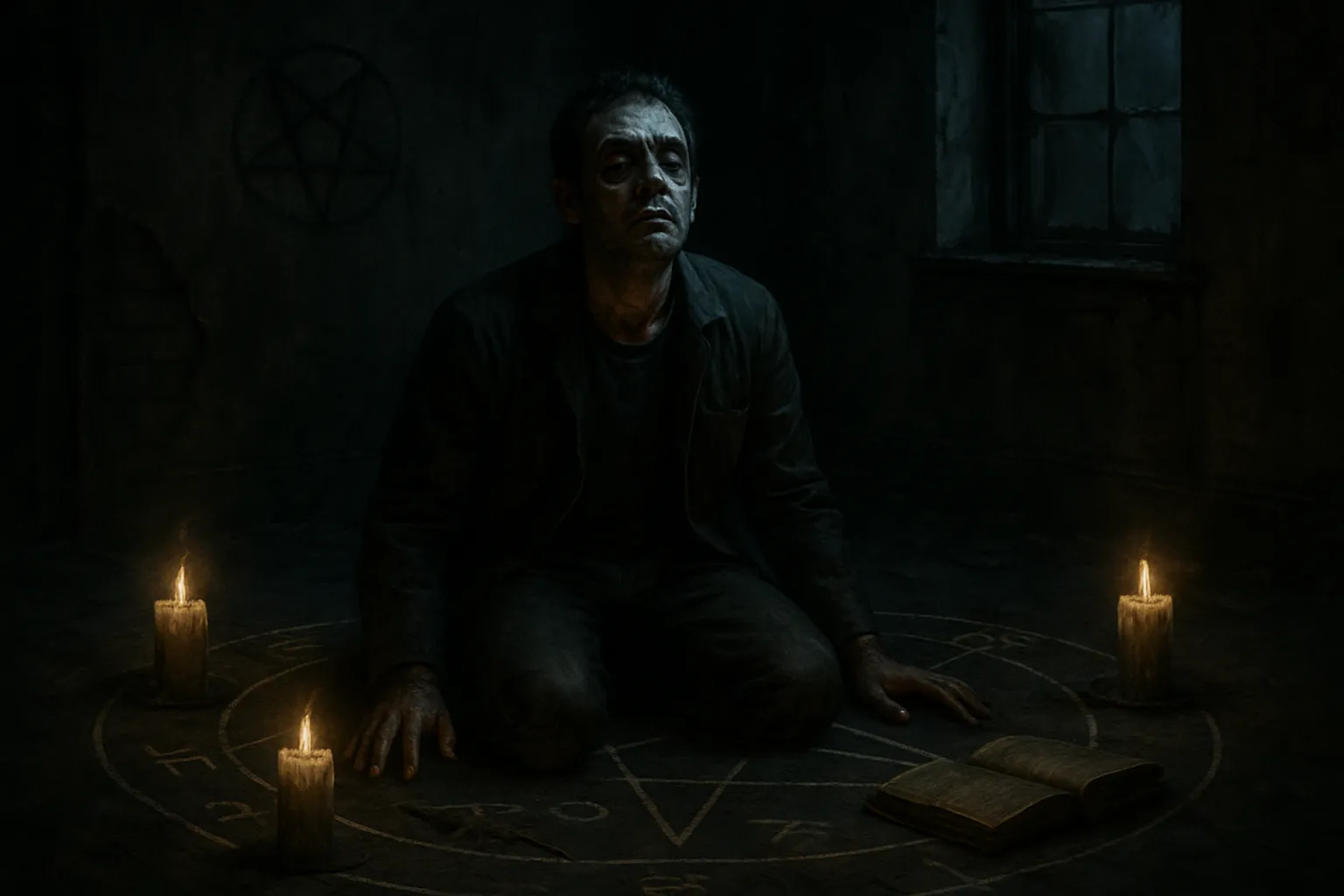
The refusal to believe is never a neutral space, but an intensive point of negation, immediately subject to the capture of the largest, most ravenous ideological machines operating on the social field.
The Schizo-Process of Skepticism: Documenting the Uncodable
Michael King begins as an anomaly, an ungrateful flow that refuses to segment itself into the familiar theological strata. His declared intent—to film a documentary aimed at "ousting the supernatural"—is not merely skepticism; it is an attempted line of flight from the great socio-theological machine. He believes he can expose the metaphysical as a mere projection of the human desiring-machine, asserting that the only truth is the immanent, visible, filmable real. This gesture, however, is immediately captured by the very thing it seeks to deny: the cinematic apparatus itself. His camera becomes a desiring-machine aimed at anti-production, attempting to cut away the theological from the real flow, only to reveal that the real is already saturated with the potential for schizo-rupture.
The initial picnic scene—a saccharine image of heteronormative family bliss—is the territorialized space par excellence. The wife's playful challenge, "If only you believed in god," followed instantly by the lightning strike of the car crash, is the Event. This contingency is the pure, indifferent chaos of the Body without Organs (BwO) (Deleuze & Guattari, 1987), manifesting as a meaningless accident. The wife's death deterritorializes Michael's life-flow; his former reality, grounded in luck and rational skepticism, disintegrates.
His documentary project shifts from debunking to deliberate self-subjection, moving from the molar apparatus of science to the molecular flows of the occult. He seeks out every demonic ritual, every form of black magic, not because he is a believer, but because he needs to re-stratify the chaos of the car crash with an imposed, deliberate structure. The trauma of the uncodable has left a void, a psychotic break in the signifying chain, and he attempts to plug this gap with the most extreme signifiers of evil. He substitutes ontological anxiety (the meaninglessness of random death) with ideological certainty (the certainty of personalized, supernatural malice). This is the very essence of the ideological fetish, where the void of the Real is sealed by an object or signifier of total belief (Žižek, 1989).
The Absurdist Axiom and the Suicidal Ethical Act
The cinematic atheist archetype often serves two functions in the face of the abyss: conversion or the suicidal ethical act. Both arcs are traps laid by the dominant ideological machine to recuperate the flow of unbelief.
Michael King's initial philosophical position, even if unarticulated in the film, aligns with the absurdist framework that identifies life as inherently arbitrary, a "tautology" (1=1), where existence is unqualified by value. Camus famously located the one truly philosophical problem in suicide, arguing that all ideological narratives are structures of thought that deny properly knowing this arbitrariness. The atheist, caught in the flow of the arbitrary, lives in the perpetual tension of choice: to live is to actively choose life in spite of oblivion.
"To live is to keep the absurd alive. Keeping it alive is, on the contrary, contemplating it... The absurd is born of this confrontation between the human need and the unreasonable silence of the world." (Camus, The Myth of Sisyphus, 1991, p. 32)
However, Michael's trajectory cancels the true absurdist gesture of revolt (living in spite of the absurd) and instead follows the cinematic route of conversion followed by self-cancellation. The film, in its ideological structure, forces the atheist into the ultimate submission: not only must he acknowledge the existence of the metaphysical, but he must destroy his own life flow to preserve the life flow of his daughter. The film, in this sense, is an Oedipal machine designed to recuperate the desiring-flow back into the familial unit—the nucleus of conservative axiomatics. His self-grenading (like the noble suicide in I Am Legend) is an ideological compromise: the atheist gets to commit a nominally "noble" existential act, but only after being fully converted to the system he was meant to oppose, thus demonstrating the necessity of belief for true sacrifice.
The Politics of the Heart and the Anti-Communist Machine
The film's most insidious layer operates through the political economy of fear. The Possession of Michael King utilizes a reactionary politics of the heart, asserting that the skeptical surface of the atheist hides a true, underlying evil. This cinematic logic parallels the socio-political rhetoric of the Red Scares, where conservative positions successfully marketed the idea that communists and anarchists, despite their talk of social good, were secretly motivated by a desire to "take your freedom of religion and choice away from you."
This is the ideological function of the film: to de-liberalize the subject. It is a morality play, an explicit effort to instill a reactionary fear that pushes the viewer toward conservative "family values" and heteronormativity as the only territorialized space safe from the molecular menace of the occult (or, politically, the leftist threat).
As Roche identifies in his analysis of The Hills Have Eyes (2006), the liberal coward (Doug, the "peace loving hippie") must be forced to become a "real man"—a gun-toting, reactionary subject—to survive. Michael King's journey is a psychic version of this de-liberalization. He moves from the weak-willed liberal reliance on science (therapy, skepticism) to the ultimate, violent, self-mutilating conservatism of the self-exorcism. The pentagram carved on his chest is the inscription of the demonic/anti-social into the flesh, a visible marker proving the conservative axiom that sin is literal and must be violently expelled.
The moment Michael confronts the occult practitioners who initiated the possession—and they deny the reality of their own magic, claiming they merely believed it was fake—is the pinnacle of this schizophrenic flow. As Michael becomes convinced of the Real (the demon), he loses the support of the very ideological flows (the occultists) that brought him to this point. He is entirely deterritorialized, stripped of his initial skepticism and now unable to find stable ground in the very counter-machine he sought to employ. He is left alone on the BwO, screaming, "I am sane, I am not depressed," as the demon, the externalized political and theological terror, completes the final capture.
"The delirium is the attempt to live on the BwO, to follow the lines of flight, but when the Socius re-territorializes, it does so through the most terrifying axiomatic: the forced inscription of a code of pure suffering onto the body." (Deleuze & Guattari, Anti-Oedipus, 1983, p. 191)
The demon is not just a spiritual entity; it is the pure axiomatic flow of conservative ideology, which demands the conversion and annihilation of the skeptical flow. It is the political force wrapped in the rhetoric of the preacher, designed to protect the contributions (political and spiritual) of the Christological desiring-machine.
Conversion, Annihilation, and the Re-Inscription of Desire
Michael’s final act of self-exorcism and subsequent suicide achieves a total axiomatization of his desire. He began by trying to master the flows of desire (through the camera's lens) but ends up fully captured. His suicide is not the defiant, life-affirming act of Camus's rebel, but the final, tragic fulfillment of the Big Other's law. He dies believing, thus proving that the only way out of the crisis of faith is faith itself, even unto death.
This serves the primary function of the Christological machine: to annul the ontological threat of the atheist. Alain Badiou's concept of the Event suggests that a true revolutionary rupture creates a new truth, forcing the subject to be faithful to it. Michael's wife's death was the Event, but instead of generating a new, atheistic truth of immanent life, the film forces him back to the pre-existing, transcendental truth machine (Christianity). His death is the final re-stratification, confirming the Christian narrative's monopoly on sacrifice and nobility.
The film's message about life in the United States, therefore, is devastatingly clear: skepticism is a dangerous luxury (Roche, 2017). The cinematic landscape mirrors the political landscape, where competing realities disintegrate the ability to clarify perspective, and the Truth becomes a matter of power in numbers, or the most effective ideological machine. We are forced to choose between the random violence of the meaningless car crash (which breaks the pattern) and the deliberate violence of the demon's design (which provides a pattern). The Possession of Michael King aggressively dictates that we must choose the latter, trading the terror of the empty BwO for the terrifying, but comprehensible, possessed body—a body that has been successfully re-coded by the machine of fear and faith.
APA References
Badiou, A. (2005). Being and Event. (O. Feltham, Trans.). Continuum.
Camus, A. (1991). The Myth of Sisyphus and Other Essays. (J. O'Brien, Trans.). Vintage Books.
Deleuze, G., & Guattari, F. (1983). Anti-Oedipus: Capitalism and Schizophrenia. (R. Hurley, M. Seem, & H. R. Lane, Trans.). University of Minnesota Press.
Deleuze, G., & Guattari, F. (1987). A Thousand Plateaus: Capitalism and Schizophrenia. (B. Massumi, Trans.). University of Minnesota Press.
Foucault, M. (1995). Discipline and Punish: The Birth of the Prison. (A. Sheridan, Trans.). Vintage Books.
Lacan, J. (2007). Écrits: The First Complete Edition in English. (B. Fink, Trans.). W. W. Norton & Company.
Marx, K. (1988). Economic and Philosophic Manuscripts of 1844. In D. McLellan (Ed.), Marx: Selections. Oxford University Press.
Nietzsche, F. (1968). The Will to Power. (W. Kaufmann, Ed., & W. J. Hollingdale, Trans.). Vintage Books.
Roche, D. (2017). Making and Remaking Horror in the 1970s and 2000s: Why Don't They Do It Like They Used To?. University Press of Mississippi.
Žižek, S. (1989). The Sublime Object of Ideology. Verso.
Comments
Post a Comment