The cinematic surface, usually a smooth plane for the inscription of commodity-signs and predictable narrative flows, is occasionally ripped open by the unbearable intensity of the human machine pushed past its breaking point.
The Mask as Commodity-Signifier and the Failure of Emotional Flow
The slasher film operates on a strict, almost Kantian, categorical imperative: the killer must be silent, masked, and emotionally dead. This silence is not merely a stylistic choice; it is an ideological necessity, a successful stratification of the terror-flow into a manageable, marketable signifier. The mask—be it Jason Voorhees’s hockey shield or the Ghostface shroud—is a commodity-sign par excellence (Baudrillard, 1994). Its value resides not in its use, but in its absolute hegemony over the category of fear. The moment a consumer sees a hockey mask outside its original context, the entire apparatus of Friday the 13th—the silent malevolence, the poorly lit woods, the sexual punishment—is instantly summoned. The product (the mask) has achieved a cultural and symbolic monopoly over the idea (the specific brand of horror), making any deviation feel like a betrayal of the mass production model of fear.
This stratification forces the slasher genre into a structural repetition that Deleuze and Guattari would identify as a failed desiring-machine, endlessly recycling the same segments and territorializations without generating true difference. The "hollow character" of the silent killer is the necessary condition for this marketing success; emotional complexity would deterritorialize the reliable consumption of the product. Emotion is a molecular flow, unstable and singular; silence is a molar signifier, stable and replicable.
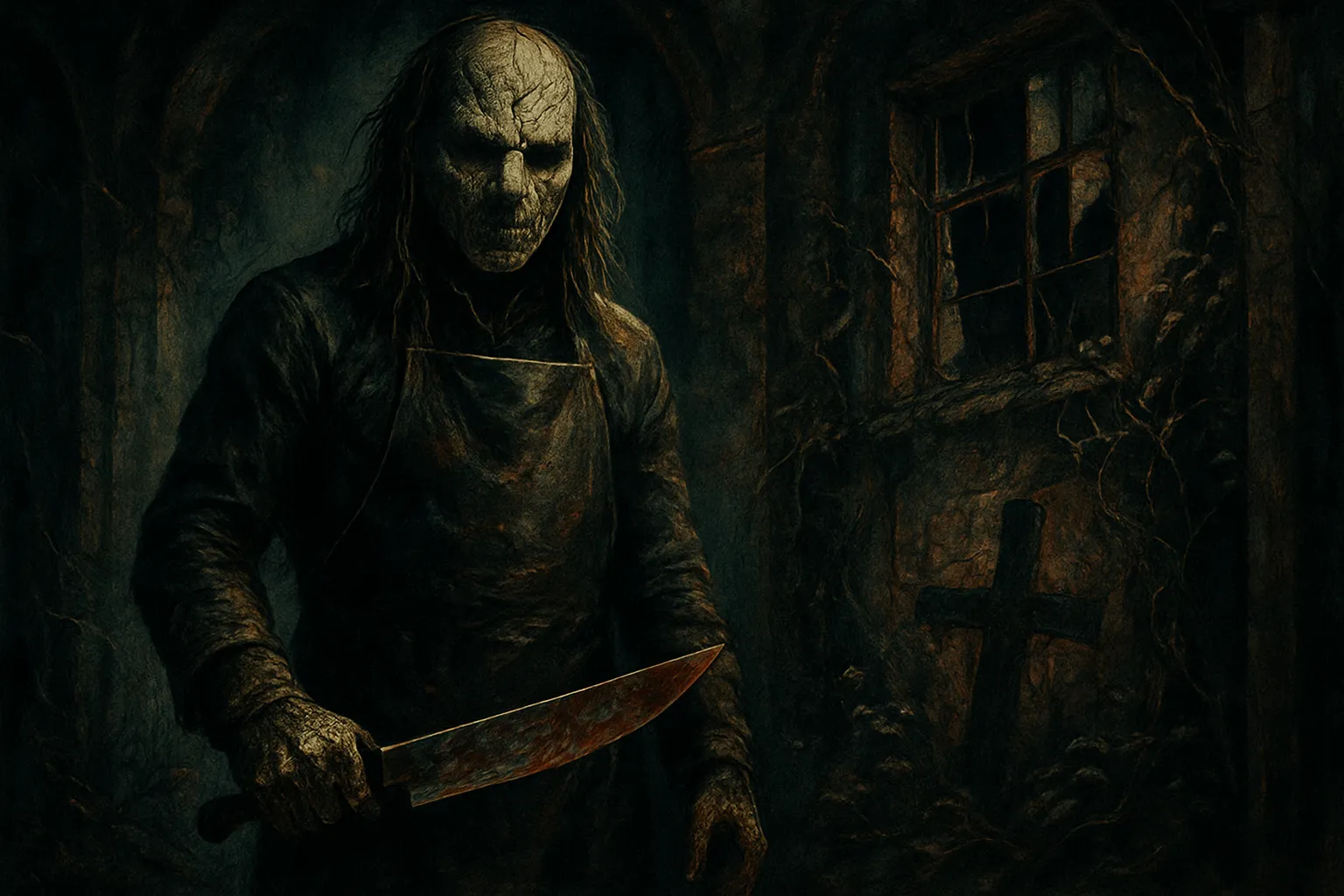
The Orphan Killer (2011) shatters this axiom precisely by injecting raged flows directly into the cinematic machine. Marcus Miller (the killer) does not hide behind silence; his rage, articulated through brutal action and the backing track of death metal, becomes the unmuffled flow of desire. This rage is a line of flight from the established slasher protocol, transforming the genre from a machine of repetitive spectacle into a volatile apparatus of intensive psychological discharge. His emotion is not a defect; it is the schizo-process made explicit, demanding the viewer confront the source, not just the symptom, of the violence.
The Institutional Desiring-Machine
Marcus Miller is not born; he is produced by the institutional desiring-machine of the Catholic orphanage. This setting is a disciplinary apparatus, a Foucauldian space of control and normalization where bodies and souls are meant to be docile and useful (Foucault, 1995). The "Religious Child Maltreatment" he endures is the violent stratification of his libidinal flows. It is not a single traumatic Event (like the death of a parent), but a prolonged exposure to systemic abuse, a process that produces Complex-PTSD.
This difference—from Post-Traumatic Stress Disorder (PTSD) to Complex-PTSD—is the molecular key to the film's schizoanalysis. PTSD is often tied to a specific break, a segment of the past that can potentially be re-integrated, or at least avoided. Complex-PTSD, however, is a prolonged, intensive assault that permanently deterritorializes the subject's self-organization. It means the trauma is not an external event that happened to the subject, but an internal process that is the subject. The orphanage, therefore, is not merely a bad location; it is the factory of the killer, the social machine that wires the child's desire-flow to the final output of violent retaliation.
The killer’s mask, then, ceases to be a signifier of commodified horror and becomes the character armor (Reich, 1949) made visible. Wilhelm Reich argued that character armor is a chronic muscular rigidity built up against the body's natural energetic and emotional flows, a psychosomatic defense against unbearable reality. Marcus’s mask and his uniform of butchery are the externalized armor of his institutional trauma, allowing the flow of his rage to bypass any sense of reciprocal recognition with the victim. He is not attacking individuals; he is attacking the residual memory of the institution inscribed into the face of every victim.
"The Body without Organs is produced, not given. It is the limit of the socius, the plane of consistency on which everything runs, where the organs—the stratified identities—are undone and rearranged by the desiring-machines." (Deleuze & Guattari, Anti-Oedipus, 1983, p. 150, modified)
Marcus is a pure machine of anti-production, generated by the failure of the Oedipal machine (the lack of parental love) and the violence of the Christological machine (the abusive priests/nuns). He is the BwO in its raw, destructive intensity, where his organs (his actions) are entirely dedicated to the destruction of the social strata that created him.
The Sibling Circuit
The relational dynamic between Marcus (the killer) and Audrey (the final girl) is where The Orphan Killer fundamentally subverts the generic slasher formula. The mystery is annulled early on, meaning the film skips the lengthy narrative spiral devoted to establishing Oedipal history and relational dynamics. This abolition of mystery is a decisive schizo-analytic move.
In most slashers, the killer's motivation is a deferred knowledge, the traumatic kernel that must be revealed to re-establish symbolic order (Lacan, 2007). In this film, the motivation—sibling rivalry and shared institutional trauma—is established as the active, intensive circuit of the narrative flow. Both Marcus and Audrey share the same source-trauma, but their lines of flight run in opposite directions.
Audrey represents the attempt to re-territorialize herself through conventional, "ripped" discipline—physical strength, psychological preparedness, and a clear understanding of the antagonist. She is not the helpless hottie awaiting her fate; she is an equally potent flow. This creates an equivalent pairing of forces that deterritorializes the viewer’s expectation of easy victimhood. She is the becoming-revolutionary within the circuit, using the disciplined stratification of her body (the gym, the training) not for capitalist fitness, but for survival against the molecular violence of her brother.
Their confrontation operates as a Nomadic War Machine (Deleuze & Guattari, 1987). It is a violent, intensive struggle fought outside the striations of the Oedipal Law. The War Machine is defined by its exteriority to the State apparatus (the Socius) and its use of smooth space—the abandoned halls, the darkened spaces of the former orphanage. Marcus and Audrey move through this smooth space, engaging in a molecular battle that is less about good vs. evil and more about the inevitable collision of two flows generated by the same traumatic source machine. The stakes are not just life and death; they are the determination of which code—the killer’s rage or the survivor’s resilience—will finally conquer the BwO they both share.
The Fear of Knowing
The traditional slasher relies on the fear of the unknown, the terrifying void behind the silent mask. This fear serves an ideological function—it pushes the unknown into the forefront so that the subject is perpetually anxious about the origin of the threat, rather than the nature of the threat. The silence ensures the slasher remains an abstraction, a pure Force of Law that punishes transgression without having to justify itself.
The question "Why is it that slashers have traditionally gone with the strong silent type?" is answered by the need to protect the Oedipal narrative. The silent killer is the repressed father, the punitive superego, who enforces the Law of the Father without having to admit his own chaotic desires or traumatic history.
Marcus, in his rage, is the unmuffled symptom of the Oedipal failure. His explicit anger, fueled by death metal and physical exertion, forces the viewer to confront the known—the specific, unforgivable trauma of religious abuse. The horror shifts from the existential dread of the unknown to the sociological terror of knowing the exact mechanism by which society produces its monsters.
The subtext of the strong silent type is indeed a subversion of feminine desire, as the initial text suggests, offering a dark reflection: Is this the desired male archetype? Strength and silence are the trauma's shield, and what instigates that silence is a history of violence that the consumer of the archetype may not want to uncover. The film, by replacing silence with rage, demands that the subject confront the origin, pushing the terror out of the abstract unknown and into the concrete, political economy of the body.
The Political Economy of Trauma
The analysis of horror films as "republican Grimm’s Fairytales"—morality plays designed to scare the viewer into reactionary individualism, conservative "family values," and heteronormativity—is a potent flow. The slasher genre, particularly in its silent form, is inherently conservative. It punishes transgression (sex, drugs, impiety) and upholds the strict axioms of the social order.
The Orphan Killer initially seems to follow this flow: the rage originates in the failed family unit and the corrupt institution, implying that the true, successful stratification is the traditional family. However, the film deterritorializes this political subtext through the figure of Audrey. Her strength and independence—her ability to fight outside of the protection of a male figure or traditional structure—is itself an unacceptable flow in a true conservative morality tale. She is the unrecuperated flow of feminine independence.
But the final irony remains: both the killer and the survivor, Marcus and Audrey, are defined entirely by the Institution (the orphanage). Their entire life-flow is a reaction to the trauma of the socius, proving that even a line of flight based on rage (Marcus) or resilience (Audrey) is still irrevocably connected to the machine that produced them. The film, in its maximalist articulation of rage, is the cinematic echo of the political lie: the trauma, whether acknowledged or suppressed, continues to dictate the form of the struggle. The schizo-circuit—the relationship between the two siblings—never closes; it merely continues, ensuring that the flows of pain, once started by the institutional machine, are perpetually in motion. The only difference is the choice of machine: the machine of silence and capital (the traditional slasher) or the machine of rage and relentless flow (the Orphan Killer).
References
Badiou, A. (2005). Being and Event. (O. Feltham, Trans.). Continuum.
Baudrillard, J. (1994). Simulacra and Simulation. (S. F. Glaser, Trans.). University of Michigan Press.
Deleuze, G., & Guattari, F. (1983). Anti-Oedipus: Capitalism and Schizophrenia. (R. Hurley, M. Seem, & H. R. Lane, Trans.). University of Minnesota Press.
Deleuze, G., & Guattari, F. (1987). A Thousand Plateaus: Capitalism and Schizophrenia. (B. Massumi, Trans.). University of Minnesota Press.
Foucault, M. (1995). Discipline and Punish: The Birth of the Prison. (A. Sheridan, Trans.). Vintage Books.
Lacan, J. (2007). Écrits: The First Complete Edition in English. (B. Fink, Trans.). W. W. Norton & Company.
Marx, K. (1988). Economic and Philosophic Manuscripts of 1844. In D. McLellan (Ed.), Marx: Selections. Oxford University Press.
Nietzsche, F. (1968). The Will to Power. (W. Kaufmann, Ed., & W. J. Hollingdale, Trans.). Vintage Books.
Reich, W. (1949). Character Analysis. (T. P. Wolfe, Trans.). Orgone Institute Press.
Žižek, S. (1989). The Sublime Object of Ideology. Verso.
Comments
Post a Comment