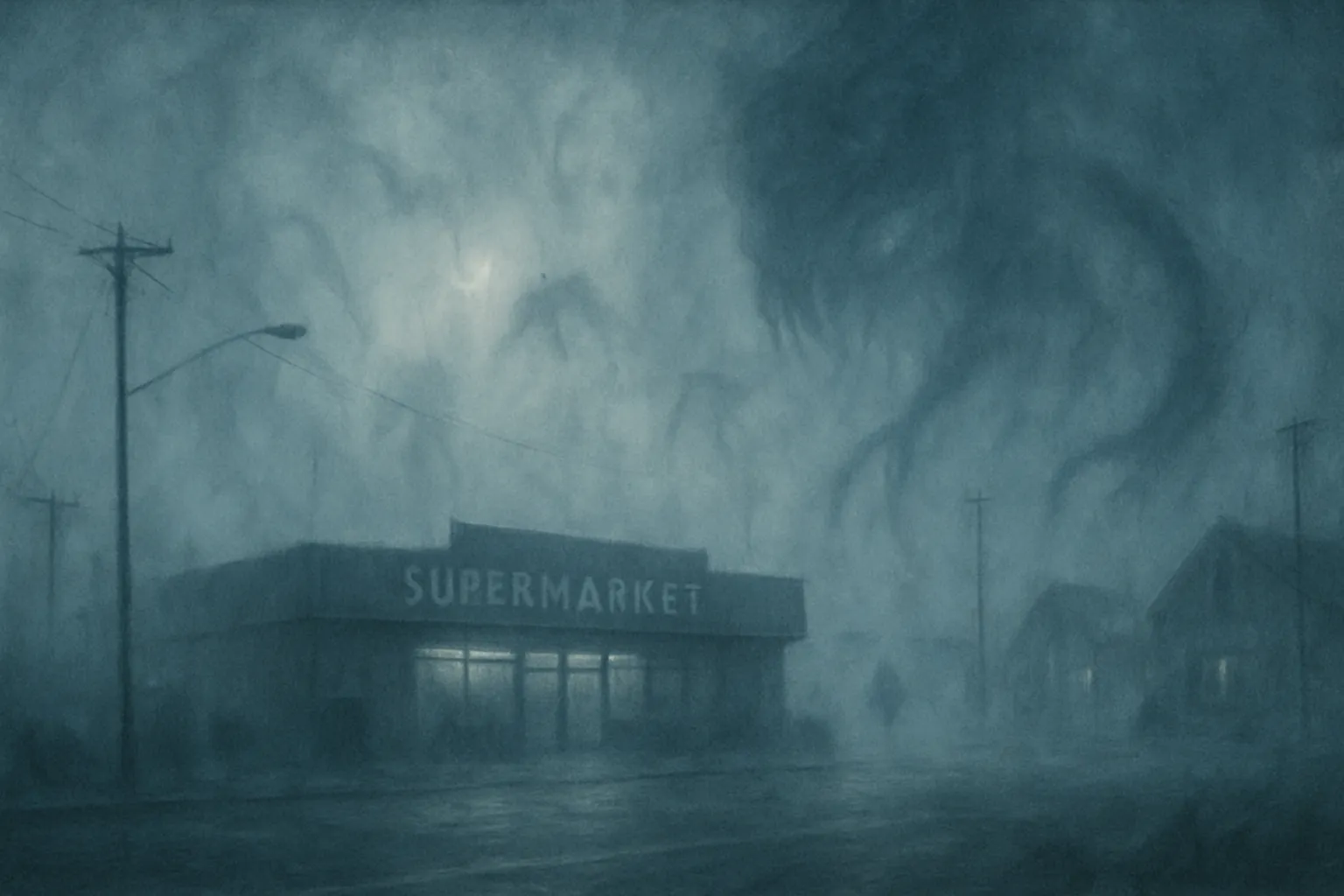
The world does not end with a whimper but with the violent, indifferent expulsion of the unintegrated Real, condensing the very atmosphere into a malignant fog that arrives not from the sky, but from the schizoid aperture of the State's own hyper-accelerated Desiring-Machine.
The Imperial Axiomatic and the Body-Without-Organs of the Unknown
DThe Mist, functions not as a traditional horror film of external invasion, but as a clinical demonstration of the Immanent Breakdown of the American micro-socius, a system whose fundamental repression is violently breached by a geological and military flow it birthed itself. The M-Flow, the deterritorializing event that engulfs Bridgton, Maine, is the Body-without-Organs (BwO) of the universe slamming against the fragile, over-coded stratum of capitalist domesticity. This fog is pure, uncut Chaosmos, a non-human becoming that refuses all recognition by the symbolic order. It is the eruption of what Žižek (2009) terms the Sinthome—the foreign body that sustains the entire symbolic structure by its very exclusion—suddenly made visible and voraciously present. The initial fracture is traced directly to the Military-Scientific Desiring-Machine of the Arrowhead Project. This apparatus, fueled by the Imperial Axiomatic of late capitalism, demands the ceaseless production of abstract power, pushing the limits of the measurable into the transcendent realm of other dimensions (Deleuze & Guattari, 1983). The Mist is the pure feedback, the return of the repressed territoriality of the cosmos itself. The project was designed to colonize a dimension beyond the Newtonian plane; in return, it received an overwhelming, schizoid discharge of the Real of Chaos—a flow of monstrous biological and spatial intensity—which it immediately dumped onto the small-town frontier. This placement is not coincidental; it exposes the structural dependency of "Pastoral Sovereignty" (the myth of rural self-sufficiency) on the global war machine, revealing the entire town to be merely a defensive outpost of the Empire, awaiting its collateral damage. The supermarket, where the primary drama unfolds, becomes the Molar Assemblage of Containment. It is a fluorescent, highly stratified space dedicated to the flow of commodities and the reproduction of the nuclear family's consumption habits. Suddenly, the functions of this architecture are violently re-coded: the commodity flow stops, and the space becomes a theater for the molecular breakdown of the human collective.
The Topology of Imprisonment: The Store as a Paranoiac Social Machine
Once trapped, the individuals immediately set about the work of re-territorialization, attempting to capture the chaotic M-Flow and translate it back into an intelligible social code. This is the moment of collective Verdrängung (repression), where the group desperately tries to avoid a full descent into the schizoid state—the open relationship with the BwO that would dissolve all identity. The Psychic Assemblage of Siege that forms inside the store is dominated by two competing mechanisms of control, each desperately seeking to re-code the non-sense of the Mist into sense, security, and structure.
The Tyranny of the Superego: Mrs. Carmody, the Paranoiac Re-coder
Mrs. Carmody, the evangelical zealot, is the most successful Paranoiac Re-coder because her system is the most ancient and the most rigid. She cannot tolerate the contingent, the scientific, or the absurd; the M-Flow must be immediately assigned the most totalizing and guilt-ridden signifier: Divine Retribution. Her success lies in her ability to act as the Superego’s Proxy. She does not appeal to reason, but to the latent Moral Masochism already deeply embedded in the collective unconscious of the community. Wilhelm Reich (1970) theorized that the masses, in moments of extreme insecurity, willingly trade freedom and desire for the protection offered by an authoritarian structure. Carmody exploits this: the monsters outside are less terrifying than the guilt she unleashes inside. She makes the group believe that the chaos is their fault, a product of their own suppressed desires (their desiring-machines having been too laxly coded). By translating the schizoid experience into the language of Sin and Sacrifice, she establishes a Collective BwO of the Church—a terrifying, striated body that demands ritual submission. The store's interior floor plan becomes a holy site where individual desires are brutally suppressed, and the group flow is violently directed toward paranoiac production: the continuous generation of guilt, scapegoats, and victims. Her theology is a totalitarian stratification, an iron-clad code that promises salvation only through the sacrificial liquidation of desire. The moment she successfully demands the sacrifice of the young soldier is the moment the assemblage of the store reaches its totalitarian climax. This is the political economy of fear in its purest form, where the collective, rather than confronting the external monster, chooses to execute the internalized monster (guilt/fear) upon the body of an outsider (Badiou, 2005). The group's fidelity is not to the truth of the event (the Mist), but to the comforting structure of the Lie (the Code).
David Drayton: Oedipalized Pragmatism and the Failure of the Schizoid Strategy
David Drayton, the artist and father, represents the failure of Oedipalized Pragmatism to invent a response equal to the event. David’s rationalism—his belief in objective analysis and secular common sense—is not a neutral force, but a defensive structure engineered by the Oedipal Machine (Deleuze & Guattari, 1983). His desire is obsessively re-territorialized onto the Family Triangle (himself, his son, and the memory of his wife). This hyper-focused repression onto the Oedipal Unit prevents him from generating a Collective Schizoid Strategy—a truly revolutionary line of flight that would engage the BwO with creativity, invention, and shared risk. Instead, his "pragmatism" becomes a weapon of exclusion; he uses surrounding people instrumentally to ensure the survival of his own nuclear unit. His goal is not the liberation of the collective, but the maintenance of his own small, private machine of desire-production. David is a man of Kant's Categorical Imperative collapsing under the pressure of the Unconscious. He seeks a universal, rational law for survival, but in the face of the un-codable, the universal law he lands on is merely the survival of his own lineage. The moment he fails to defend the woman retrieving medicine, choosing instead the safety of the unit, marks the ethical failure of his entire approach. He allows the paranoiac machine to continue its work by his inertia, proving that the silent pragmatist is often the best accomplice of the fanatic.
The Lines of Flight and the Recapture by Thanatos
The escape from the supermarket is the film’s first genuine Line of Flight. The murder of Mrs. Carmody, executed not by David but by the one man who had transcended the Oedipal fixation (Ollie), is the Breakdown of the Paranoiac Code. By leaving the store, the remaining group rejects the Symbolic Order imposed by Carmody, deterritorializing themselves from the safety of the molar assemblage and committing to the chaos of the outside. The drive through the Mist is the pure, molecular experience of becoming-escape. They are no longer subjects governed by a known space, but rather nomads of the BwO, traversing a landscape that is simultaneously an external territory and an internal psychic flow. This period of flight, however, is a failed becoming-revolutionary. It is a schizoid journey undertaken with a paranoiac objective—to return to the home, the original site of the Oedipal repression. The moment the car runs out of gas is the Crucial Recapture. The line of flight, having broken from the supermarket, snaps back under the domination of the Death Drive (Thanatos). Confronted with the absolute certainty of the M-Flow's continued density and the final exhaustion of all material, pragmatic resources, David's repressed desire, the one code he cannot shed, takes over.
The Amputation of the Future: The Logic of Nihilistic Closure
David’s final act—the murder of the remaining survivors, including his son, with four bullets for five people—is the ultimate expression of Nietzschean Nihilism cloaked in paternal love. It is not an act of heroism but an Amputation of the Future. In this moment, David embraces the total failure of the M-Flow to produce any new, sustainable territory. He cannot invent a new reason to live in the face of absolute absurdity. Instead of allowing the possibility of a collective BwO to emerge from the shared trauma—a chance for a new kind of social machine to be forged in the chaos—he chooses the Total Closure of Non-Existence. He replaces the terrifying, open flow of the Mist with the clean, final Stratification of Death. Lacan (1977) teaches that the Real is that which resists symbolization. David, faced with the Real of the monster, collapses into a psychotic attempt to master it by mastering death itself. His action is a desperate attempt to assert the Master-Signifier (Father/Protector) one last time, even if it means destroying the material reality of the signifier.
The question is no longer to master the flow, but to block it. The blockage of the flow, this is the final solution of the Oedipal trap. (Deleuze & Guattari, 1983, p. 310)
This is the anti-production of the Oedipal machine at its finest: the violent termination of all future desire to satisfy the ideological demand for control in the present. David executes his family not out of love, but out of a failure of the Will to Power (Nietzsche, 1886) to affirm life and becoming in the face of its ultimate terror.
The Return of the Code: The Tragic Absurdity of the Symbolic Order
David Drayton, having performed the ultimate sacrificial act demanded by his own hyper-Oedipalized Superego, steps onto the road, awaiting the fifth bullet (for himself), which he does not possess. This moment is the Zero-Degree of the Subject, the consciousness that has fulfilled its most terrifying, repressed desire and is now ready for liquidation. The arrival of the military—the tanks, the flamethrowers, the organized, armored columns—is the Total Re-codification of the Socius. It is the State Machine reasserting the Symbolic Order with brutal efficiency. The Mist, the chaotic BwO, is suddenly managed, contained, and reduced back to an external problem that can be solved by technological molarity. This climax is the tragic absurdity of the entire schizoanalysis. David's profound sacrifice, borne of the deepest strata of his psychic repression, is rendered meaningless by the single variable he failed to anticipate: the speed of the Code’s return. The chaos was always temporary, subject to the eventual re-capture by the State apparatus that manufactured it. David is left screaming at the military—not at the rescue, but at the Absurdity of his condition. His screaming is the sound of the revolutionary potential being violently re-territorialized. He is not screaming at the monsters; he is screaming at the realization that the Lie of the Symbolic Order has won, demanding the blood price for a crisis it already had the means to resolve. The film proves that the true horror is not the external monster (the M-Flow), but the internal, totalitarian Paranoiac Assemblage that, when confronted with the Schizoid Event, inevitably turns inward to cannibalize its own freedom in the name of a comforting, self-destructive code. The final shot of David—isolated, condemned, yet alive—is the portrait of the Zero-Degree Subject forever chained to the knowledge that his ultimate act of control was merely the final, necessary sacrifice required for the maintenance of the System.
References
Badiou, A. (2005). Ethics: An essay on the understanding of evil (P. Hallward, Trans.). Verso.
Darabont, F. (Director). (2007). The mist [Film]. Dimension Films; The Weinstein Company.
Deleuze, G., & Guattari, F. (1983). Anti-Oedipus: Capitalism and schizophrenia (R. Hurley, M. Seem, & H. R. Lane, Trans.). University of Minnesota Press.
Lacan, J. (1977). Écrits: A selection (A. Sheridan, Trans.). W. W. Norton & Company.
Nietzsche, F. (1886). Beyond good and evil: Prelude to a philosophy of the future (H. Zimmern, Trans.). George Allen & Unwin.
Reich, W. (1970). The mass psychology of fascism (V. R. Carfagno, Trans.). Farrar, Straus and Giroux.
Žižek, S. (2009). The plague of fantasies. Verso.
Comments
Post a Comment