The Hunger Games: Catching Fire (2013) How Capital Turns Deterritorialized Desire into a Circus of Compliance.
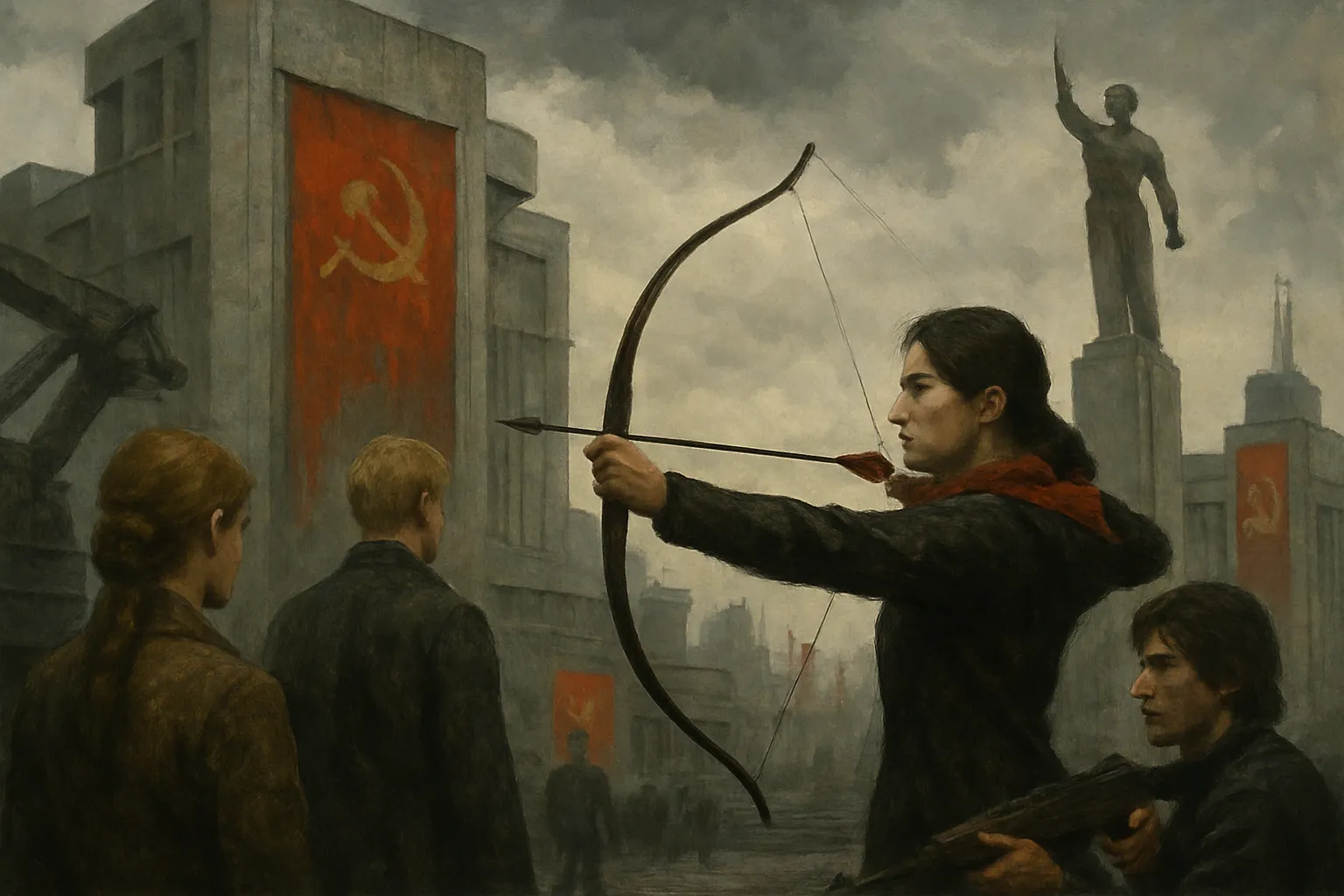
The Capitol is not a city; it is a terminal, an organ-machine built to intercept and re-route the planetary flows of desire. When Katniss Everdeen is seized by the Reaping, her subjectivity is violently deterritorialized, becoming an involuntary hero codified by the media spectacle. This treatise traverses the fragmented terrain of The Hunger Games and its sequel to track that molecular fracture, mapping the precise architecture of Panem’s desiring-machine through the schizoanalytic lens. We argue that the critical shift between the first film (Farce) and the second (Tragedy) reveals the moment the State’s axiomatic fully exposes itself. The protagonist's core issues of reluctance, hysteria, and obliviousness are analyzed not as personal flaws, but as the psycho-political mechanisms by which the system attempts to reterritorialize her revolutionary potential, locking her becoming-revolutionary into the oedipal cage of Capital. This analysis is propelled by the tension between Leninist organization theory and the perpetual warning of anarchist philosophy, mapping the spectacular violence of Panem onto the continuous threat of re-capture by the axiomatic of Capital.
The Production of Panic: When the Unconscious Stops Being a Family Drama
The Districts of Panem are not simply geographical locations of extraction, but segments of a sprawling, planetary Desiring-Machine 1, a colossal assemblage whose primary function is the continuous modulation of energy and scarcity. The operation of this machine precedes any notion of lack or symbolic prohibition; it is at work everywhere, "functioning smoothly at times, at other times in fits and starts" (Watkin, 2007).1 This productive materialism insists that everything is production: "production of productions, of actions and of passions; productions of recording processes... productions of consumptions, of sensual pleasures, of anxieties, and of pain" (Deleuze & Guattari, 2003, p. 4).2 The entire Capitol apparatus, particularly the Games, exists to ensure that the raw output of the Districts (labor, resources, life) and the resulting affects (terror, hope, sadness) are immediately recorded, consumed, and reproduced as flows necessary for the system’s self-maintenance.2
The fundamental schizoanalytic intervention must be the rejection of the psychoanalytic project as a reactionary Reterritorialization. The unconscious, in its raw, schizophrenic mode, is infinitely productive, moving along lines of connective and disjunctive synthesis.2 Yet, the psychoanalytic institution, through the imposition of the Oedipus complex, seeks to impose a "social reality" that confines this cosmic productivity to the cramped "bedroom of Oedipus" (Sokal, 2017; Deleuze & Guattari, 2003, p. 24).3 Deleuze and Guattari argue that psychoanalysts are intentionally "bent on producing man abstractly, that is to say ideologically, for culture" (Deleuze & Guattari, 2003, p. 24).3 This oedipal structuring—which they regard as a reterritorialization on the "rock of castration" (Sokal, 2017) 4—is essential for the smooth operation of the social field. It ensures that the desire that dreams of "wide-open spaces" is stocked and contained within an established, familial order, diverting revolutionary energies back into private, negotiable neuroses.3
The Districts themselves represent a "grid of disjunctions" inherent in production: separate lines of material flow (coal in District 12, luxury goods in District 1, etc.).1 The Capitol, in response, attempts to impose a "fake map of unities" (Watkin, 2007) 1—the unifying identity of ‘Panem’ and the ritualistic cohesion of the Reaping—to mask the real industrial and material divisions. The system of tributes and the Games are the specific means by which the productive material flows (labor, life) are immediately consumed as media-commodity, ensuring the violent deterritorialization of the body is instantly re-coded into the Axiomatic of Capital.
This dual function reveals capitalism’s essential schizophrenic nature. The Capitol is not merely a despotic monarchy; it is the ultimate expression of the global system that deterritorializes the individual and social flows to their extreme limit, achieving the "movement of social production that goes to the very extremes of its deterritorialization".5 This process "frees (deterritorialises) materiality and human interaction from a hierarchical overcoding," but instantly subjects that liberation to a desperate reterritorialization, violently recoding the energy "into the generic axiomatic of capital" (Meisner, 2011).6 The explosion of a mine, the death of a Tribute, the spectacle of consumption—these are all interconnected machine parts, where "a connection with another machine is always established, along a transverse path" (Deleuze & Guattari, 2003, p. 6).2
The Body Without Organs: The Smooth Surface of the Arena and the Void of Becoming
The central political concept opposing the State’s stratified organization is the Body-without-Organs (BwO). The BwO is not a metaphor for a lifeless entity, but the material plane of consistency upon which desire operates prior to its stratification by the social machine. It is the site of resistance, the "smooth, slippery, opaque, taut surface" that resists the imposition of organ-machines and repressive fixation (Watkin, 2007; Sokal, 2017).1 When the desiring-production achieves its third, non-productive stage, the BwO emerges, "produced as a whole, but in its own particular place within the process of production, alongside the parts that it neither unifies nor totalizes" (Goodchild, 2003).7 It is "the unproductive, the sterile, the unengendered, the unconsumable" 7, a powerful refusal of the capitalist imperative to ceaseless consumption and integration.
The arena, in a cruel parody, acts as a temporary, coerced BwO. In this space of sheer survival, all social identities, all oedipal constraints, and all gendered stratifications are dissolved, forced into a pure, immediate immanence of life-or-death decision.8 This manufactured BwO is the ground zero for the production of the Last Man. Nietzsche’s letzter Mensch is the ultimate commodity, part of a society where "everyone wants the same, everyone is the same" (Meisner, 2011, p. 25).9 This conformity is enforced through the logic of hyper-competition, the "survival of the fittest disciplining everyone into adjustment".9 The competition is framed as the ultimate political reality—the "war of all against all" (Marx, as cited in Meisner, 2011, p. 27) 9—ensuring that revolutionary solidarity is constantly deterritorialized and reterritorialized into self-serving rivalry.
When Katniss refuses the Capitol’s rules, she performs an Event in the Badiouian sense. The Event names "the void inasmuch as it names the not-known of the situation" (Badiou, 2005).10 The established situation—the ritual necessity of one victor—is ruptured, and the resulting process, her emergence as the Mockingjay, becomes the Truth Procedure. Truth, as Badiou defines it, is not a static form, but "the decision to be true to the unknown" (Badiou, 2014).10 The fidelity to this void—the truth that the system is ultimately arbitrary and contingent—is what allows Katniss to build a "new situation" that is a "constant becoming".10 This refusal is the active construction of a revolutionary BwO, believing in "the germ of life, the seed which splits open the paving stones" (Deleuze, 1989, p. 8).11
To understand the scope of this schizoanalytic project, the following table maps the fundamental conflicts regarding the nature of desire itself, affirming production against the doctrine of lack.
Conceptual Axis | Desire Function | Primary Repressive Mechanism (Reterritorialization) | Schizoanalytic Position |
Schizoanalysis (D&G) | Production, Assemblage, Connection, Flow (Deleuze & Guattari, 2003) 2 | The Oedipus Complex (Social Reality) (Sokal, 2017) 4 | Affirmative: Desire is an active, material force operating prior to lack. |
Freudian/Lacanian Psychoanalysis | Lack, Castration, Demand, The Signifier (Lacan, 1966; Lacan, 1992) 12 | Repression, The Name-of-the-Father, Symbolic Order | Critical: Represses the true productivity of the unconscious, confining it to familial drama. |
Reichian Somatics | Discharge of Inner Tensions (Biopsychic Unity) (Reich, 1945) 14 | Character Armor, Political Irrationalism (Reich, 1946) 15 | Integrated: Desire as elemental discharge, directly politicized through social repression. |
The Hyperreal Panopticon: How the Capitol Programs the Flows of Annihilation
The power structure of Panem is an architectural nightmare, perfecting the calculated economy of visibility described by Foucault. The Games are not a raw display of vengeance but a continuous, disciplinary operation. Disciplinary power "is a modest, suspicious power, which functions as a calculated, but permanent economy" (Foucault, 1977, p. 31).16 The certainty of constant visibility is the key mechanism of subjection. The arena is a hyperreal Panopticon 17 where the Tributes are maintained in "subjection" due to "the fact of being constantly seen, of being able always to be seen" (Foucault, 1977, p. 52).16 The examination—the camera’s unblinking gaze—is the technique by which power objectifies the individual.16 The Capitol has moved beyond the "horrifying spectacle of public punishment" and instead relies on the inevitability and certainty of surveillance.16
This system of total, mediated surveillance necessitates the Baudrillardian condition of hyperreality. The media, controlled entirely by the Capitol, creates a "world that is more real than reality that we can experience" (Baudrillard, 1994).19 The Games are the ultimate Simulacrum 20, a map that precedes the territory.21 The violence is immediately deterritorialized from its material consequence and reterritorialized as pure sign. Baudrillard argues that information "did not relate either to the event or the facts, but to the promotion of information itself as event" (Baudrillard, 2002).21 The audience, particularly the Capitol citizens, loses the capacity to distinguish reality from fantasy, seeking fulfillment through the simulacra and avoiding interaction with the real world.19 The resulting affect is a "nihilistic passion par excellence," a collective fascination for the "very operation of the system that annihilates us" (Baudrillard, 1994).18
The ideological trap is maintained by this hypervisibility. Slavoj Žižek’s analysis reveals that ideology is a fundamental "social reality whose very existence implies the non-knowledge of its participants as to its essence" (Žižek, 2012).22 The citizens of the Capitol believe they are engaging with authentic human suffering and heroism, while in reality, they are "eating from the trash can" of ideology.22 The highest form of ideological purity is achieved when the system pretends to address "real people with their real worries," thereby "overlooking this Real of spectrality" (Žižek, 2012).23 The ideological obfuscation in Panem is twofold: it masks exploitation by appealing to survival, and it uses Roman aristocracy imagery (like Coriolanus Snow) to frame the revolution as a rebellion against monarchy, rather than against the deeper, more pervasive forces of capitalism and exploitation.24
The entire disciplinary, spectacular structure relies on the schizophrenization of value achieved through commodity fetishism. Marx recognized that in capitalist society, the products of labor are "endowed with a life of their own" (Marx, 1867) 25, mystifying the social relations of production. Bourgeois ideology attributes "supra-sensuous, mystical properties" to these things (Konstantinov, 1957).26 In Panem, the life of the Tribute is the supreme fetishized commodity, divorced from the horrific material reality of the Districts. This relentless detachment—the constant promotion of the sign as sign 21—is the molecular process that keeps the subject perpetually deterritorialized from the material roots of their suffering, ensuring the system "schizophrenizes" but "the better it works, the American way" (Deleuze & Guattari, 2003, p. 24).3
The Political Economy of Perversion: The Affective Overcoding of Servitude
The persistence of the Capitol’s power necessitates an explanation for the people's collective investment in their own subjugation. The classic query of De La Boétie—"Why do people love and fight for their chains?" (Guattari, 1977) 8—finds its answer in the politicization of primal desire. Wilhelm Reich’s work provides a material basis for this political irrationalism: on an elementary level, desire is the urge to "discharge inner tensions," requiring "contact with the outer world" (Reich, 1945, p. 271).14 When natural life functions are ostracized by the social order, the result is the political irrationalism that "infests, deforms and destroys our lives" (Reich, 1946).15
The Capitol engineers a system where the discharge of anxiety and tension finds immediate, channeled expression in the spectacle, preventing the free flow of expressivity that might otherwise organize a revolutionary BwO.8 The strategy is to find something "more efficient than repression, so that repression, hierarchy, exploitation, and servitude are themselves desired" (Deleuze & Guattari, 2003, p. 24).3 The affective charge surrounding the Games—the hunger, the spectacle, the fear—becomes an intense, sought-after investment. The revolutionary machine is confronted with the immense task of acquiring "at least as much force as these coercive machines have for producing breaks and mobilizing flows" (Deleuze & Guattari, 2003, p. 10).3 The symbolic power of the Mockingjay must be capable of generating an affective wave comparable to the arousal generated by "Flags, nations, armies, banks".3
The initial conflict between Katniss’s desire for survival and the political necessities of the uprising reflects the tension between Lacanian lack and Schizoanalytic production. Lacan insists that desire is structured by language and lack, "the desire for nothing nameable," existing as a function of this lack (Lacan, 1966).12 For Schizoanalysis, this lack is merely the oedipal containment. Katniss’s final, defiant act in the Arena, refusing the imposed code of the Games (the signifier of the Capitol's power) and creating a new, unpredictable outcome, shatters the established order. This action is the molecular line of flight that allows desire to move toward "wide-open spaces," rejecting the restrictive economy of lack.3
However, the political flow of desire is always at risk of being re-captured. Gale Hawthorne, the embodiment of radical political perception—who accurately identifies the Capitol’s tactic of manufacturing "hatred between the starving workers of the Seam and those who can generally count on supper" 27—nonetheless harbors an early, problematic fantasy of escape. His vision is to "Run off. Live in the woods".27 This retreat to the wild is a false refuge, a reterritorialization onto the nuclear couple and the family structure.28 True courage, according to schizoanalysis, requires that the flight itself be an intense "social investment," rejecting "private certitudes" and avoiding the deceptive tranquillity of isolation (Deleuze & Guattari, 2003, p. 96).28 The flow must be diverted into collective, revolutionary organization, not individualized survivalism.28
The Line of Flight and the Vanguard: Molecular Revolution and Molar Recoding
The transition from spontaneous uprising to organized revolt presents the eternal political problem of organization versus freedom, crystallized in the tension between Leninist theory and Anarchist critique. The "spontaneous struggles" of the masses—the immediate, raw flows of revolt that surge through the Districts—are acknowledged by Lenin as the starting point, the "raw diamond".29 But Lenin argued against the romantic glorification of spontaneity, insisting that conscious organizational activity and the vanguard party must "bring light into these struggles, to raise the workers’ consciousness" (Lenin, 1902).29
The necessity of the vanguard, however, immediately confronts the Anarchist Warning against molar reterritorialization. The critique maintains that using the state or centralized violence inevitably leads to the means becoming the ends. This process is a recursive pattern of substitution: "The Party is then substituted for the Workers, then the Central Committee is substituted for the Party, then the Secretary-General/Chair-Man/Supreme Leader/Dear Leader substitutes for the Politburo" (Sacco, 2023).31 This historical pattern—this "Definition of Insanity" 31—is the mechanism by which revolutionary deterritorialization is captured and recoded back into the despotic machine under a new ideological banner.
The schizoanalytic project offers the Line of Flight as a molecular, processual counter to this trap. The line of flight is not merely escape, but a movement that simultaneously leaves the old territory while also "constitut[ing] and extend[ing]" the new territory itself (Deleuze & Guattari, 2003).5 It is the movement de- and the active process -ing that matters (Meisner, 2011).6 To avoid the anarchist substitution trap, the line of flight must sustain its singularity and speed, refusing the organizational rigidity that produces the "abstract man".3
The revolution succeeds when the political organization is structured around Badiou’s definition of truth-production, which is inherently "disinterested" and creates a new subject "without proper interest" (Badiou, 2005).32 This subject is devoted solely to the fidelity of the Event—the breaking of the Capitol’s axiomatic—and the continuation of the process. The Mockingjay symbol, functioning initially as a non-signifying sign that indicates "flow change, interruption, diversion, grafting, splitting" (Watkin, 2007) 1, must remain molecular, avoiding the molar capture of the centralized State apparatus that inevitably seeks to exploit the truth it has produced.32 The true revolutionary subject must embody Constant Becoming (Badiou, 2014) 10, refusing the final, static category of the victorious Molar State.
The Crystal Image of Un-Belief: Filming the Faith in This World
The cinematic representation of Panem operates at the edge of the Time-Image. The violence and pervasive spectacle have shattered the foundational link between man and world, resulting in a state where the subject is paralyzed, living "as if in a pure optical and sound situation" (Deleuze, 1989, p. 12).11 The traditional "movement-image" (action leading to predictable reaction) is corrupted because the ideological apparatus prevents any genuine reaction from seizing the flow.
The task of modern cinema, according to Deleuze, is to restore a necessary political faith. The reaction that man has been dispossessed of "can be replaced only by belief".11 This is not a transcendental escape; it is the radical decision to "believe in this world" (Deleuze, 1989, p. 8).11 The cinema must capture "not the world, but belief in this world" (Deleuze, 1989, p. 4).11 This imperative aligns with the schizoanalytic project of affirming the BwO as the potentiality dwelling within the catastrophe. It requires filming the "germ of life, the seed which splits open the paving stones" 11, demonstrating that intense desire, once deterritorialized from the oedipal and capitalist axes, persists and connects.
Ultimately, the cinematic critique of Panem becomes a Crystal Image: a prism where the actual (the brutal exploitation and death) and the virtual (the Capitol’s aestheticized, hyperreal narrative) constantly reflect and overlap, forcing the realization of the system’s ontological instability.11 The revolutionary flow succeeds when it captures this crystalline instability and uses it to restore belief in the singular, collective capacity of the body to produce non-oedipal desire, achieving the line of flight that is simultaneously a social investment.
References
Badiou, A. (2005). Being and event. Continuum.
Badiou, A. (2014). Ethics: An essay on the understanding of evil. Verso Books.
Baudrillard, J. (1994). Simulacra and simulation. University of Michigan Press.
Baudrillard, J. (2002). Screened out. Verso Books.
Deleuze, G. (1989). Cinema 2: The time-image. University of Minnesota Press.
Deleuze, G., & Guattari, F. (2003). Anti-Oedipus: Capitalism and schizophrenia. University of Minnesota Press.
Foucault, M. (1977). Discipline and punish: The birth of the prison. Vintage Books.
Goodchild, P. (2003). Deleuze and Guattari: An introduction to the politics of desire. Sage Publications.
Konstantinov, F. V. (1957). Role of advanced ideas in development of society. Foreign Languages Publishing House.
Lacan, J. (1966). Écrits: A selection. W. W. Norton & Company.
Lacan, J. (1992). The ethics of psychoanalysis 1959-1960: The seminar of Jacques Lacan Book VII. W. W. Norton & Company.
Lenin, V. I. (1902). What is to be done? Foreign Languages Publishing House.
Marx, K. (1867). Capital: Critique of political economy. Progress Publishers.
Meisner, M. (2011). Deleuze and Guattari’s lines of flight: Deterritorialization in political theory. [Unpublished master's thesis]. Radboud University Nijmegen.
Reich, W. (1945). Character analysis. Farrar, Straus and Giroux.
Reich, W. (1946). The mass psychology of fascism. Farrar, Straus and Giroux.
Sacco, L. (2023). Anarchist critique of vanguardism. Reddit. [Online forum comment].
Sokal, S. (2017). The schizorevolutionary project: Escaping to the future of new earth. Social Ecologies.
Watkin, W. (2007). Deleuze and Guattari: Anti-Oedipus. William Watkin’s Blog.
Žižek, S. (2012). The plague of fantasies. Verso Books.
Comments
Post a Comment