The affluent activist, packaged in guilt and flown in at high velocity, is the terminal expression of Capital’s infinite capacity to absorb and monetize its own critique.
The Activist-Simulacrum
The film opens not in the green furnace of the Amazon, but within the meticulously stratified space of the American university, a local node in the global machine where the flows of liberal guilt are engineered into the currency of commodity-activism. The students, particularly Justine, are the products of an advanced Oedipal economy, burdened by the immense psychic debt owed for their privileged positioning within the global chain of exploitation (Lacan, 2007). Their activism—the desire to “help”—is not a line of flight escaping the system, but a line of capture meticulously laid by the system itself. This is the simulacrum of resistance (Baudrillard, 1983).
Baudrillard’s assertion that the contemporary world is defined by the substitution of the real with its signs finds its perfect clinical model in the organization. The goal is not to stop the bulldozer—the real, geological production of capital—but to generate media spectacle, the hyperreal signifier of resistance, which is immediately digestible and sellable within the news cycle. The entire operation is a desiring-machine whose sole, hidden purpose is the production of affect (the self-satisfaction of the activists) and the exchange value of outrage (the funding and media hits).
The activists, assembling their bodies into a collective, molar machine of protest, are still deeply encased in character armor (Reich, 1949). This armor is the somatic constraint necessary to maintain the separation between the comfortable self and the messy, uncodable flows of the world they claim to oppose. They are docile bodies (Foucault, 1995), disciplined by the academic/social contract, seeking to manage the world's chaos without allowing that chaos to breach their own carefully constructed boundaries of safety and privilege.
The decision to fly to the Amazon is the ultimate deterritorialization that remains strictly relative (Deleuze & Guattari, 1987). They detach from the North American territory only to re-territorialize themselves onto the new, abstract territory of the "Global South as the Site of Ethical Tourism." Their bodies, temporarily removed from the immediate demands of their homes, are transformed into a Jet-Powered Body without Organs (BwO)—a transient, intensive vehicle for flows of ethical intention that believes itself pure, but is still driven by the subterranean debt of the Socius. The entire trip is an engineered fantasy, a temporary release valve for capitalist anxiety.
The Crash as the Event
The plane crash is the Singularity, the point of zero-degree signification where the Symbolic Order of the West (the organized, technological machine) is violently returned to the Real (Lacan, 2007). The organized flows of the activist-machine are instantly shattered, scattered, and dissolved into the intensive flows of the Green Inferno. The smooth space of the airplane is ripped open, forcing the contents—the bodies, the cameras, the satellite phones—into the violently stratified space of the jungle.
This catastrophic event achieves the absolute deterritorialization the activists claimed to seek. The Molar identity—the college student, the daughter, the charismatic leader—is instantly stripped of its Signifiers. There is no authority here to validate their degrees, their social media presence, or their moral intentions. The immediate, terrifying silence of the jungle is the roar of the Anoedipal Territory (Deleuze & Guattari, 1983).
The terror that grips them is the recognition that their bodies are no longer objects of Biopower, regulated by state controls and disciplinary techniques (Foucault, 1995). They become merely biological matter, unindexed, uncataloged, and returned to a primal, use-value assessment by the indigenous War Machine that watches them. Their very existence is now dictated by the pure flow of the primary process, devoid of the Symbolic Law.
The running villager, framed against the monstrous, geological production of the bulldozer at the film's start, is the initial line of flight. The activist machine attempts to co-opt this line of flight, to re-territorialize the indigenous resistance into a media commodity. The crash, however, reverses the circuit: the indigenous resistance violently seizes the activists and re-territorializes them into raw material.
The Jungle as the Geological Unconscious
The Green Inferno is not simply a forest; it is the ultimate Body without Organs (BwO), the geological unconscious of the planet (Deleuze & Guattari, 1987). It is a pure, intensive space operating on a logic external to the axioms of global capitalism. This BwO is a surface of pure, interconnected flows—cellular life, rot, energy transfer, consumption—where the abstract notions of ownership, property, and moral debt simply do not exist.
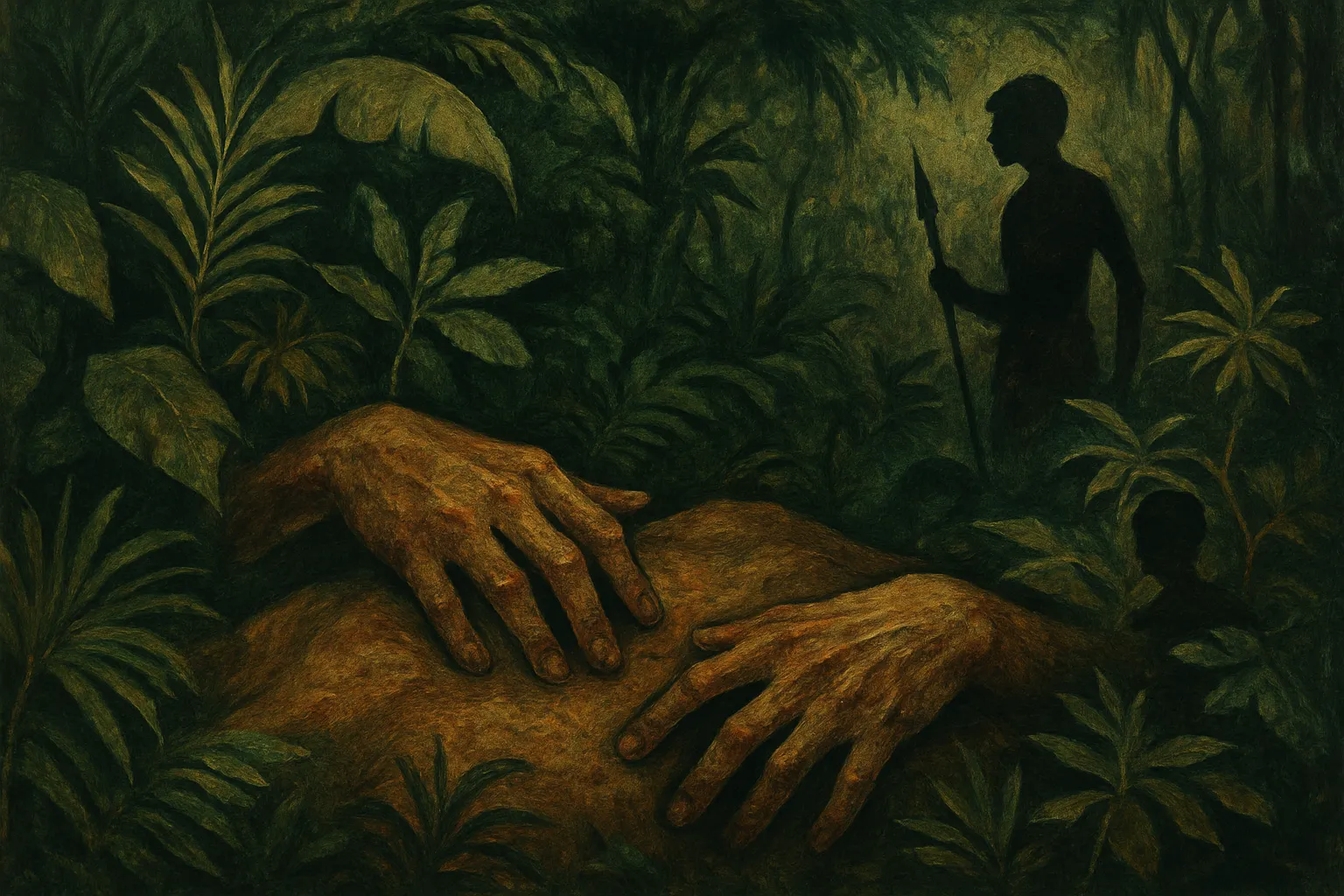
The indigenous tribe, the Yanomami, function as a nomadic War Machine. They are external to the State apparatus, external to the capitalist grid, and operate according to a code that prioritizes the maintenance of their intensive territory over the abstraction of exchange. Their code is one of immediate retaliation and pure consumption—the inverse of the Western system, which prioritizes delayed exchange and abstract debt. They attack the invaders not out of malice, but out of necessity, defending the smooth space of their existence against the striated space of the Capitalist State (the helicopter, the logging company).
Their rituals, particularly the cannibal feast, are not barbaric in the capitalist sense; they are the ultimate act of deterritorialization on the body of the colonial invader. The consumerist body, defined by what it buys and possesses, is reduced to the simplest possible term: what is consumed.
The true essence of capitalism is that it does not cease to deterritorialize the flows that it re-territorializes on itself." (Deleuze & Guattari, Anti-Oedipus, 1983, p. 240)
The cannibals reject the capitalist re-territorialization. They refuse to treat the activist as a hostage (exchange value), a subject of moral judgment (Symbolic value), or even as a prisoner to be sold (commodity value). They treat the activist as pure, intensive use-value. This act fundamentally strips the Western subject of its entire philosophical armature: the body is no longer a temple, a site of personal property, or a vehicle for the soul. It is only meat, a flow of energy returned directly to the territorial consumption-machine. The cannibal is the ultimate schizoanalytic philosopher, asserting the primacy of pure use over abstract exchange.
The Feast of the Alienated Subject
The horrific dismemberment and consumption of the activists performs a rigorous Marxist critique through the logic of the Real. The bourgeois subject, which participates in the global economy by consuming the cheap labor and resources of the "Third World," is now forced to confront the violent reality of its own consumption cycle.
The body, formerly the site of alienated labor (Marx, 1988)—the site where the subject sells its time and energy for wages—is now literally broken down into its elemental components, reversing the flow of alienation. The activists flew to the jungle to observe the exploitation; they become the object of a different, more ancient, and more honest form of exploitation—total corporeal appropriation.
The consumption of the eye is particularly resonant in this schizoanalytic flow. The eye, the instrument of disciplinary surveillance (Foucault, 1995) and the primary organ of the Symbolic Gaze (Lacan, 2007) that indexed their privileged social status, is consumed. It is the rejection of the camera lens, the social media feed, and the Western narrative that structured their lives. The consumption of the eye ensures that the Western gaze, the flow of observation and judgment, is violently blocked and integrated into the internal territory of the tribe.
The fate of Smuck, the initial anti-hero and self-aware cynic, culminates this section. His final image is one of re-territorialization—not into a corpse, but into black paint. His body, or at least his pulverized remains, is ground down and used as an adornment, a cultural element, a literal Signifier of the War Machine’s triumph. Smuck’s transformation from a cynical, self-alienated Western subject into a pigment used to decorate the very tribe he tried to protect is the ultimate, horrifying joke of the system: even in death, the body is re-purposed, its energy absorbed and re-coded into the aesthetic flow of the Anoedipal Territory. He does not become free; he becomes a component part of the new machine.
Justine’s Becoming-Prey
Justine's journey is the line of flight most rigorously tested. She begins as the most naive, most ideologically burdened (Lacan's "Father's Name" is heavy on her), and most morally constrained of the group. Her survival hinges on a continuous series of deterritorializations. She loses her friends (molar support), her idealism (symbolic code), and her comfort (stratified existence).
Her most crucial transition is the moment she chooses active self-coding over the pre-packaged narrative of commodity-activism. Her final lie—that the tribe was peaceful and saved her—is not a simple untruth; it is a profound ethical act and a necessary re-territorialization (Badiou, 2001).
Alain Badiou's concept of the Event and Fidelity is critical here. The cannibal feast and her survival are the Event—a sudden, uncodable intrusion of the Real that shatters her previous truths. Her decision to lie is an act of Fidelity to that Event. She chooses to protect the intensive flow (the Anoedipal War Machine) over the State apparatus (the military/rescue helicopter). She understands, fundamentally, that the tribe is not "savage" or "evil"; they are simply the Anoedipal Law, responding to an external threat with total, pure consumption.
She re-enters the Symbolic Order (the helicopter, the rescue workers) as a changed subject, a becoming-prey who understands the terrifying, non-negotiable logic of the BwO. The lie is the Signifier she creates herself, a protective shield necessary to ensure that the State, the final and most powerful apparatus of capture, does not immediately liquidate the last vestige of the Anoedipal Territory.
Her gaze, as she lands, is no longer the passive, judgmental gaze of the activist, but the intensely focused, traumatized gaze of the survivor—a body that has been irrevocably altered by its confrontation with the Real. She has failed as an activist (the molar project), but succeeded as a subject (the molecular flow), trading the shallow rewards of social credit for the terrifying, uncodable knowledge of the body's pure, intensive fragility. The price of this knowledge is the burden of the lie, the final code she must carry to protect the flow that set her free. The helicopter flight back is the ultimate, smooth re-stratification, moving her from the intensive flow of the jungle back into the stratified anxiety of the Western capitalist machine. The film concludes not on liberation, but on the inevitable, necessary re-capture of the subject by the Symbolic.
Conclusion: The Absolute Irony of the Anti-Oedipal Detour
The Green Inferno performs a radical schizoanalytic dissection of liberal humanism, revealing that the attempt to engage with the world from a position of profound privilege is merely a self-serving detour, a momentary flow that the global Capitalist-Oedipal machine will immediately co-opt, metabolize, or violently reject.
The essay finds that the ultimate deterritorialization is achieved not through conscious political resistance, but through corporeal annihilation—the total reduction of the subject to pure use-value in a hostile, Anoedipal territory. The activists, believing they were advancing a line of flight, were merely the latest offerings to the complex, material logic of the jungle. Their failure is the failure of the Signifier when confronted by the Real. Their final purpose was not to save the rainforest, but to diagram the precise boundaries of Western moral hypocrisy, confirming that true freedom from the code of the Socius often means total dissolution of the body itself. Justine’s choice is the final, tragic synthesis: she preserves the chaotic flow of the BwO through a necessary lie, ensuring that the revolution, even if unseen, is never fully re-coded by the State.
References
Badiou, A. (2001). Ethics: An Essay on the Understanding of Evil. (P. Hallward, Trans.). Verso.
Baudrillard, J. (1983). Simulacra and Simulation. (S. F. Glaser, Trans.). University of Michigan Press.
Deleuze, G., & Guattari, F. (1983). Anti-Oedipus: Capitalism and Schizophrenia. (R. Hurley, M. Seem, & H. R. Lane, Trans.). University of Minnesota Press.
Deleuze, G., & Guattari, F. (1987). A Thousand Plateaus: Capitalism and Schizophrenia. (B. Massumi, Trans.). University of Minnesota Press.
Foucault, M. (1995). Discipline and Punish: The Birth of the Prison. (A. Sheridan, Trans.). Vintage Books.
Lacan, J. (2007). Écrits: The First Complete Edition in English. (B. Fink, Trans.). W. W. Norton & Company.
Marx, K. (1988). Economic and Philosophic Manuscripts of 1844. In D. McLellan (Ed.), Marx: Selections. Oxford University Press.
Reich, W. (1949). Character Analysis. (T. P. Wolfe, Trans.). Orgone Institute Press.
Comments
Post a Comment