The Crucible of Horror (2025): The Oedipal Machine, the Spectre of the BwO, and the Failure of Molecular Revolution
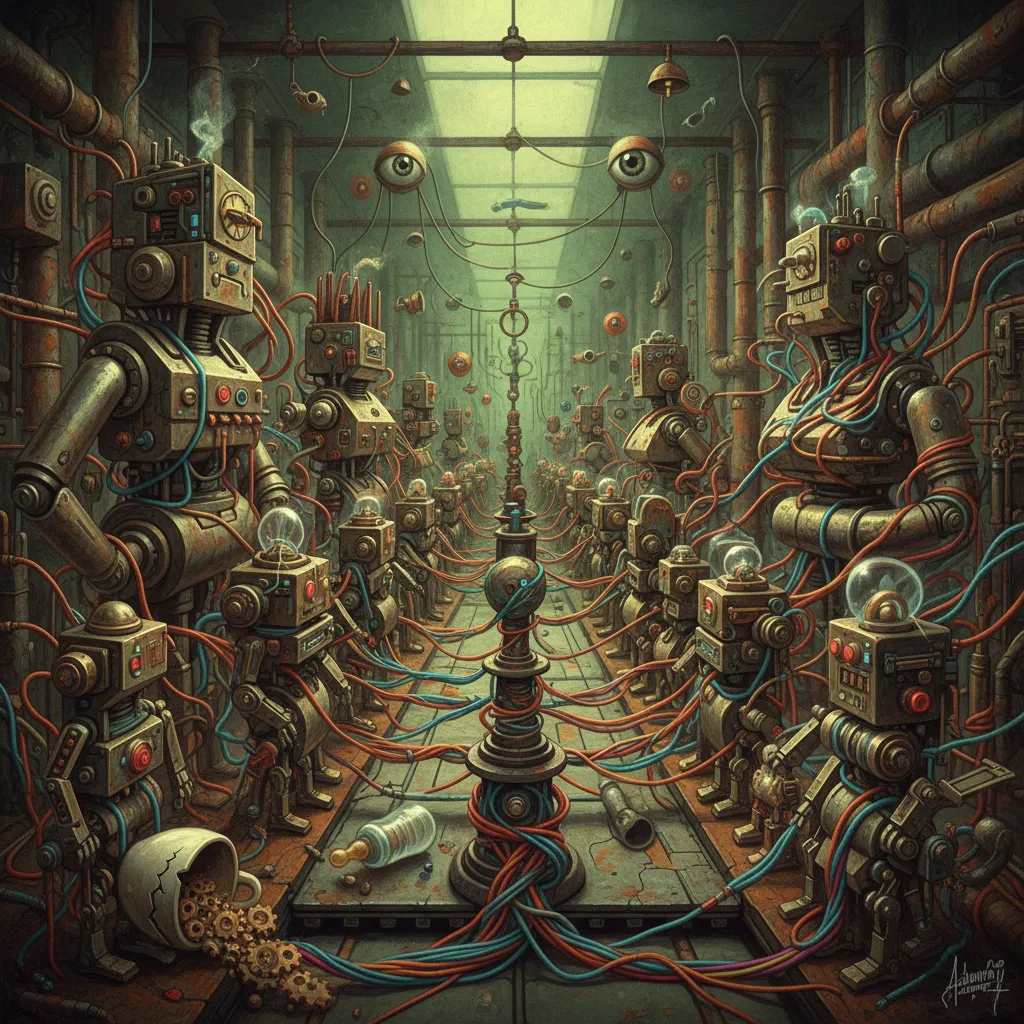
The family, this bizarre institution , is not a structure built on love but a factory floor where the desiring-machines of its subjects are violently wired, stratified, and policed. It is the schoolhouse, yes, where you learn the careful steps—how to walk, how to internalize the world's cruel, cold rules—but also the primary source of the fault lines, the psychic fractures, where trauma lodges and leaves behind its residue of dysfunctional personality traits and maladaptive behaviors. At its core, the family is the zero-point of initiation: a heavy, contradictory space where we receive the cultural programming for both the species' best intentions and its most brutal, nihilistic potentiality. Crucible of Horror, through the lens of the Eastwood family, forces us to walk that very tightrope.
I. The Oedipal Stratification: Armor and the Blocked Flows
The Eastwood family is not a household; it is a siege. The father is the central Axiomatic force, operating as the territorial machine, imposing a regime of stratification designed to block the molecular flows of desire and resistance in his wife and daughter. This system doesn't require words, only the constant pressure of a heavy fist, a crippled will—the scales are tipped, always, toward powerlessness. A learned helplessness that settles deep into the bone. A body with a shattered spirit, yes.
And what feeds this submission? The Mother and Daughter are pure action without voice. Their dialogue is merely echo, reflex—responses to the father’s cruel dinnertime badgering. They are twin impulses of reaction, two sides of the same traumatic coin, reflecting the divided self .
The Mother: Foreclosed Flow. She is a subject suffering from acute ontological insecurity (Laing). Her being, systematically negated, becomes a "shell of a person struggling to speak." Her silence is the final tightening of the muscular armor (Reich)—a bodily blockage where emotional and kinetic flows are immobilized. She is not simply broken; she is foreclosed, existing outside the dialectic of self, numb and awaiting instruction.
The Daughter: Reactive Surge. She is the raw, uncoded desire-flow that violently resists this stratification. All "spit and fire," lashing out. Her impulses, like the act of stealing, are a distorted, blind line of flight—pure resistance without a map. This flow is immediately absorbed and punished by the father's rigid Axiom. Her spirit, a brilliant and visible fire, becomes the perfect target for systemic repression.
II. The Turning Point: The Conductor Son and the Fascist Code
The turn—the brutal event that shakes loose the shackles—is triggered not by dialogue, but by a sudden, kinetic eruption: the daughter caught stealing, the father charging her room, the switch whipping against her flesh. This is the externalization of violence made visible, audible.
The camera, however, does not stay fixed on the obvious physical violence (the beating, the whipping). It cuts, associatively, to three concurrent flows: the physical assault, the Mother overhearing the screams, and the son, mockingly waving a stick, playing orchestra conductor. This last frame is the unique violence—the deep horror of the fascist in training.
The son is the successor , the guarantee that the father’s oppressive stratification will be perpetually regenerated. The father's aggression is transformed into a highly ritualized, aestheticized performance (conducting). This means the violence is no longer merely private; it has been culturally internalized and coded as "orderly" and "correct." This machine is designed for continuous reproduction. The son proves the family is a self-sustaining Molar apparatus: the oppression is a code transmitted across generations, ensuring the father's Character Armor finds a new body to inhabit and enforce its function.
The Mother’s awakening is the sound of her own Character Armor fracturing. Up to this point, she had successfully compartmentalized the abuse as her private, numb injury. But seeing the violence visited upon the Daughter—the externalization of the terror—violently reintegrates her hidden feelings of helplessness and rage. The abuse is universalized; the psychic self can no longer remain divided.
III. The Failed Escape: The Specter and the Compulsion to Return
Awakened, the Mother tells the Daughter she wants to kill the father—the initiation of a line of flight, a desperate becoming-revolutionary act. But they fail. After killing the father and staging it as a suicide, his body faithfully returns, fully rematerializes at the end of the film, as if nothing happened.
This is the ultimate, non-negotiable schizoanalytic critique . A Molar, physical act—killing the body—cannot defeat a pervasive molecular code. The father's rematerialization is the terrifying cinematic truth of the internal oppressor.
The Internalized Code: The Father's Axiom—the code of submission, guilt, and powerlessness—was too deeply inscribed upon their entire desiring-machine. They acted out of reactive, passionate flow, failing to forge a critical consciousness (Freire) or a new, affirmative, molecular code of liberation. Their Character Armor shattered for a moment, but the core psychic wiring remained.
The Specter of Guilt: The father's return is the spectral, physical manifestation of their own ontological guilt and ontological insecurity (Laing). He is compelled to return because their desiring-machines are still wired to demand his authority, his punishment, and his stratification. They failed to associate the righteousness of their acts, meaning they failed to truly deterritorialize the oppressive code within their own minds. The Superego-Machine demands retribution, capturing the revolutionary act.
The Crucible of Horror is not a ghost story; it is a political treatise on the paralysis of the self. The Mother and Daughter are forced back into their respective armors—the numb victim and the volatile rebel—because the flow of liberation was immediately re-captured by the internal mechanisms of repression. They failed to forge a lasting molecular solidarity (a collective becoming-revolutionary) that could create an affirmative BwO, free of the father's code. True freedom demands a molecular transformation of the self, ensuring the desiring-machine is perpetually wired for creation, not the mere reaction to destruction.
Comments
Post a Comment