The Consuming Dead: Zombie Cinema as a Diagnostic of Ideology and Commodity Fetishism in Late Capitalism
Abstract
The cinematic zombie, a cultural figure of horror, has evolved across numerous subgenres, offering a continuous and refined diagnostic tool for social and economic anxieties within Western society. This dissertation expands its analysis across five key evolutionary waves—from the foundational consumer to the trivialized pet, the hyper-militarized bioweapon, the rage-infected host, and finally, the reintegrated or demonized subject. Drawing primarily on the critical theory of Slavoj Žižek and the concept of commodity fetishism, this study asserts that the shifting form and function of the zombie directly index the changing mechanisms of late-capitalist ideology. The evolution of the threat—from a collective consumption imperative to a privatized corporate weapon, and eventually to a challenge of subjectivity itself—demonstrates how systemic pressures have moved from external threats to internalized, domestic crises. The contemporary zombie narrative ultimately reveals the collapse of the host-parasite dichotomy, where the human subject either becomes the infectious ideological agent or attempts to reclaim agency within a system that has utterly normalized the apocalypse.
Chapter 1: Introduction
1.1 The Parasitic Analogy and the Problem of the Zombie
The study of parasitic manipulation, where a host's behavior is fundamentally hijacked for the reproductive benefit of the guest (Dennett, 2007), provides a foundational metaphor for analyzing ideological capture. The zombie, driven by the ceaseless, non-sentient impulse to consume, is the quintessential host, its humanity subordinated to a singular, externally imposed function. The core premise of this work is that the zombie, beyond its role as a horror figure, is a profound cultural indicator of how capitalist ideology structures human behavior, particularly the urge for mass, anonymous consumption.
Romero’s foundational definition of the zombie as an "animated corpse that feeds on the living human flesh" (Brooks, 2003) is merely the starting point. The true depth of the genre lies in its ideological flexibility, allowing it to adapt to contemporary anxieties regarding globalization, institutional failure, and the trivialization of crises.
1.2 Defining the Expanded Scope and Thesis
This dissertation utilizes an expanded scope, identifying five crucial waves that track the zombie's ideological evolution:
The Foundational Consumer: The slow, massed critique of commodity fetishism (Romero).
The Trivialized/Domesticated Pet: The normalization and social integration of systemic crisis (e.g., Shaun of the Dead, Fido).
The Neoliberal/Bioweapon: The fast, militarized threat tied to corporate or state malfeasance (e.g., 28 Days Later, Resident Evil).
The Sympathetic/Cured Subject: The return of subjectivity and the desire for integration (e.g., Warm Bodies, In the Flesh).
The Demonized/Ideological Agent: The supernatural host, representing the complete collapse of agency and total ideological capture (Rec).
The central thesis remains: the expanded cinematic evolution of the zombie, across its diverse forms, serves as a crucial diagnostic tool for late-capitalist ideology, revealing the progressive internalization, normalization, and, finally, the desperate attempts to reverse the ideological capture of the human subject under systemic pressure.
Chapter 2: The Foundational Critique and its Trivialization
The initial wave of zombie cinema established the critique of mass consumption, but subsequent iterations immediately challenged the seriousness of that critique by domesticating the threat.
2.1 The Consuming Corpses: Romero and the Ideological Mall
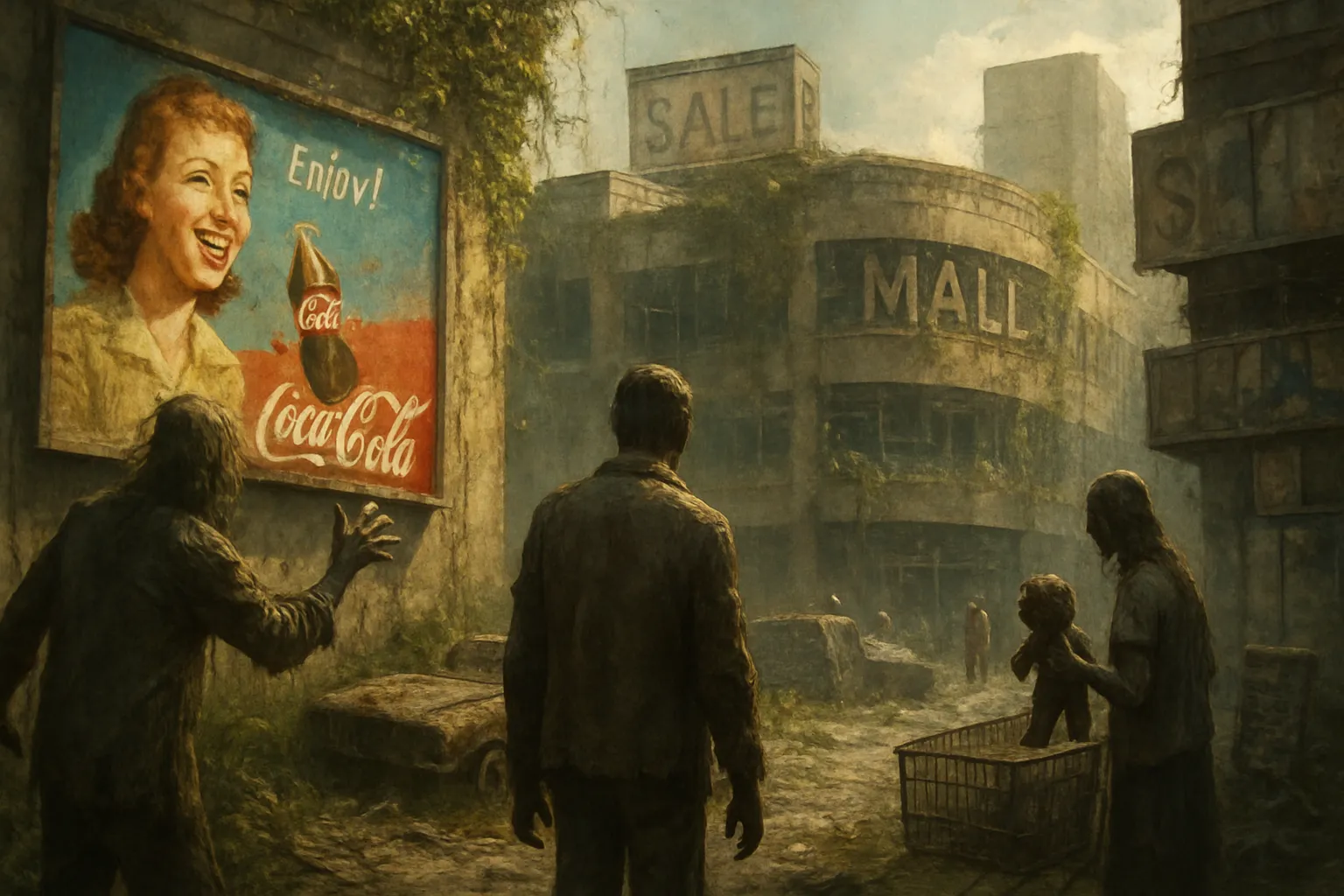
George A. Romero’s work solidified the zombie’s link to commodity fetishism. In Dawn of the Dead (1978), the dead are drawn to the shopping mall—the site of their former lives’ primary function. This non-tactical, ritualistic draw illustrates Marx's concept where human relations are mystified, replaced by the relationship to things. The zombie horde, non-coordinated yet uniformly reactive, is the perfect representation of the alienated, anonymous mass consumer. The consumption is compulsive, pure ideological practice stripped of biological need.
2.2 The Trivialized Pet: Normalizing the Apocalypse
A key subversion of the foundational model is the introduction of the Trivialized or Domesticated Zombie (e.g., Shaun of the Dead, 2004; Fido, 2007). In these narratives, the apocalypse is less an existential horror and more an inconvenience or a backdrop for personal drama.
Shaun of the Dead frames the outbreak as a disruption of mundane daily routine, implicitly arguing that modern life is already so automated and low-stakes that the infected are only marginally different from the uninfected commuters.
Fido pushes this further, presenting the zombie as a domesticated pet or servant, kept in check by a collar. This trivialization is a profound ideological commentary: it suggests that society, having failed to defeat the crisis of consumption, has instead found a way to normalize and profit from it. The source of the threat is now merely another disposable, manageable product or tool, demonstrating the market’s capacity to absorb even its own existential threat and integrate it into the economic structure. The systemic collapse is repurposed as a new industry (zombie collars, maintenance, servitude).
Chapter 3: The Neoliberal Threat: Acceleration and Militarization
The transition from the slow consumer to the fast, weaponized infection reflects the shift in global anxiety from static consumerism to accelerated, globalized risk and corporate control.
3.1 The Viral Rage and the Failure of Acceleration
The Rage-Infected Zombie (e.g., 28 Days Later, 2002) shifted the narrative from methodical, collective consumption to instantaneous, individual fury. This acceleration mirrors the pace of late-stage capitalism and the rapid, overwhelming speed of modern crises—financial crashes, viral pandemics, or information overload. The threat is no longer something you can patiently barricade against, but a velocity that outstrips institutional response time.
This era also saw the demise of institutional safety. As seen in 28 Weeks Later (2007), the military's attempts at large-scale quarantine fail due to internal human error and the inability to manage the speed of the crisis. The noise and commotion of the barricading process itself attract the mass hordes, indicating that the attempt to contain the system's breakdown only accelerates its destruction.
3.2 The Bioweapon and Corporate Malfeasance
The Bioweapon Zombie (e.g., Resident Evil franchise, World War Z, 2013) moves the ideological critique from abstract commodity fetishism to concrete, structural power. In this framework, the infection is not an act of nature or cosmic chance, but the result of a corporate or state-sponsored experiment gone wrong.
The zombie becomes an expression of the military-industrial complex or unchecked corporate greed. Umbrella Corporation, the deep state, or clandestine military units create the disease not for consumption, but for profit, power, or population control. This shifts the target of critique away from the mass consumer and toward the elite structure of global power. The enemy is no longer the horde but the hidden hand that weaponized them. This reflects a contemporary anxiety that true systemic threats are not organic but engineered by opaque, powerful entities.
Chapter 4: The Post-Apocalyptic Subject: Sympathy and Agency
As the apocalypse normalized, a new wave emerged that explored the possibility of reversing the ideological capture, focusing on the return of the subject behind the infection.
4.1 Reclaiming the Subject
The Sympathetic Zombie (e.g., Warm Bodies, 2013; In the Flesh, 2013) introduces the idea that agency and human connection can survive or be recovered from the state of zombification.
In Warm Bodies, a zombie, R, begins to recover his memory and emotion through a relationship with a human, suggesting that consumption can be replaced by connection and love. Similarly, In the Flesh presents the concept of "Partially Deceased Syndrome" (PDS), where former zombies are treated, rehabilitated, and returned to society.
This wave represents a desire for ideological reintegration and recovery. It is a hopeful, if naive, counter-narrative to the relentless critique of earlier decades. It suggests that the alienated, consuming subject (the zombie) can be saved—not through violence, but through therapy, acceptance, and the reclamation of individual memory. This challenges the notion of total ideological capture by asserting the fundamental resilience of human subjectivity, even if it has to exist in a deeply compromised, post-crisis state.
4.2 The Challenge of Coexistence
The sympathetic zombie narratives also force the human survivors to confront their own prejudice and fear, posing the question: if the consuming threat is now manageable, curable, or integrated, what does that say about the society that created the threat in the first place? These narratives turn the critique inward, forcing the audience to consider the ideology of their own "survivor" status.
Chapter 5: The Demonized Subject and Total Ideological Capture
The final, most nihilistic wave returns to the issue of total capture, but frames it spiritually and ideologically, completing the collapse of the separation between host and parasite.
5.1 The Spiritual Inversion
Films like [Rec] (2007) and [Rec] 2 (2009) introduce demonic possession as the underlying cause, creating an inversion where survivors are forcibly contained and desperately seeking escape. The external barricade is now a cage, trapping the subjects within the ideological structure, rather than defending them from it.
This demonic shift aligns powerfully with the culmination of Žižek's concept of ideology. The cause is no longer a biological virus or a corporation, but an abstract, malevolent force that strips the subject of free will and identity.
5.2 The Collapse of the Host/Parasite Dichotomy
This supernatural turn allows for the ultimate critical move: the subject becomes the ideological agent. The contemporary narrative recognizes that consumption is no longer merely external (buying things); it is a total state of being. Through constant social networking, digital performance, and self-optimization, the individual pressures others to consume and conform. The flight to safety fails because the subject, having internalized the structural imperative, becomes the carrier of the ideological infection itself.
The subject is no longer a victim being eaten, but an active, if unwitting, agent urging others toward the consuming culture. The Demonized Zombie is the final stage of this process: the human subject, stripped of autonomy, reduced to a functional extension of the ideological imperative, confirming Žižek's analysis that "Instead of immediate relations between people we have social relationships between things" (Žižek, 1989). The consumption is complete; the human is the commodity.
Chapter 6: Conclusion
6.1 Summary of Findings
This expanded analysis has demonstrated that the cinematic zombie is not a static figure but an evolving cultural diagnostic. The shift from the slow, foundational consumer to the trivialized pet, the corporate bioweapon, the rage-infected host, and the sympathetic subject maps directly onto shifting anxieties about capitalism:
The critique of mass production and fetishism (Foundational Consumer).
The normalization and domestication of systemic failure (Trivialized/Domesticated Pet).
The acceleration and militarization of global economic risk (Neoliberal/Bioweapon).
The desperate hope for recovery and reintegration of the alienated subject (Sympathetic/Cured Subject).
The total, ultimate ideological possession (Demonized/Ideological Agent).
The most chilling revelation is the genre's current trajectory: the apocalypse has become either manageable background noise or a permanent, internalized state of being.
6.2 Final Thought
The expanded zombie narrative offers a complex, if often terrifying, mirror to contemporary social reality. Whether we are laughing at the domesticated dead, running from the hyper-speed virus, or hoping for redemption, the core message remains: the greatest ideological victory is achieved not when the subject is destroyed, but when the subject willingly, compulsively, and often anonymously, reproduces the conditions of their own consumption.
REFERENCES
Brooks, M. (2003). The Zombie Survival Guide. New York: Random House.
Dennett, D. (2007). Breaking the Spell: Religion as natural Phenomenon. New York: Penguin.
Romero, G. A. (Writer). (1968). Night of the Living Dead. United States: The Walter Reade Organization.
Romero, G. A. (Writer). (1978). Dawn of the Dead. United States: United Film Distribution Company.
Wright, E. (Writer). (2004). Shaun of the Dead. United Kingdoms: Universal Pictures.
Currie, A. (Writer). (2007). Fido. Canada: Lions Gate Entertainment.
Boyle, D. (Writer). (2002). 28 Days Later. United Kingdom: Fox Searchlight Pictures.
Fresnadillo, J. C. (Writer). (2007). 28 Weeks Later. United Kingdoms: Fox Atomic.
Plaza, P. (Writer). (2007). [REC]. Spain: Filmax.
Plaza, P. (Writer). (2009). [REC] 2. Spain: Magnolia Pictures.
Levin, J. (Director). (2013). Warm Bodies. United States: Summit Entertainment.
Green, C. (Creator). (2013-2014). In the Flesh [Television Series]. United Kingdom: BBC Three.
Anderson, P. W. S. (Director). (2002). Resident Evil. United Kingdom/Germany/France: Constantin Film.
Forster, M. (Director). (2013). World War Z. United States: Paramount Pictures.
Žižek, S. (1989). The Sublime Object of Ideology. London: Verso.
Comments
Post a Comment