The 'Burbs (1989) How White Flight Deterritorializes Desire into the Fetish of the Neighbor's Corpse
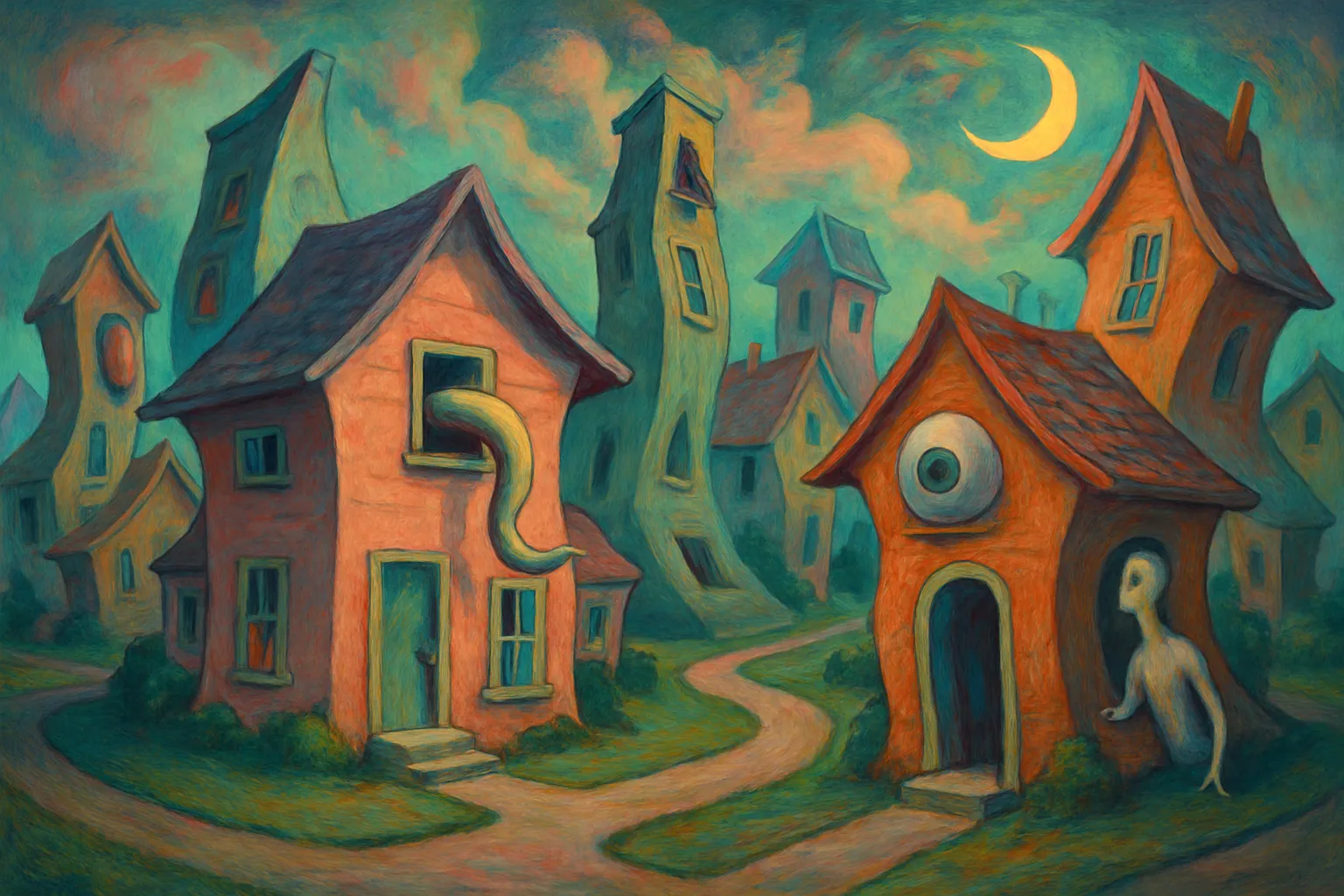
A smooth, indifferent space is always a paranoid illusion, a quiet plane of consistency concealing the violent striations of capital and ideology.
I. The Suburb as Striated BwO: The Repression of the Urban Flow
The American suburb, the geographic offspring of corporate strategy and white flight, is the ultimate striated space—a meticulously organized apparatus of capture designed to block the flow of class consciousness and re-territorialize desire onto the privatized commodity (Deleuze & Guattari, 1987, p. 384). The historical function of the "First Suburbs" was profoundly schizoanalytic: to geographically fracture the molecular solidarity of the unionized city worker, replacing collective struggle with the individual's desperate investment in private life (Althusser, 2014, p. 11), an Ideological State Apparatus built on the twin pillars of the lawnmower and the mortgage. Workers were allocated housing as a means of controlling the very texture of their desire, transforming revolutionary potential into the maintenance of "manufactured self-esteem embedded in owning stuff."
When The 'Burbs introduces Ray Peterson (Tom Hanks) on his staycation, we see a desiring-machine in crisis. He is a flow blocked, suspended between the exhausted flow of production (his job) and the prescribed flow of leisure (his pre-approved market activities). Ray's pajama-clad stomping through his manicured yard is not the beginning of a thriller; it is the molecular spasm of a psyche failing to adjust to the crushing weight of enforced idleness. He wants to lounge, but the very structure of the suburban Body-without-Organs (BwO) demands perpetual, if meaningless, activity. The BwO of the suburb is built upon homogeneous repetition: the eight hundredth time one mows the lawn, the predictable exchange of platitudes over the fence. This BwO is a Paranoid Machine perpetually defending itself against any desiring-flow that is not already coded and approved.
The film's initial montage introduces the neighborhood's molar components: Ray (the repressed suburban everyman), Rumsfield (the militaristic, hyper-vigilant War Machine), Art (the resident schizo-provocateur), and Ricky Butler (the punk, the line of flight who observes the absurdity from the fringe). Each character is less a personality and more a function of the suburban neurosis, caught in a tense, mutually surveilling relationship. This is the carceral archipelago of the cul-de-sac:
The distribution of bodies, the spatial partitioning, the serial arrangements and the control of activity are all mechanisms for forming relations of power/knowledge, for constituting subjects who are both observed and observing" (Foucault, 1995, p. 197).
The suburban structure is a Panopticon without a center, where neighbors police neighbors, transforming the public space (the street, the yard) into a site for the mandatory display of normalcy, a theatrical shoving of "weirdness into the public space." The women, as the draft notes, are relegated to the Symbolic function of policing the domestic boundary, seeking to "control their freedom," embodying the domestic Oedipal repression.
II. The Klopek Flow: The Deterritorialization of Privacy
The arrival of the Klopeks, the 'creepy family,' is the molecular event that throws the entire Paranoid Machine into gear. What is their great sin? They are "protecting their privacy." Privacy, in the suburban territory, is an absolute transgression. The suburb demands total visibility as the guarantor of social reproduction; any attempt to deterritorialize oneself by withdrawing the flow of information or the flow of spectacle is immediately read as a threat to the established code.
The Klopeks are the pure flow of the Other, the unbearable Real that the Symbolic order of the suburb must assimilate or purge. They are the non-coded event—they move trash strangely, they remain silent, they are Eastern European and thus historically linked to the "other" of the Cold War and the immigrant flow that the initial white flight was designed to escape. They function as a fetish object onto which the repressed flows of paranoia and historical guilt can be projected and discharged.
Žižek (2009, p. 61) speaks of the Neighbor as the traumatic element: the problem is not that the Neighbor is different, but that the Neighbor is too close, forcing us to confront the Thing that lies beneath their Symbolic mask—the chaotic, inhuman substance of pure desire. The suburban machine can handle the Symbolic Other (the well-behaved African-American neighbor who adheres to the lawn-care code), but it cannot tolerate the Real Other who simply refuses to participate in the game of visibility.
The suburban men, driven by this discharge of repressed libidinal energy, immediately begin "building a fictitious narrative built around pseudo-clues." This is the delirium of the Paranoid Machine—the production of sense where none exists, the construction of a molar conspiracy to justify the aggressive impulse:
The paranoiac is never wrong; he only interprets, or rather, overinterprets, the signs which all point to the conspiracy that threatens him... The whole social field is an object of paranoia" (Deleuze & Guattari, 1983, p. 28).
The suburbanites are manufacturing the truth they need—the truth of the skeleton—in advance of the evidence, solely to provide a Symbolic justification for the Real violence they are compelled to enact.
III. The Molar Eruption and the Reproduction of the Code
The escalating invasion, the systematic breaking and entering, and the ultimate act of arson represent the molar eruption of the repressed historical code. The draft astutely connects this micro-aggression to the pattern of "bullying, torture, and crime that early American Christian hate groups perpetuated on black families during segregation." The Klopeks are the latest iteration of the historical ‘Other’, a symbolic placeholder onto which the flows of racial violence—the reproduction of systemic racism that Althusser identified as "always-already" happening—can be discharged without the anxiety of naming the real historical stain.
The aggression is not an act of defending property; it is a fascistic micro-act designed to re-establish the purity of the suburban BwO. The men's actions (vaulting fences, peeking in windows, throwing garbage) are themselves a deterritorialization of the suburb's moral code, but they are performed in the name of re-territorializing the Klopeks. This paradox is the essence of conservative neurosis: using anarchic, destructive methods to enforce an imagined, stable order.
Ray's climactic speech ("WE'RE the ones who are vaulting over the fences... WE'RE THE LUNATICS") briefly opens a line of flight. It is a moment of schizoid self-critique, where Ray sees his function not as a subject but as an effect of the suburban apparatus, realizing that the paranoia is immanent to their own desire-flow, not external (Deleuze & Guattari, 1983, p. 343). He nearly achieves becoming-revolutionary, an honest appraisal of the political economy of his own paranoia.
But the film cannot sustain this line of flight.
The infamous plot twist—the discovery of the skeletons in the trunk—is the Symbolic Machine's ultimate maneuver. It is the cinematic re-territorialization that immediately arrests Ray’s momentary schizoid insight.
The twist serves to justify the paranoia post hoc, dissolving the moral charge of the hate crime by rendering the object of persecution actually guilty. As Žižek might argue, the film uses this twist to suture the ideological gap:
The true horror is not the traumatic Real of the corpse, but the void of the big Other, the total absence of guarantee that the world is meaningful" (Žižek, 2008, p. 97).
By proving the Klopeks are murderers, the film prevents the suburbanites (and the audience) from confronting the true horror: the fact that their paranoia was meaningless, a purely internal, self-generated neurosis. The skeleton in the trunk is a fetish—an object used to maintain the delusion that their collective violence was justified by an external threat, rather than being the necessary product of the suburb's own structural repression. The skeleton is the simulacrum of Truth, a fake Real inserted to protect the ideological fantasy of the suburban BwO, ensuring that the Code of white paranoia is fully reproduced and maintained for the next generation. The film collapses the line of flight and successfully returns the characters to their neurotic capture, assuring them that their fascistic desire was, all along, merely a commendable act of neighborly defense. The horror is that the suburban machine works perfectly.
References
Althusser, L. (2014). On the Reproduction of Capitalism: Ideology and Ideological State Apparatuses. (G. M. Goshgarian, Ed. & Trans.). Verso. (Original work published 1970).
Baudrillard, J. (1994). Simulacra and Simulation. (S. Faria Glaser, Trans.). University of Michigan Press.
Deleuze, G., & Guattari, F. (1983). Anti-Oedipus: Capitalism and Schizophrenia. (R. Hurley, M. Seem, & H. R. Lane, Trans.). University of Minnesota Press.
Deleuze, G., & Guattari, F. (1987). A Thousand Plateaus: Capitalism and Schizophrenia. (B. Massumi, Trans.). University of Minnesota Press.
Foucault, M. (1995). Discipline and Punish: The Birth of the Prison. (A. Sheridan, Trans.). Vintage.
Marx, K. (1976). Capital: A Critique of Political Economy, Volume 1. (B. Fowkes, Trans.). Penguin Classics.
Žižek, S. (2008). The Plague of Fantasies. Verso.
Žižek, S. (2009). Violence: Six Sideways Reflections. Picador.
Comments
Post a Comment