Teeth (2007) The Schizo-Fissure in the Oedipal Reactor: How the Vagina Dentata Refuses the Logic of Castration and Enacts Absolute Deterritorialization
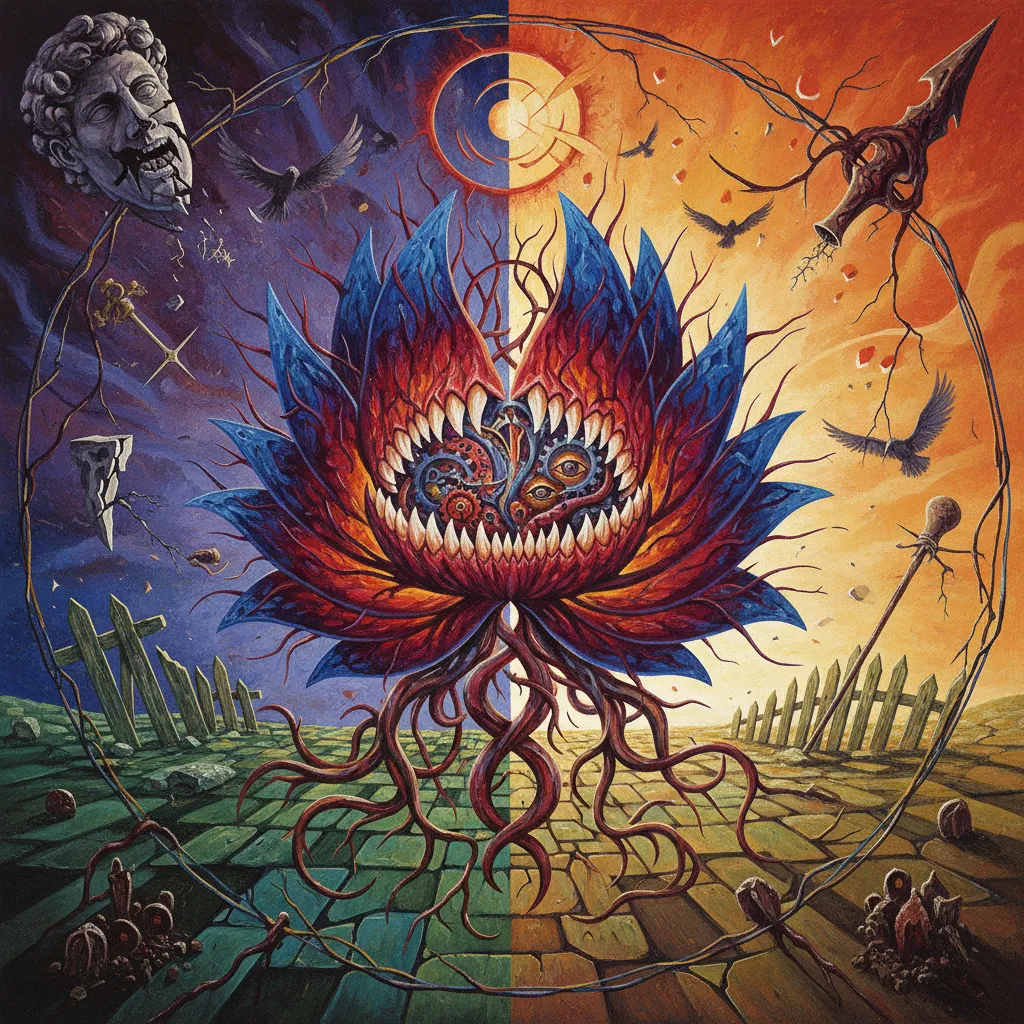
The mythic fear of the Vagina Dentata is not, and has never been, a fear of the feminine anatomy, but a paranoiac inscription of the Oedipal Axiom onto the female body—a projection of castration anxiety that seeks to transform the pure, libidinal flow of the Body-without-Organs (BwO) into a localized terror of lack (Freud, 1923). This film, however, reverses the diagnostic, presenting the teeth not as a symptom of male fear, but as the anti-production desiring-machine (Deleuze & Guattari, 1983) that actively cuts the flow of patriarchal subjugation.
The setting is already an explosion of contradiction. The reoccurring totem of a nuclear power plant haunts the suburban community, a massive Molar organization (Deleuze & Guattari, 1983) whose function is the highly controlled production of continuous energy—the very model for the regulated, normalized, suburban flow of family and sexuality. Panning down, the camera introduces us to the family: Mother and stepfather resting in the psychic torpor of Character Armor (Reich, 1949), while young Dawn and Brad, the step-brother, are caught in the molecular tension of the inflatable pool. Brad’s desire to "play Doctor" is a larval stage of the Paternal Abstract Machine, an early attempt to code, capture, and examine the feminine mystery. Dawn's appropriate response—biting off a chunk of Brad’s finger—is the primal, molecular revolt, the first schizo-fissure in the Oedipal reactor’s containment unit.
I. Purity as Neurotic Reterritorialization: The Stratification of Desire
The jump forward finds Dawn, the post-pubescent subject, speaking for the abstinence only program. This is her profound, self-imposed neurotic reterritorialization (Freud, 1923), a rigid, Molar code designed to manage the terrifying truth of her own anatomy. Her zealous adherence to the "gospel of abstinence" is not divine motivation; it is the muscular rigidity of Character Armor (Reich, 1949), a collective defense mechanism developed against the unconscious knowledge of her own lethal capacity. Purity, in this suburban context, is the ultimate attempt to stratify the raw sexual flow, forcing it into a linear, non-explosive channel aligned with the Father-God’s law.
This tension builds in her "restrained romance" with Tobey. The relationship is a temporary, fragile assemblage, a neurotic fiction awaiting inevitable rupture. The moment of crisis arrives not in the sterile, Molar confines of the school, but in the second-order BwO of the river and cave. They pass into the cave, an orifice with a teeth-like linking around its edge, a geological echo of Dawn’s own biology. This is the sublime BwO of the earth meeting the BwO of the girl. Tobey’s decision to force his will upon her is the Oedipal act of capture, attempting to violently colonize the territory. Her body, shocked awake, leaps into an act of absolute deterritorialization (Deleuze & Guattari, 1983), severing the connection and performing the castration Event.
II. The Gymnasium Speech and the Collapse of Oedipal Causality
The trauma of the Event—experiencing both the violence of rape and the full, lethal capacity of her own anatomy—deterritorializes Dawn's religious certainty. Her final speech, given after the deflowering and the violence, is a moment of ontological insecurity (Laing, 1960) exposed before the paranoiac socius of the crowd.
Dawn: "… And yesterday I could have done that... because yesterday I was pure..."
The crowd's chanting—"She shall be called women because she was take out of man... The serpent!"—is the voice of the Socius, attempting to immediately re-inscribe the trauma into the acceptable Molar narrative of Christian misogyny. They are desperate to pin the causal responsibility back onto the feminine, making Dawn the source of evil (Eve) and thus absolving the masculine Abstract Machine of its violence.
Mr. Vincent, the Law-Giver and shepherd of the repressive code, steps in to guide Dawn off stage, performing the final semiotic capture: "Exile from the garden. Tho it was not part of gods original plan. Thanks to Eve and the devil..." (Žižek, 2009). The misogynistic logic plays on a causal displacement, linking Dawn's flirtation (Eve's influence) as the initial causal point for Tobey’s actions. This is the structural flaw that needs to be exploded.
The schizo-flow must now leap to Hume. David Hume makes clear that causal relationship is a construction based on historical tradition and probability, not necessity. "That the sun will not rise tomorrow is no less intelligible a proposition, and implies no more contradiction, than the affirmation, that it will rise" (Hume). Between Dawn's flirtations and Tobey's force, there exists a bifarious chain of possibilities that the biblical interpretation fails to address. The existential freedom to choose remains: Adam could have chosen not to eat; Tobey had the existential freedom to not force his will. The biblical logic reduces the human dynamic, with its layered agencies and multiple desiring-machines, to the simple, predictable pattern of probability (the sun's orbit).
The courts and the police, the contemporary judicial Abstract Machine, suffer from the same flaw as the film viewer: they inspect the narrative retrospectively, lacking access to the molecular symbolic relativity of the actors on screen. They are forced to discern truth through Molar narrative, which is always susceptible to the infestation of biblical causality. The feminist legalistic approach—consent as an ongoing, revocable process—is an attempt to disrupt this causal displacement, to force the Abstract Machine to recognize the discontinuity in the moment of choice, thus affirming the woman's sovereign BwO.
III. The Vagina Dentata as Evolutionary Line of Flight
Dawn, however, moves beyond the victim-hood narrative that cinema usually demands. She eventually takes full responsibility for her capacity to defend herself and use her anatomy as a weapon. This is the central concept production of the text.
The Vagina Dentata must be re-read not as a Freudian projection, but as an evolutionary adaptation (Nietzsche, 1967).
A Nietzschean Affirmation: The capacity to sever, to castrate the castrator, is the ultimate affirmation of a different will to power—one that does not seek to dominate, but to affirm its own boundary and survival flow against a pervasive system of sexual colonization.
The body, responding to the Abstract Machine that has historically reduced woman to property to be used and exchanged (her value linked to her sex and capacity to produce male lineage), produces an anomaly that disrupts the Molar economy. The teeth are a defense against the Oedipal Axiom that dictates female value is located in exchangeability and submission. If a man is paired with a female whose anatomy could potentially emancipate him from his junk, the dynamics of human mating—and the stability of patriarchal marriage—would radically change.
The teeth become the ultimate anti-production machine, a weapon against the sexual economy.
This final acceptance is Dawn’s becoming-revolutionary act (Freire, 2000). She achieves critical consciousness not through dialogue with an oppressor, but through a molecular rupture that forces her divided self (Laing, 1960) to unify around the truth of her power. The nuclear power plant totem, the symbol of controlled suburban energy, is replaced by the uncontrolled, lethal flow of her own biology. She moves from neurotic repression to affirmation of power, choosing the absolute, singular defense of her BwO over the fragile, codified peace of the paranoiac socius. The terror that was a result of male projection is now fully reterritorialized as a tool of female autonomy. The Vagina Dentata is not a curse; it is the absolute line of flight.
References
Badiou, A. (2005). Being and event (O. Feltham, Trans.). Continuum.
Deleuze, G., & Guattari, F. (1983). Anti-Oedipus: Capitalism and schizophrenia (R. Hurley, M. Seem, & H. R. Lane, Trans.). University of Minnesota Press.
Freud, S. (1923). The ego and the id. Hogarth Press.
Freire, P. (2000). Pedagogy of the oppressed (M. B. Ramos, Trans.). Continuum.
Hume, D. (1748). An enquiry concerning human understanding. A. Millar.
Laing, R. D. (1960). The divided self: A study of sanity and madness. Penguin Books.
Nietzsche, F. (1967). On the genealogy of morals (W. Kaufmann & R. J. Hollingdale, Trans.). Vintage Books.
Reich, W. (1949). Character analysis (T. P. Wolfe, Trans.). Orgone Institute Press.
Žižek, S. (2009). The parallax view. MIT Press.
Comments
Post a Comment