Schizoanalyzing The Walking Dead S2E4: The Desiring-Machine as Pure Consummation and the Collapse of the Romantic
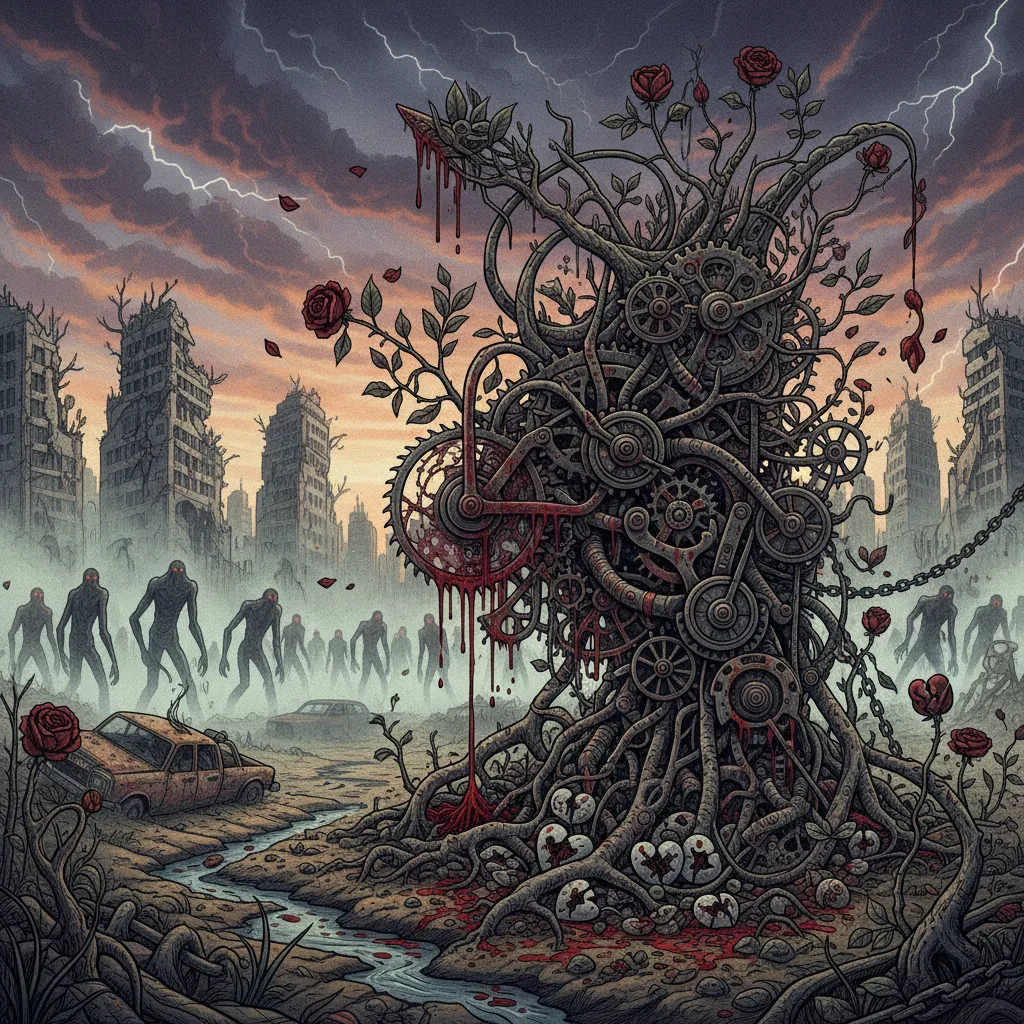
The symbolic network that once constrained the urge to couple has not merely frayed; it has suffered a catastrophic rupture, scattering its fragments across the debris of the highway and the relative calm of Hershel’s farm. One rose is an expression of sentiment; a dozen roses is symbolic oppression (de Beauvoir, 1952). But Maggie and Glenn offer us the ultimate zero-point: no roses at all.
I. The Socius as Choreographer: Stratification and the Capture of Sexual Flow
To understand their leap to hanky-panky, we must first map the Molar apparatus that policed romantic flow for the last two hundred years. The history of dating is the history of the socius attempting to territorialize the chaotic, libidinal currents of youth.
The earliest origins in community festivals—the line dancing, the synchronized steps—were not expressions of freedom, but rituals of Molar regulation. These required a physical discipline, where bodies were forced to move in a unified, observed manner. “The socius is the body without organs of the earth, the full body of the earth... It is on the socius that desire is forced to become a recorded, repressed desire” (Deleuze & Guattari, 1983, p. 10). The dance floor was this recording surface, enforcing social coherence by capturing and codifying the slightest sexual gesture. Any mistake was instantly observable and redirected by community elders—the high priests of the social recording apparatus.
The subsequent practices—calling, the chaperoned dates—merely shift the scale of the recording surface. Calling transfers the gaze from the community elders to the bourgeoisie’s snooping ears, translating public discipline into private, domestic surveillance. The chaperone, following the couple’s car, is the pure Molar sentinel, ensuring that the flow of desire does not exceed the sanctioned, stratified channel of socially acceptable courtship. The body of the woman, in particular, is subject to this rigid enforcement, a constant layering of Character Armor (Reich, 1949)—a rigid defense mechanism hardened into a patrimonial identity determined by the Father’s Law.
II. Capitalism’s Deterritorialization: Music, Text, and the Commodity-Sign
The collision of jazz and women entering the workforce marks a crucial, paradoxical moment in the history of desire: Capitalism’s deterritorialization.
The economy of desire moves out of the father’s parlor and into the bar, but the Abstract Machine of Capitalism cannot tolerate an uncoded flow. It immediately re-territorializes the liberation onto the commodity. Music ceases to be a regulatory ritual and becomes a consumer lifestyle signifier. The mix tape, the CD, the shared music taste—these are not flows of pure affect, but topographies of piercing styles, tattoo patterns, and consumer products. “The axiomatic of capital proceeds by deterritorialization, but only in order to reterritorialize on the commodity, on the sign of consumption” (conceptual synthesis of Deleuze & Guattari, 1983).
The internet and the dating app perfect this process. Desire is reduced to data-flow—a plastering of smiling faces and consumer preferences. The app itself is the ultimate Abstract Machine, transforming the physical, corporeal encounter (the communal festival) into an entirely textual, molecular flow of communication (email, text). This process exacerbates the ontological insecurity (Laing, 1960) of the subject: since the actual, lived body is absent, the self is fragmented, constantly seeking validation through the flat, digital affirmation of the match.
III. The Zero-Point of the Axiom: Maggie’s Line of Flight
When Maggie and Glenn meet, all these strata—the line dance, the chaperone, the profile—are dissolved. The symbolic order that kept the romantic discourse alive has been entirely corroded. Their jump to consummation is a pure line of flight from the social body.
This instantaneous coupling is not mere haste; it is a profound refusal of Oedipal capture. The old world dictated that the man and woman must first pass through the entire regime of signs (dating) to prove their allegiance to the Axiom before being permitted the flow of sex. By skipping this process, they declare the Axiom dead.
But Maggie’s motive is split—a schizophrenic fracture between the political and the primal.
A. The Neurotic Reterritorialization (The Paternal Gaze)
One flow asserts that Maggie is just trying to piss off her father. This, however, is the neurotic loop of rebellion. If her sexual freedom is motivated only by the desire to pick a mate furthermost from the ethnicity and socioeconomic class of her family of origin, her actions are still entirely determined by the Father-Axiom.
The father's system remains the magnetic north for her trajectory; her line of flight simply curves back into the Oedipal triangle. This neurosis, this compulsion to act against the Father, only reconfirms the Father’s ultimate power. This is the tragic failure of many rebellions—they seek to change the content of the stratifications without attacking the system of stratification itself.
B. The Uncoded Flow (The Well-Walker Event)
The true, molecular rupture in Maggie’s desire occurs not when they undress in the grocery store, but when she witnesses Glenn wrangle the obese and soggy zombie in the well. This is the Event (Badiou, 2005)—a moment of pure truth that cannot be contained by the existing codes.
Glenn’s action—the complex task performed under intense pressure—is the pure display of the survival-machine’s capacity for desiring-production. He bypasses symbolic wealth, class, and ethnicity, proving only his material utility and his molecular capacity to manage chaos-flow.
The well-walker is the ultimate test of the BwO. The walker is a chaotic, disgusting flow of fluids and decay (a perfect, non-productive Body-without-Organs). Glenn, by managing this flow, demonstrates a capacity that is purely genetic and purely political. He shows he can transform trauma into action, fulfilling the underlying ethical demand for critical consciousness and transformative praxis (Freire, 2000). Maggie's desire is thus reduced to the primal evolutionary drive, seeking a mate with demonstrable genetic benefit—a flow so fundamental it precedes both the Father’s Law and the Axiom of Consumption.
IV. The Becoming-Woman and the New Political Economy of the Couple
Maggie's forwardness is not a comment on neo-feminist discourse, which itself is often a reterritorialization onto new, coded lifestyles. Rather, it is a becoming-woman line of flight that refuses to be contained by the masculine systems of courtship, ownership, and surveillance.
As Deleuze and Guattari would ask, what is this becoming? "What is a becoming? It is not an imitation, nor an identification; it is the production of a zone of proximity... an emission of particles that shifts the dominant majority term" (conceptual synthesis of Deleuze & Guattari, 1987). Maggie's sudden sexual autonomy is the emission of particles—the refusal of the wait and the ritual—that shifts the dominant Patriarchal Axiom embodied by her father, Hershel.
The end of the world has returned desire to its point of origin: not community festivals, but primal, uncoded flow. The ultimate schizo-flow is the realization that the BwO must validate itself through pure material production (survival capacity, wrangling the zombie) rather than through symbolic consumption (mix tapes, church attendance).
The struggle, as Žižek (2012) might suggest, is to ensure that this primal coupling does not become another form of ideological fantasy—a retreat into the private sphere where the public, political struggle is ignored. Maggie and Glenn's relationship must constantly affirm its becoming-revolutionary status by continually refusing the comforts of reterritorialization, remaining open to the chaotic flows of the world, and validating their existence through praxis, not prayer. The Cherokee Rose, a symbol of domestic beauty and regional stability, must be replaced by the ultimate, uncoded aesthetic: the pure, terrifying utility of the desiring-machine in action.
Comments
Post a Comment