Schizoanalyzing The Walking Dead S2E3: The Abstract God-Machine and the Psycho-Political Failure of Faith
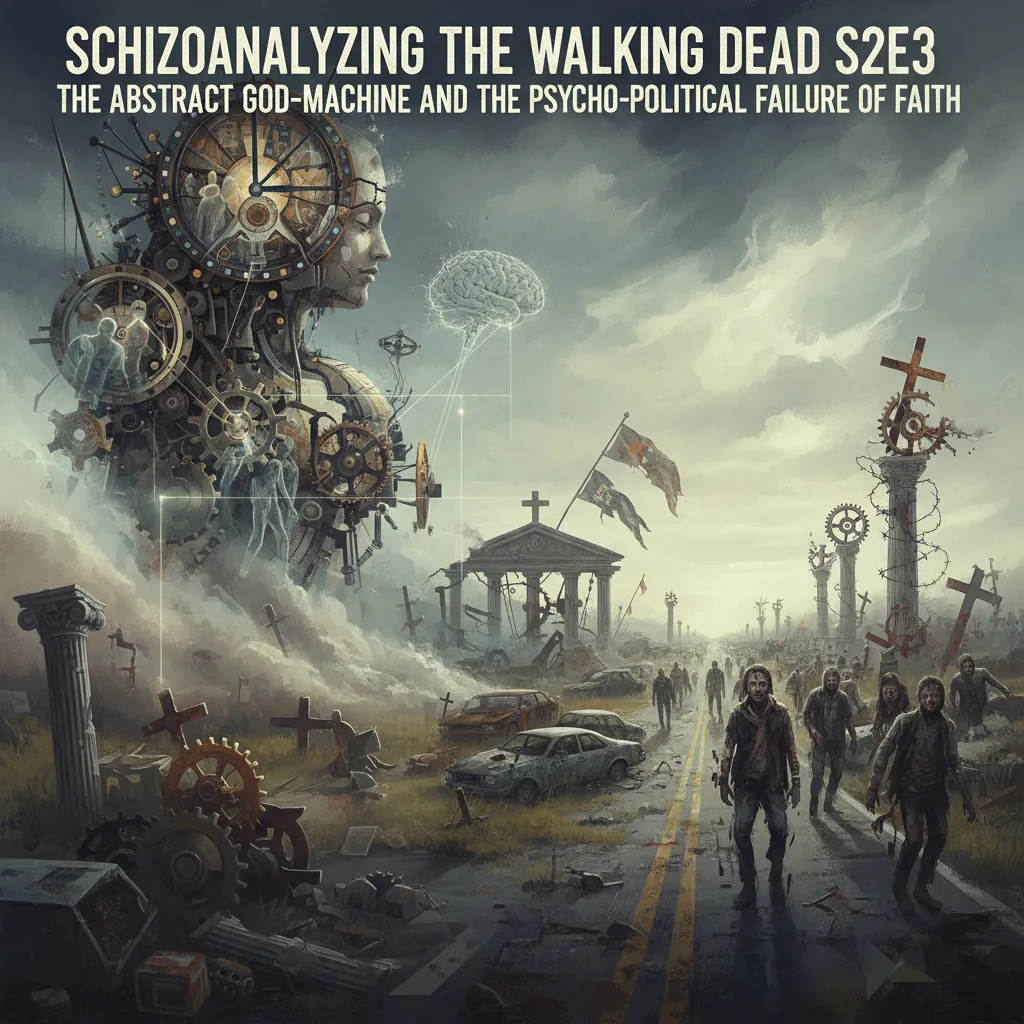
The theological scarcity in The Walking Dead is, in itself, the deepest political commentary . For all the death, there are few prayers, and those that erupt come only from characters already engaged in an ambiguous, schizo-neurotic dialogue with their own fracturing ego. Rick, previously, in an empty church, belts out a desperate plea for a sign—a stabilizing external validation to silence the dialogue of the self that constitutes his leadership crisis. The prayer is an attempted re-territorialization of his authority back onto the comforting strata of the divine Father-Law.
Now, in Save Last One, Glenn is found hunched over a rocking chair—a strange domestic simulacrum of the sacred—engaging in his first prayer.
Glenn: “I was Praying. I was trying to. . . Actually... ah... this is my first try.”
Glenn's prayer, tentative and watched by Maggie, is not a demand for divine intervention; it is a search for an external stabilization for his friends—the fragile, coalescing Molar group-unit. It is a desperate impulse to impose the Oedipal triangle (God/Father as Law-Giver, the Group as Child, Glenn as Mediator) onto the chaotic molecular flow of the apocalypse. Glenn seeks to borrow the Abstract Machine of God to stabilize his immediate social desiring-machine.
I. The God-Machine as Non-Existent Molar Structure
The conversation explodes when Maggie and Glenn circle the crisis of existence itself:
Glenn: “Do you think God Exists?” Maggie: “I always took it on faith. Lately I've wondered.”
The provided text rightly interrogates the philosophical premise: Existence is a property a thing has in the world, in space and time, verifiable by perceptual relationship. If the general Christian God is beyond space and time, then God is an entity that can be thrown into language but lacks existence proper.
From a schizoanalytic perspective, this is the crucial distinction: God is the ultimate, non-existent Molar structure that functions as the final, most terrifying Anti-Production of the socius. God is the Despotic Signifier that controls all flows by residing everywhere and nowhere. “The truth is that the socius is not a simple recording surface, but one where production is recorded, where desiring-machines and social machines join in the circuit of the socius” (Deleuze & Guattari, 1983, p. 30). God is the ultimate social recording device, encoding desire, lineage, and morality onto the individual without ever having to exist as a verifiable entity.
The chair analogy deterritorializes this concept: I can interrogate the properties of a chair in space-time. If the chair does not coincide with my being, my "faith" in it is bad faith in relation to temporal reality. The same applies to the non-existent God-Machine. Maggie, acculturated into the white male patriarchal family structure, is performing a programmed faith. Her conviction is not organic; it is an imposition onto her Body-without-Organs (BwO).
II. Faith as Axiomatic Capture and the Stratification of Desire
Maggie's "faith" is not a spontaneous molecular flow, but a highly stratified product of her environment. Her sociopolitical position—the "father's God fearing child" in a Southern religious community—has played a determinative role in foreclosing and promoting a routine of belief.
This is the pure function of the socius in regulating desire, as articulated by Deleuze and Guattari:
“The socius is the body without organs of the earth, the full body of the earth... It is on the socius that desire is forced to become a recorded, repressed desire” (Deleuze & Guattari, 1983, p. 10).
Maggie's faith is the inscription of the Patriarchal-Religious Axiom onto her BwO. Her "freedom" to choose faith is illusory; she was obligated into church attendance, ruthlessly acculturated to be in bad faith. Her entire capacity to distinguish between claims that require faith and those that do not was foreclosed by the established codes of the Hershel-Axiom. Her faith is the sedimented Character Armor (Reich) that provides social and familial security, even if it is ontologically void.
The possibility that Maggie is using a separate definition of being, or "experiencing psychosis," is the schizoanalytic core: the difference between the Molar code (God must exist for the structure to hold) and the Molecular reality (God is absent, therefore the subject is fragmented).
III. The Nietzschean Turn and the Autonomy of Narrative
Maggie’s true becoming-revolutionary act arrives at the end of the conversation, when she dismisses the question of God's existence as irrelevant:
Maggie: “...the thing is you have to make it ok somehow. No matter what happens.”
This is the explosion of critical consciousness (Freire) and the final deterritorialization of the divine code. She claims the title of theist but acts as a Nietzschean: there is no truth, God does not intervene, trauma is senseless.
The terrible, senseless experiences that intervene into our social and personal narratives (the bullet, the zombie flow) cannot be encoded by the failed religious Axiom. They are meaning-resistant. Maggie’s solution—to create a new narrative to recreate who we are in respect to the trauma—is the pure affirmation of the BwO.
If God exists, it doesn't matter, because the ultimate political economy of the world is now governed by molecular survival and self-production of meaning. The subject must become their own desiring-machine, capable of encoding a new self on the surface of their own BwO:
“The schizo is not the patient but the producer of desire, the one who knows how to move through the different regimes of the socius, constantly deterritorializing and reterritorializing” (Conceptual synthesis of D&G, Anti-Oedipus).
Maggie’s stance is the refusal to long for the Father-God. Her pragmatism is the path to true atheism—the stance where, as Zizek argues, the question is irrelevant. The struggle towards meanings is the only process that makes life relevant. The ultimate revolution is the realization that the BwO must be its own recording surface, free from the non-existent Molar Signifier.
Comments
Post a Comment