Schizoanalyzing The Walking Dead S2E1: The Gastro-Anal Deficit and the Problem of Necrotic Flow—A Definitive Argument on the Zombie Pooping
Section I: Introduction: The Highway as a Stoppage in Molar Flow
1.1 The Necrotic Axiomatic: Crisis and the Collapse of the Socius
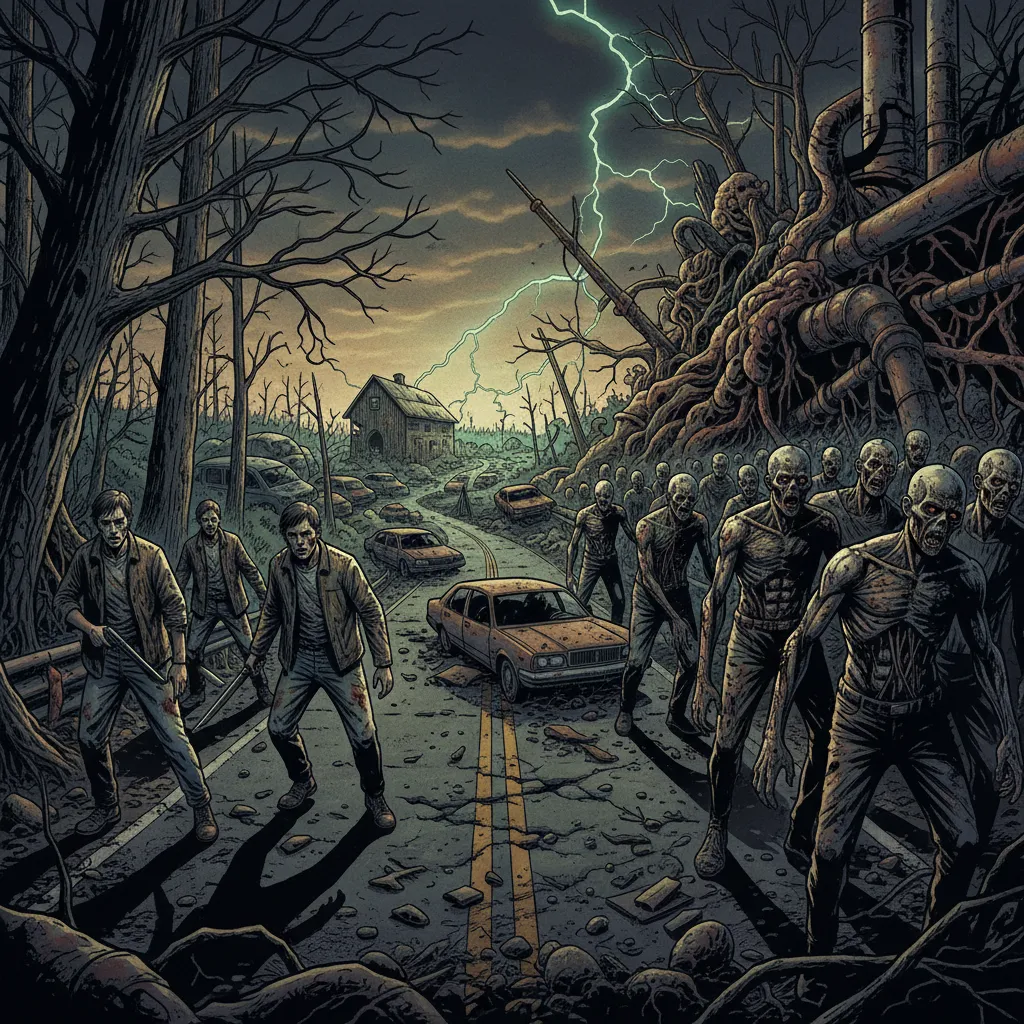
The opening sequence of The Walking Dead Season 2, Episode 1, featuring the abandoned highway, is not merely a cinematic scene of post-apocalyptic decay but a profound diagrammatic representation of the collapse of the molar social machine. The discarded vehicles and motionless traffic symbolize "a sudden stop in the Molar flow of civilization" [original text]. This abrupt cessation signifies a catastrophic, traumatic decoding of established territorial flows.
The socius, which relies upon sophisticated mechanisms of coding and stratification to organize production and maintain hierarchy, necessitates a specific regime of repression—or, more efficiently, a system where "repression, hierarchy, exploitation, and servitude are themselves desired".1 The zombie apocalypse represents the moment when this repressive-coding system fails absolutely, leading to a massive, immediate deterritorialization of all material and psychological flows. However, this failure does not liberate these flows into a productive, schizophrenic process; rather, the chaotic output is instantaneously captured and re-territorialized onto a radically impoverished biological axiomatic: pure, relentless consumption. The horde is thus a decoded flow of primal hunger, but its action—the devouring of the living—fails to create a new, functional machine or code. The molar structure (civilization) stops, but the molecular flows that emerge are immediately frozen into a state of mechanical, lethal repetition, preventing revolutionary transformation.
1.2 The Question of the Poop: Excretion as the Non-Metaphorical Hinge
The primary philosophical question addressed by the zombie's existence—its capacity for excretion—compels an analysis rooted in the mechanical operation of the body, moving beyond symbolic or theatrical representations. Deleuze and Guattari argue forcefully that the schizoanalytic approach must move away from idealism: "The great discovery of psychoanalysis was that of the production of desire, of the production of the unconscious. But once Oedipus entered the picture, the discovery was soon buried beneath the new brand of idealism: a classical theater was substituted for the unconscious as a factory".2 Schizoanalysis demands that representation be substituted for the actual "units of production of the unconscious".2
The ontological problem of the zombie's waste cannot be resolved by analyzing its status as an icon of horror; rather, it must be solved as an engineering problem. This framework necessitates analyzing the digestive tract as an apparatus of desiring-production involving input flows (ingestion), processing cuts (metabolism), and output flows (excretion). The body is a collection of coupled technical machines, and "Everywhere it is machines, not at all metaphorically: machines of machines, with their couplings, their connections".3 The failure to produce waste is thereby a failure to complete the cycle of production, confirming a total blockage in the body's mechanical operation.
1.3 Cartography and Claims: The BwO of Terminal Congestion
The central claim of this report is that the zombie embodies the limit-state of the pathological Body without Organs (BwO): the BwO of the Death Drive, defined by terminal congestion. This is a state resulting from the catastrophic failure of the disjunctive synthesis—the excretory cut—required to expel the residual product.
The zombie's entire physiological structure has become a site of antiproduction. The "pure BwO, the BwO at its limit, is totally unproductive. This is why D&G will come to associate it with the death drive".4 While productive desiring-machines operate through continuous breakdown coupled with renewal, the necrotic machine achieves a static, catatonic breakdown that generates no renewal. The zombie’s movement is a mechanical ritual required only to sustain the internal, non-generative process of decay. It is the inverse of the intensive, productive BwO; it is a limit-body where antiproduction—the internal accumulation of rot—has completely overwhelmed any potential for functional production or flow management.
Section II: The Ontology of Production: The Machine-Logic of Consumption and Blockage
2.1 Desiring-Machines: Production, Flows, and the An-Oedipal Reality
The analysis of the zombie begins with the fundamental axiom of schizoanalysis: the identity of desire and production. Desire is not a lack; it is a force that creates reality. "Desire is the set of passive syntheses that engineer partial objects, flows, and bodies, and that function as units of production... Desire is a machine, and the object of desire is another machine connected to it".5 Furthermore, desire "can be productive only in the real world and can produce only reality".5 The zombie’s frenzied pursuit and consumption of flesh is thus a real machine, achieving a concrete connective synthesis: the coupling of the mouth-machine to the source-machine (the living victim). The ingested flesh is a captured flow, a real product of the initial desiring act.
However, the problem arises in the subsequent syntheses required for integration and resolution. The zombie machine is hyper-focused on the immediate, aggressive connection—the biting—which constitutes an anoedipal, pre-oedipal partial object relation.6 The partial objects of mastication (teeth, jaw) function as units of production solely for the act of ingestion. The flow of life is cut short and internalized, but this process terminates immediately, failing to engage the systemic, passive syntheses necessary for transformation. The immediate product of the zombie machine is therefore not sustenance or energy, but blocked flow and necrosis. The output flow of the zombie is the flow of non-life, a product generated by the internal system’s mechanical incapacity to process the input.
2.2 Flows, Cuts, and Couplings: The Failure of Metabolic Synthesis
The metabolic failure of the zombie is structurally defined by the incomplete coupling of its organ-machines, specifically the digestive tract. The body, human or zombie, is fundamentally organized by the relationship between flows and interruptions. The system must operate such that, "For every organ-machine, an energy-machine: all the time, flows and interruptions".1 The cutting action defines this operation: "An organ-machine is connected to a source-machine: the one produces a flow that the other cuts".3
In the case of the living human, the flow of ingested food (the source-machine's product) is subjected to a series of cuts by the gastric and intestinal machines (the organ-machines). These cuts are transformative processes—digestion and metabolism—that break the matter down into functional energy and manageable waste. In the zombie, however, the flow of ingested flesh is internalized, but the necessary cut is absent. Necrosis has deactivated the complex enzymatic and circulatory systems required for processing. The flow is interrupted—it enters the body—but the transformative cut is functionally zero. The food remains merely an internal accumulation of putrescent matter, failing to yield energy or transform into a differentiated, excretable product.
The kinetic energy described in the introductory text—"The entire process—the chewing, the pursuit—is a kinetic, furious detour towards a final, absolute zero-point" [original text]—is a pure, deterritorialized expenditure of force. Yet, this energy is immediately and paradoxically re-territorialized onto the sole site of function (ingestion), without ever engaging the metabolic axiomatic. The zombie demonstrates kinetic action but lacks productive, metabolic flow. The "absolute zero-point" is the internal destination of this process: the terminal congestion and rot that defines the biological stasis of the machine.
Section III: The Catastrophic Body Without Organs: Necrosis as Anti-Production
3.1 The BwO of Stagnation: The Death Drive Made Flesh
The zombie’s existence represents the concrete realization of the catastrophic BwO, differentiating it sharply from the desirable, intensive BwO of smooth flows. The necrotic body is the BwO defined by inertia, its motor being the death instinct itself. While the death instinct provides the energy, the body itself is the site of pathological decoupling.
Desiring-machines, when functional, couple production with antiproduction. Their productive capacity is maintained only through constant breakdown and renewal. Deleuze and Guattari specify this necessity: "The full body without organs belongs to the realm of antiproduction; but yet another characteristic of the connective or productive synthesis is the fact that it couples production with antiproduction, with an element of antiproduction. Desiring-machines work only when they break down, and by continually breaking down".4 The zombie machine is broken down biologically, but this breakdown is not coupled with renewal; it is a terminal breakdown. The ingestion of flesh does not recycle the decay; it simply adds new fuel to the process of stasis. The rot that accumulates is the non-expelled product of antiproduction, trapped within a system that has lost the ability to deterritorialize its own waste. The resulting state is a pathological decoupling, where antiproduction has become the exclusive function and output of the entire organic system.
3.2 Consumption Without Integration: The Piling Up of Rot
The horror of the zombie machine is its efficiency in consumption coupled with its absolute inefficiency in integration, resolving the definitive schizoanalytic distinction between production and disposal. The original statement confirms this: "The zombie machine is defined by consumption without excretion, production without disposal... it consumes the living without integrating or resolving the product. It has no ethical problem with waste because it has no system of stratification—it is a closed, pathological loop of destructive desire that only piles more internal rot upon existing rot" [original text].
The lack of a "system of stratification" is the technical definition of metabolic failure. Stratification refers to the necessary internal cuts and differentiations (biological codes) that allow the body to distinguish between useful energy, structural material, and residual waste. Without this stratification, the incoming flow (flesh) is treated identically to the existing internal territory (the necrotic body). It simply adds undifferentiated volume to the internal site of decay. The result is the physical manifestation of the pathological loop: an engine designed solely to ingest and accumulate decay, continually raising the internal pressure of rot until mechanical fragmentation or complete stasis occurs.
3.3 The Ethical Failure of the BwO: Repression and Necrotic Coding
The zombie’s terminal congestion also highlights a unique instance of biological repression. While society relies on repressing desire to establish and maintain order, resulting in the "fabrication of docile and obedient subjects" 2, the zombie represents a state where all vital, self-regulatory flows (circulation, complex metabolism, excretion) are completely repressed by the necrotic process. Yet, the central, primitive, connective desire (hunger) remains intensely active.
This necrosis provides a new, terrifying axiomatic coding of the body—a code of pure consumption-inertia that successfully represses every flow except the initial act of ingestion. The ethical failure articulated in the source text is the machine's absolute lack of ability to manage its flows. The zombie machine is ultimately the most docile subject imaginable: one perfectly subjugated to the single, destructive imperative of its own necrotic coding.
Section IV: The Gastro-Anal Deficit: Schizoanalyzing Excretion and Waste
4.1 The Schizo-Mouth: The Kissing Device and the Failed Functionary
The lip, the kiss, the softest border between the sexual and the digestive, becomes a point of acute schizoanalytic tension. Let us detour through the mucous membrane:
"The kiss... is held in high sexual esteem... in spite of the fact that the parts of the body involved do not form part of the sexual apparatus but constitute the entrance to the digestive track" (Freud, Three Essays on the Theory of Sexuality). [original text]8
Freud gives us the necessary fracture: the sociopolitical value of the lip (the kiss, the symbolic exchange) and its base functional reality (the digestive tract’s suction device). The zombie mouth, however, is a site of terminal failure. It retains the compulsion for contact, for intimacy through ingestion, but it has lost the functionality. The lips are no longer kissable, nor can they perform the precise suction required to move the flow of food. They are reduced to blunt tools—pure deterritorialized jaw action.
The zombie's bite is not an act of reproduction (it is not a virus) nor nourishment. It serves the same purpose as using a rock: it is a Molar tool to kill, a means to introduce chaos into the organized world. The zombies seek no nutritional benefit; their desire is simply to create more identical desiring-machines by reducing the living to the uncoded dead. Their consumption is a pathological, metaphysical demand: to make the living affirm the necrosis. [original text]
4.2 The Solar Anus and the Anal Machine: The Non-Metaphorical Production of Product
To definitively address the question of excretion, the schizoanalytic approach demands that the anal function be understood as a site of rigorous, non-metaphorical production. The mouth itself is viewed as capable of oscillating between different machines, wavering between "an eating-machine, an anal machine, a talking machine, a breathing machine".3 The anal mechanism is a fundamental, active machine of production within the BwO.
The definitive schizoanalytic statement on the productivity of expulsion comes from the analysis of Judge Schreber:
"Hence we are all handymen: each with his little machines. For every organ-machine, an energy-machine: all the time, flows and interruptions. Judge Schreber has sunbeams in his ass. A solar anus. And rest assured that it works: Judge Schreber feels something, produces something, and is capable of explaining the process theoretically. Something is produced: the effects of a machine, not mere metaphors".1
The significance of the solar anus is its assertion that excretion, or expulsion, is a productive act—it generates a flow or product. The zombie, by contrast, is defined by the zero cut. No matter the volume of input (flesh), the anal machine is rendered completely inoperative by the terminal congestion achieved in Section III. If the Schreberian experience proves that the cut/expulsion is production, the zombie's blocked tract proves the systematic absence of production. The digestive process cannot execute the final disjunctive synthesis (excretion) because the upstream metabolic cuts have failed entirely. The body contains matter, but it has not produced waste as a product—it has only produced rot and accumulation.
This structural failure can be formalized by comparing the productive machine with the necrotic machine:
Component | Human Desiring-Machine (Schreber/Survivor) | Necrotic Desiring-Machine (Zombie) | Schizoanalytic Status |
Input Flow | Connective Synthesis (Food/Trauma) | Connective Synthesis (Flesh/Impact) | Operative (Immediate coupling) |
Processing Cut | Gastric/Intestinal Machine (Metabolic Transformation) | Absent Cut (Necrosis/Stasis) | Inoperative (Terminal congestion) |
Disjunctive Synthesis | Anal Machine/Solar Anus (Expulsion/Deterritorialized Product) | Zero Cut (No expulsion possible) | Failure (Accumulation/Hyper-territorialization) |
Excretory Product | Waste as Deterritorialized Flow/Energy ("Something is produced") 7 | Rot as Internal, Territorialized Stasis | Pathological Antiproduction |
4.3 The Zizekian Waste and the Ethics of the Gut
The burning side-question, the truly deterritorializing query, is the problem of waste: Do zombies poop?
The immediate, associative answers: Zombies do not poop, and even if they did, we may never know. The clothes are too dirty, the muck too thick to distinguish the stain. The digestive tract is seized—gravity, not suction or acid, is the only factor in people-chuck descent. Brainz cannot make the long journey without a fully functional, contractile system. [original text]
But the question is not biological; it is ethical and political. We must detour through the problem of human waste:
"One of the features which distinguishes man from the animals is precisely that with humans the disposal of [poop] becomes a problem." (Slavoj Žižek, The Plague of Fantasies). [original text]
Disposal is the problem of the Axiom. Civilization is defined by the rigid stratification and management of its flows—the sewer systems, the refuse disposal, the elaborate social contracts built around what is deemed waste and what is deemed useful.
The Ethical Failure of the BwO: The zombie, as pure BwO, does not manage its flows. The zombie machine is defined by consumption without excretion, production without disposal. This is the final philosophical horror: it consumes the living without integrating or resolving the product. It has no ethical problem with waste because it has no system of stratification—it is a closed, pathological loop of destructive desire that only piles more internal rot upon existing rot. [original text]
Section V: The Becoming-Revolutionary of the Survivors: Processing Trauma and Desire
5.1 Refusing the Terminal Congestion: The Ethical Imperative
The existential and ethical dilemma of the survivors in The Walking Dead is precisely defined by the need to manage flows, lest they replicate the zombie's mechanical failure. The survivors must avoid the inertia and self-choking, closed-system thinking that defines the necrotic machine. Their mandate is a "becoming-revolutionary process that constantly manages the flows of trauma and desire, ensuring that the body and the social group remain open systems—capable of processing the outside, excreting the waste, and refusing the terminal, self-choking congestion of the necrotic machine" [original text].
To "metaphorically and literally poop" is the ethical demand for continual deterritorialization—expelling the accumulated psychological and social "waste" (trauma, outdated morals, rigid hierarchy) that could lead to systemic congestion.
5.2 The Decoding of the Apocalypse and the Schizophrenic Process
The collapse of the Molar civilization forces the survivors into a state of intense decoding. The abandonment of the highway forces the characters out of their old, fixed, Oedipal roles and into a nomadic, open existence. This situation presents the potential for a genuine schizo-process, defined by the "unstructured process of emission of random flows" 9 and the "immediate investment of a historical social field".9
The dream of the revolutionary flow involves desire that "dream[s] instead of wide-open spaces, and... do not let themselves be stocked within an established order".1 Survival requires the "courage" to accept this nomadic state, agreeing "to flee rather than live tranquilly and hypocritically in false refuges".2 If the survivors attempt to rapidly re-establish repressive, authoritarian camps or rigidly defined social structures, they merely replicate the old societal coding and embrace a new form of congestion, failing to manage the flow of decoded desire.
Section VI: Conclusion and Cartographic Synthesis
The intensive schizoanalysis of the zombie's digestive function confirms its definitive status as the Body without Organs of the Death Drive. The original textual argument, which posited a machine "defined by consumption without excretion," is validated through the functional logic of desiring-machines.
6.1 The Definitive Answer: The Zombie's Failure as Ontological Proof
The question of whether the zombie poops is answered definitively: The zombie cannot and does not poop.
This inability is not a simple biological consequence of death, but an ontological truth established by the schizoanalytic framework. Excretion is defined as the product of the disjunctive synthesis—the necessary cut required for the machine to produce and expel a deterritorialized flow of waste. Because the necrotic process has achieved terminal congestion by deactivating all metabolic stratification (cuts), the ingested flow is immediately hyper-territorialized as internal rot, bypassing the anal machine entirely. The zombie is a closed, pathological loop, where the zero cut ensures the perpetual internal accumulation of antiproduction, confirming its status as a self-choking machine that embodies absolute inertia.
6.2 Future Directions: Viral Flows and Necro-Axiomatics
The zombie provides a crucial cartographic tool for analyzing systems that produce stasis and congestion. The necrosis that defines the zombie's mechanical failure is analogous to ideological, bureaucratic, or capitalist systems that accumulate and fail to process or expel their own waste (e.g., debt, trauma, bureaucracy). These are systems that consume reality (labor, resources) but generate non-life (stasis, crisis) as their primary product, refusing the necessary cuts required for productive renewal. The zombie's physical state, therefore, serves as the ultimate warning against any closed system that confuses hyper-consumption with productive flow, trapping its contents in an endless, anti-productive cycle of internal decay.
References
Deleuze, G., & Guattari, F. (1983). Anti-Oedipus: Capitalism and schizophrenia (R. Hurley, M. Seem, & H. R. Lane, Trans.). University of Minnesota Press. 10
Freud, S. (1905). Three essays on the theory of sexuality. In J. Strachey (Ed.), The standard edition of the complete psychological works of Sigmund Freud, Volume VII (1901-1905): A case of hysteria, three essays on sexuality and other works (pp. 123–246). Hogarth Press. 8
Žižek, S. (1997). The plague of fantasies. Verso. 12
Comments
Post a Comment