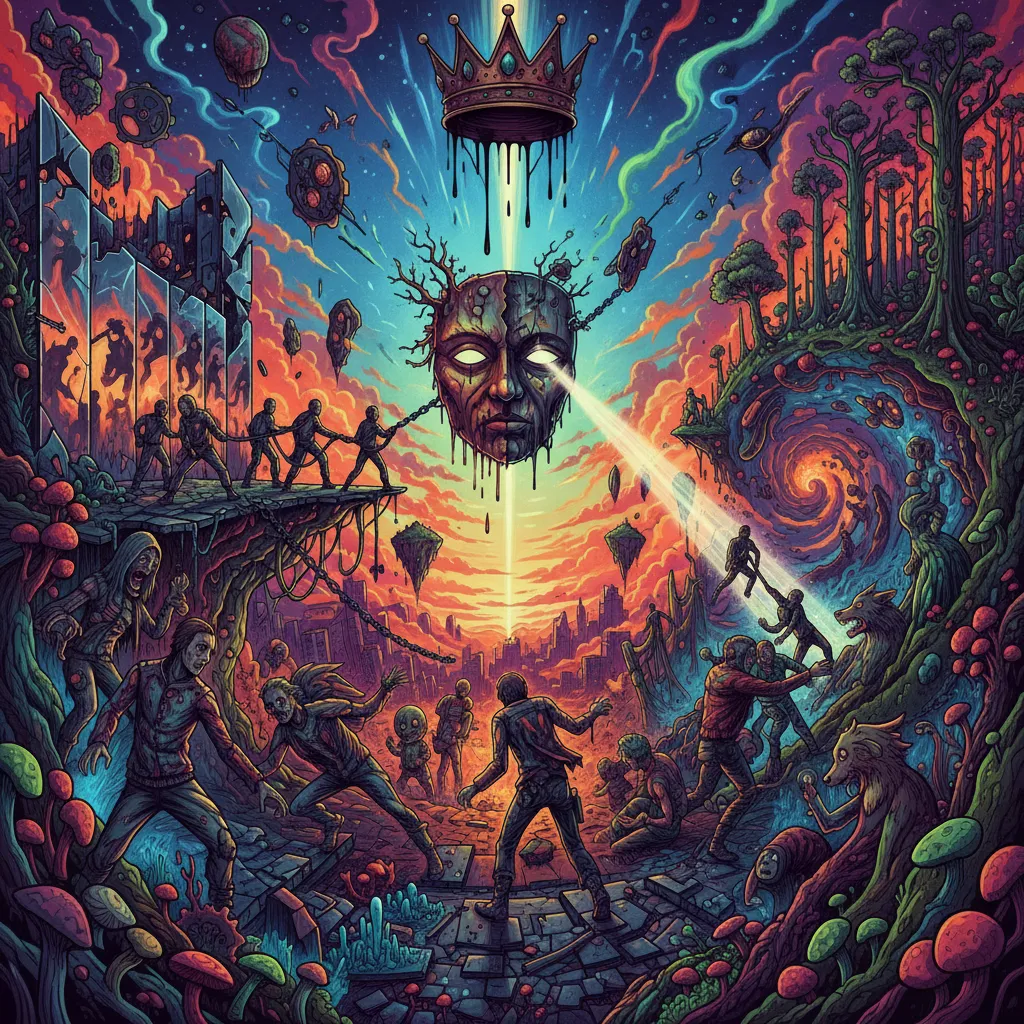
The ultimate schizophrenia is not the loss of reality, but the terrifying clarity that the Law itself is an empty set, a ringing telephone connecting the subject only to its own manufactured guilt.
The collapse of the world, that magnificent deterritorialization of all social and economic strata, failed to deliver the Body-without-Organs (BwO) promised by the absolute flux. Instead, S3E9, "The Suicide King," reveals the grim re-territorialization of the psychic apparatus under pressure. It is not the zombies—the pure, non-productive dead-flow—that paralyze Rick Grimes, but the ghost of Lori, the ultimate Oedipal signifier, who returns not as a person, but as the voice of the Repressive Code. This episode is the clinical demonstration of the subject’s failure to achieve the schiz-flow, instead succumbing to the Paranoid Administrator that occupies the mind even when the physical world has been reduced to dust. This administrator ensures that the catastrophic line of flight opened by the apocalypse snaps back, binding the desiring-machines of the survivors to the oldest, most crippling forms of social debt (Deleuze & Guattari, 1983).
The Dialectics of the Telephone and the Oedipal Debt-Flow
The true horror of the apocalypse is the persistence of neurosis. Rick's communication with the phantom telephone is the quintessential machinic assemblage of psychic failure. The instrument—an amputated umbilical cord of the pre-apocalyptic Law—rings without a sender, existing only to transmit the Guilt-flow directly into the desiring-production of the schizoid subject. It is the perfect Lacano-Deleuzian joke: a call from the Big Other (Žižek, 2008) who doesn't exist, forcing the subject to hear its own internalized censorship.
The voice on the line is Lori, the Maternal/Symbolic Signifier. Her spectral presence is the mind’s final, desperate attempt to re-code the overwhelming, unstructured chaos of the Outside (the walkers, the Governor’s war-machine) back onto the manageable, internal tragedy of the Oedipal Triangle. Why Lori, and not Shane, the visceral, authentic Brother-Machine whose murder was the real traumatic event?
Shane represented the schizo-flow of raw, amoral survival. He embodied the possibility of an ecstatic becoming-animal (Deleuze & Guattari, 1987), an existence entirely outside the limits of the Repressive Code. Rick's killing of Shane was the political act necessary to re-territorialize the group under a new, albeit fragile, Code of Law. To hallucinate Shane in a wedding dress—to acknowledge the profound, destructive homosocial desire-flow and debt of blood—would be to completely undermine the entire foundation of Rick’s post-apocalyptic identity as the Protector and Father. Such a vision would force a schizoid deterritorialization so absolute that Rick’s Character Armor (Reich, 1972) would shatter, leaving him entirely exposed to the molecular chaos he desperately seeks to repress.
Lori, conversely, allows for safe neurosis. She is the Signifier of the Law and the Debt of the Family. Her voice demands not liberation, but confession, responsibility, and the re-inscription of the dead family's Symbolic Order. Rick is not grieving Lori the woman; he is grappling with the Death of the Oedipal Machine she symbolized, now weaponized by his own mind to prevent the terrifying freedom of the schizo-subject. The phone calls are the desiring-machine of guilt operating on auto-pilot, generating anxiety and paralysis to maintain the Psychic Stratum against the pure, non-coded flow of the outside. The Suicide King stands paralyzed not by external threat, but by the internal logic of the Code he is too afraid to fully dissolve (Deleuze & Guattari, 1983, p. 77).
Daryl and Merle: The Molecular Flow of Kinship vs. The Molar Assemblage of the Group
The reappearance of Merle Dixon during the Governor’s retaliatory attack forces a catastrophic bifurcation in the desire-flow of Daryl, the Prison’s most effective Nomadic Machine. Daryl, the tracker, the hunter, the pure line of flight against the structured world, had successfully integrated into the molar assemblage of the Prison group, finding a new, ethical territoriality under Rick’s fragile Law.
Merle, however, represents the Arch-Territoriality of their shared, brutalized past. He is the original assemblage of kin—a pre-political, genetically coded debt-machine. Merle's body itself is a flow of trauma; his amputated hand is the literal deterritorialized body part that constantly reminds Daryl of the social failure of his new group (they left Merle to die) and the social reality of his old group (they stuck together, however violently).
Daryl's decision to leave with Merle is an act of Fidelity to the Event (Badiou, 2005) of kinship, temporarily overriding his fidelity to the emerging Truth of the collective. It is the molecular desire for the old flow temporarily overwhelming the newly installed social debt. The two brothers become a desiring-machine of sheer, immediate survival and fraternal loyalty, momentarily refusing the discipline of the molar group and the obligations of the nascent State-form that the Prison represents.
Merle is the ultimate schizoid repository of social trauma. He is the racialized signifier of the 'othered' white working class, the subject already rejected by the pre-apocalyptic social machine. His body bears the marks of this rejection, making him a walking critique of the social order. Daryl, in following him, chooses the purity of the schizo-line—the path of non-integration and refusal—over the safety of the Paranoid Stratum of the Prison. It is a terrifying regression: the embrace of the archaic, familial stratum over the political-ethical stratum. The flow is directed backward, attempting to re-establish a minoritarian machine that is already destined for failure because it lacks the productive capacity (the land, the knowledge, the ethical code) necessary to sustain itself outside the larger molar formations.
Woodbury's Dissolution: From Spectacle to Reactive Nihilism
The Governor's retaliatory attack—a poorly coordinated, impulsive gesture—is less a military maneuver and more a chaotic flow-discharge of his own humiliation. The resulting chaos in Woodbury, with residents panicking and demanding retreat, signals the profound failure of his Paranoid Stratification.
Woodbury was built on the diversion of the schizo-flow of the apocalypse into a controlled spectacle (the arena fights, the contained 'safety'). The Governor successfully acted as the Administrator of Appearance, selling the illusion of absolute order. Once Rick's nomadic war-machine ruptures that spectacle, exposing the community to the unmediated chaos of the outside, the internal order collapses into pure anxiety.
The inhabitants, denied the opportunity for outward vengeance against the invaders, turn their frustration inward, entering a phase of intense Ressentiment (Nietzsche, 1968). This is the reactive emotion of the weak, who, accustomed to the protection of the tyrannical molar structure, cannot handle the freedom of the void. They beg for the return of the Administrator, demonstrating that the libidinal energy of the crowd is not aimed at liberation, but at the comfortable re-inscription of control.
The Governor's subsequent withdrawal and feigned abandonment is a masterstroke of strategic deterritorialization. He understands that to regain power, he must stop being the spectacle and become the pure, focused War-Machine. By letting the survivors experience the truth of the lack—the absence of the promised order—he ensures their eventual, desperate return to his Code. He transforms himself from the neurotic administrator who needed the heads in the tank to the schizo-tyrant driven by a singular, unmixed desire for pure, surgical vengeance against Rick. This is the ultimate lesson in political economy: the totalizing code of the tyrant, once lifted, leaves behind a vacuum filled not by democratic action, but by the paralyzing flow of nihilism.
The Prison as the Failed Body-without-Organs
The Prison, in this episode, functions as a body under severe psychic stress, struggling to maintain its territorial surface. The structure itself—a stratified, concrete bunker—is the physical attempt to realize the BwO as a purely defensive shell, a hardened exterior against the smooth space of the infected world. Yet, the molecular chaos of the outside constantly invades: first, the Governor’s bullets (the organized flow of destruction), and second, the unregistered code of Rick’s psychosis (the ringing phone).
The desiring-machine of the community is now stalled. It is unable to produce survival (food, defense) because its central organizing principle (Rick) is consumed by internal repression. The only productive force remaining is the sheer, unyielding will-to-continue embodied by subjects like Glenn, who force the issue. Glenn’s aggressive confrontation with Rick is not just a personal challenge; it is the ethical subject (Badiou, 2005) demanding the political subject’s return to immanence. Glenn demands that Rick stop operating in the subterranean stratification of his guilt and return to the surface of the collective BwO.
This confrontation is a necessary evental break that shatters the internal stasis. Rick’s eventual return to functionality marks the painful re-coding of the Prison group’s purpose. They affirm their commitment to the new socius—a minoritarian assemblage focused on the production of a new, post-Oedipal ethical code, one that prioritizes the collective will-to-power over the paralysis of individual guilt (Nietzsche, 1968).
The tragedy, however, remains fixed: the apocalyptic rupture failed to fully liberate the subject. Instead, the mind—fearful of the unlimited flow—reverts to its most familiar, repressive patterns. The Body-without-Organs remains a tantalizing promise, perpetually deferred by the seductive, terrible voice of the Law on the other end of the dead line. The schizoanalysis confirms that the true enemy is not the walker, but the Capitalist/Oedipal code that continues to stratify the mind, even in the absence of civilization. The walk continues, but the footsteps are heavy with the dust of the old world's neuroses.
References
Badiou, A. (2005). Being and event. (O. Feltham, Trans.). Continuum.
Deleuze, G., & Guattari, F. (1983). Anti-Oedipus: Capitalism and schizophrenia. (R. Hurley, M. Seem, & H. R. Lane, Trans.). University of Minnesota Press.
Deleuze, G., & Guattari, F. (1987). A thousand plateaus: Capitalism and schizophrenia. (B. Massumi, Trans.). University of Minnesota Press.
Freud, S. (1961). Civilization and its discontents. (J. Strachey, Ed. and Trans.). Liveright Publishing.
Nietzsche, F. (1968). The will to power. (W. Kaufmann, Ed., & W. Kaufmann & R. J. Hollingdale, Trans.). Vintage Books.
Reich, W. (1972). Character analysis. (V. R. Carfagno, Trans.). Farrar, Straus and Giroux.
Žižek, S. (2008). The sublime object of ideology. Verso.
Comments
Post a Comment