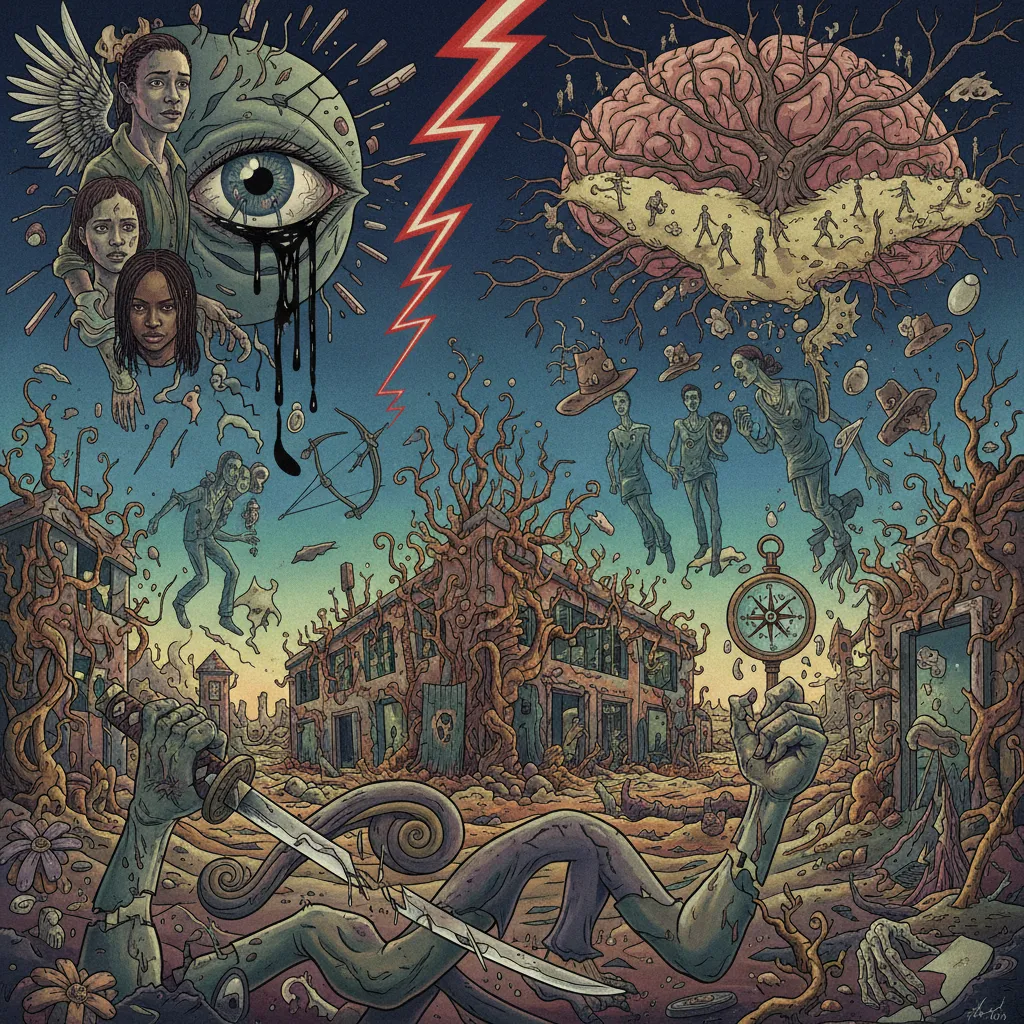
The territorial imperative is merely the death drive disguised as order, and in the post-Oedipal desert, every connection is a seizure of the free flow of becoming.
The machinic delirium of "Hounded" is not merely a narrative of pursuit and capture, but a rigorous diagramming of the war between the molecular and the molar in the aftermath of total deterritorialization. The world, stripped of its social, symbolic, and economic codes, is now the Body-without-Organs (BwO)—a surface of pure capacity where flows of desire, death, survival, and aggression connect without mediation. This episode simultaneously maps the terminal schizoid collapse of the individual subject (Rick) and the violent re-stratification of the collective subject (Woodbury’s fascist hunt). It is the moment where the nomadic urge to flee encounters the Paranoid Administrator’s absolute need to re-code, capture, and territorialize every stray flow.
I. Rick and the Terminal Circuit of the Schizoid Scream
Rick Grimes, locked in the fetal space of the prison boiler room, is not grieving; he is experiencing a schizoid line of flight that has become a closed, non-productive loop. The death of Lori was the final blow to the Oedipal machine—the familial unit and the patriarchal guarantee—that he desperately clung to. Without the mother/wife object, the Oedipal triangulation dissolves entirely (Freud, 1961), leaving the subject exposed to the terrors of the undifferentiated BwO.
The phone calls are the central desiring-machine of this collapse. Rick’s desire is for re-territorialization into the lost Symbolic Order. The voices—Amy, Jim, Jacqui, and finally Lori—are not ghosts of the dead; they are the ghost of the socius itself, the recorded echoes of the former social machine that once provided him with an identity (Sheriff, Husband, Father). His attempts to dialogue are a search for the absent code that justifies his acts and anchors his sanity.
This is the pure expression of ontological insecurity (Laing, 1960). His 'real self,' unable to cope with the reality of his political choices (killing, leading, losing), has evacuated the body, leaving the 'false self' to participate in this meaningless circuit. The phone literally connects him to non-existence—a "happy magic land zombie free" that exists only as a fantasy of the code restored. The calls ask him to account for his violence and his loss ("explain his justification for killing other people," "refusing to talk about Lori's death"). The voices demand a symbolic accounting—a language of confession and explanation. Rick’s final act of hanging up is a temporary, non-linguistic liberation—a refusal of the therapeutic capture of his psychosis. He rejects the lie of communication and enters the silence.
II. Merle’s Muscular Armor and the Molar Hunt-Machine
Merle Dixon, tasked by the Governor to hunt Michonne, is the embodiment of fascinated aggression rigidly coded into a military-machinic apparatus. Merle is the perfect fascist subject, his entire life flow captured and re-routed into the service of the Paranoid Administrator.
Merle’s body is a walking monument to Character Armor (Reich, 1972). His prosthetic hand, a weaponized extension of his body, is the technological prosthetic of his defense mechanism—a literalization of the muscular rigidity and repressed emotional flow that has hardened into an identity defined by violence and loyalty to authority. The hunt is not about justice; it is about re-stratification. Michonne represents a line of flight that successfully ruptured Woodbury’s territorial membrane. Her escape is an Event (Badiou, 2005) that threatens the consistency of the Governor’s constructed world. She must be nullified to prove the eternal stability of the new fascist code.
Merle’s hunt becomes a desiring-machine of pursuit, driven by the flow of reactive nihilism (Nietzsche, 1968). He is chasing not Michonne, but the nomadic freedom she embodies—a freedom Merle traded long ago for the security of being an authoritative appendage. When the walkers converge, pinning them down, the molecular flow of death interrupts the molar hunt. Michonne escapes by literally becoming-walker—slicing open a corpse and covering herself in entrails. This becoming-unnoticeable is a supreme act of deterritorialization (Deleuze & Guattari, 1983). She uses the flow of decay to nullify her flow of identity, passing through the BwO unrecorded.
Merle’s subsequent decision to kill the eyewitness, Gargulio, before lying to the Governor, is the ultimate affirmation of the molar code. The truth of the failed hunt—the Event of Michonne’s escape—must be suppressed to maintain the illusion of the machine's omnipotence. Merle’s loyalty is not to the Governor as a person, but to the totalizing lie of the Woodbury assemblage.
III. Andrea’s Capture and the Biopolitical Sex-Machine
Andrea’s journey from critical bystander in the previous episode to the Governor’s sexual partner in "Hounded" is a swift and brutal example of the capture of liberation-desire. Her action of jumping the wall to kill a walker with a knife is a brief becoming-revolutionary—a spontaneous, un-coded act of self-assertion against the town’s rules, rooted in critical consciousness (Freire, 2000).
However, she immediately re-codes this molecular moment by explaining it as "invigoration" inspired by the staged fight she previously criticized. Her desire for agency is immediately diverted and captured by the master-signifier (Žižek, 2008) of the Governor’s power.
The sexual act between Andrea and the Governor is not intimacy; it is a biopolitical coupling. Andrea seeks stability and re-territorialization through the male authority figure—a return to a symbolic Father. The Governor’s desire, however, is purely administrative—a Will to Power (Nietzsche, 1968) that seeks to absorb and neutralize the critical flow that Andrea represents. The sex is the final seizure of her line of flight, ensuring her fidelity to the micro-fascism of Woodbury. She is now an integrated component of the Paranoid Administrator's control machine, trading her knife-wielding nomadic freedom for the false security of the despotic center.
IV. The Intersecting Flows: Prison, Supplies, and New Forms of Solidarity
The chance intersection of the three molecular flows—Michonne's flight, Merle's hunt, and Glenn/Maggie's supply run—at the shopping mall provides the nexus for the episode’s dramatic crisis.
Glenn and Maggie are engaged in the pragmatic, non-ideological flow of provisioning for the new life (the baby)—a molecular act of creating a minoritarian machine at the prison, divorced from grand totalitarian ambition. Their function is survival-as-care. Their capture by Merle is the violent stratification of the flow of supply. Merle recognizes Glenn as a component of Rick’s old rival machine and violently re-routes their flow, capturing them as strategic assets for the Governor’s militaristic economy.
Meanwhile, at the prison, Rick’s schizoid loop is broken by the arrival of Michonne, who appears outside the fence, disguised by the Flow of Decay and carrying the supplies Glenn and Maggie had gathered. Michonne's arrival is a nomadic gift and an external Event. She is the physical manifestation of the line of flight that successfully escaped the Woodbury molar machine, offering the prison group the chance to connect with an outside they did not know existed.
The final element, Carol’s rediscovery by Daryl, provides the internal re-territorialization that grounds Rick’s descent. Daryl, whose own nomadic history and proto-schizoid tendencies (his close connection to nature, his fluid identity) make him adept at navigating the BwO, finds Carol, who was presumed lost to the Flow of Death. Her survival represents the resilience of the small, pragmatic machine of solidarity that the prison has become. Unlike Woodbury, which is built on the Will to Power and spectacle, the prison is built on the molecular flows of care, labor, and mutual aid. Rick’s subsequent decision to finally clean up and see his daughter is the beginning of his return from the terminal BwO loop—not to the old Oedipal Father role, but to the role of the Nomad-Leader of a new, decentralized machinic group.
V. Conclusion: The War Between the Two Societies
“Hounded” demonstrates that in the post-apocalyptic BwO, two types of societies are forming: the Society of Fascist Stratification (Woodbury) and the Society of Schizoid Solidarity (the Prison).
Woodbury, under the Governor, seeks to stop the flow of desire by imposing a spectacular code (the fights, the hunt) and muscular armor (Merle, Andrea’s submission). It is a new despotism founded on the lie that chaos can be controlled, and it operates by violently capturing any line of flight (Michonne).
The Prison group, however, begins its becoming-revolutionary by embracing the molecular flows—Michonne’s nomadic wedge, the anonymous act of supply-gathering, and the spontaneous, non-coded solidarity of Daryl finding Carol. Rick’s departure from the boiler room is the subject returning from the void, ready to lead a minoritarian machine defined not by the Will to Power, but by the desperate, pragmatic flow of continuous survival.
References (APA 7th Edition Style)
Badiou, A. (2005). Being and event. Continuum.
Deleuze, G., & Guattari, F. (1983). Anti-Oedipus: Capitalism and Schizophrenia. (R. Hurley, M. Seem, & H. R. Lane, Trans.). University of Minnesota Press.
Freire, P. (2000). Pedagogy of the oppressed. (M. B. Ramos, Trans.). Continuum.
Freud, S. (1961). Civilization and its discontents. (J. Strachey, Ed. and Trans.). Liveright Publishing.
Laing, R. D. (1960). The divided self: An existential study in sanity and madness. Pantheon Books.
Nietzsche, F. (1968). The will to power. (W. Kaufmann, Ed., & W. Kaufmann & R. J. Hollingdale, Trans.). Vintage Books.
Reich, W. (1972). Character analysis. (V. R. Carfagno, Trans.). Farrar, Straus and Giroux.
Žižek, S. (2008). The sublime object of ideology. Verso.Start writing your blog here...
Comments
Post a Comment