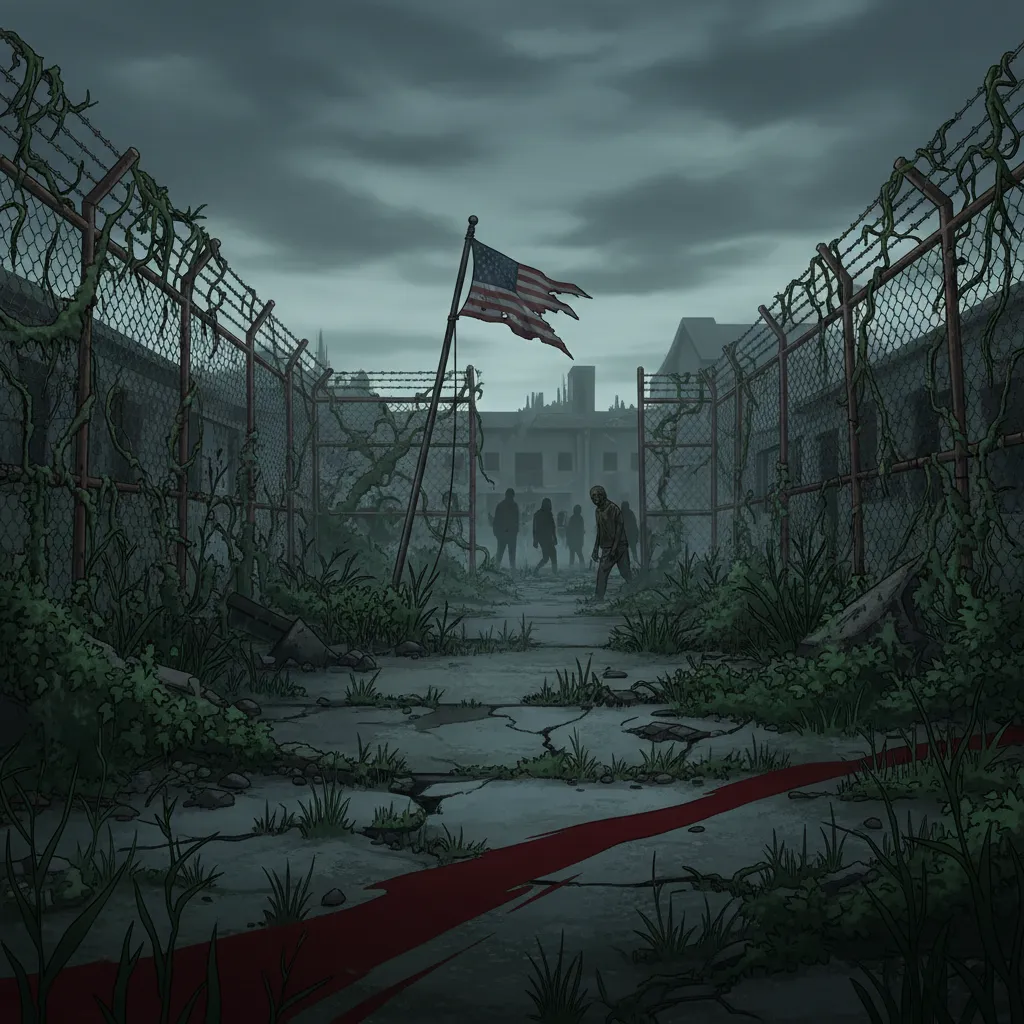
The absolute silence of the post-apocalyptic void is never truly empty; it is simply the amplified echo of the symbolic order’s terminal collapse, where the Name-of-the-Father turns into the static of a dead phone line.
The Terminal Line of Flight: Rick's Catatonic Desiring-Machine
The body, stripped of its social armor and its Oedipal function, seeks the most radical deterritorialization available: the Body-without-Organs (BwO) of the bedridden, catatonic, or mad. Rick Grimes, having witnessed the violent dissolution of his familial assemblage—the maternal axis liquidated in a bloody act of survival by the Son—cannot simply grieve. Grief is a re-territorializing process; this is a schizoid disintegration (Laing, 1960). His catatonia is a terminal line of flight, a forced escape from the socius into an interior void where the actual, material world is replaced by the pure, spectral flows of the unconscious.
The farmhouse attic, once a symbol of nostalgic re-territorialization (the search for safe, rural family life), now becomes the theater of this schizoid break. Rick does not merely mourn Lori; he is trying to re-establish the machinic connection that has been violently severed. The ringing telephone is not a simple hallucination; it is the physical manifestation of the desiring-machine attempting to repair itself.
The voice on the other end, the voice of the dead, is the imago of the Symbolic Law—the last, dying flow of the pre-apocalyptic super-ego trying to re-code the shattered Subject. It is the spectral echo of the Name-of-the-Father that Rick himself is failing to embody (Freud, 1961). When he speaks to the "dead," he is not seeking comfort; he is seeking the lost axiomatic codes of morality, leadership, and stability that evaporated the moment the Law-Giver (Lori, the Mother-Womb) was liquidated. He is, in the precise sense of schizoanalysis, a desiring-machine in zero production, idling on the BwO, attempting to process the shock of becoming purely un-coded (Deleuze & Guattari, 1983). The flow of communication is inverted: reality is static, and only the dead can speak with clarity. The trauma is so great that the Subject demands a complete liquidation of the Real, replacing it with a comforting, yet chillingly familiar, Oedipal phantasm.
The Governor’s Theater of Arrested Desire
If Rick represents the disintegration of the familial-Oedipal re-territorialization, the Governor represents the triumphant, highly organized Paranoiac Machine that violently captures and re-codes all liberated flows. Woodbury is not a community; it is an apparatus of capture, and "Say the Word" peels back its smooth, democratic facade to reveal the brutal, machinic truth beneath.
The key to the Governor’s power lies in the Walker Pit and the Trophy Room.
The Walker Pit: Stratification and the Spectacle of Arrested Flow
The walker pit, where Michonne discovers the chained, snarling Body-without-Organs (BwO) used for entertainment, is the Governor's ultimate political technology. This is not a practical defense; it is a spectacle of stratification. The BwO—the absolute, pure flow of death and deterritorialization that dissolved the world—is captured, neutralized, and forced into a repeatable, contained performance. The Governor, the Master of Simulacra, takes the force that ended civilization and turns it into entertainment that sustains his power (Žižek, 1989).
By forcing the spectacle, the Governor imposes a strict hierarchical flow upon the desires of his subjects in Woodbury:
The Walker (BwO): Pure, unmediated, violent flow—now chained and impotent. The ultimate "Other" is rendered harmless.
The Fighter: The subject who channels the contained violence, becoming a machinic component of the spectacle. Their aggression is not revolutionary; it is Oedipalized and directed inward against another captive subject.
The Spectator: The citizen of Woodbury whose fear and potential line of flight are arrested and re-coded into a collective thrill. They are given a brief, controlled taste of the chaos they fear, convincing them that the Governor is the only guarantee against the outside.
This is the perfect Reichian encapsulation of the collective libido (Reich, 1972). The sexual and aggressive energy that might otherwise become revolutionary flow is redirected into a controlled, spectacular release, hardening the collective character armor of the town into rigid conformity and loyalty to the Governor’s Law. This ritual of violence is how the Governor re-codes the collective unconscious, ensuring that the desire for freedom is immediately transformed into the desire for more security, more walls, and more spectacle.
The Trophy Room: The Crystallization of Paranoia
Michonne’s discovery of the Governor’s secret room—the preserved heads in tanks, his daughter Penny chained and hidden—is the visualization of the Paranoiac’s ultimate fantasy: the arrest and re-animation of time and matter.
The heads are not trophies of victory; they are crystallized fragments of the BwO itself, preserved in formaldehyde as a desperate, fetishistic attempt to stop the flow of decay. The Governor is trying to literalize the symbolic function—to take the absolute deterritorialization of the walker flow and re-territorialize it as a stable, personalized collection (Deleuze & Guattari, 1983).
His daughter, Penny, is the core of this pathology. Chained, hidden, and fed, she is the machinic failure of the Oedipal fantasy. The Governor cannot allow the "death" of his daughter to become a true loss that generates a line of flight into mourning or change. Instead, he maintains her as a functional component of his personal desiring-machine, a dead daughter who is alive in a perfect, contained loop. This is a profound moment of ontological insecurity (Laing, 1960)—the refusal to accept the reality of loss, leading to a divided self that must enforce its delusional reality on the physical world. The Governor’s tyranny is not merely power-lust; it is the externalized pathology of a schizoid subject who is desperately trying to maintain the integrity of his private, shattered world by becoming the Sovereign of the Socius.
Daryl and Maggie: The New Nomad Assemblage
While Rick descends into the Oedipal static and the Governor consolidates his Paranoiac Code, Daryl and Maggie form a micropolitical assemblage—a temporary, functional union based on shared loss and pragmatic survival, entirely outside the Oedipal structure.
Their supply run is a Nomadic movement contrasting sharply with the Governor’s rigid territorialization. They do not seek a fortress; they seek flows (fuel, supplies) necessary for the continued operation of the prison-machine. Their silent, effective teamwork—their ability to communicate and coordinate without the need for verbal or symbolic injunctions—is a practical example of becoming-Nomad-Machine. They are pure production (finding supplies) achieved through the liquid flows of trust and shared trauma, rather than the rigid, hierarchical stratification found in Woodbury.
Maggie, having lost the idealized safety of the farm, and Daryl, who has always existed on the line of flight outside the traditional American family structure, co-create a new ethical space. This space is defined by critical consciousness (Freire, 2005)—an unspoken, mutual recognition of the reality of their oppression and loss—rather than the sentimental appeals to familial bond. Their loyalty is to the process of survival, not the symbol of the Father. They are building a machinic solidarity unburdened by the neurotic weight of the old world’s moral debt.
Michonne: The Political Literacy of Sight
Michonne, unlike Andrea (who is willingly re-territorialized by the comfort of Woodbury), functions as the schizo-analyst-in-motion. Her immediate, visceral suspicion, noted in the previous analysis, is confirmed in this episode through a persistent line of flight aimed at dismantling the simulacrum.
Her investigation—her purposeful detachment and quiet observation—is an act of political literacy (Freire, 2005). She does not rely on the Governor's doublespeak (the flow of the symbolic word); she trusts the flows of the Real—the sight of the trophy room, the sound of the chained walkers, the feel of the hierarchy. She sees the stratification (the racialized labor distribution) and the spectacle (the pit) and understands immediately that Woodbury is an ethical catastrophe masked by a veneer of order.
Her capacity for seeing with her own eyes is the most revolutionary act in the episode. While Rick is trapped in the symbolic static of the telephone, Michonne is actively deterritorializing the Governor’s fortress from the inside out. She is the pure desiring-machine whose sole output is the production of Truth-Event (Badiou, 2005)—the discovery of the horror beneath the smooth surfaces—a truth that will inevitably shatter the Paranoiac structure and set off the next wave of Nomadic war.
Conclusion: The Schizophrenic Dialectic of Woodbury and the Prison
"Say the Word" presents a perfect dialectic of schizoid response to the apocalypse:
The Prison (Rick): The collapse into pure, passive BwO where the desire to restore the Oedipal function is so strong that it consumes the Subject, replacing the world with auditory hallucinations and schizoid regression.
Woodbury (Governor): The formation of a hyper-active, aggressive Paranoiac Machine that violently re-territorializes the flows of death and desire, turning the BwO into a spectacle-commodity to support the Sovereign’s private psychosis.
The episode confirms the Nietzschean insight that when the Law dissolves, the subsequent order is not dictated by ethical evolution, but by the most effective will to power (Nietzsche, 1968)—whether that will manifests as the Governor’s collective deception or Carl’s cold, new pragmatism. The true word to be spoken is not one of healing or forgiveness, but the recognition that the world has become a desiring-machine whose only output is the relentless flow of survival, irrespective of the old moral codes.
References
Badiou, A. (2005). Ethics: An Essay on the Understanding of Evil. (P. Hallward, Trans.). Verso.
Deleuze, G., & Guattari, F. (1983). Anti-Oedipus: Capitalism and Schizophrenia. (R. Hurley, M. Seem, & H. R. Lane, Trans.). University of Minnesota Press.
Freire, P. (2005). Pedagogy of the Oppressed (30th anniversary ed.). (M. B. Ramos, Trans.). Continuum.
Freud, S. (1961). The Ego and the Id. (J. Strachey, Ed. and Trans.). Liveright Publishing.
Laing, R. D. (1960). The Divided Self: An Existential Study in Sanity and Madness. Tavistock Publications.
Nietzsche, F. (1968). The Will to Power. (W. Kaufmann & R. J. Hollingdale, Trans.). Vintage Books.
Reich, W. (1972). Character Analysis (3rd ed.). Farrar, Straus and Giroux.
Žižek, S. (1989). The Sublime Object of Ideology. Verso.
Comments
Post a Comment