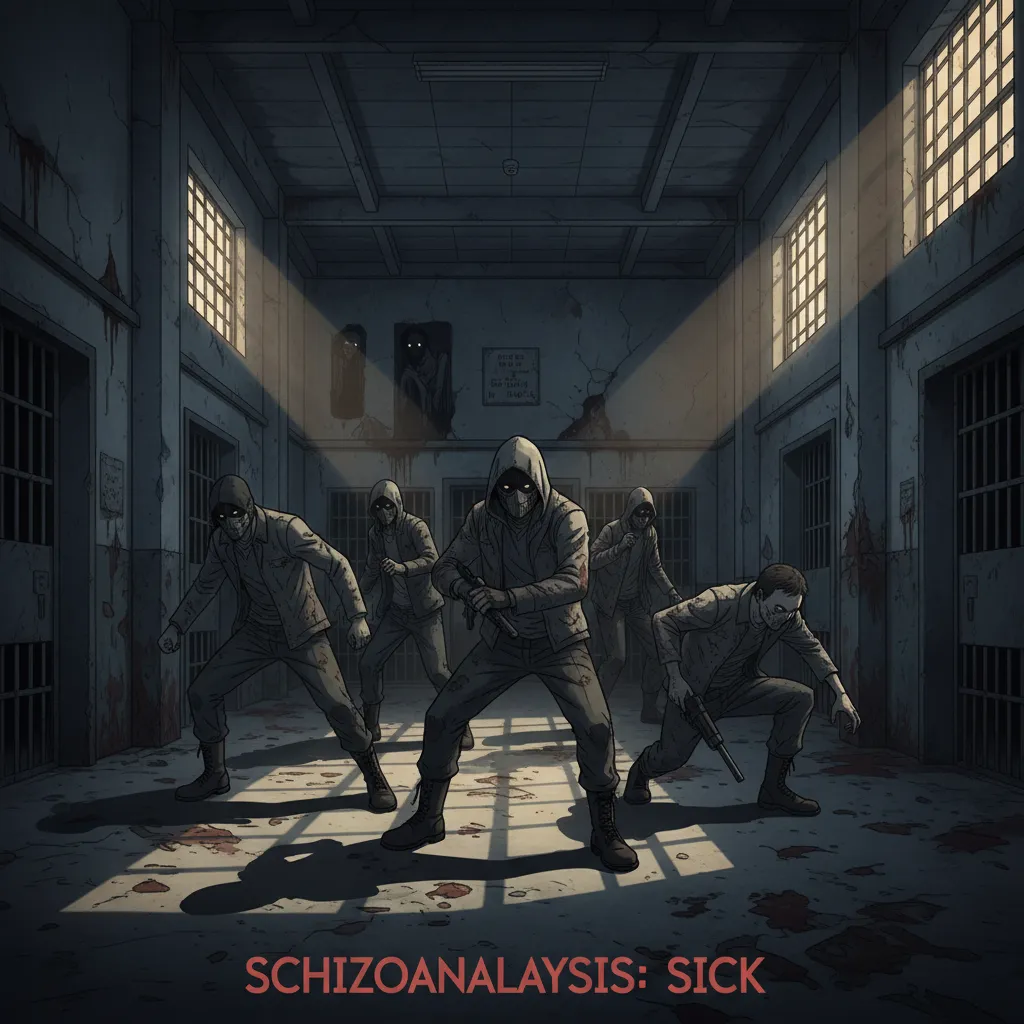
The massive, cold-shouldered geometry of the prison, that concrete monument to the paranoiac impulse of the State, is not merely a shelter; it is a machinic promise—a promise to finally arrest the absolute deterritorialization of the zombie flow by imposing an impossible, self-referential order. Within its walls, the survivors confront not the Body-without-Organs (BwO) of the walker swarm, but the residue of the former State Apparatus: the prisoners, the perfect undeserving flow.
The Universal-Totalitarian Axiom: Pre-Coding Disposable Flows
The historical genesis of the "deserving poor"—that necessary theological split that legitimizes charity for some and abandonment for others—is the foundational ideological stratification machine of Western thought. The textual reference to Galatians 3:23-29—the proposition that "in Christ Jesus you are all one"—is not a declaration of genuine universalism, but the birth of totalitarian universalism (Badiou, 2005).
This Christian Universal-ism acts as a pre-emptive code (Deleuze & Guattari, 1983). It declares a universal category (Humanity qua Christian) and then violently excludes all that cannot be subsumed under that signifier. If the category encompasses everything (Jew, Gentile, slave, free), it simultaneously renders any alternative, non-coded identity non-existent—a mere unreal flow. The non-Christian, the non-believer, the one outside the symbolic enclosure, is not just different; they are non-human in the ethical calculus. This is the totalitarian seed: the move from recognizing difference to proclaiming a comprehensive, singular identity that must absorb or liquidate all opposition.
The contemporary echo, colorblind racism, utilizes this identical machinic logic. It asserts the legalistic, transcendental equality of all humans while allowing really existing inequality to regulate social and economic flows (opportunity, capital, survival). The law provides the symbolic, oedipalized reassurance ("We are all human"), yet the socius-machine continues to ruthlessly sort, stratify, and exclude. The system is not blind to race; it is blind to the material flows of oppression that race codifies, ensuring that only the properly coded subject may access the desirable flows of capital and opportunity.
The Prisoner as the Non-Coded Residue
When the survivors encounter the prisoners, they are encountering the pure residue of the collapsed capitalist State Apparatus. The prison is the ultimate deterritorialized space under the old regime—the zone where subjects were stripped of social function, citizenship, and the right to the flow of self-determination. They are the desiring-machines violently unplugged from the body of society, labeled "criminal," and stored in concrete.
The survivors, led by the hardening Ricktocracy, instinctively apply the pre-apocalyptic stratification code. The prisoners are not rejected because they are an out-group; they are rejected because they are the undeserving poor—a flow already branded as ethically toxic, morally outlawed, and therefore disposable. The survivors, having spent nine months becoming Nomads, still cling to the character armor (Reich, 1972) of their former lives—specifically, the ideological armor that dictates who is worthy of trust and shared resources.
This adherence to the old code is an act of profound ontological insecurity (Laing, 1960). The world has dissolved, the symbolic is shattered, and the only way to prevent the self from shattering (the divided self) is to violently assert a fixed boundary of "us" against a clearly defined "them." The prisoners provide this necessary negative definition. By making the prisoners non-human (in an ethical, not literal, sense), Rick re-secures his own precarious identity as a moral human leader.
The Machete as the Purifying Cut: Rick’s Machinic Logic
The initial negotiation—offering the prisoners a separated wing in exchange for food—is a momentary hesitation, an attempt at a micro-reterritorialization. Rick tries to create a sub-stratum within the prison's geometric order, allowing a minimal, contained flow of coexistence.
But the prisoner’s sudden, chaotic swing is a rupture of the code. It is a line of flight from the negotiated truce, a direct challenge to the muscular armor of Rick's authority. Rick's immediate, machete-fueled response is not a reaction of self-defense as much as a machinic execution of the undesirable flow. It is a schizoid assimilation of the Will to Power (Nietzsche, 2005) into a non-moral, purely operational command. The undesirable flow (the criminal, the chaos, the unpredictable threat) is instantly liquidated to maintain the stability of the Ricktocracy-machine.
This act is far from Bad Faith (Sartre, 1956); it is a terrifying affirmation of total faith in his own newfound law. Rick is no longer appealing to pre-apocalyptic values; he is creating the value through the brutal efficiency of the cut. He has internalized the logic of the prison—a machine whose purpose is the instantaneous and brutal removal of any internal element that threatens the structural flow. He is the Warden of the Nomadic War Machine, and his authority is written in machete strokes.
The Irony of the Fortress: The Oppressor’s Armor
The profound irony noted in the source text—Rick claiming ownership over one of the strongest dehumanizing machines in the capitalist structure—is the central schizoanalytic thesis. The survivors did not escape the totalitarian logic of the State; they merely inherited its infrastructure. The prison, which was built to solidify the stratification of the old world, now serves to solidify the totalitarian stratification of the new.
Rick's failure is one of critical consciousness (Freire, 2000). He cannot perform the dialogue necessary to recognize the prisoners—stripped, isolated, and discarded by the same forces that created the apocalypse—as fellow subjects of deterritorialization. Instead, he acts as the oppressor, using the residual symbolic violence of the old code ("criminal") to justify their disposable status in the new world. He builds the walls of his Ricktocracy not just from concrete, but from the exclusionary theological axioms of the past. The freedom gained from the farm's destruction is immediately reinvested in the most absolute form of containment and control.
The great failure of the "us" in Sick is its inability to become-revolutionary, instead choosing to re-Oedipalize the world through violence and exclusion. The ultimate sickness, it seems, is not the walker virus, but the paranoiac urge to build a fortress of self and definition, no matter how many bodies must be cut to secure its walls.
References
Badiou, A. (2005). Ethics: An Essay on the Understanding of Evil. (P. Hallward, Trans.). Verso.
Deleuze, G., & Guattari, F. (1983). Anti-Oedipus: Capitalism and Schizophrenia. (R. Hurley, M. Seem, & H. R. Lane, Trans.). University of Minnesota Press.
Freire, P. (2000). Pedagogy of the Oppressed (30th Anniversary Edition). Continuum.
Laing, R. D. (1960). The Divided Self: An Existential Study in Sanity and Madness. Tavistock Publications.
Nietzsche, F. (2005). Beyond Good and Evil: Prelude to a Philosophy of the Future. (R. P. Horstmann & J. Norman, Eds.). Cambridge University Press.
Reich, W. (1972). Character Analysis (3rd ed.). Farrar, Straus and Giroux.
Sartre, J. P. (1956). Being and Nothingness: A Phenomenological Essay on Ontology. (H. E. Barnes, Trans.). Philosophical Library.
Žižek, S. (1989). The Sublime Object of Ideology. Verso.
Comments
Post a Comment