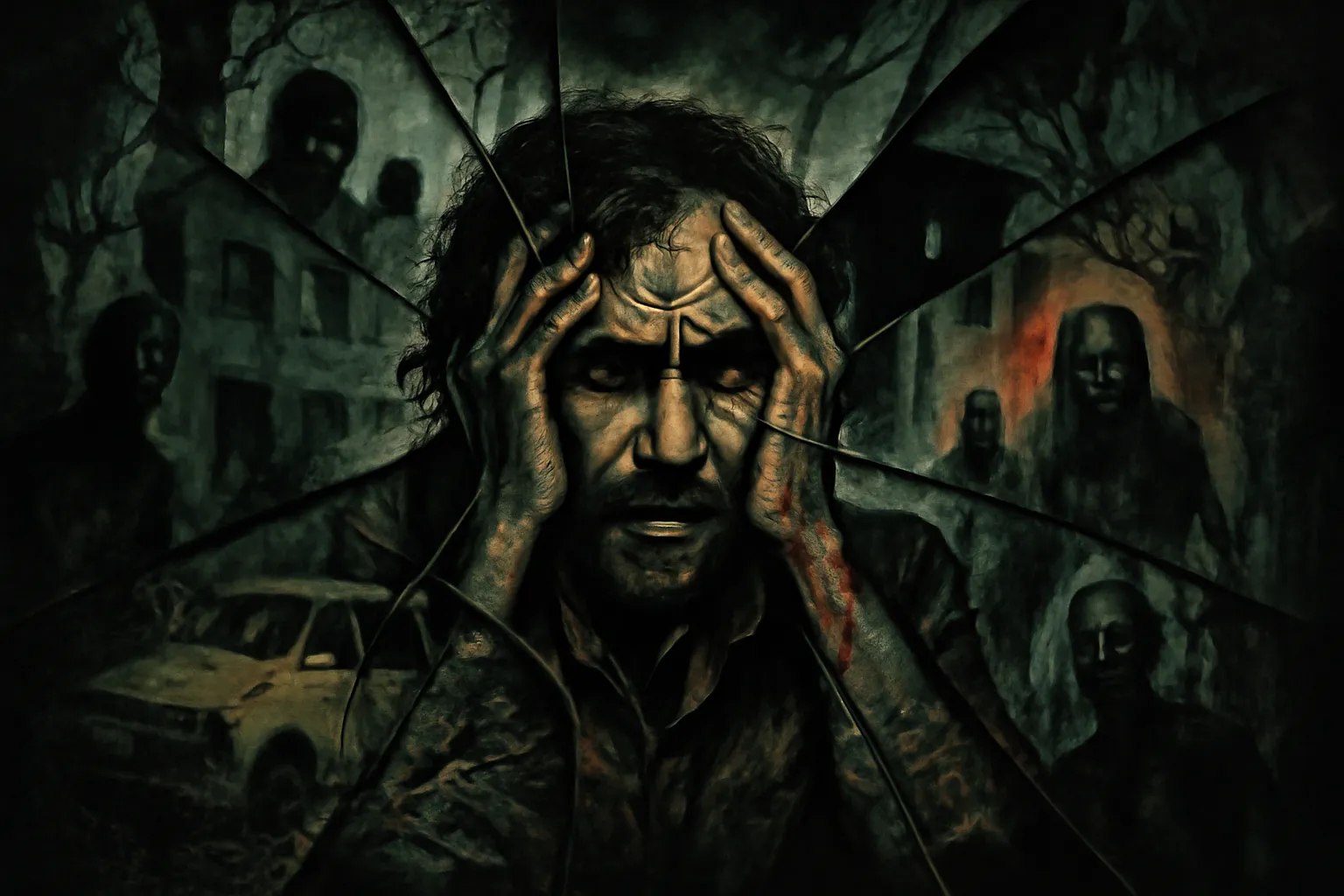
The tragic failure of Andrea is not a failure of courage, but the absolute paralysis of the liberal-democratic desiring-machine when confronted with the imperative of the schizoid cut.
This episode, "Prey," functions as a psycho-political diagram, mapping the moment when the decoded flow of ethical obligation runs headlong into the molar necessity of pure, intentional violence. Andrea is provided with the ultimate point of concept production—The Governor's head centered in her gun sights—and she freezes, collapsing the potential line of flight into a depressive, circular re-territorialization. Her inaction is more than simple cowardice; it is the deep-seated, systemic horror of the democratic psyche, which, by its very architecture, must tolerate and grant ontological equivalence to all perspectives, even the one that is actively constructing the means of its own annihilation. The liberal machine insists that the Governor’s perspective—his malignant, sadist organization of the world—is merely one opinion among many, rather than the abstract machine of death that it actually is.
The Parallax View of Inaction: Cowardice as Ideology
Andrea’s ongoing role throughout the series is that of the quintessential Oedipalized Liberal. She is the individualistic, rights-conscious subject who constantly tries to mediate between two competing social strata: the Ricktocracy, a pragmatic, paternalistic anti-production machine focused on bare life, and the Woodbury-Apparatus, a fascistic, highly stratified machine focused on spectacular control and libidinal sadism. Her bravery is rooted not in action, but in the belief that the will of the individual must always rise against the overriding molar command. She is perpetually attempting to force peace, a synthetic re-territorialization she arranges in S3E13, failing to grasp the profound Schizoanalytic reality that certain flows of desire—specifically, the will to power embodied by The Governor—are inherently non-negotiable and demand only annihilation (Nietzsche, 2005, p. 119).
Her dilemma in the torture room, revealed by Milton, is the nexus where the philosophical argument explodes. She sees the cage, the restraints, the tools prepared for Michonne’s slow, calculated demise—the materialization of the Governor’s Body-without-Organs (BwO). The BwO of the fascist is not just an anti-production machine, but an elaborate, meticulous mechanism for negative production: the production of pain, fear, and submission (Deleuze & Guattari, 1983, p. 151). This cage is a desiring-machine built specifically to arrest and codify the flow of Michonne’s schizoid freedom. When Andrea levels the gun, she is on the cusp of performing the revolutionary Act—the Badiouian fidelity to the event that demands a decisive, anti-status-quo intervention (Badiou, 2005, p. 55).
But she pulls back. The gun is nudged by Milton—the intellectual coward, the archivist who desires documentation over intervention—and Andrea accepts this deflection. Why? Because the liberal subject is terrified of the political murder. To kill The Governor in his sleep is to admit that the marketplace of ideas is closed; that his desiring-flow is not merely distasteful but malignant and must be surgically excised. To pull that trigger is to move from the passive observer of democracy to the active revolutionary operator, a shift that necessitates leaving the comforting structure of the Law and embracing the untamed line of flight of pure, decisive action. Her fear is the fear of being irrevocably outside the legal, liberal framework—the fear of becoming the monster she seeks to destroy, a true schizo-flow dedicated solely to the singular task of survival through absolute cut.
The Governor as the Anti-Production Machine
The Governor is the pure, decoded flow of sadism organized into a State. His existence, especially in this episode, serves as the perfect illustration of Wilhelm Reich’s observation that fascism is the political organization of the repressed sexual and social flows (Reich, 1970, p. 55). The apocalypse deterritorialized the flows of society—money, law, civility—but The Governor immediately re-territorialized those flows into a closed, molar structure designed solely to channel desire into destructive, controlled spectacle.
Woodbury is not a survival collective; it is a libidinal fortress built on the performance of normalcy that masks an underlying, controlled chaos. The torture room, which Milton reveals, is the abstract machine made concrete. It is a chamber of pure anti-production, designed not to extract labor or capital, but to produce despair and brokenness. The Governor’s desire is not for more resources, but for the spectacle of absolute power over the life and death of the other, confirming his own paranoid fantasy of control. His pursuit of Andrea across the landscape in "Prey" is the hunt of the State-hunter after the attempted line of flight.
When Andrea flees, she is attempting a becoming-animal—shedding the strata of the civilized subject (the jacket, the constraints of Woodbury's dress code) and reverting to the primal flow of movement. She seeks refuge in the smooth space of the wilderness, the non-codified forest where she hopes to dissolve into pure speed and camouflage, escaping the striations of the road and the town (Deleuze & Guattari, 1987, p. 382). However, The Governor, driving a truck—a machine of molar transportation and re-territorialization—is the superior hunter precisely because he understands the logic of the war machine. He turns the hunt itself into a sadistic spectacle, using the walker flows (pure, unorganized death) as tools to direct Andrea’s movement, collapsing her line of flight back into the predetermined structure of his pursuit.
The political failure of Andrea is sealed when she is captured. The Governor’s machine is simply more efficient at capturing and re-stratifying the flows of desire than her liberal-humanitarian drive is at remaining deterritorialized.
The Necessity of Totalitarian Cuts in the Schizo-Survival State
The initial user hypothesis—that a degree of totalitarianism is necessary for survival in a schizoid landscape—requires a rigorous schizoanalytic lens. The apocalypse, as a great deterritorialization, rips away the social codes (the "civilization" Freud described as built on the repression of instinctual drives) (Freud, 1961, p. 51). In the vacuum, groups rush to form new stratifications—new ways to organize the body of society.
The Ricktocracy at the Prison succeeds because it enacts a functional, pragmatic form of totalitarianism of action. Decisions must be made quickly; flows of command must be linear; and the Individualist flow must be subordinated to the Collective BwO (the fortified prison walls, the shared resources). The group cannot stop to vote on every decision; the constant presence of the zombie flow demands immediate, unified response. This is not fascism, but the stratification necessary to combat absolute chaos—a temporary re-stratification to sustain the integrity of the collective organism.
Liberal democracy, with its mandate of universal representation, is a luxury afforded only to stable, high-intensity societies where the decoded flows of capital have reached a certain point of repressive maturity. In the apocalypse, to tolerate the anti-social flow (the Merle flow, the Shane flow, or the Governor flow) is to invite immediate systemic breakdown. The liberal insistence on allowing "everyone to voice and put into motion their agenda" is, in this context, a death sentence. It is the failure to recognize that some agendas—specifically those rooted in pure sadism and control—are not flows to be accommodated, but malignant cancers that must be violently excised for the health of the BwO.
Žižek (2009) often speaks of the necessity of the Act—the moment where the subject must break with the existing ideological framework to perform the political intervention that changes the coordinates of the possible. Andrea’s failure to act is the failure of the liberal subject to commit the Act. She is paralyzed by the fantasy that if she gives The Governor enough time and space, his underlying humanity will emerge, or that some negotiation can still occur. This fantasy of universal goodness is the ultimate liberal repression, preventing the only move that could save both her and her people: the elimination of the threat outside the Law.
The Final Re-Oedipalization
Andrea’s final position—captured, bound, and placed in the torture room—is the ultimate symbolic re-Oedipalization. She has been stripped of her agency and returned to a state of infantile passivity, awaiting the sentence of the Father-figure (The Governor). Her journey from the schizoid line of flight (escaping into the woods) back to the molar constraint (the chair) is the physical manifestation of the Repressive Machine triumphing over the desiring-flow.
Milton, as the final active betrayer, performs the ultimate servitude to the molar order. His intellectual dedication to archiving the tragedy outweighs his ethical capacity for intervention. By warning The Governor and, ultimately, deflecting the gun, he ensures that the schizoid potential remains repressed. The failure of Andrea and Milton is the failure of the academic and the activist in the face of absolute fascism: they are paralyzed by the need to understand, to document, or to mediate, rather than to simply act and cut.
The lesson of "Prey" is that when the abstract machine of War fully materializes in a despotic figure, the liberal flow of tolerance becomes an accomplice to its own destruction. The survival of any collective, from the Ricktocracy to any revolutionary cell, depends on its capacity for ruthless, non-negotiable stratification against the flows that seek to destroy it. Andrea desired a peace built on inclusion; The Governor understood that the only peace is built on exclusion and control. In the schizoid landscape, the desiring-machine that is willing to make the sharpest cut is the one that survives. Andrea’s tragedy is that she let the cut be made upon her own body, rather than enacting it upon the body of the enemy.
References
Badiou, A. (2005). Ethics: An Essay on the Understanding of Evil. (P. Hallward, Trans.). Verso.
Deleuze, G., & Guattari, F. (1983). Anti-Oedipus: Capitalism and Schizophrenia. (R. Hurley, M. Seem, & H. R. Lane, Trans.). University of Minnesota Press.
Deleuze, G., & Guattari, F. (1987). A Thousand Plateaus: Capitalism and Schizophrenia. (B. Massumi, Trans.). University of Minnesota Press.
Freud, S. (1961). Civilization and Its Discontents. (J. Strachey, Ed. & Trans.). W. W. Norton & Company. (Original work published 1930).
Nietzsche, F. (2005). Beyond Good and Evil: Prelude to a Philosophy of the Future. (R. J. Hollingdale, Trans.). Penguin Classics. (Original work published 1886).
Reich, W. (1970). The Mass Psychology of Fascism. (V. R. Carfagno, Trans.). Farrar, Straus and Giroux. (Original work published 1933).
Žižek, S. (2009). Violence: Six Sideways Reflections. Picador.
Comments
Post a Comment