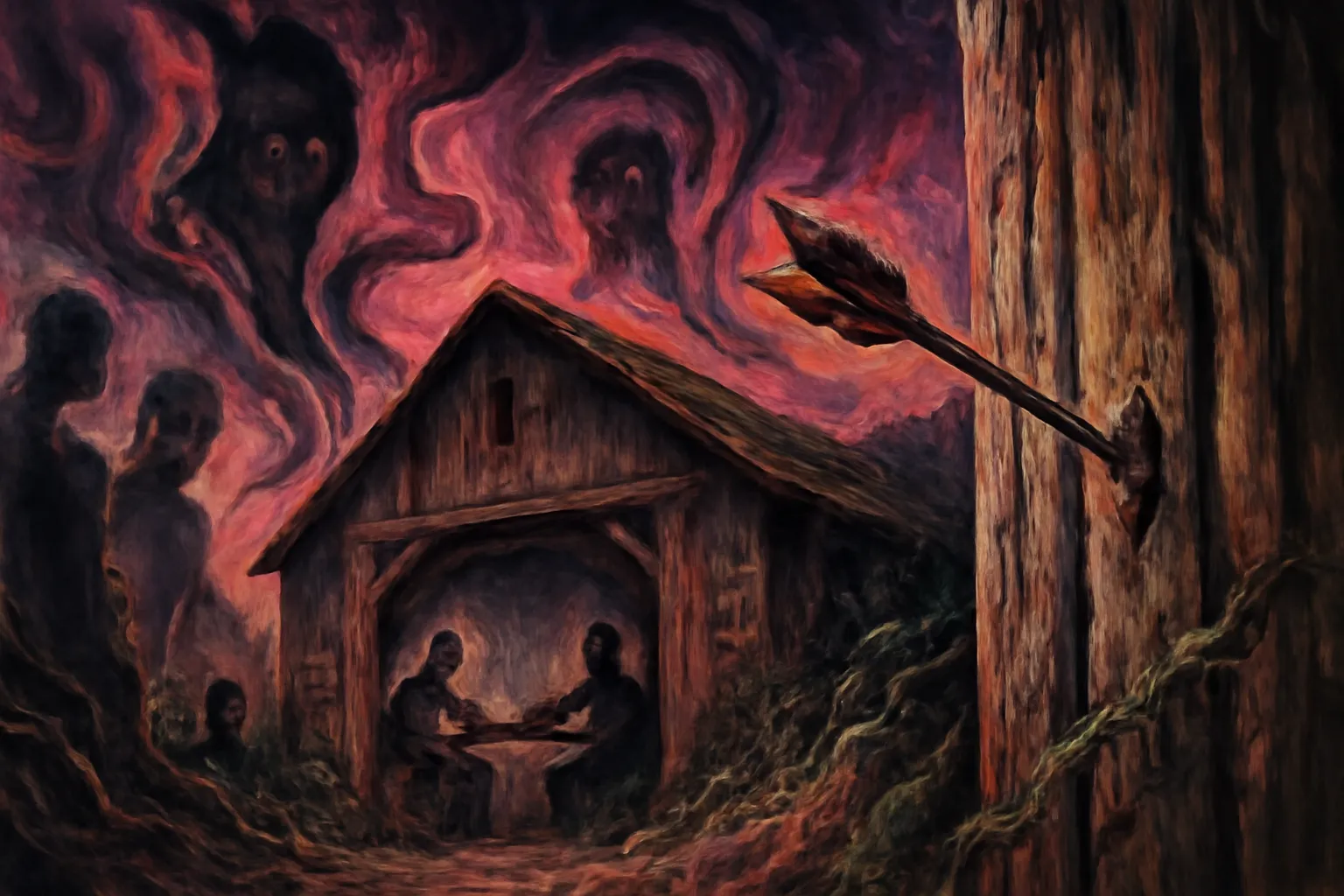
The smooth space of the abandoned feed store, a former node of commodity flow, becomes instantly striated by the two bodies entering it: Rick Grimes and The Governor, both desperate to arrest the accelerating deterritorialization of their respective socii through a purely molar negotiation. This meeting, framed by the rigid arch of the doorpost—a demarcation point between the feral outside and the pseudo-civilized inside—is not a peace summit but a feverish attempt to re-territorialize the entire apocalypse into a manageable, albeit mutually hostile, Oedipalized field of war. The very structure of the episode is a diagram of the political economy of survival, revealing how flows of desire, once released by the zombie-event, rush immediately back to find channels of repression and command (Deleuze & Guattari, 1983, p. 303).
The Paranoia of the Molar Meeting
The barn is a theatre of two despotic desiring-machines attempting to couple: Rick's machine of paternal anxiety and ethical exceptionalism cutting into The Governor's machine of sadistic capital and pure, codified control. They enter the structure, a space of false enclosure, and attempt to use language—the most territorial of all flows—to capture the uncodified violence circulating outside.
The initial dialogue is a perfect illustration of reterritorialization through discursive violence. Rick offers a map—a geometric codification of the land split by a river. The river, naturally a pure line of deterritorialization, is instantaneously converted into a border, a political-geographical boundary designed to stop the flow of blood and walkers. The Governor's immediate laughter—a convulsive spasm of pure cynical reason—shatters the illusion of the map's efficacy. He knows the map is irrelevant; the only flow that matters is the flow of command-and-control, the capacity to organize the death-drive of his followers. He demands Rick’s surrender, seeking to subsume the Prison-Machine entirely into the Woodbury-Apparatus. This is the schizoid reality of the State form post-apocalypse: it can only conceive of survival as absolute absorption, a totalizing anti-production that consumes all external difference.
The hidden pistol taped beneath The Governor’s side of the table is the ultimate commentary on the negotiation's real content. It is the unsaid truth, the abstract machine of death that undergirds every political statement. The conversation about boundaries and peace is mere surface chatter; the true negotiation is conducted by the weights of their concealed weapons, the implicit threat that the only way to arrest the flow of the opponent's desire is through the total, instantaneous short-circuit of a bullet. The pistol, a small, polished object, is the ultimate deterritorialized flow of capital (firearms manufacturing) re-territorialized into a function of political assassination (Deleuze & Guattari, 1987, p. 433).
The Oedipal Trap and The Governor's Void
The discourse quickly descends into a personal, Oedipal struggle, precisely where the paranoid machine prefers to operate. Rick, projecting his anxiety onto The Governor, calls him the "town drunk who knocked over my fence," reducing the apocalypse to a neighborhood feud—a stunning familial re-territorialization of a global catastrophe. By making it about his 'yard' and his 'fence,' Rick attempts to use the repressive machinery of the Family to explain the chaos of the Social Field.
The Governor's counter-attack, the reference to Judith’s paternity and "failing to see the devil beside you," is a masterstroke of Oedipal subversion. He knows that the ultimate weakness in Rick's authoritarian structure is the anxiety over the biological legitimacy of his command. This uncertainty is a crack in the socius, a line of flight leading directly back to the primal, Freudian scene. The Governor leverages this anxiety—the fear of the unknown origin, the unspoken cut of the non-biological father—to destabilize Rick's self-perception as the legitimate ruler. Rick’s reply, "I see him, all right," is a desperate attempt to externalize the paranoia, pointing the Oedipal accusation outward, when The Governor has successfully lodged the question of the internal 'devil' back within Rick's own psyche (Freud, 1961, p. 119).
The Governor then offers his origin story: his dead wife's unanswered voicemail. This seemingly banal anecdote is a core component of his desiring-machine. He doesn't offer it as tragedy, but with a smirk. This is the revelation of his Body-without-Organs (BwO)—the non-organic life of the machine itself. His BwO is constituted by a void of unanswered connection, a black hole of missed desire. The missing message, "what did she want?", is the engine of his organizational paranoia. Since he cannot complete the connection or codify the final desire of the lost object, he must compulsively over-codify the rest of the world (Woodbury, the rules, the heads in the tanks). His rule is an attempt to compulsively answer that missing voicemail by demanding absolute obedience from every available flow around him. This constant, unfulfilled lack drives the production of his social fascisms (Reich, 1970, p. 28).
The Molecular Production Outside: Flows of Becoming
Crucially, while the two despots are engaged in their molar, paranoid theatre inside the barn, a truly molecular production is taking place outside, amongst the guards: Daryl, Martinez, Hershel, Milton, and Andrea. This external space is the true BwO of the episode, a zone where desire escapes the rigidity of the signifier and finds new, minoritarian assemblages.
The brief competition between Daryl and Martinez in killing the incoming walkers is a profound moment of schizoid synthesis. The walkers are pure flows of undifferentiated desire and death, the very uncodified reality the leaders are trying to repress. When Daryl and Martinez compete in the killing, they are not fighting each other; they are engaged in a shared deterritorialized production of skill and efficiency. This shared act forms a molecular bond—a temporary, non-hierarchical assemblage based on competence and the mutual recognition of the actual threat. This bond is immediately sealed by the sharing of cigarettes taken from a dead man's pocket, a brief communalist micro-exchange operating entirely outside the capitalistic or Oedipal logics of the leaders. Martinez's cynicism ("They'll do their little dance... eventually they'll give the word") shows that the molecular assemblage knows the molar state apparatus is incapable of genuine peace; it only produces war (Deleuze & Guattari, 1983, p. 306).
Simultaneously, the dialogue between Hershel (The Ethicist, The Healer) and Milton (The Codifier, The Archivist) forms another powerful molecular pairing. Milton, obsessed with "making a record of events post-apocalypse," is attempting to re-territorialize the chaos through the State apparatus of History. Hershel, discussing the amputation of his own leg to stop infection, speaks of cuts and flows at the biological level. His amputation is the ultimate BwO maneuver: removing an organ to save the whole body. He allowed a cut—a radical deterritorialization of his own body image—in order to arrest the flow of death. This conversation is a collision between the paranoid codification of history (Milton) and the revolutionary pragmatics of the BwO (Hershel).
Andrea, caught between these flows, embodies the tragedy of the molar re-inscription. She attempts to mediate, to serve as the inter-connecting membrane between the two despots, but is violently ejected. She is trying to synthesize the molecular connection she shares with The Governor (a libidinal tie) with the molar command structure of Rick (a moral duty). When Hershel confirms The Governor is a "sick man," he is confirming that the Woodbury-Apparatus is fundamentally a fascist machine that cannot be repaired, only destroyed or fled. Andrea's despair is the recognition of her own failure to function as a line of flight for either side.
Michonne as the Body-Without-Organs (BwO)
The ultimate pivot point of the episode, the conceptual singularity where all the flows converge, is The Governor’s demand: "I want Michonne. Turn her over and this all goes away."
Michonne is not a person in this economy; she is pure BwO. She operates as a desiring-machine of pure movement and cut. Her previous actions—the surgical cutting of the walker flows with her katana, her refusal of speech, her use of walker-shields—all represent an absolute, uncompromising rejection of Oedipal and societal codification. She is a schizo-flow personified: a wandering, solitary element that uses the flows of death (walkers) to pass undetected through the social field (Deleuze & Guattari, 1983, p. 150).
For The Governor, Michonne represents the unbearable freedom of the external line of flight. She is the living, breathing impossibility of his totalitarian rule. He cannot codify her; he cannot control her movement; and she literally gouged out the eye that served as his singular, paranoid vision (a schizoid surgical strike against the very organ of State vision). He demands her as a sacrifice, not for safety, but for ontological completion. He wants to arrest the BwO, to capture and neutralize the uncodifiable flow, thereby re-establishing his own false, synthetic BwO built on paranoid control. This is the final, most cynical act of territorialization: demanding the revolutionary body in exchange for a temporary reprieve from war.
The Final Codification and the Choice of Oedipus
Rick’s subsequent lie to his group—telling them The Governor wants them all dead, thereby pre-emptively manufacturing the group’s consent to war—is an act of molar self-preservation. But the true horror is in his private confession to Hershel. He presents the choice as a mathematical problem of survival ("sacrifice his daughters' lives for Michonne's"), which is precisely how the Oedipal machine reduces complex ethical and political flows to sterile, familial arithmetic.
The conversation with Hershel is Rick’s last chance at deterritorialization of the self. Hershel—the man who allowed the cut to live—tells Rick, "She's earned her place." This means Michonne is not an object of exchange but a producer of value within the new assemblage. But Rick, crippled by the paranoid neurosis of leadership, asks, "Why are you telling me? Because I'm hoping you can talk me out of it." This is the Oedipal request: the Father (Rick) asking the Substituted Father (Hershel) for ethical absolution for the impending political murder. Rick seeks a voice to articulate the line of flight he is too terrified to take himself.
By considering the sacrifice of Michonne, Rick fully embraces the logic of the State apparatus. He is willing to sacrifice the schizoid potential—the pure line of flight embodied by Michonne—in order to preserve the paranoid molar unit of the prison. This is the ultimate betrayal of the revolution in favor of the fascistic desire for stability. The final decision is not about Michonne’s death, but the re-codification of all desire into the family-State form. Rick has moved from the anxious Father to the cynical Despot, ready to sell the purest, most deterritorialized flow (Michonne) to the largest capitalistic machine (The Governor) to preserve his own small, fragile territory. The episode ends not with the arrow of war, but with the arrow pointing straight back to the Oedipal cage. The flow of desire finds its most destructive channel: the desire for power to maintain the territorialized illusion of home.
References
Deleuze, G., & Guattari, F. (1983). Anti-Oedipus: Capitalism and Schizophrenia. (R. Hurley, M. Seem, & H. R. Lane, Trans.). University of Minnesota Press.
Deleuze, G., & Guattari, F. (1987). A Thousand Plateaus: Capitalism and Schizophrenia. (B. Massumi, Trans.). University of Minnesota Press.
Freud, S. (1961). Civilization and Its Discontents. (J. Strachey, Ed. & Trans.). W. W. Norton & Company. (Original work published 1930).
Reich, W. (1970). The Mass Psychology of Fascism. (V. R. Carfagno, Trans.). Farrar, Straus and Giroux. (Original work published 1933).
Comments
Post a Comment