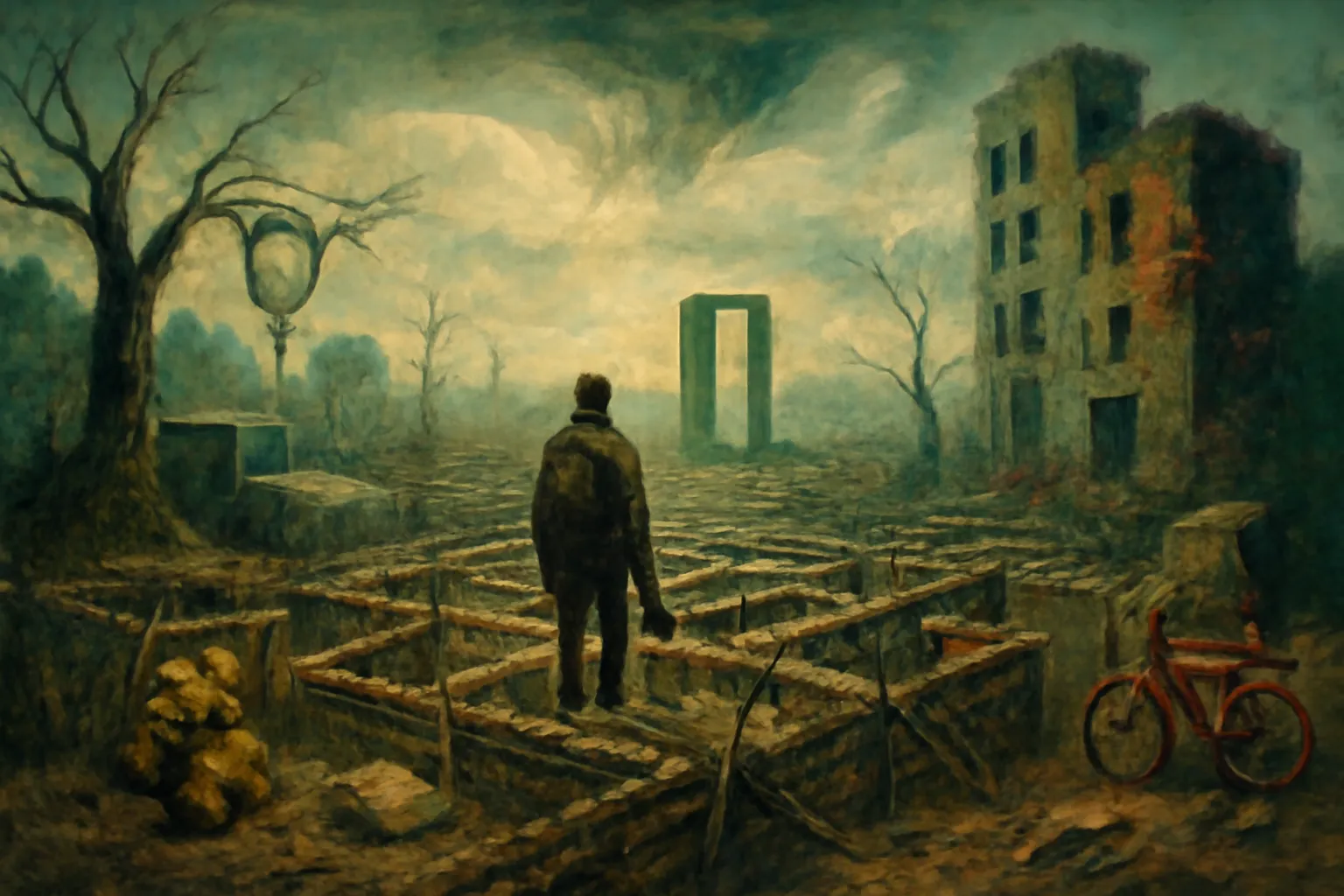
The ultimate horror of the flow of debt is not the zombie outside the perimeter, but the moment a traumatized consciousness achieves pure, crystalline schizophrenia—a self-constructed, auto-destructive apparatus where the flow of memory is stratified into an unbreachable fortress of terminal logic.
S3E12, "Clear," is not merely a subplot reunion; it is the most crucial schizoanalytic diagram the series has yet produced, mapping the three divergent lines of flight available to the subject when confronted with the absolute deterritorialization of societal collapse. The journey undertaken by Rick, Carl, and Michonne is a forced excursus from the established strata of the Prison, an involuntary passage into the smooth space of the road, where the rules of flows are brutally exposed. We are witnessing the War-Machine in its political-economic infancy, learning the ruthless calculus of liquidation against the unbearable pressure of Oedipal debt.
The Great Failure: Morgan Jones and the Autistic Apparatus of Debt
Morgan Jones is the episode's central concept, the ultimate realization of a desiring-machine whose internal circuits have short-circuited into pure, self-referential psychosis. His town is not a defensive outpost; it is an externalized Body-without-Organs (BwO), a terrifying stratification designed not to keep the walkers out, but to keep the flow of memory and truth in—a monument to his own failed affective discharge (Deleuze & Guattari, 1983).
The kernel of Morgan’s madness is revealed in his tragic confession: his inability to liquidate the primary signifier—the zombified remains of his wife. This is the Oedipal Debt weaponized. In psychoanalytic terms, the debt is not merely grief, but the neurotic paralysis that prevented the necessary violence (Freud, 1961). By failing to destroy the zombified imago of the wife, the flow of trauma was not discharged; it was repressed, recycled, and intensified, until it metastasized and produced the secondary, catastrophic debt: the death of his son. The death of the son is the anti-production of the failed desiring-machine, a consequence of the stasis of liquidation.
The walls of Morgan’s fortress are not brick and wire; they are the scrawled, fragmented signifiers—"Clear," "Turn Around," "Gone"—the desperate attempts of his Repressive Apparatus to code and contain the uncontainable flow of his experience. These signs are not meant for external readers; they are the auto-inscriptions of schizophrenia (Reich, 1972), the continuous, frantic output of a machine attempting to define the parameters of its own delusional reality. His flow is terminal entropy; he exists only to feed the machine of his own madness, forever trapped in the molecular repetition of the initial trauma. His consciousness has achieved perfect stratification: it is an immovable, closed system, impervious to Rick’s attempts to re-inject the logic of the social stratum. Rick’s attempts to “talk sense” fail because Morgan’s sense is perfectly immanent to his psychosis, operating under a logic that the War-Machine must recognize as an unrecoverable failure.
The Economics of Contingency: The Hitchhiker's Disposable Flow
The fate of the Hitchhiker is the cold, definitive political declaration of the episode, the true "Clear" moment that Rick's group finally affirms. The Hitchhiker is the figure of pure, unmediated molecular contingency. He is loud, unattached, demanding—a random fluctuation in the smooth space of the road that threatens to introduce noise and risk into the group's highly coded survival apparatus.
Rick’s decision to drive past him is the necessary, ruthless suppression of the humanitarian flow. The man, alive, is an economic liability (a potential threat, a drain on resources, a call for an affective debt). The War-Machine—now operating under the principles of pure utility—cannot afford such luxury. The will-to-power in this new world requires the instantaneous valuation of all incoming flows (Nietzsche, 1968).
The climax of this calculation is the second encounter. The Hitchhiker, now dead, is immediately transformed from a social liability into a liquidated asset. His corpse is scavenged for supplies, reduced entirely to usable flow (Deleuze & Guattari, 1983). The group stops for the man only when he is no longer a man, when his body can be decoded into pure resources. This cold, instantaneous shift from contemptuous avoidance to utilitarian extraction confirms the group’s complete deterritorialization from the Code of Civilized Sentiment. The Hitchhiker, like Morgan, is ultimately judged by the War-Machine as a non-productive element requiring liquidation—one by abandonment and the other by pure consumption. This equivalence is the profound schizoanalytic insight: in the ultimate economic collapse, the madman trapped in his debt and the random stranger begging for life are given the same valuation: zero, until death transforms them into resource flow.
The Molecular Alliance: Carl, Michonne, and the De-Oedipalizing Fetish
The line of flight from the paralyzing paranoia of Rick’s grief is executed by the minoritarian alliance of Carl and Michonne. This is the Event of Trust (Badiou, 2005) occurring outside the Symbolic Structure of the father’s authority.
Rick is still trapped by the Symbolic Spectre of Lori, a haunting presence that has immobilized his leadership into a paranoiac coding of every threat. Carl, the child-subject who carries the future flow, intuitively understands the need for de-intensification. His quest for the photograph is not sentimental, but a necessary act of psychic engineering.
The photograph is the de-Oedipalizing fetish (Žižek, 2008). It reduces Lori from a totalizing, paralyzing ghost (a debt that cannot be paid) into a manageable, molecular fragment—a small piece of paper that can be inserted into the desiring-machine to produce a controlled output of memory, rather than the collapse induced by the spectral flow. By acquiring the photo, Carl is violently coding the chaos of the past into a discrete, portable stratum.
Michonne’s role is critical. Her defining trait is her character armor (Reich, 1972)—her almost absolute silence and the ritualistic use of her katanas, which form a protective, impenetrable stratum around her own history. She is initially viewed with suspicion by the War-Machine because she is a nomadic flow; she resists coding. Carl’s mission forces her to temporarily shed her Becoming-Samurai and engage in an affective production. When she risks herself to retrieve the frame, she is not obeying a moral decree; she is demonstrating her immanent reliability as a productive component of the group’s future assemblage. She proves her loyalty not through words to Rick, but through a shared molecular intensity with Carl. The successful return, holding the fetishized fragment of the past, solidifies a minoritarian flow of trust—an alliance based on action-image (Deleuze, 1989) rather than verbal agreement, essential for the group’s capacity to flow efficiently without being dragged back by the Oedipal debt.
The Necessity of Paranoia: Rick's Administration of Flows
Rick Grimes is the Administrator of the War-Machine, caught in the impossible tension between the schizo-flow of the world (pure, uncontrolled chaos, exemplified by Morgan’s self-destruction) and the need for paranoiac organization. His paranoia is not just madness; it is the necessary logic required to stratify chaos into a viable survival system. He must code, control, and contain every flow: resources, threats, and emotion.
His internal conflict with Lori’s ghost is the last remnant of the social stratum’s demand for neurotic repression—the need to conform grief to a recognizable pattern. Carl’s mission, supported by Michonne, is the catalyst that allows Rick to re-code this trauma from a debilitating haunting into a functional debt. By accepting the photo, he accepts the liquidation of the spectral presence, choosing the manageable fragment over the crushing totality.
The true “Clear” moment of the episode is the collective affirmation that survival demands the shedding of non-productive attachments. The group cannot save Morgan; they can only utilize the Hitchhiker. This is the ethical baseline of the becoming-warlord—the cold, high-density logic that recognizes affective waste as a fatal liability. Rick fully embraces the stratification of life where the only things that matter are the flows of utility, the machine parts (Carl and Michonne), and the necessary ruthlessness required to de-code the chaos just enough to maintain forward motion on the smooth space of the road. His final failure is not with Morgan, but his temporary lapse into the illusion that the flow of humanity could be restored to a man who had already created his own terminal autistic apparatus. The War-Machine must remain cold, productive, and perpetually deterritorialized from sentiment.
References
Badiou, A. (2005). Being and event. (O. Feltham, Trans.). Continuum.
Deleuze, G. (1989). Cinema 2: The time-image. (H. Tomlinson & R. Galeta, Trans.). University of Minnesota Press.
Deleuze, G., & Guattari, F. (1983). Anti-Oedipus: Capitalism and schizophrenia. (R. Hurley, M. Seem, & H. R. Lane, Trans.). University of Minnesota Press.
Freud, S. (1961). The ego and the id. (J. Strachey, Ed. & Trans.). Liveright.
Nietzsche, F. (1968). The will to power. (W. Kaufmann, Ed., & W. Kaufmann & R. J. Hollingdale, Trans.). Vintage Books.
Reich, W. (1972). Character analysis. (V. R. Carfagno, Trans.). Farrar, Straus and Giroux.
Žižek, S. (2008). The sublime object of ideology. Verso.
Comments
Post a Comment