The true betrayal is not the refusal of peace, but the desperate, neurotic insistence that the apocalyptic flow can still be re-coded by the soft, dead currency of liberal morality.
Andrea's mission—her self-appointed trajectory toward an impossible treaty between the Paranoid Administrator (The Governor) and the Schizoid Warlord (Rick)—is the sublime, tragicomic failure of the Liberal Charity-Machine to register the truth of the War-Flow. Her journey from Woodbury to the Prison is not a political action, but a neurotic flow-diversion, a frantic, last-ditch attempt to inject the soothing sedative of bourgeois compromise into a world defined by the absolute will-to-power (Nietzsche, 1968).
The political clarity of the post-apocalyptic landscape—the cold, hard truth that two war-machines cannot co-exist without the total annihilation of one—is precisely the truth that Andrea’s character armor (Reich, 1972) is built to repel. Her belief in the possibility of a "third way," a neutral ground between the totalizing despotism of Woodbury and the molecular, survivalist assemblage of the Prison, is the perfect echo of the historical amnesia that structures the American subject: the delusional act of foreclosing the kernel of hate through the paternalistic violence of the "helping hand." The white glove of charity is often the deadliest weapon, masking the profound moral superiority of the intervener (Žižek, 2008).
The Liberal Assemblage: Projecting Pity onto the Flow
Andrea's drive for peace is not an ethical response to the Event of the collapse, but a symptomatic flow of her own unresolved debt. She has libidinally invested in both sides: the Governor as the charismatic Administer of Order who offered her temporary security and a stable territoriality, and Rick as the Symbolic Father-Figure of her past trauma, the leader of the original family-assemblage she left behind. Her peace mission, therefore, is nothing less than an attempt to Oedipalize the War. She seeks to force the two competing paternal signifiers—the Governor and Rick—into a familial truce, thereby resolving the split in her own desiring-machine.
Her argument to The Governor is rooted in an overly ambitious projection of her own imaginary capital—her capacity to influence the Ricktocracy. Her argument to Rick, conversely, is rooted in pity, a patronizing gesture toward the "grimy and war torn" schizo-assemblage that has finally, painfully, achieved a profound, authentic deterritorialization from the old world's ethical structures.
The Ricktocracy stared back at Andrea as if she was a puppy licking a light socket. This image is the moment of conceptual rupture. It is the sight of the schizo-subject—now operating on the brutal but clear logic of desiring-production—staring back at the neurotic subject trapped in the loops of repressive representation. Rick’s group understands the immanent truth of their situation: any truce based on the "ideas of the individual" or "peace for peace's sake" would mean the genocide of the community because it would necessitate a commitment to a Code of weakness (Deleuze & Guattari, 1983).
The very idea of a liberal "peace treaty" in this context is a displaced theological flow. It is the ridiculous, tragic gesture of "caroling through a battlefield," where the hymn of compromise is a paternalistic wheel that grinds both sides under the weight of an external, irrelevant morality. The political clarity of both war-machines is that self-preservation requires the total, uncompromised commitment to the Code of Conflict.
The Woodbury Stratum: Paranoid Despotism and the False BwO
The Governor, the consummate Paranoid Administrator, understands that peace is merely the temporary stratification of conflict. Woodbury is not a society; it is a meticulously engineered molar assemblage built on the repression of nomadic flow. He constructs a false Body-without-Organs (BwO)—a comfortable, walled-off space where the chaos of the outside (the walkers, the enemy) is contained and re-coded into controlled spectacle (the arena fights).
His genius lies in his ability to mobilize the desire for security into absolute obedience. The people of Woodbury do not desire freedom; they desire the absolute denial of risk. This is the schizo-subject failing to achieve its potential line of flight and instead accepting the ultimate re-territorialization under the sign of the Despot (Deleuze & Guattari, 1983, p. 195). The Governor, in turn, is a pure desiring-machine focused only on the flow of total control and the production of his own singular Will over all other flows.
When Andrea proposes peace, the Governor does not reject the concept; he absorbs it into his strategy. He lets her leave, knowing her mission will provide him with vital intelligence and confirm the weakness of the enemy (their attempt to negotiate is a sign of fear). He uses Andrea's liberal flow of compassion as a wiretap into the enemy camp, demonstrating the absolute utilitarian cruelty of the despotic machine. Her attempt to be the neutral mediator only serves to re-activate and reinforce the very machine she claims to want to pacify.
Rick's Refusal: The Clarity of the Schizoid Warlord
Rick’s refusal of Andrea’s mission is the political event (Badiou, 2005) of the episode. After his psychic collapse in "Home," Rick has achieved a brutal, schizoid clarity. The Oedipal Signifier (Lori's ghost) has been temporarily silenced, and the Repressive Code has been fractured, allowing the War-Machine (the group) to operate on the immanent logic of survival.
When he stares at Andrea, he is seeing the ghost of his former self—the man who would have entertained the illusion of compromise, the man who would have clung to the old world's ethical debt. His group, the Ricktocracy, has been stripped down to its essential function: a molecular assemblage existing entirely in the smooth space of constant warfare, capable of rapidly mobilizing and deterritorializing their concepts and defense. They are a minoritarian machine that has correctly analyzed the political economy of the apocalypse: trust is an economic liability; compromise is a flow-diversion that ends in death.
Rick's cold summation of the Governor's threat is the language of the Schizoid Warlord who has finally shed the crippling weight of neurotic representation. He does not speak of good and evil; he speaks of flows and territories, of who must be liquidated to ensure the continuation of his own desiring-production. This is the affirmation of self-interest not as a moral failing, but as the only Code capable of sustaining life in the void.
The Figure of Judas: A Political Economy of Betrayal
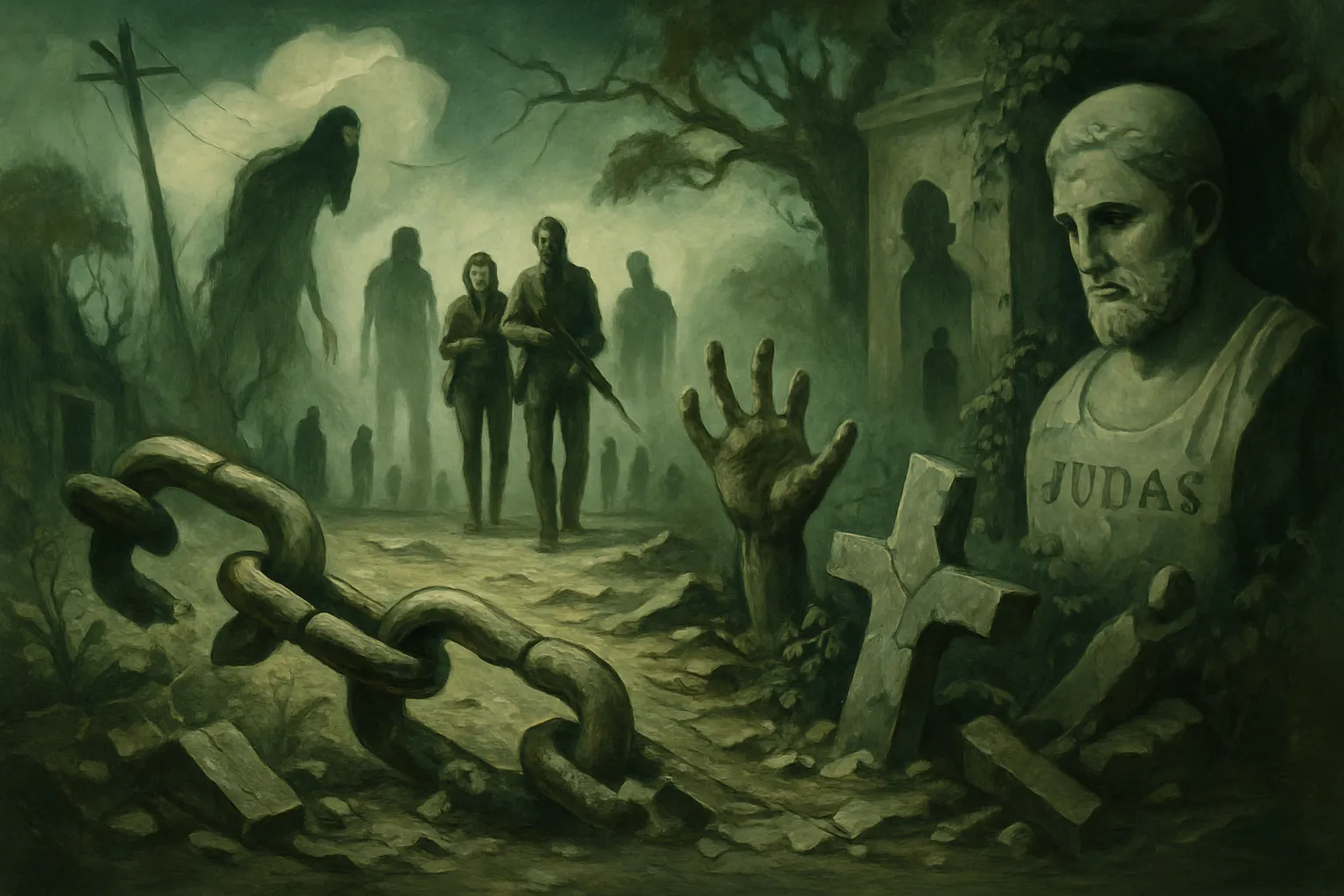
The title "I Ain't a Judas" is the ultimate double-bind. Who is the Judas?
Andrea as Judas: She is the classic traitor, returning to the old family (Rick) only to recommend peace with the new, tyrannical family (The Governor). She tries to sell out the Prison's will-to-power for the promise of false security. She betrays the truth of the War-Flow for the lie of liberal coexistence.
Rick as Judas: Rick is forced to betray his own past Code of Ethics (the Code Andrea represents). He must betray the memory of the bourgeois value structure that gave rise to his neurosis to protect the molecular life-flow of his group. This betrayal of the past is the necessary act of becoming-revolutionary—a commitment to an Evental Truth that requires the rupture of all former allegiances (Badiou, 2005).
The greatest tragedy is that Andrea, in attempting to be the peace-signifier, becomes the catalyst for her own capture. Her inability to see the moral clarity of the conflict—that the Governor's survival demands the genocide of Rick’s group—is what forces her back into the stratified space of Woodbury, effectively sealing her fate. Her peace mission was always a line of flight directed backward, a self-destructive attempt to re-territorialize onto the comfortable sign of the Despot rather than confronting the terrifying, exhilarating freedom of the schizo-flow. She fails to realize that the difference between the Governor and Rick is not one of morality, but one of economic function: one produces repression and spectacle; the other produces pure survival and nomadic will. And the latter, however brutal, is the only desiring-machine capable of extending its will-to-live (Nietzsche, 1968) into the absolute void.
References
Badiou, A. (2005). Being and event. (O. Feltham, Trans.). Continuum.
Deleuze, G., & Guattari, F. (1983). Anti-Oedipus: Capitalism and schizophrenia. (R. Hurley, M. Seem, & H. R. Lane, Trans.). University of Minnesota Press.
Nietzsche, F. (1968). The will to power. (W. Kaufmann, Ed., & W. Kaufmann & R. J. Hollingdale, Trans.). Vintage Books.
Reich, W. (1972). Character analysis. (V. R. Carfagno, Trans.). Farrar, Straus and Giroux.
Žižek, S. (2008). The sublime object of ideology. Verso.
Comments
Post a Comment